Being arrested in Texas can be terrifying—but you don’t have to face it alone. When a criminal record follows you, it can feel like a constant roadblock, slamming the door on jobs, housing, and other opportunities. In Texas, sealing your record with an Order of Nondisclosure is a powerful legal tool that can help you put the past behind you by making your record invisible to the public. It’s a real path to a second chance.
Your Path to a Fresh Start in Texas

If a past mistake is holding you back, it's important to know that Texas law offers a way forward. An Order of Nondisclosure doesn't completely erase your record, but it places serious restrictions on who can see it.
Once a judge grants the order, for most practical purposes—like filling out a job application or applying to rent an apartment—you can legally deny the arrest and prosecution ever happened.
This isn't a legal loophole; it reflects a growing understanding that people deserve to move on from their mistakes. In fact, more than two-thirds of U.S. states have passed similar laws to provide criminal record relief. The goal is to help people overcome the lifelong barriers that a record can create, especially when it comes to employment and housing.
Understanding Your Primary Options
It is absolutely critical to understand the difference between sealing a record and another legal process called expunction. Both offer a fresh start, but they apply to very different situations and have different outcomes.
- Record Sealing (Nondisclosure): This option is typically for people who successfully completed a form of community supervision, like deferred adjudication. Your record is hidden from the public, but it remains accessible to law enforcement and certain state agencies.
- Record Expunction: This is the complete destruction of all records related to your arrest. It's usually only available if your case was dismissed, you were acquitted at trial (found "not guilty"), or you received a pardon.
Think of it this way: sealing your record is like putting it in a locked filing cabinet that only a few authorized people can ever open. Expunction, on the other hand, is like shredding the file completely.
Record Sealing vs. Expunction: What's the Difference for You?
Choosing the right path starts with knowing which one you qualify for. This table breaks down the key distinctions between sealing your record and having it expunged.
| Aspect | Record Sealing (Nondisclosure) | Record Expunction |
|---|---|---|
| Eligibility | Typically for cases ending in deferred adjudication community supervision. | Usually for cases that were dismissed, you were acquitted (found not guilty), or pardoned. |
| Record Status | The record is hidden from the public but not destroyed. | The record and all related files are permanently destroyed. |
| Who Can See It | Law enforcement, prosecutors, and certain government agencies can still access it. | No one can see the record because it no longer exists. |
| Legal Denial | You can legally deny the arrest and charge on most applications (e.g., jobs, housing). | You can legally deny the arrest ever happened for all purposes. |
| Best For | Individuals who successfully completed a deferred adjudication plea bargain. | Individuals whose cases were resolved in their favor without a conviction. |
Because the eligibility requirements are so different, figuring out which process applies to your situation is the single most important first step. The path to expunction is often much stricter, which is why we cover the complexities of expunging felony convictions in Texas in a separate, detailed guide.
At The Law Office of Bryan Fagan, PLLC, we believe everyone deserves a second chance. We're here to provide the clear, compassionate guidance you need to navigate this journey.
Checking Your Eligibility for an Order of Nondisclosure
Before you start filing paperwork, the first and most critical step is figuring out if you're legally eligible to seal your criminal record. The official rules are found in Texas Government Code Chapter 411, but trying to read the statute can feel like deciphering a foreign language.
Let's break down what you actually need to know in plain English so you can see where you stand.
The most common way you become eligible to seal a record with an Order of Nondisclosure is by successfully completing deferred adjudication community supervision. This is a specific kind of plea deal where you plead "guilty" or "no contest," but the judge holds off on finding you guilty. Instead, you're placed on a form of probation.
If you complete all the requirements—pay your fines, finish your classes, and most importantly, stay out of trouble—the judge dismisses the case. You walk away without a formal conviction. For many Texans, this is the key that unlocks the door to nondisclosure.
Common Scenarios That Lead to Eligibility
Your specific case will determine if you qualify, but most eligible situations fall into a few common categories. Seeing if your case fits one of these can give you a good idea of your chances.
A classic example is a first-time charge for a Class A or B misdemeanor, like theft or simple assault, where you completed deferred adjudication. Once you're done with probation and the case is dismissed, you can often petition to have that record sealed.
Another major area is first-time DWI offenses. This is a big one. Under a special exception in Texas law, you might be eligible to seal the record even if you were convicted of a first-time DWI, as long as your blood alcohol content (BAC) was below 0.15. This is a huge benefit, since most convictions can't be sealed. Of course, if you completed deferred adjudication for a DWI, you're also likely in a good position to seek an Order of Nondisclosure.
For those who faced more serious charges, some felonies can be sealed after completing deferred adjudication. Be aware, though, that the waiting periods are much longer, and the list of qualifying offenses is shorter. It's crucial to remember this option is only for cases that ended in deferred adjudication, not a final felony conviction that led to jail or prison time. Many people find themselves eligible through programs designed to offer a second chance, like the various first-time offender programs in Texas.
Don't assume you aren't eligible without speaking to an attorney. The laws around nondisclosure are complex, and recent changes may have opened doors that were previously closed.
Offenses That Can Never Be Sealed
Just as important as knowing what can be sealed is understanding what cannot. Texas law draws a hard line on certain offenses, permanently barring them from ever being hidden from public view. This is done to protect public safety, and there are no exceptions.
If your case involved any of the following, a nondisclosure is off the table:
- Violent Crimes: Offenses like murder, capital murder, and aggravated kidnapping are permanently disqualified from being sealed.
- Offenses Against Children: Any crime involving injury to a child, indecency with a child, or sexual assault of a child is ineligible.
- Sex Offender Registration: Any offense that requires you to register as a sex offender automatically blocks you from sealing that record.
- Family Violence: If the judge made an affirmative finding of family violence in your case, you generally cannot seal that record.
- Stalking: A conviction for stalking is another permanent barrier to nondisclosure.
This list isn't exhaustive, but it covers the major categories. If your charge falls into one of these, an Order of Nondisclosure is simply not a legal option for that specific offense.
Figuring out your eligibility is the foundation of this entire process. It takes a careful look at your specific charge, how the case ended, and your history since then. Getting this part right saves you time, money, and the frustration of filing a petition that is destined to fail.
Navigating the Record Sealing Process in Texas
So, you've determined you are likely eligible for nondisclosure. That's great news. Now comes the part where you actually make it happen, and this is where the details really matter. Petitioning the court for an Order of Nondisclosure isn't just filling out a form; it's a precise legal journey. Think of it like a roadmap—one wrong turn can lead to frustrating delays or even an outright denial from the judge. This is why so many Texans team up with a defense attorney to handle the heavy lifting.
The real work of sealing a record starts long before you ever step foot in a courthouse. It begins with meticulous preparation and gathering every piece of information needed to build a solid, error-free petition.
This infographic breaks down that critical first assessment, which is the foundation for everything that follows.
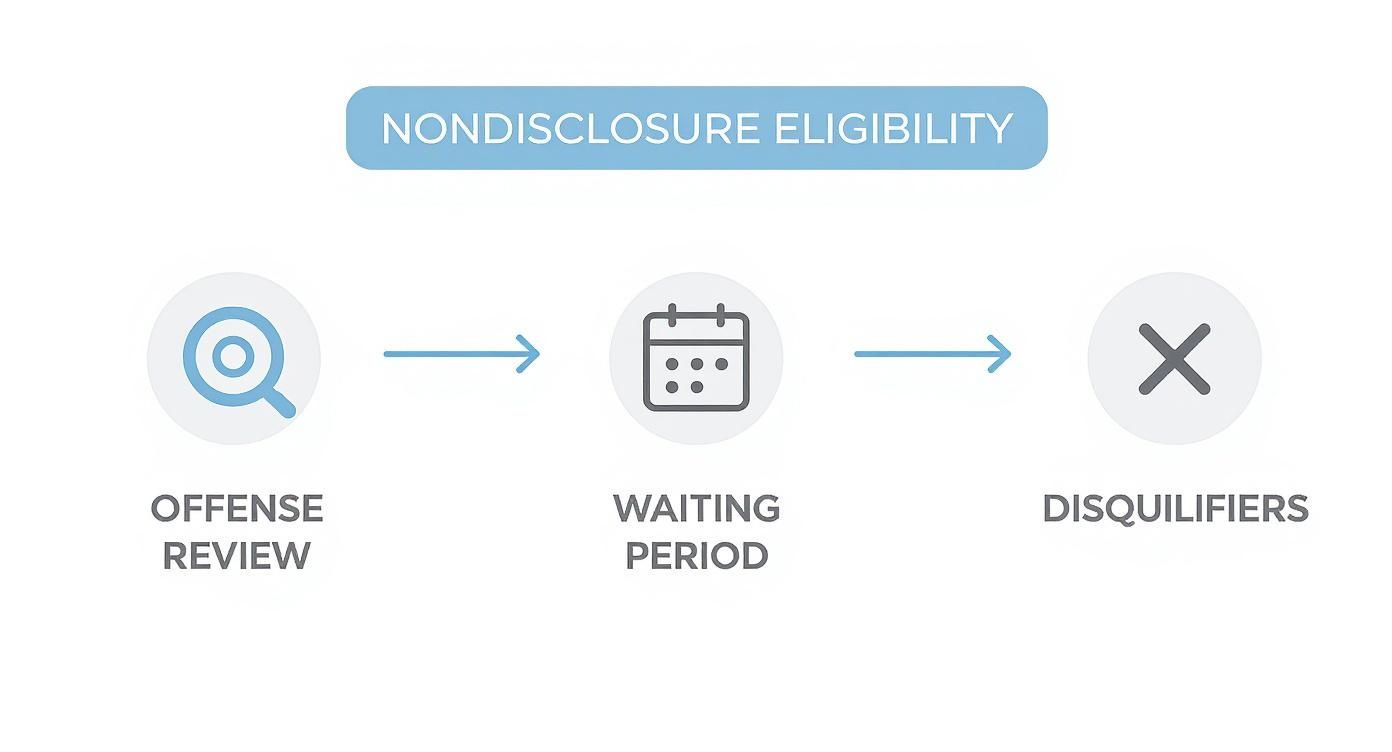
As you can see, it all boils down to three things: the type of offense, meeting the mandatory waiting period, and making sure nothing else in your criminal history gets in the way. If you can confirm these three elements from the start, you're on the right track.
Gathering Your Essential Paperwork
Before you can file, you need to pull together all the official documents tied to your case. This isn't just busywork. This is how you prove to the court, on paper, that you meet every single legal requirement for getting your record sealed.
Here’s the core list of what you'll need:
- A Certified Copy of Your Criminal History: You can get this directly from the Texas Department of Public Safety (DPS). It’s the official rundown of your arrests and case outcomes in Texas.
- Court Disposition Documents: This is the final paperwork from the court that handled your original case. It must clearly show that your case was dismissed after you completed deferred adjudication.
- Proof of Sentence Completion: You’ll need to show you did everything the court asked. This includes proof that you finished your community supervision, paid all your fines, and completed any required classes or programs.
Having these documents ready allows your attorney to draft a petition that's accurate and leaves no room for questions about your eligibility.
Drafting and Filing the Petition
The key to this whole process is the Petition for an Order of Nondisclosure. This is a formal legal document filed in the same court that handled your original criminal case. It must be drafted perfectly, hitting all the points required by the Texas Government Code.
The petition introduces you, spells out the specific offense you want sealed, and formally states that you meet all the legal requirements. A critical part of this is confirming that you've waited long enough since your case ended.
The waiting period is a deal-breaker. For most misdemeanors, you must wait two years after finishing your sentence. For eligible felonies, that wait jumps to five years. Remember, the clock only starts ticking the day your sentence is officially discharged.
Once drafted, the petition is filed with the court clerk. You will also have to pay a filing fee, which typically runs between $250 and $400, though it can vary by county.
Notifying the State and Attending the Hearing
Filing the petition is a huge step, but you're not done yet. Texas law requires you to formally notify the State—specifically, the prosecutor's office that handled your original case. You do this by providing them with a copy of your filed petition.
This gives the prosecutor a chance to review your request and decide if they want to object. In many straightforward cases where eligibility is clear, the State won't object. But if they believe you're not eligible or argue that sealing your record isn't in the "best interest of justice," they can contest it. While a DWI conviction has unique hurdles, you can see how clearing similar offenses works in our guide on everything you should know about DUI expungement law.
Finally, the court will set a hearing date. If the prosecutor doesn't object, this hearing can be a quick formality where the judge simply signs the order. But if the State does object, the hearing becomes a real legal proceeding. Your attorney will need to present evidence and make arguments for why you deserve the nondisclosure. This is where having a skilled advocate in your corner can make all the difference.
How Sealing Your Record Changes Your Life

After all the paperwork, waiting, and court dates, the moment a judge signs your Order of Nondisclosure is a genuine turning point. This isn't just about hiding a file; it's a legal document that rewrites your future by giving you the right to finally move on from a past mistake.
The single most powerful benefit? You can now legally deny the arrest and prosecution on most applications. When a potential employer, landlord, or loan officer asks if you’ve ever been arrested or charged with a crime, you can confidently and truthfully say "no."
This one change opens doors that may have been slammed shut for years. Suddenly, you're competing on a level playing field for jobs, apartments, and educational programs, all without the shadow of a past charge hanging over you.
What Changes in the Real World
The impact of a sealed record is immediate and incredibly practical. A standard background check run by a private company—the kind most employers and landlords use—will come back clean for that sealed offense. The arrest, the charge, and the case details simply won't be visible to the general public anymore.
This means you can pursue your goals with a newfound sense of freedom:
- Better Job Opportunities: You no longer have to stress over that dreaded "box" on job applications or figure out how to explain a past mistake in an interview.
- More Housing Options: Landlords won't see the sealed offense, removing a major barrier to finding a safe and desirable place to live.
- Peace of Mind: Honestly, one of the greatest benefits is the emotional relief that comes from knowing your past is no longer public knowledge.
Beyond the legal side of things, sealing your record can give your professional life a serious boost. For more guidance on making the most of this fresh start, you might find some great tips in a related Career Advice Blog.
Understanding the Limitations
While an Order of Nondisclosure is a powerful tool, it's not a time machine. It’s important to understand that the record isn't destroyed; it's just restricted. We believe in being transparent, so you need to know who can still see a sealed record.
Texas law carves out specific exceptions, giving certain government and licensing agencies continued access. This is done to protect public safety and ensure people applying for sensitive jobs are properly vetted.
An Order of Nondisclosure hides your record from the public, but it does not make it invisible to law enforcement or certain state agencies.
So, who is on that access list? It’s a specific group that includes:
- Law enforcement agencies and other criminal justice entities.
- State licensing boards, like the Texas Medical Board, State Bar of Texas, and Texas Board of Nursing.
- Government agencies that work with vulnerable populations, such as children, the elderly, or disabled individuals.
- School districts, charter schools, and private schools.
- Banks, credit unions, and other financial institutions.
This means if you're applying for a job as a police officer, a teacher, or a nurse, you will still need to disclose the offense. In these situations, honesty is always the best policy.
Finally, it's worth noting that sealing a record is a proven step toward personal rehabilitation. Studies have shown that people who get their records cleared have remarkably low rates of reoffending. For instance, data from one state revealed that only 1.8% of individuals with cleared records were reconvicted within two years—a risk level even lower than that of the general population.
What About Automatic Nondisclosure for a First Offense?
For a long time, the only way to get a criminal record sealed in Texas was to file a formal petition. It was a grind—full of paperwork, court fees, and a whole lot of waiting. This system created a huge barrier for people who deserved a second chance, so lawmakers created a more direct path for certain first-time offenders: automatic nondisclosure.
The idea behind this newer system is to make things easier for people with specific, low-level misdemeanors. Instead of forcing you to jump through legal hoops, the record gets sealed without you ever having to file a petition. It's designed to help people who've paid their dues for a minor mistake and stayed out of trouble since.
Who Actually Qualifies for This?
This automatic nondisclosure law, which you can find in Texas Government Code § 411.0725, is incredibly specific. It’s not a free-for-all; it’s a targeted solution meant for a narrow group of cases.
Generally, you might be eligible if you successfully completed deferred adjudication for certain Class C misdemeanors. More importantly, it covers many first-time Class A and B misdemeanors, as long as they are not in an excluded category like family violence or anything that requires sex offender registration.
This automatic path is mainly for people who:
- Were placed on deferred adjudication for an eligible misdemeanor.
- Completed all the terms of their community supervision without any issues.
- Had the judge formally dismiss their case.
- Have not been convicted of or placed on deferred for another crime since (except for minor traffic tickets).
Think of it as the system rewarding you for proving you learned from a mistake. You did everything the court asked, and now the law is supposed to give you a hand in return.
How "Automatic" Sealing Is Supposed to Work
On paper, the process seems simple. Once the required waiting period is over—usually 180 days after your sentence is complete—the court clerk is supposed to flag your case as eligible. From there, they notify the Texas Department of Public Safety (DPS), which then seals the record.
But here’s the reality: the word "automatic" can be very misleading. It definitely doesn't mean instant or perfect.
The entire system depends on government agencies catching your case and processing it correctly without you ever saying a word. With thousands of cases flowing through Texas courts, you can bet that administrative delays and flat-out errors happen all the time.
Automatic record sealing is becoming more common across the country. States like Utah have sealed over 400,000 records automatically, but the process isn't without its flaws. Studies often show that simple things, like missing information in old paper records, can stop a case from being processed correctly. You can learn more about how these policies are working by reviewing recent criminal justice research findings.
This is exactly why you can't just cross your fingers and assume your record was sealed. The stakes are just too high. A record you believe is hidden could pop up on a background check for that dream job or a new apartment, all because of a clerical mistake you knew nothing about.
Having a knowledgeable attorney confirm that the nondisclosure went through properly is the only way to get real peace of mind. A lawyer can check with the court and DPS to make sure your record is officially sealed. And if it wasn’t, they can step in immediately to get it fixed, ensuring your second chance is truly secure.
Common Questions About Sealing a Criminal Record
After digging into the steps and benefits of sealing a criminal record, it’s completely normal to still have a few questions. The process can feel tangled and overwhelming, and getting clear, straight answers is the best way to move forward with confidence.
Let's tackle some of the most common concerns we hear from our clients every day.
How Long Does the Record Sealing Process Take in Texas?
This is usually the first thing people ask: "How long until this is behind me?" While every case is unique, you can generally expect the process to take anywhere from three to six months after the petition is officially filed.
So, what happens during that time?
- Filing and Notifying: First, your attorney has to file the petition correctly with the court and make sure the prosecutor's office is formally notified.
- The State's Response: The prosecutor then has a specific amount of time to review your petition and decide if they are going to object.
- Getting on the Calendar: Finally, the court must find an open slot on its calendar for a hearing. This can be a real wild card, as it depends entirely on how busy that particular county's court system is.
Having an experienced attorney in your corner is a huge advantage here. We can help sidestep unnecessary delays by ensuring every document is perfect the first time and by keeping the lines of communication open with the court and the prosecutor.
Can I Seal a Felony Conviction in Texas?
This is a big one, and the answer is hopeful but very specific: yes, but only in certain situations. Texas law is incredibly strict on this point. If your felony conviction ended with you serving time in prison or state jail, it can never be sealed. Period.
However, there's a significant exception. If you successfully completed deferred adjudication community supervision for a felony that qualifies, you are likely on the right path. Once the mandatory five-year waiting period has passed since your sentence ended, you can file a petition for an Order of Nondisclosure.
It is absolutely critical to remember that many serious crimes, especially those involving violence or sexual offenses, are completely off the table for nondisclosure. The only way to know for sure if your specific felony is eligible is to have a lawyer conduct a thorough review of your case.
How Much Does It Cost to Seal a Criminal Record?
Cost is a practical and important concern for everyone. The total expense breaks down into a few different parts: the court’s filing fees, service fees to notify the State, and of course, attorney fees.
In Texas, court filing fees usually land somewhere between $250 and $400, though this can vary depending on the county. While it's an investment, you have to look at it in the context of what you're getting back. The long-term financial payoff from better job offers, more housing options, and even lower insurance rates often dwarfs the initial cost of clearing your name.
We offer free consultations to give you a clear and honest breakdown of all potential costs associated with your specific case, so you can make an informed decision without any surprises.
What Happens If My Petition for Nondisclosure Is Denied?
Getting a denial can feel like a punch to the gut, but it doesn't have to be the end of the line. When a judge denies your petition, they are required to explain why.
Some of the common reasons we see for denial include:
- Ineligibility: You might not have met the waiting period, or the offense itself may not qualify under the law.
- Prosecutor's Objection: The State may have successfully convinced the judge that sealing your record is not in the "best interest of justice."
- Procedural Mistakes: Simple errors in the petition or a failure to properly notify all the right parties can unfortunately lead to a denial.
This is a moment where a skilled criminal defense lawyer becomes invaluable. We can analyze the judge’s reasoning, figure out if the problem can be fixed, and map out the best path forward. Sometimes that means correcting a mistake and refiling, and in other cases, it might mean pursuing an appeal.
If you’ve been charged with a crime in Texas, call The Law Office of Bryan Fagan, PLLC for a free and confidential consultation. Our defense team is ready to protect your rights.