Skip to content
Being arrested in Texas can be terrifying—but you don’t have to face it alone. It's a chilling thought that you could be found guilty of a crime you never physically committed. In Texas, this isn't just a hypothetical scenario; it's a legal reality under what's known as the law of parties.
This powerful law means that if you encourage, aid, or even just attempt to aid someone else in committing a crime, you can face the exact same charges—and the same devastating penalties—as the person who actually did the deed. If you're facing this situation, you are likely feeling scared and confused, but understanding your rights is the first step toward building a strong defense.
Understanding Your Risk Under The Law Of Parties

Being arrested for something someone else did is a deeply confusing and frightening experience. Many people assume they're innocent because they weren't the one who pulled the trigger, threw the punch, or pocketed the stolen goods. But in the eyes of Texas law, that's a dangerous misunderstanding.
The law of parties, clearly laid out in Texas Penal Code §7.02, essentially erases the line between the main actor and those who helped them.
Imagine a bank robbery. The person who walks into the bank with a gun is obviously guilty. But under this law, so is the person who drove the getaway car. So is the one who disabled the alarm system. And so is the one who simply provided the map of the building. In the eyes of the law, they are all equally responsible.
How The Law Connects You To The Crime
This powerful legal doctrine gives prosecutors the ability to charge multiple people for a single criminal act. The core idea is that the crime couldn't have happened—or wouldn't have been as successful—without everyone's contribution. From the law's perspective, that makes everyone equally responsible.
To convict you as a "party" to a crime, the State has to prove you were criminally responsible for what the other person did. This usually means showing that you, with the intent to help the crime along, did one of the following:
- Solicited, encouraged, directed, or aided the other person to commit it.
- Attempted to aid the other person in committing it.
This concept is a cornerstone of the Texas criminal justice system. If you want a deeper look into the legal framework, you can learn more by understanding the Texas Penal Code structure and how the state classifies different offenses.
The most critical takeaway is this: your punishment will be identical to the main actor's. If your friend commits a first-degree felony and you're found to be a party to that crime, you also face first-degree felony penalties—even if your role felt minor.
This is why understanding the law of parties is the absolute first step toward building your defense. An accusation is not a conviction, and an experienced criminal defense attorney can fight back against the prosecution's attempt to tie you to a crime you didn't commit.
How The Prosecution Proves Guilt Under This Law
To get a conviction under the law of parties, a prosecutor can’t just point a finger and say you were at the scene of the crime. They have a tough hill to climb: they must prove, beyond a reasonable doubt, that you had a specific criminal intent to help the offense succeed. Simply being there, even if you knew something illegal was happening, is not enough to make you guilty in the eyes of the law.
A prosecutor’s entire case boils down to connecting your actions directly to the crime itself. They must present concrete evidence showing you didn't just stand by, but actively and intentionally participated in a way that furthered the crime.
This means their game plan is built around proving one of four things: that you solicited, encouraged, aided, or attempted to aid the main person who committed the crime. Knowing what these terms mean is your first line of defense because it’s where a good attorney starts poking holes in the state’s story.
Breaking Down The State's Burden Of Proof
To build their case, prosecutors will dig into every detail of your involvement. They are looking for proof that you did more than just watch from the sidelines. They need a clear, unbroken line between your behavior and the successful completion of the crime.
Here’s what those key legal terms look like in the real world:
- Soliciting: This is when you ask, command, or try to convince someone else to commit a crime. For instance, offering your cousin cash to set a rival’s food truck on fire is solicitation.
- Encouraging: Think of this as being a cheerleader for a crime. If you’re yelling "get him!" during a bar fight, a prosecutor could argue you were encouraging the assault, making you a party to it.
- Aiding: This is the one we see most often. It’s all about providing help or support. A classic example is letting a friend borrow your pickup truck so they can haul away stolen copper wire—you just aided a theft.
- Attempting to Aid: Here’s where it can get scary: even if your help fails, you can still be held responsible. If you try to create a distraction for a shoplifter but a security guard stops you before you can do anything, that attempt alone can still get you charged under the law of parties.
Prosecutors will use everything they can find—witness statements, text messages, security camera footage, even Venmo transactions—to try and prove you took one of these deliberate actions.
Crucially, the prosecutor must show you weren't just an unwilling bystander or an accidental participant. They have to prove your actions were completely voluntary and that you shared the same criminal goal as the person who committed the main offense.
The Dangers Of Conspiracy Liability
Now, this is where the law of parties gets truly frightening. The concept of conspiracy liability can hold you responsible for a crime you never wanted or even imagined would happen.
Here’s how it works: if you agree with others to commit one felony (like robbing a convenience store), and during that robbery, someone commits another felony that you should have anticipated (like an aggravated assault or even murder), you can be charged with that second, more serious crime.
For example, let’s say you agree to be the lookout for a simple burglary. Your partner goes inside, gets confronted by the homeowner, and unexpectedly shoots them. You could find yourself facing a murder charge right alongside them. The prosecutor will argue that a violent confrontation was a foreseeable risk of breaking into someone's home, even if you specifically told your partner not to bring a gun.
The following table breaks down how an accomplice's actions can directly tie them to the principal crime.
Actions That Can Trigger The Law Of Parties
| Your Action (The Accomplice) | The Principal Crime | Potential Charge Under Law of Parties |
|---|---|---|
| Acting as the lookout for a burglary. | Burglary of a Habitation | Burglary of a Habitation |
| Loaning your car for a getaway. | Robbery | Robbery |
| Drawing a map of a business for a theft. | Theft | Theft |
| Encouraging a friend during a bar fight. | Assault | Assault |
That idea of "foreseeability" is where the real fight happens in the courtroom. A strong defense will focus on dismantling the prosecutor's claim, showing that the second crime was a completely independent act that you couldn't have possibly predicted. This is exactly why having a tenacious legal advocate is non-negotiable when facing charges under the law of parties texas.
The Severe Penalties Of A Conviction
When you're charged under the Texas law of parties, one of the most jarring realities is that the penalties are identical to those for the person who actually committed the main crime. It makes no difference if your role was minor or you never intended for things to go so far. The law simply doesn't distinguish when it comes to punishment.
This means if you acted as a lookout for what you thought was a simple burglary, but it turned into a violent home invasion, you're facing the same first-degree felony charges as the person who kicked in the door. The consequences aren't just severe; they're life-altering.
Your Punishment Mirrors The Primary Offense
The core principle here is equal culpability, which leads directly to equal punishment. If the main offense is a state jail felony, you face state jail felony penalties. If it's a first-degree felony punishable by life in prison, that's exactly what you're up against, even if you never set foot on the property.
It's a tough concept to swallow, especially when your involvement feels insignificant compared to what others did. But prosecutors use this part of the law to their advantage, building a case to hold everyone just as responsible for the final outcome.
The infographic below shows the main ways a prosecutor can link you to an offense to prove you were a party to the crime.
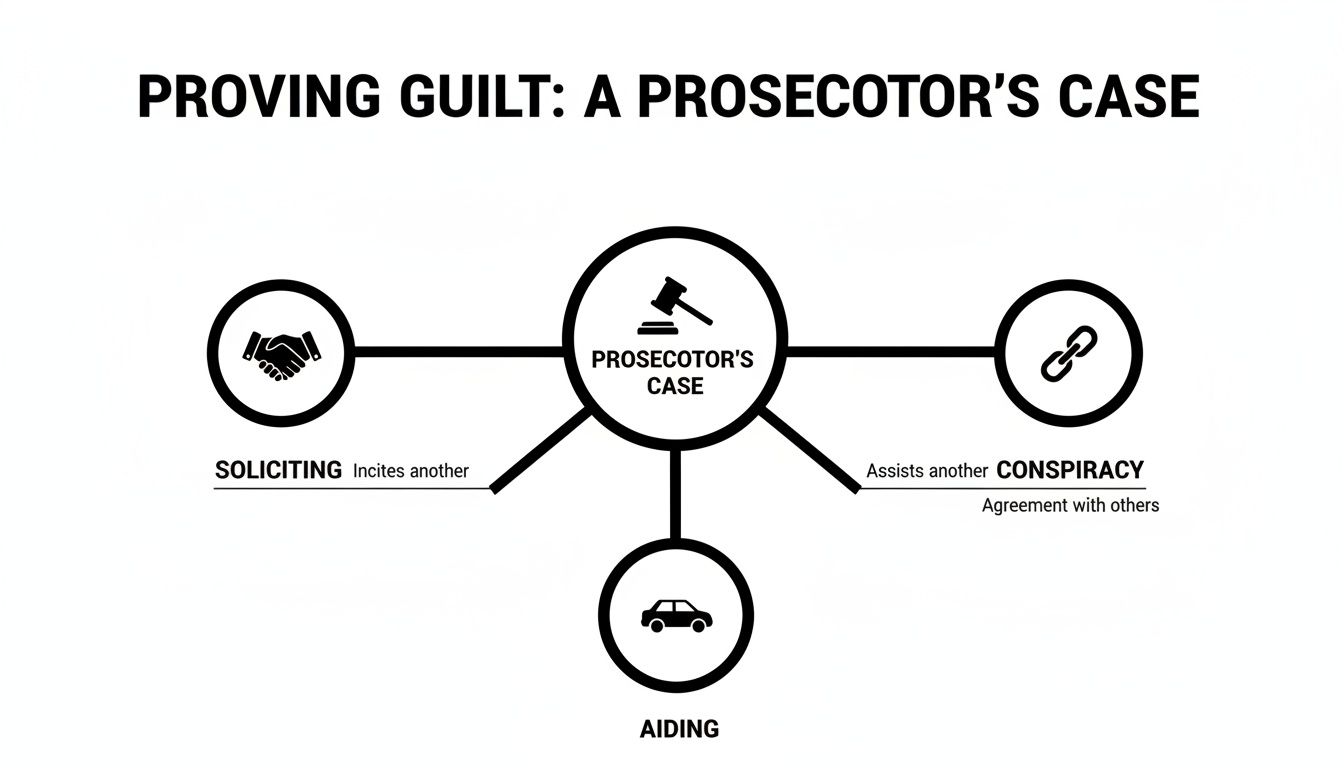
Whether you solicit, aid, or conspire, the prosecution's goal is to draw a straight line from your actions to the crime itself, holding you fully accountable.
The Ultimate Price In Capital Murder Cases
Nowhere are the stakes of the law of parties in Texas higher than in capital murder cases. In these situations, you can be sentenced to death even if you did not kill anyone, had no intention of killing anyone, and weren't even there when the murder happened.
If a death occurs during another felony you were a party to—like a robbery, burglary, or kidnapping—the state can absolutely pursue the death penalty against you. It's a terrifying and extreme application of the law, but it's a legal reality here in Texas.
In fact, according to the Texas Coalition to Abolish the Death Penalty, Texas has executed 6 people who did not personally kill the victim but were convicted solely under the law of parties. That's more than any other state, where this has only happened once. Right now, at least 6 more people are on death row under this same legal theory, their families caught in an unimaginable nightmare.
Lifelong Consequences Of A Felony Conviction
Beyond prison time or the death penalty, a felony conviction under the law of parties leaves a lifelong mark. It's a permanent stain on your record that follows you long after you've served your time.
These consequences include:
- Loss of Civil Rights: You will permanently lose your right to vote (while incarcerated and on parole/probation), serve on a jury, and own a firearm.
- Employment Barriers: Finding a good job becomes incredibly difficult. Many employers simply won't hire convicted felons, severely limiting your career and financial stability.
- Housing Difficulties: Landlords often run background checks and can legally deny your rental application because of a felony conviction, making it hard to find a safe place to live.
- Social Stigma: You'll carry the label of "felon," which can strain relationships with friends, family, and your community for the rest of your life.
The penalties for a conviction under the law of parties are not just about serving time; they are about fundamentally altering the course of your life forever. The stakes are simply too high to face these charges without a powerful and strategic legal defense.
Understanding these harsh realities isn't meant to scare you. It's meant to underscore the absolute necessity of an aggressive defense from the moment you're accused. An experienced criminal defense attorney can challenge the prosecution's case, work to disconnect you from the actions of others, and fight to protect your future from these devastating consequences.
Common Scenarios Where This Law Is Applied
The "law of parties" can feel like a distant, abstract legal theory—right up until it slams into your life. To really get a handle on its power, it helps to see how prosecutors actually use it in everyday situations across Texas. A single bad decision or a moment of poor judgment can pull you into a serious criminal case you never saw coming.
The stories below aren’t far-fetched Hollywood plots. They show how easily an ordinary person can get tangled up in this complicated law, turning a regular day into a legal nightmare. These are grounded in the types of cases we see all the time, showing just how thin the line is between being a bystander and being charged as a party to a crime.

Practical Advice: The DWI Getaway Car
Picture this: you’re at a party, and your friend has had way too much to drink. He swears he’s fine to drive. You're sober, but you don't want to start a fight by grabbing his keys. So, you do the next best thing—or so you think. You hop in the passenger seat to help him navigate and make sure he gets home.
Then, tragedy strikes. He blows through a red light and causes a horrific accident, leading to charges of intoxication assault or even intoxication manslaughter. Your friend was the one behind the wheel, but a prosecutor might not see you as just a passenger.
Under the law of parties texas, your actions—getting in the car, giving directions—could be twisted to look like you were aiding or encouraging his crime. The state's attorney could argue that you actively helped him commit DWI, which directly led to the crash. Just like that, you could be facing the same felony charges, all because you tried to help a friend who never should have been driving.
Practical Advice: The Lookout In a Shoplifting Case
Here’s another one we see often. You go to a department store with a friend who jokes about stealing an expensive jacket. You laugh it off, not taking it seriously. While your friend wanders over to the clothing racks, you hang back near the entrance, scrolling through your phone and casually keeping an eye on the security guard.
Your friend gets caught. When the police review the security tapes, they see you glancing over at the guard. To them, that doesn't look like someone just waiting around. It looks like you were the lookout.
A prosecutor can build a case that your presence wasn't a coincidence. They'll argue it was a deliberate act to aid the theft by watching for security, making it easier for your friend to commit the crime. As a result, you could be charged with the exact same theft offense, even though you never laid a hand on the merchandise.
Practical Advice: The Unexpected Escalation of an Assault
Let's say you go with your roommate to a bar to confront someone who owes him money. You have zero intention of fighting. You're just there for moral support, to make sure things don't get out of control. But the conversation gets heated, and your roommate suddenly throws a punch, seriously injuring the other person.
When the police arrive, witnesses say you were standing right there, looking intimidating. The prosecutor now has a story to tell: your presence encouraged the assault. You made the other person feel outnumbered and trapped. Even if you never touched anyone, you could be charged with aggravated assault right alongside your roommate.
One of the most terrifying things about the law of parties is how it applies in homicide cases. If that bar fight had tragically resulted in a death, you could be staring down a murder charge. Prosecutors frequently use this law to hold everyone involved responsible for an unforeseen death. It’s critical to understand the nuances here, as there are many common misconceptions about homicide explained under Texas law.
These examples all boil down to one thing: intent. A prosecutor's job is to weave a narrative that frames your actions as proof of criminal intent. A skilled criminal defense attorney's job is to pick that narrative apart, protect your rights, and show that you were simply in the wrong place at the wrong time.
Strategic Defenses Against Law Of Parties Charges
Being charged under the law of parties can feel like a nightmare, especially when you’re being held responsible for someone else's choices. But an accusation isn't a conviction. A sharp criminal defense attorney knows how to pick apart the prosecution's story and expose the holes in their case.
The entire defense strategy often hinges on a simple but powerful truth: your mere presence at a crime scene is not enough to prove you're guilty. The state carries the full burden of proving you had the specific intent to help the crime along. If they can't prove what was in your head, their case crumbles.
Lack Of Criminal Intent
The most direct and common defense is simply showing you had no criminal intent. The prosecutor has to prove—beyond a reasonable doubt—that you knowingly and intentionally acted to help the crime succeed. Your attorney’s job is to prove you were an unwitting bystander, not a willing accomplice.
Imagine you gave a friend a ride, having no idea they were planning to steal something from your destination. Your lawyer would immediately start digging for evidence, like text messages or witness statements, to prove you were completely in the dark. By demolishing the idea of intent, we can snap the link the prosecutor is desperately trying to forge between you and the crime.
A prosecutor's case is often built on assumptions about your state of mind. Our job is to replace those assumptions with cold, hard facts that prove you were just in the wrong place at the wrong time with the wrong person.
Proving You Withdrew From The Crime
Sometimes, people have a change of heart after initially agreeing to be part of a criminal plan. Under Texas law, this can be a legitimate defense, but it takes more than just walking away. To successfully use a withdrawal or renunciation defense, you have to prove two key things:
- You backed out and abandoned your involvement before the crime was actually committed.
- You made a substantial effort to stop the crime from happening.
Getting cold feet and just leaving the scene won't cut it. You must take clear, decisive action to prevent the offense, like calling the police or warning the potential victim. This defense demonstrates that you not only rejected the plan but actively tried to stop it.
The Offense Was Not A Foreseeable Consequence
In conspiracy cases, prosecutors love to argue that you should be held responsible for any crime that happened during the original offense, claiming it was a "foreseeable consequence." A strong defense confronts this claim head-on. Your attorney will argue that the second crime was so unexpected and out of left field that no reasonable person could have seen it coming.
For example, if you agreed to help with a simple shoplifting plan and your partner suddenly assaulted a security guard, your defense would hammer home that violence was never discussed, planned, or even a remote possibility. This strategy works to limit your liability to the original, much lesser offense you may have agreed to.
A skilled lawyer explores all available criminal defenses, justifications, and excuses to build the strongest possible case for you. Fighting a law of parties charge requires a deep understanding of how to dismantle the prosecution's arguments piece by piece.
What To Do If You Are Charged In Texas
Getting arrested under the Texas law of parties can feel like the world is collapsing around you. In that moment, every single decision you make matters. The most important thing to remember is that you have constitutional rights designed to protect you, and knowing how to use them can change everything.

Your first move is the most critical: invoke your right to remain silent. Police and investigators are trained to ask questions designed to make you accidentally incriminate yourself. You need to clearly and calmly state, "I am exercising my right to remain silent, and I will not answer any questions without my attorney present."
Once you’ve said that, stop talking. Don't say another word about the case to law enforcement, cellmates, or even family members over a recorded jail phone line. Anything you say can—and absolutely will—be used against you.
Step-by-Step Guidance: What Happens Next
As soon as you’re arrested, the wheels of the criminal justice system start turning immediately. Understanding what’s coming can help lower your anxiety and put you in a better position to take control.
Here is a general roadmap of what to expect:
- Arrest and Booking: After being taken into custody, you’ll be brought to a police station or county jail for booking. This is where they take your fingerprints, photograph (mugshot), and personal information.
- Arraignment and Bail Hearing: You will appear before a magistrate judge for an arraignment, typically within 48 hours. The judge will read the charges against you and set your bail amount. A sharp attorney can argue for a more reasonable bail right at this hearing.
- Grand Jury Indictment: For felony charges, a prosecutor presents the case to a grand jury. If the grand jury believes there is probable cause, they issue an indictment, and the case officially moves forward to trial court. This is followed by pretrial motions, plea bargaining, and potentially a trial and sentencing.
Keep in mind that procedures can vary slightly between major Texas metroplexes. Harris County (Houston), Dallas County, Travis County (Austin), and Bexar County (San Antonio) all have their own local rules and court processes. Having a lawyer who knows the lay of the land in the specific county where you were charged is a massive advantage.
The time between your arrest and your first court appearance is a critical window. A defense attorney can get involved early, shield you from interrogation, and start gathering evidence to challenge the prosecution's case from day one.
There Is A Path Forward
Even if a case ends in a conviction, that doesn't always have to be the end of the story. There are often options for a fresh start down the road. Post-conviction relief like expunctions and nondisclosures (record sealing) can clear your name or hide your record from public view, allowing you to move on without the weight of a past mistake.
When you're up against charges under the Law of Parties, getting the right legal representation is non-negotiable. For law firms, effective outreach often involves various marketing channels, including understanding TV advertising strategies for attorneys. This just goes to show how vital it is to connect with a skilled legal advocate who can fight for you. Your future is far too important to leave to chance.
Common Questions About the Texas Law of Parties
When you're caught up in a charge under the Texas law of parties, a flood of questions and worries is completely normal. It’s a confusing and frankly scary part of the law, and getting straight answers is the first step to feeling in control again. Here are a few of the most common questions we hear from people in your exact situation.
Can I Be Charged If I Didn't Know a Serious Crime Was Going to Happen?
Yes, and this is where the law can feel incredibly unfair. You absolutely can be charged. Imagine you and a few others agree to commit one felony, like breaking into an empty warehouse to steal copper wire. If, during that burglary, one of your accomplices unexpectedly assaults a security guard, you could be on the hook for that assault, too.
The key is whether that second, more serious crime was a "foreseeable" result of the first one. The prosecutor has to prove to a jury that a reasonable person should have anticipated that things could go south. This is a huge gray area and a critical battleground where an experienced defense attorney is essential to poke holes in the state's argument.
What If I Was Just There When It Happened?
This is a big one. Simply being present at the scene of a crime is not enough to convict you under the law of parties. The prosecutor can’t just say, "Well, you were there, so you must be guilty." They have a much higher mountain to climb.
They have to show concrete evidence that you intentionally did something to help the crime along. Did you solicit it? Encourage it? Direct it? Aid it in some way? A solid defense often revolves around proving you were merely a bystander, caught in the wrong place at the wrong time with no criminal intent.
It is the State’s burden to prove your active, intentional participation. A defense attorney's job is to show that the prosecution’s evidence fails to meet this high standard, demonstrating you were nothing more than an observer caught in a bad situation.
Does the Law of Parties Only Apply to Felonies?
Not at all. While the law of parties gets the most attention in high-stakes felony cases, it applies equally to misdemeanors across Texas.
Think about it this way: if you act as a lookout while your friend shoplifts a few items (a Class C misdemeanor), you can be charged with theft right alongside them. The legal logic is identical, no matter if the crime is a minor theft or a major felony. Don't make the mistake of underestimating the charges just because they aren't felonies; a misdemeanor conviction can still haunt your record for years to come.
If you’ve been charged with a crime in Texas, call The Law Office of Bryan Fagan, PLLC for a free and confidential consultation. Our defense team is ready to protect your rights. Visit us at https://texascriminallawyer.net.