If you've been arrested for a weapons charge in Texas, you're likely feeling anxious and uncertain about what comes next. Searching for answers online about the legal length of a knife can be confusing, especially with so much outdated information out there. Let's clear things up: in Texas, there is no specific maximum legal blade length for an adult to carry in most public places.
A major law change in 2017 removed the old 5.5-inch statewide restriction. This means it's now legal for adults to carry knives of any length, but with a critical exception: you cannot carry them into certain designated locations. Understanding this distinction is the first step toward protecting your rights, and you don't have to face this challenge alone.
Understanding the Shift in Texas Knife Laws
Trying to find a clear answer about the legal knife length in Texas can be a real headache. It's no surprise that many Texans still believe the old law, which capped blade length at 5.5 inches, is still in effect.
But that's no longer the case. A huge shift in state law completely rewrote the rulebook for carrying knives.
If you're facing a weapons charge, this change is everything. The focus isn't just on your knife's size anymore—it’s about where you were carrying it. Getting a handle on that distinction is the first step to building a strong defense.
From Blade Length to Location: The Impact of HB 1935
The game-changer was a piece of legislation called Texas House Bill 1935. Passed in 2017, this law fundamentally altered how Texas regulates knives by wiping the category of "illegal knives" right out of the Texas Penal Code. Before this, carrying items like daggers, stilettos, and any knife with a blade over 5.5 inches was against the law. You can learn more about how Texas House Bill 1935 reshaped weapon regulations and what it means for you today.
So what does that mean in practice? Adults can now legally carry knives of almost any size—we're talking large Bowie knives, machetes, even swords—in most public places.
However, the law didn't create a total free-for-all. Instead, it introduced a new, critical concept: location-restricted knives. This means that while the statewide length limit is gone, there are still specific places where carrying a larger knife is a criminal offense.
A "location-restricted knife" is defined under Texas law as any knife with a blade that is longer than 5.5 inches. Carrying one into a designated restricted zone is a crime, and the penalties can be severe.
This infographic breaks down the key differences between the old and new Texas knife laws.
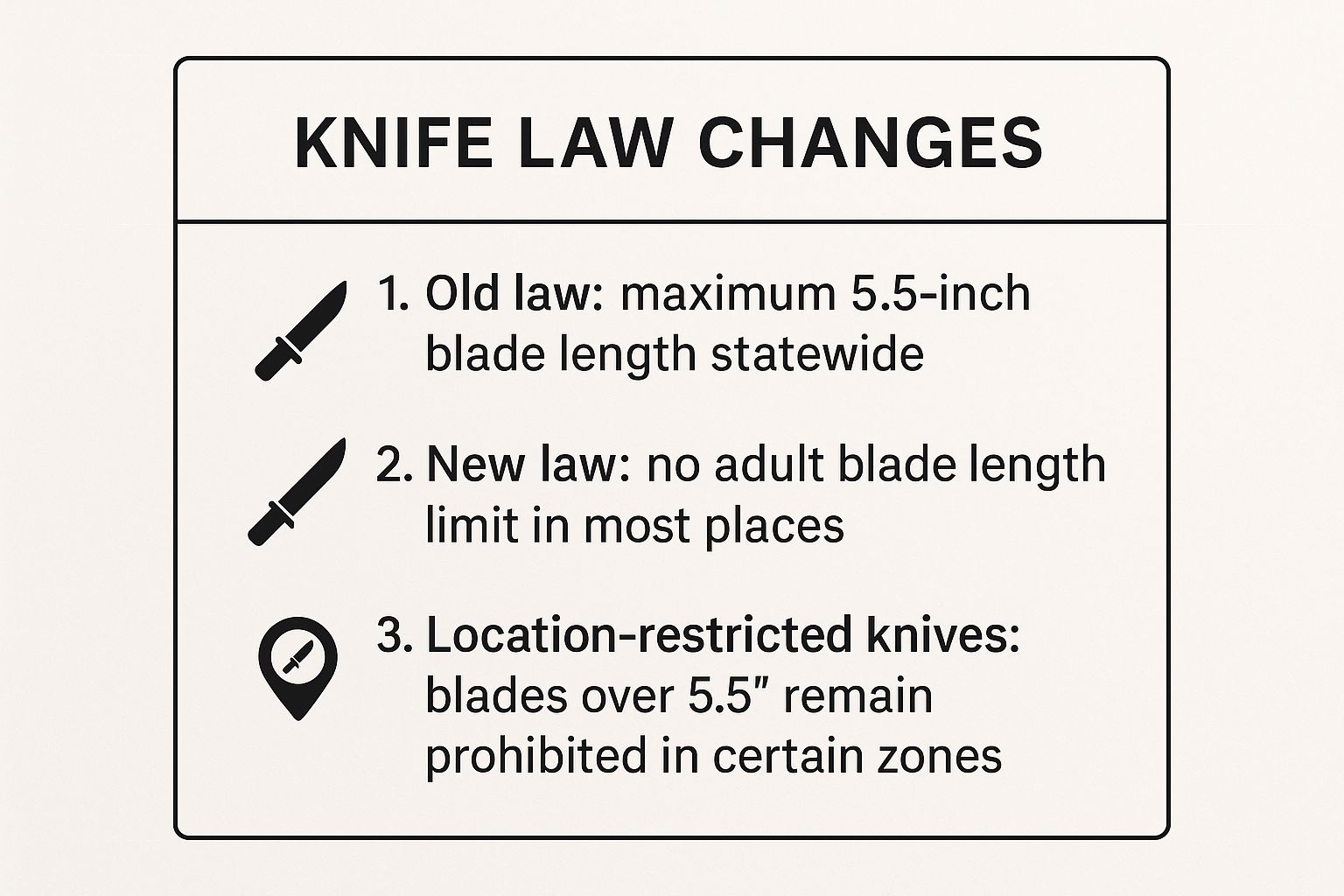
As you can see, the legal focus has moved from a simple measurement to a more nuanced, location-based system. It's a shift every knife owner in Texas needs to understand inside and out.
The table below gives a simple side-by-side comparison of how things have changed.
Texas Knife Law Changes at a Glance
| Legal Aspect | Law Before HB 1935 | Law After HB 1935 |
|---|---|---|
| Statewide Blade Limit | 5.5 inches. Carrying a knife with a longer blade was generally illegal. | No statewide limit. Blade length is no longer the primary factor for legality in most places. |
| "Illegal Knives" | Daggers, stilettos, Bowie knives, and swords were illegal to carry. | This category was eliminated. These types of knives are now legal to carry. |
| Focus of the Law | The type and size of the knife. | The location where a knife over 5.5 inches is carried. |
| Restricted Areas | Primarily schools and certain government buildings. | An expanded list of "prohibited locations" was created for "location-restricted knives." |
This shift from "what you carry" to "where you carry it" is the single most important update to understand.
Why This Change Matters for You
This legal update isn't just some historical footnote; it has real-world consequences for anyone who carries a knife for work, recreation, or self-defense. If you've been arrested or even just questioned by law enforcement about the knife you were carrying, the specifics of your location are now the most important detail in your case.
An officer trying to apply the old 5.5-inch rule without considering where you were could lead to an unjust charge. In that situation, knowing your rights under the current law is your strongest asset.
How Texas Law Measures a Knife Blade
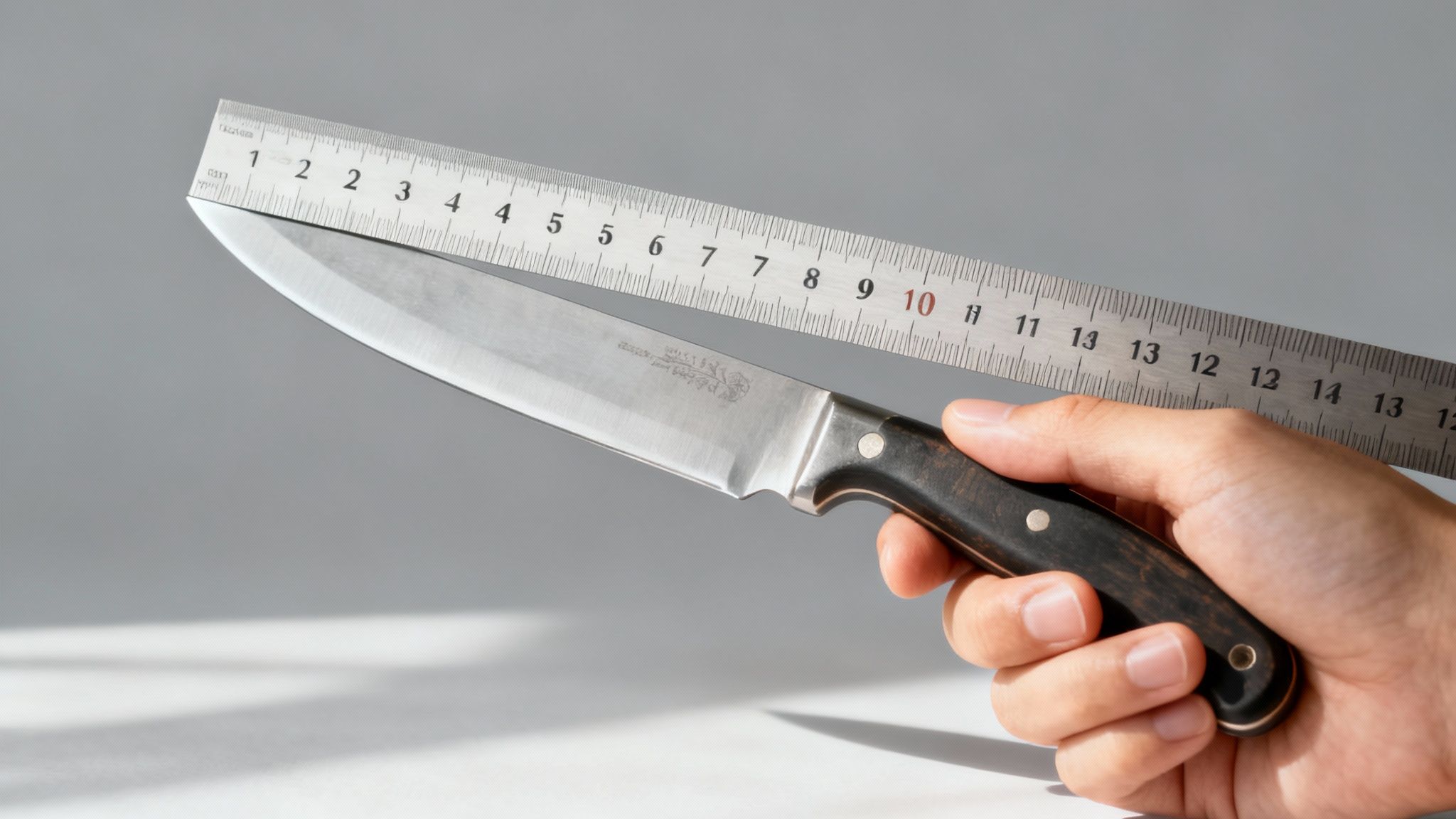
Even though Texas knife laws have become more lenient, one number remains absolutely critical: 5.5 inches. Misunderstanding this measurement could lead to serious legal trouble, as it's the official line separating a regular knife from what the law calls a "location-restricted knife."
Understanding how law enforcement measures a blade isn't just a technicality—it’s essential knowledge for any knife owner in Texas. A simple mistake here could turn a legal carry into an unexpected weapons charge.
And here’s the key point: the official method isn't what most people think. Many assume it’s just the sharpened edge that counts. That's a common, and very risky, assumption.
The Official Measurement Method
According to the Texas Penal Code, the measurement is taken in a straight line from the very tip of the blade to the forward-most part of the handle or guard.
Think of it like measuring someone's full height—you go from the top of their head to their feet, not just to their shoulders. The law cares about the entire potential length of the blade that extends from the handle, not just the sharp part.
This means any unsharpened portion of the blade near the handle is included in the total measurement. A knife with a 5-inch cutting edge could easily be legally classified as over 5.5 inches if it has a sizable unsharpened choil or ricasso before the hilt.
This detail is incredibly important. A simple miscalculation can have serious consequences. Being proactive and informed is always your best defense. For a deeper dive into how these rules fit into the bigger legal picture, it helps in understanding the Texas Penal Code structure.
Practical Steps to Measure Your Knife Correctly
To avoid any guesswork, here’s a simple, step-by-step way to check if your knife qualifies as location-restricted:
- Get Your Tool: Lay a tape measure or ruler flat against the blade.
- Start at the Tip: Align the zero mark of your measuring tool with the absolute tip of the knife.
- Find the End Point: Run the tape measure in a straight line down to where the blade metal meets the handle, guard, or hilt.
- Read the Measurement: The number you see at the front edge of the handle is the official blade length.
If that number is over 5.5 inches, you're holding a location-restricted knife. Knowing this empowers you to make smart, lawful decisions about where you can and cannot carry it.
Where You Cannot Carry Large Knives in Texas
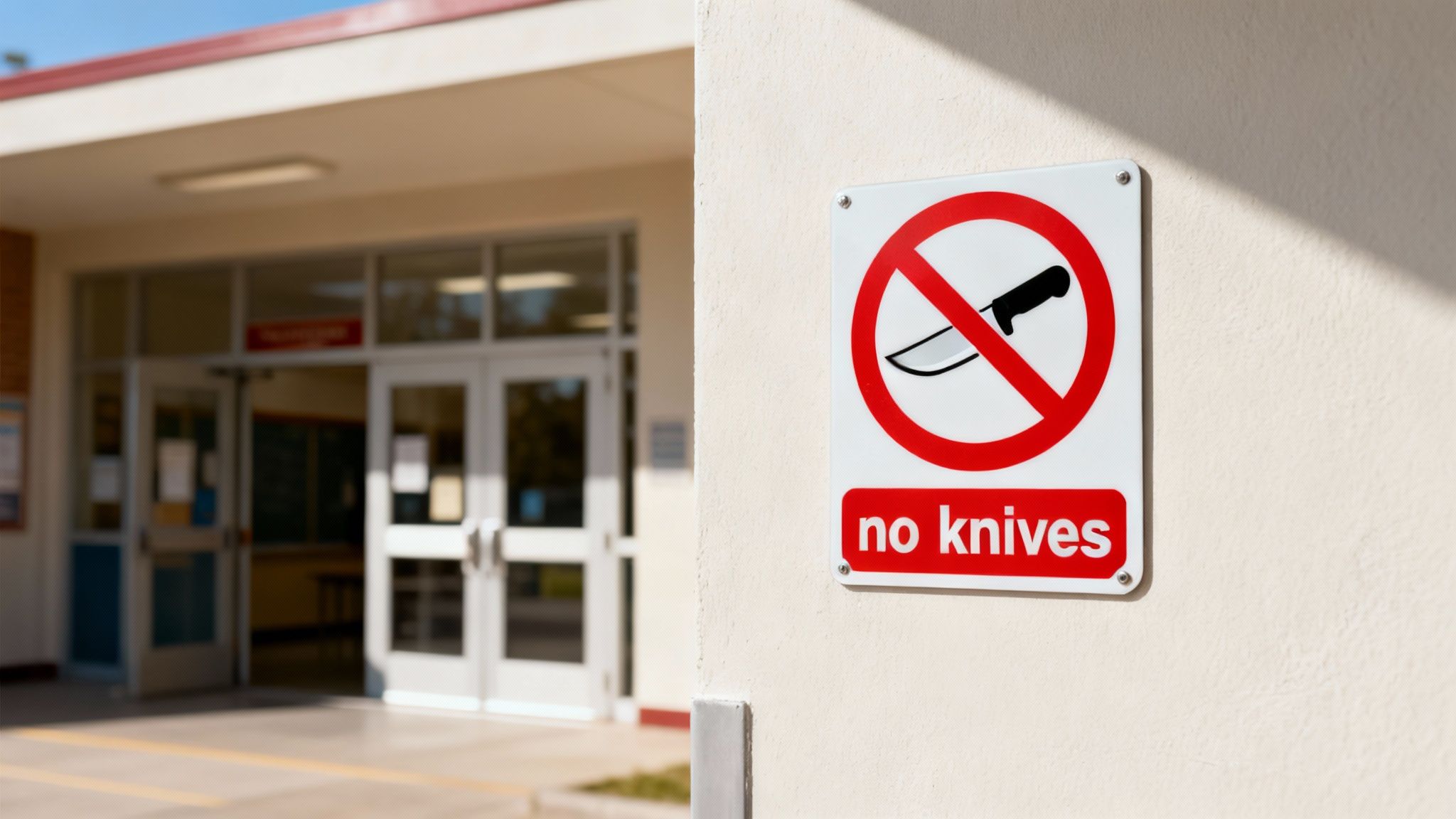
While Texas law gives you a lot of freedom to carry different kinds of knives, that freedom isn't absolute. Think of it like driving—you have the right to be on the road, but you still have to obey traffic laws, especially in sensitive areas like school zones. The exact same idea applies to carrying what the law calls a "location-restricted knife"—any knife with a blade over 5.5 inches.
Knowing these off-limits zones isn't just good advice; it's a critical part of being a responsible knife owner. Accidentally walking into a restricted area with a large knife, even with no bad intentions, can lead to serious legal trouble. Understanding these boundaries is your best defense against an easily avoidable arrest.
The Official List of Restricted Locations
The law is very specific about these "large-knife-free" zones. Texas Penal Code § 46.03 lays out a clear list of places where you simply cannot carry a location-restricted knife. Committing these locations to memory can save you from a potential legal crisis.
Here's a breakdown of the key places where carrying a knife with a blade longer than 5.5 inches is against the law.
Location-Restricted Zones for Knives Over 5.5 Inches
The state has designated several types of places as off-limits for larger knives, primarily to protect vulnerable people and secure sensitive areas. The table below lists these zones as outlined in the Texas Penal Code.
| Restricted Location | Key Considerations and Examples |
|---|---|
| Schools & Educational Institutions | Includes any public or private school, from preschools to universities. Also covers school buses or any vehicle used for school activities. |
| Polling Places | You cannot carry a large knife into a voting location on election day or during the early voting period. |
| Government Courts & Offices | This applies to the premises of any government court or the offices used by that court. |
| Racetracks | Any place licensed for pari-mutuel wagering, such as a horse or dog racetrack. |
| Airports | Specifically, the secure area of an airport controlled by the TSA is off-limits. Do not try to bring a large knife through security. |
| Correctional Facilities | Jails, prisons, and other detention centers are strictly prohibited zones. |
| Hospitals & Nursing Homes | The premises of a hospital or nursing facility are restricted unless you have written authorization. |
| Amusement Parks | This applies to permanent theme parks with a relatively fixed location, like Six Flags or SeaWorld. |
| Places of Worship | Churches, synagogues, mosques, and other established places of religious worship are on the list. |
| Bars & Certain Restaurants | Any business that gets 51% or more of its income from selling alcohol for on-site consumption. Look for the "51% sign." |
Getting familiar with this list is non-negotiable for anyone who carries a larger blade in Texas. Awareness is your best tool for staying on the right side of the law.
Understanding What "Premises" Really Means
The law uses the term "premises," and that word is incredibly important. "Premises" means the actual building or a portion of the building. It typically does not include surrounding parking lots, public sidewalks, or your own vehicle.
This is a crucial distinction that can make all the difference in a criminal case.
For example, you can legally keep a large hunting knife in your truck while parked in a hospital parking lot. But the moment you carry that knife from your truck and walk through the hospital doors, you have crossed a legal line and could be facing a felony charge.
The simplest way to stay compliant is to make a habit of securing your larger knives in your vehicle before entering one of these locations. An honest mistake can still lead to a life-altering arrest, and being proactive is your best protection.
The Story Behind Texas Knife Regulations
To understand why Texas knife laws are structured as they are today, it helps to look at their history. This isn't just an academic exercise; it's the story of how Texas's unique identity—forged in frontier justice and a stubborn independent streak—shaped the regulations we have now. The laws on the books are a direct reflection of shifting cultural attitudes and public safety concerns.
For a long time, Texas had some of the most restrictive knife laws in the country. To understand why, you need to picture Texas in the 19th century, especially after the Civil War. It was a volatile time, and certain weapons earned a fearsome reputation.
The Era of the Bowie Knife
The most legendary of these was the Bowie knife. It was more than just a tool; it was a symbol of frontier duels and deadly fights. Its large, intimidating blade made it an incredibly effective weapon, and lawmakers saw it as a threat to public order.
This concern wasn't just hypothetical. Texas passed some of the earliest restrictive knife laws in the U.S., dating back to the 1800s. In 1871, the state banned the carrying of Bowie knives, along with other weapons like swords and brass knuckles, as a direct response to post-Civil War lawlessness. The laws reflected a genuine fear, as these weapons were seen as symbols of violence. You can read more about the history of these early Texas knife laws to see just how deep these roots go.
In fact, penal codes from that time doubled the penalties for crimes committed with a Bowie knife or dagger. That shows you just how much the public and the government feared these weapons.
This history is the direct origin of the 5.5-inch blade limit that stuck around for nearly 150 years. That specific length was intended to outlaw large, combat-style knives while still allowing people to carry smaller, practical tools.
The Long Road to Repeal
For decades, that 5.5-inch rule was the law of the land. However, as society changed, so did opinions on personal protection and Second Amendment rights. Reform advocates argued that the old laws were obsolete and that law-abiding citizens should have the right to carry the tools they feel they need for self-defense.
This modern viewpoint went head-to-head with the 19th-century fears that created the original ban. The debate boiled down to one key question: Do these laws actually stop crime, or do they just disarm responsible people?
The Landmark Change and What It Means Today
This long debate finally came to a head with the passage of House Bill 1935 in 2017. This bill was a monumental shift, wiping the 146-year-old ban on "illegal knives" off the books. It signaled a massive philosophical change in Texas law, moving away from restriction and toward freedom and personal responsibility.
By eliminating the statewide blade length limit, lawmakers acknowledged that most people who carry larger knives do so for legitimate reasons—whether for work, hunting, camping, or self-defense.
Understanding this backstory explains why the current law is structured the way it is. The focus isn't on the knife anymore; it's on behavior and location. The "location-restricted" zones we have today are a modern compromise, balancing the right to carry with the need for security in sensitive places.
Penalties for a Texas Knife Law Violation

If you’ve been accused of carrying a location-restricted knife into a prohibited area, you are undoubtedly worried about what comes next. The first thing to remember is this: an arrest is not a conviction, and you have the right to a strong defense.
Understanding the potential penalties is the first step toward building that defense. In Texas, the severity of a charge for illegally carrying a knife depends almost entirely on where the alleged offense happened. The consequences can range from a simple fine to significant prison time, which makes getting experienced legal guidance absolutely essential.
Misdemeanor Knife Charges
For most of the restricted places we’ve discussed—like hospitals, bars, or amusement parks—carrying a knife with a blade over 5.5 inches is classified as a Class C misdemeanor. This is the lowest level of criminal offense in Texas.
A conviction for a Class C misdemeanor doesn't involve jail time, but it does come with a fine of up to $500. While that might sound minor, it's a mistake to take the charge lightly.
A conviction, even for a Class C misdemeanor, creates a permanent criminal record. This record can show up on background checks for jobs, housing, and professional licenses, creating unexpected roadblocks for your future.
Simply paying the fine is the same as pleading guilty. Before you do anything, you should speak with an attorney. There may be ways to fight the charge, get it dismissed, or arrange for a deferred disposition that keeps your record clean.
Felony Knife Charges on School Grounds
The stakes get dramatically higher if the restricted location is a school or any other educational institution. Texas law takes an incredibly firm stance on weapons in school zones to protect students and staff.
If you are caught carrying a location-restricted knife onto school grounds, a school bus, or any property where a school-sponsored event is happening, the charge skyrockets to a third-degree felony.
This is a life-altering charge with severe penalties, including:
- Prison Time: A conviction carries a potential prison sentence of 2 to 10 years.
- Significant Fines: You could face a fine of up to $10,000.
- Loss of Rights: A felony conviction means losing your right to vote (while incarcerated and on parole) and your right to ever legally own a firearm again.
The difference between a misdemeanor and a felony is immense, and it all boils down to the location. For a comprehensive overview of how Texas classifies offenses, you can explore our detailed guide to Texas laws and penalties.
When you're facing a felony, a skilled criminal defense attorney is non-negotiable. We can investigate every detail of your case to build a defense aimed at protecting your freedom and your future.
What to Do If You Are Charged with a Knife Crime
Being arrested can turn your world upside down. One minute you’re going about your day, and the next, you’re tangled up in a legal system that feels foreign and intimidating. If you've been charged with a knife-related weapons violation in Texas, the most important thing to remember is this: you have rights, and you have options.
The moments immediately following an encounter with law enforcement are critical. Your most powerful protection is the right to remain silent. You are under no obligation to explain anything to the police. You can, and should, politely state that you are invoking your right to remain silent and wish to speak with an attorney.
Your Immediate Next Steps
It’s also critical that you never resist arrest, even if you feel the charge is wrong. Resisting only adds another charge and can lead to unnecessary injuries. The right place to fight is in a courtroom with a lawyer by your side, not on the street.
As soon as you can, your top priority should be to contact an experienced criminal defense attorney. Here’s a brief overview of what happens after an arrest:
- Arraignment: This is your first appearance before a judge. The court will read the official charges against you, and you’ll enter a plea (almost always "not guilty" at this stage). This is also when bail is usually set.
- Building a Defense: Your lawyer will immediately begin investigating the details of your case. We’ll review the evidence, scrutinize the police report for errors or inconsistencies, and determine if your rights were violated at any point during the stop, search, or arrest.
- Plea Bargaining: In many cases, your attorney can negotiate with the prosecutor to have the charge reduced or argue for a more lenient sentence. The stronger your defense, the better your bargaining position.
A key part of any defense comes down to the circumstances and your intent. For example, were you carrying the knife for work? Were you on your way to go hunting? Or were you acting in self-defense? The answers to these questions can change everything.
We will explore every possible defense to protect you, including whether your actions were legally justified. To learn more about how this works, take a look at our guide on the various criminal defenses, justifications, and excuses under Texas law.
Facing a weapons charge feels like a lonely battle, but you don’t have to fight it by yourself. Having a skilled legal advocate in your corner can replace fear and uncertainty with a clear plan to move forward.
Common Questions About Texas Knife Laws
Even after a detailed guide, it’s normal to have practical questions. The law can feel abstract, but how it applies to your everyday life is what truly matters. Let's tackle some of the most common scenarios we hear about.
Our goal is to provide clear, practical answers you can use to carry with confidence and stay on the right side of the law.
Can I Openly Carry a Sword or Machete in Texas?
Believe it or not, the answer is generally yes for adults. After the 2017 law change, Texans can legally carry items like swords, machetes, and large Bowie knives in most public places. However, since their blades are obviously longer than 5.5 inches, they fall under the category of "location-restricted knives."
This is the key limitation. While you can walk down a public sidewalk with a sword, you absolutely cannot bring it into any of the prohibited zones—schools, bars, hospitals, government buildings, and so on. Before you enter one of those places, that blade needs to be secured in your vehicle.
Are the Knife Laws Different for Minors?
Yes, the laws are far stricter for anyone under the age of 18.
A minor commits a crime if they carry a location-restricted knife (blade over 5.5 inches) anywhere besides their own home, their property, or a vehicle they control. The law even restricts them from carrying it directly to or from those places. The freedom to carry large knives in public does not extend to minors.
What if I Accidentally Bring a Large Knife into a Restricted Area?
This is a difficult situation. While a person's intent can be a factor in a criminal case, simply forgetting you have a knife on you usually isn't a strong enough defense on its own. If you're caught with a location-restricted knife inside a prohibited place, you can be charged. That’s a Class C misdemeanor in most locations, but it jumps to a third-degree felony if it happens on school grounds.
Your best defense is a proactive one. Get into the habit of double-checking your pockets, belt, and gear before you walk into any building that might be on the restricted list. A simple self-pat-down is the easiest way to avoid an accidental and serious legal headache.
Is a Knife in My Car Considered "Carrying" It?
Generally, no. A knife kept inside your private vehicle isn't treated the same as one you're carrying on your person. This means you can legally have a knife with a blade over 5.5 inches in your car, even if you’re parked at a school, hospital, or another restricted location.
The crime occurs the moment you take that knife out of your car and carry it onto the premises. Think of your vehicle as a private, secure space where those location-based rules don't apply.
If you’ve been charged with a crime in Texas, call The Law Office of Bryan Fagan, PLLC for a free and confidential consultation. Our defense team is ready to protect your rights. https://texascriminallawyer.net