Being arrested in Texas can be terrifying — but you don’t have to face it alone. Your mind races, filled with questions about your job, your family, and your future. You're not alone in feeling this way, but navigating what comes next is critical, especially now. The laws for Driving While Intoxicated (DWI) are always evolving, and 2026 has ushered in some major changes you absolutely need to understand.
This guide is designed to cut through the noise and replace that anxiety with clarity. We will provide plain-English explanations of Texas law, practical advice, and step-by-step guidance to help you understand your rights and options.
What the 2026 Texas DWI Law Changes Mean for You

A DWI arrest can flip your world upside down in an instant. It’s a frightening situation, but the worst thing you can do is face it without knowing the rules of the game. The legal ground is shifting under our feet as Texas gets even tougher on drunk driving.
Understanding these new rules is the very first step in taking back control. The updates for 2026 aren't just minor tweaks; they're significant changes that will directly impact your case.
Here’s a quick rundown of what’s new on the table:
- Tougher Consequences for First-Time Offenders: A standard first-offense DWI used to follow a predictable path. Now, the penalties are harsher, with the potential for more jail time and significantly higher fines right out of the gate.
- Expanded Police Authority: Law enforcement has been given more leeway to build their case against you. This includes making it easier for them to secure warrants for blood draws if you refuse a breathalyzer.
- Stricter Ignition Interlock Device (IID) Rules: The requirements for installing an in-car breathalyzer have expanded. It's no longer just for repeat offenders; you could be ordered to install one even after a first offense, especially in certain counties or circumstances.
These changes have very real, practical consequences. For example, a first-time DWI arrest with a high Blood Alcohol Concentration (BAC) might now be filed as a felony instead of a misdemeanor. That’s a life-altering charge that can strip you of your rights and follow you forever.
The bottom line is this: the stakes for any DWI charge in Texas are higher than they have ever been. An arrest is not a conviction, but the road ahead requires a firm grasp of the new DWI laws in Texas and a defense strategy built from day one.
So, let's break down exactly what you're up against. The following sections will give you a straightforward look at these critical updates, from increased penalties and license suspension rules to how a strong defense is built. Our goal is to demystify the process and show you that with the right guidance, you can protect your rights and your future.
Quick Guide to 2026 Texas DWI Law Changes
To give you a clearer picture, we've put together a table summarizing the most important shifts in Texas DWI law for 2026. This is a high-level overview, but it highlights just how much has changed.
| Area of Law | Previous Status | Current/Proposed Status (2026) | What This Means for You |
|---|---|---|---|
| First Offense Penalties | Standard Class B Misdemeanor penalties were common. | Increased fines and potential for longer jail sentences, even for first-timers. | A first mistake is now more costly and carries a greater risk of incarceration. |
| Blood Draw Warrants | Required specific probable cause, sometimes leading to delays. | Streamlined process for officers to obtain "no-refusal" blood warrants. | If you refuse a breath test, police can get a warrant to take your blood much faster. |
| Ignition Interlock Devices (IID) | Primarily required for repeat offenders or high BAC cases. | Mandatory IID installation is being applied more broadly, even for some first offenses. | You may be forced to have a breathalyzer in your car to keep your driving privileges. |
| Deferred Adjudication | Previously an option for some first-time offenders to avoid a conviction. | Eligibility has been restricted, particularly for cases involving a BAC of 0.15 or higher. | The "easy way out" is disappearing, making it harder to keep a DWI off your record. |
As you can see, the trend is clear: Texas is closing loopholes and increasing penalties across the board. Navigating this new environment without experienced legal help is a risk you can't afford to take.
Understanding the Harsher DWI Penalties in 2026
The consequences of a DWI conviction in Texas have always been serious, but make no mistake: the game has changed. Lawmakers are rolling out tougher penalties to crack down on intoxicated driving, and the stakes are now significantly higher for anyone pulled over.
It's critical to understand this new penalty structure in plain English, so you know exactly what you’re up against. What used to be a somewhat predictable legal path now has steeper, more life-altering consequences. For anyone facing a DWI charge in 2026, this new reality makes a proactive defense more urgent than ever.
From Misdemeanor to Felony: The New Reality of a DWI Charge
In the past, a standard first-time DWI was charged as a Class B Misdemeanor under Texas Penal Code § 49.04. While still serious, the penalties were generally capped at 180 days in county jail and a fine of up to $2,000. Those days are quickly disappearing.
Recent legislative proposals, like some seen in 2025, show a clear trend toward getting tougher. For instance, proposals like Senate Bill 2320 aimed to dramatically ramp up penalties to combat the state's high rate of drunk driving incidents. Under these kinds of new laws, a first-time DWI could easily escalate from a Class B to a Class A misdemeanor. And for cases involving higher BAC levels, the charges could jump straight to a state jail felony, with sentences of 180 days to two years and fines up to $10,000. You can find more insights on how these legislative shifts are changing DWI defense on wm-attorneys.com.
This shift alone means a first offense could carry double the maximum jail time—up to one year—and double the maximum fine, up to $4,000. That's a much more daunting prospect for a single mistake.
A DWI conviction is no longer just about fines and a suspended license. Under these new guidelines, even a first mistake can lead to substantial jail time, creating a permanent mark on your record that affects your job, housing, and future opportunities.
High BAC Levels Trigger Felony Consequences
One of the most dramatic changes in the new DUI laws in Texas is the severe punishment for driving with a high Blood Alcohol Concentration (BAC). If you’re caught with a BAC of 0.15 or higher—nearly double the legal limit—the consequences are immediate and severe.
Under the new penalty structure, a first-offense DWI with a BAC of 0.15 or more can now be charged as a State Jail Felony. This is a huge leap from a misdemeanor and carries devastating potential outcomes.
Here’s what a State Jail Felony conviction really means:
- Prison Time: Instead of a few months in county jail, you could face between 180 days and 2 years in a state prison facility.
- Massive Fines: The maximum fine skyrockets to $10,000—a five-fold increase from a standard first-time DWI.
- Loss of Rights: A felony conviction means you lose your right to vote (while serving your sentence) and your right to own a firearm.
- A Permanent Felony Record: This creates lifelong barriers to employment, professional licenses, and even renting an apartment.
Aggravating Factors That Increase Penalties
Beyond a high BAC, other circumstances can turn a DWI arrest into an automatic felony. The law comes down hard when certain "aggravating factors" are present, and it's critical to know what they are. They can turn a bad situation into a life-altering catastrophe.
- DWI with a Child Passenger: If you are arrested for DWI with a child under the age of 15 in the vehicle, the charge is automatically a State Jail Felony under Texas Penal Code § 49.045. This is true no matter your BAC level or whether it’s your first offense.
- DWI Resulting in Serious Bodily Injury (Intoxication Assault): If your driving causes an accident that seriously injures someone else, you will face a third-degree felony charge under Texas Penal Code § 49.07. This is punishable by 2 to 10 years in prison.
- DWI Resulting in Death (Intoxication Manslaughter): If an accident leads to a fatality, the charge is Intoxication Manslaughter, a second-degree felony under Texas Penal Code § 49.08. A conviction carries a prison sentence of 2 to 20 years.
The message from Austin is crystal clear: any leniency that might have existed in the past is gone. Understanding these harsher penalties is the first step in building the powerful defense you will absolutely need.
Navigating Ignition Interlock and License Suspension Rules
One of the most stressful parts of a DWI arrest hits you right away: the fear of losing your license. The law moves incredibly fast on this front, often before your criminal case ever gets to a judge. Here in 2026, Texas is relying more and more on technology like the Ignition Interlock Device (IID) and swift administrative penalties to keep drivers off the road.
An IID is essentially a small breathalyzer wired into your car’s ignition. Before the engine will start, you have to blow into it and provide an alcohol-free breath sample. If it detects any alcohol, your car won’t turn over. It used to be something reserved for serious repeat offenders, but that’s changing fast.
The Rise of Mandatory Ignition Interlock Devices
The trend in Texas is impossible to ignore: IIDs are no longer just for those with a history of DWI. While they’ve been required for second or subsequent charges for years, judges now frequently order them as a condition of bond or probation for a first offense, especially if the case involves a high BAC.
This isn’t happening in a vacuum. The state is feeling pressure from federal proposals like the End DWI Act of 2025, which aims to create a national standard that could push Texas toward mandating IIDs for all DWI convictions. That would be a huge shift. This proposed law also underscores the harsh penalties for refusing a breath or blood test, which already triggers an automatic license suspension under Texas implied consent laws. For a deeper look at how this federal act could reshape Texas law, you can read more on restrepodwilawyer.com.
Having an IID installed is more than just an inconvenience. It’s a major burden.
- Significant Costs: You foot the entire bill. This includes installation fees, monthly calibration and monitoring fees that often exceed $100/month, and a final removal fee. The costs add up quickly.
- Strict Compliance: You have to use the device perfectly. Every failed test, every missed "rolling re-test" while you're driving, and every attempt to bypass the system gets logged and sent straight to the court.
- Severe Penalties for Violations: A single slip-up can have serious consequences. Violating your IID terms could get your bond revoked (meaning you go back to jail), land you with new criminal charges, or extend your license suspension even further.
The Battle to Save Your Driver's License
A DWI arrest kicks off two separate legal battles. One is the criminal case. The other is a civil case aimed directly at taking away your driver's license. This second fight is handled through the Administrative License Revocation (ALR) program, and it moves on its own timeline, completely separate from the criminal court.
This whole process is built on the "Implied Consent" law, found in the Texas Transportation Code. In simple terms, the law says that by getting a Texas driver's license, you have already agreed to give a breath or blood sample if you are lawfully arrested for DWI.
If you refuse that test or if you take it and blow over the 0.08 BAC limit, the Texas Department of Public Safety (DPS) begins the process to suspend your license automatically. Most people are shocked when they learn their license can be gone long before their first court date.
The clock starts ticking the second you're arrested. You have just 15 days from the date of your arrest to formally request an ALR hearing to fight the suspension. This is a hard deadline, and missing it means you automatically lose your license.
Fighting this suspension is absolutely critical. The ALR hearing is your first—and sometimes best—chance to challenge the state's evidence. A skilled attorney can cross-examine the arresting officer about the traffic stop, the arrest, and the testing procedures. We often find weaknesses here that not only help save your license but also give us a huge advantage in the criminal case. To see how a lawyer can fight for you on this front, check out our guide on getting your DWI license back.
If you don't request that hearing within the 15-day window, you forfeit your right to fight. The suspension kicks in automatically.
- A 90-day suspension for a first offense where you failed a chemical test.
- A 180-day suspension for a first offense where you refused the test.
These periods are even longer if you have any prior DWI-related history. The takeaway is simple: you cannot afford to wait. Protecting your right to drive requires immediate action.
What to Expect During the DWI Arrest and Legal Process
The moment you see flashing lights in your rearview mirror, your mind starts racing. The entire DWI legal process can feel chaotic and overwhelming, especially when you’re anxious and unsure of what’s coming next.
Let's walk through it step-by-step. Knowing what to expect—and what your rights are—can make a world of difference in how you handle the situation.
The process kicks off with the traffic stop. An officer needs reasonable suspicion to pull you over in the first place, which could be something as simple as weaving or speeding. Once stopped, they’ll start looking for signs of intoxication—the smell of alcohol, slurred speech, or red, glassy eyes.
The Initial Stop and Field Sobriety Tests
The officer will likely ask you to get out of your car to perform Standardized Field Sobriety Tests (SFSTs). These are the classic walk-and-turn, one-leg stand, and eye-tracking tests designed to build a case against you.
Here’s something most people don’t realize: you are not legally required to perform these tests.
Politely refusing is your right. These tests are notoriously subjective and difficult to pass perfectly even when you're completely sober. The video footage is almost always used by the prosecution to argue you were impaired. You can find more on this in our guide on whether you can refuse a breathalyzer test in Texas.
If the officer believes they have probable cause for a DWI arrest, they will take you into custody. This is the single most important time to remember your right to remain silent. Simply provide your name and ID, then state clearly, "I am invoking my right to remain silent and I would like to speak with an attorney." Say nothing else.
The flowchart below shows how a DWI arrest immediately triggers consequences for your driver's license, based on whether you take or refuse a chemical test.
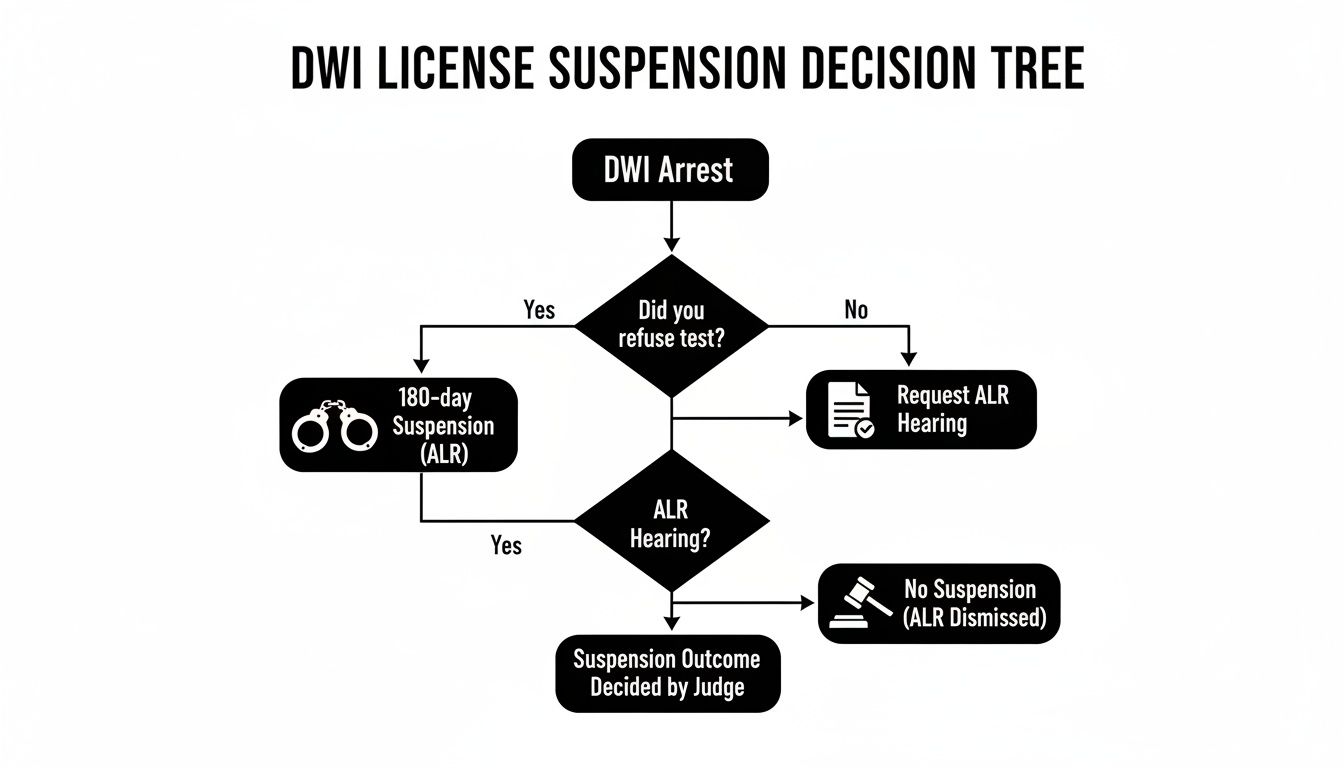
As you can see, refusing a chemical test automatically starts a 180-day license suspension. Even if you agree to the test and fail, you still have to request a special hearing to try and stop the suspension from happening. It's a lose-lose situation from the start.
Post-Arrest Procedures: Blood Draws and Booking
After the arrest, you’ll be taken to a police station or hospital. This is where the officer will ask for a chemical test—a breath or blood sample—to get a specific Blood Alcohol Concentration (BAC) number. Under Texas's "Implied Consent" law, refusing this test triggers that automatic license suspension we just talked about.
But a refusal doesn't mean the police give up. Thanks to recent legal changes, it's easier than ever for them to get your blood anyway. A new law that went into effect on September 1, 2025, now allows officers to get a blood draw search warrant much faster, even if they have to cross county lines to find a judge to sign it. This change is designed to get BAC evidence before it has a chance to dissipate.
After the evidence is collected, you'll be booked into jail. This process involves:
- Fingerprinting and getting your mugshot taken.
- A search of your person and any property you have with you.
- Recording your personal information into the system.
Arraignment and the Bail Process
You will be held in jail until you can see a judge or magistrate for your arraignment, which typically happens within 24-48 hours of your arrest. At this first court appearance, the judge will officially tell you what you're being charged with and set your bail amount.
Bail is not a fine or a punishment. It’s a financial promise that you will show up for your future court dates. An experienced Texas DWI attorney can argue for a lower bail amount or even a personal recognizance (PR) bond, which lets you get released without having to pay any money upfront.
Seeing the road ahead helps reduce the fear of the unknown. The prosecutor’s job is to secure a conviction. Your defense attorney’s job is to protect you at every turn. Knowing their roles is the first step toward getting the right legal support on your side.
How to Build a Strong Defense Against a DWI Charge
Getting arrested for DWI feels like a gut punch. It’s easy to assume the worst, but here’s something the police and prosecutors don’t want you to know: an arrest is not a conviction. The State of Texas has the burden of proving its case beyond a reasonable doubt, and their case is often weaker than they let on.
A strong, proactive defense can dismantle the prosecution's narrative and dramatically change the outcome. This fight doesn’t start in the courtroom; it begins the moment a skilled DWI lawyer gets involved, digging into every single detail of your arrest.
Picking Apart the State's Case, from Stop to Station
The first move in any solid defense is to attack the very foundation of the case—the traffic stop itself. If the officer didn't have a legitimate, legal reason to pull you over in the first place, then every piece of evidence they gathered after that moment could be thrown right out of court.
A sharp attorney will comb through the evidence, asking the tough questions:
- Was the traffic stop even legal? An officer needs "reasonable suspicion" for a stop. A flimsy excuse like “driving in a high-crime area” or a vague "weaving" claim often isn't enough to hold up under scrutiny.
- Were the field sobriety tests done by the book? These tests are notoriously subjective and easy to fail even when you're sober. They have strict, standardized protocols, and any deviation—like conducting them on an uneven surface or giving improper instructions—can invalidate the results.
- Is the breathalyzer machine reliable? These devices are not foolproof. They need constant calibration and maintenance to work correctly. We will immediately demand the machine’s service and calibration logs to hunt for a history of errors or malfunctions.
Every step of the arrest process is a potential landmine for the prosecution. An experienced lawyer knows exactly where the state is likely to make mistakes.
An arrest is simply the beginning of the legal process, not the end. Your defense attorney’s job is to deconstruct the prosecution’s narrative piece by piece, exposing the doubts and procedural errors that can lead to a reduction of charges or a full dismissal.
Challenging Blood Warrants and Lab Results
With the new DUI laws in Texas making it easier for police to get warrants for blood draws, attacking this evidence has become more important than ever. Just because they have a warrant and a blood sample doesn't mean the result is accurate or admissible.
For example, we will aggressively investigate the "chain of custody." This means we track your blood sample from the moment it was drawn to its arrival at the lab, ensuring it was properly collected, sealed, and stored. Any gap or mistake can lead to contamination or tampering, making the result completely unreliable.
We also look at who performed the draw. Was it a qualified medical professional in a sanitary setting, as the law demands? If not, the entire blood test could be thrown out.
Finding a Path Forward: Negotiation and Second Chances
Not every DWI case needs to end in a high-stakes trial. Often, the smartest strategy is to negotiate with the prosecutor to secure a better deal. A skilled negotiator might get the DWI charge reduced to a lesser offense like reckless driving, which carries far lighter penalties and avoids the permanent stigma of a DWI conviction.
For first-time offenders who are eligible, other powerful options may be on the table:
- Deferred Adjudication: This option allows you to complete a period of probation. If you do everything the court asks, the case is dismissed. Later, you can petition to have the entire arrest record sealed from public view.
- Pretrial Diversion Programs: Many Texas counties offer special programs for first-time offenders. Successfully completing the program requirements also leads to a full dismissal of the charges.
These alternative paths can help you keep a DWI conviction off your record for good. A knowledgeable Houston criminal lawyer will assess your situation, fight for your eligibility, and show you that there are always options. A proactive defense can change everything.
Clearing Your Record and Rebuilding Your Future

A DWI charge doesn’t just end when the court case does. It follows you, impacting your ability to get a job, find housing, and even get affordable insurance. It can feel like a permanent mark on your name. But it doesn't have to be.
Fortunately, Texas law provides a couple of powerful ways to clean up your record and reclaim your future. These aren't automatic, though. You have to be eligible, and you have to take the first step to apply. Knowing which option might work for you is the key to finally moving on.
Expunction vs. Nondisclosure: What Is the Difference?
When it comes to clearing a DWI charge, the two main tools are an expunction and an order of nondisclosure. They sound similar, but in practice, they are worlds apart.
Think of an expunction as the ultimate reset button. When a judge grants an expunction, it’s like the arrest never happened. Every record tied to the charge—from police reports to fingerprints and court documents—is located and physically destroyed. This is the gold standard, but it’s usually only an option if your case was dismissed, you were found not guilty at trial, or you completed a special pretrial diversion program.
An order of nondisclosure is the next best thing. This court order seals your criminal record, hiding it from the public. That means most employers, landlords, and anyone running a standard background check won't see it. However, the record isn't destroyed; government agencies and law enforcement can still access it under certain conditions.
"A DWI charge feels like a permanent stain, but it doesn't have to be. An expunction or nondisclosure can be a life-changing opportunity to get a clean slate and move forward without the weight of a past mistake holding you back."
Who Is Eligible for Post-Conviction Relief?
Eligibility for these powerful remedies is narrow and defined strictly by Texas law. For a DWI charge, the path you can take to clear your record depends entirely on how your case was resolved.
Expunction: You’re generally in a position to seek an expunction if your DWI case ended with a dismissal or an acquittal (a "not guilty" verdict from a jury).
Order of Nondisclosure: You might be eligible for nondisclosure if you successfully completed deferred adjudication for a first-time DWI where your BAC was below 0.15.
The new DUI laws in Texas have added layers of complexity to qualifying for these programs, especially since deferred adjudication is becoming harder to get. The process isn't simple—it involves filing a formal petition with the court and satisfying specific waiting periods. You can learn more about the detailed requirements in our guide on DWI expungement in Texas.
Frequently Asked Questions About Texas DWI Laws
Getting arrested for DWI is a disorienting experience. Your head is probably spinning with questions, and the uncertainty can feel overwhelming. That’s completely normal. Getting clear, honest answers is the first step toward taking back control. Here, we've tackled some of the most common questions we hear from clients about the latest DWI laws in Texas and what they really mean for you.
Can I Refuse a Breathalyzer Test in Texas?
Yes, you can absolutely refuse a breathalyzer test. But you need to know that this choice isn’t free—it comes with immediate consequences. Texas has an "Implied Consent" law, which means that by driving on a Texas road, you've already agreed to provide a breath or blood sample if lawfully asked.
Refusing automatically triggers a driver's license suspension. For a first-time offense, that suspension lasts for 180 days. What’s more, you only have 15 days from your arrest to request a formal Administrative License Revocation (ALR) hearing to fight it. While refusing the test means prosecutors lose a key piece of evidence, it doesn't stop the state from trying to convict you on other grounds.
Is Jail Time Mandatory for a First DWI in Texas?
While the law allows for it, jail time isn't always mandatory for a first-time DWI. A standard first offense is a Class B Misdemeanor, which carries a potential sentence of 72 hours to 180 days in jail. However, this is where having an experienced Texas DWI attorney makes a world of difference.
We can often negotiate for alternatives that keep you out of a jail cell. These options might include:
- Probation: Instead of jail, you serve a supervised sentence in the community.
- Community Service: You complete a set number of hours working for an approved organization.
- Deferred Adjudication: This is a huge win. If you're eligible, you can complete a probation period, and afterward, the case is dismissed. This prevents a final conviction from ever showing up on your public record.
How Can a Lawyer Help if My BAC Was Over the Legal Limit?
It’s easy to feel like your case is unwinnable if your Blood Alcohol Concentration (BAC) was over the 0.08 legal limit. But an arrest is not a conviction, and that BAC number is not the end of the story. A strong defense is still entirely possible.
A BAC number is only as reliable as the people and equipment that produced it. Every mistake law enforcement makes is an opportunity for your defense.
A dedicated DWI lawyer won't just accept the state's evidence at face value. We dig into every detail. Was the initial traffic stop even legal? Were the breathalyzer or blood testing machines properly maintained and calibrated? Did the officer follow the exact legal protocols for collecting evidence? A single procedural mistake can be enough to get the BAC evidence thrown out, often leading to a complete dismissal of your case.
If you’ve been charged with a crime in Texas, call The Law Office of Bryan Fagan, PLLC for a free and confidential consultation. Our defense team is ready to protect your rights. https://texascriminallawyer.net