Being arrested in Texas can be terrifying. You may be worrying about jail, your job, your family, and what happens when the judge asks for your plea.
Legal proceedings commonly offer two basic choices: guilty or not guilty. But there’s a third option that can matter a lot in the right case. That option is nolo contendere, often called no contest.
The hard part is that the nolo contendere meaning sounds simple, but the decision itself isn’t simple at all. In Texas, this plea can help in some situations and hurt in others. If you’re facing a DWI, assault, theft, or drug charge, the right question usually isn’t just “What does it mean?” The better question is, “What does it do for me, in my case, right now?”
Facing Criminal Charges in Texas? You Have Options
After an arrest, your case starts moving fast. You may deal with bail, court settings, prosecutor negotiations, and eventually a point where a plea has to be discussed. For many people, that first plea decision feels like stepping into a room where everyone else knows the rules except you.
In Texas criminal cases, the process usually moves through a few major stages. The names can sound formal, but the purpose of each step is straightforward.
The basic path of a Texas criminal case
Arrest and booking
Police arrest you, take your information, and file the charge. In a DWI, assault, theft, or drug possession case, this often happens before you’ve had time to understand what evidence the State claims to have.Magistration or first appearance
A judge may address bond and tell you about the accusation. This isn’t the same thing as a full trial, and it usually moves quickly.Arraignment or plea setting
At this stage, the court deals with your plea. In plain English, the court asks whether you’re fighting the case, admitting it, or resolving it some other way.Plea bargaining, trial, or dismissal
Many cases are negotiated. Some should be tried. Others may be reduced or dismissed depending on the facts, witnesses, and legal issues.
Practical rule: Your plea isn’t just a formality. It affects punishment, leverage, and what may happen outside the criminal courtroom.
Why this plea gets so much attention
A nolo contendere plea is often misunderstood because people hear “no contest” and assume it means “no consequences.” That’s not true. It still leads to criminal punishment if the judge accepts it.
What makes it important is that it may protect you in a related civil case. That issue comes up more often than people realize. A DWI crash, an assault allegation, or a property-related offense can create both a criminal case and a lawsuit over injuries or damage.
That’s why this plea deserves careful attention from a Texas DWI attorney, a Houston criminal lawyer, or anyone handling a serious Texas assault defense matter. The question isn’t whether the phrase sounds technical. The question is whether using it helps protect your future better than a guilty plea or a trial strategy would.
What Nolo Contendere Means in a Texas Courtroom
The nolo contendere meaning is simple in plain English. It means “I do not wish to contend.” In court, that usually means you are not fighting the charge, but you are also not formally admitting guilt.
That distinction confuses people because the result in criminal court looks a lot like a guilty plea. If the judge accepts a no contest plea, the court can still convict you and sentence you.
A simple analogy helps. Think of a referee calling a penalty in a game. A guilty plea is like saying, “Yes, I broke the rule.” A not guilty plea is like saying, “No, I didn’t, prove it.” A nolo contendere plea is closer to saying, “I’m not going to argue this call here.” You still take the penalty, but you’re not making a full admission that can follow you into another courtroom.
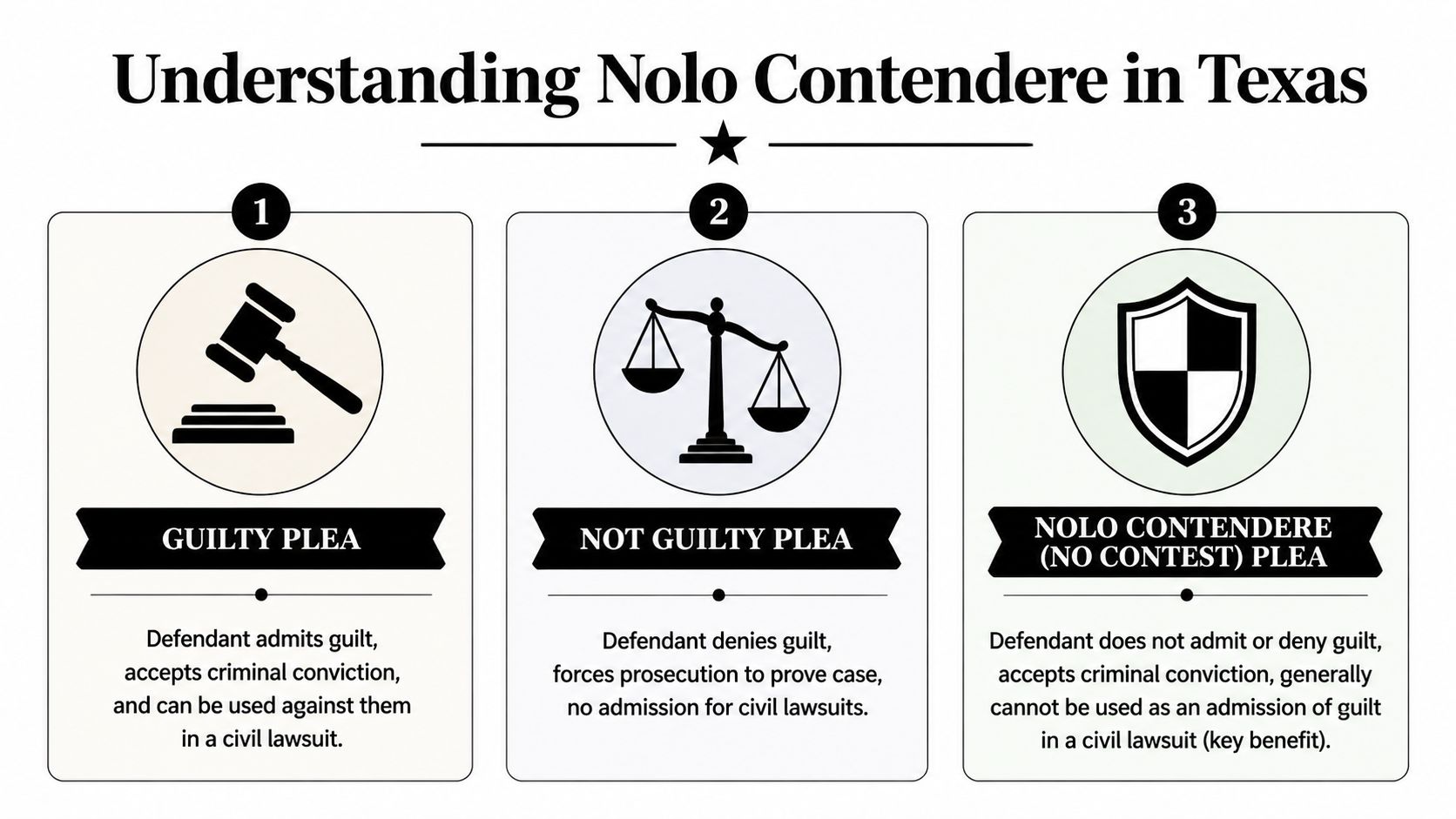
How the three pleas compare
| Plea | Do you admit guilt? | Is there a trial? | Can criminal punishment follow? | Civil lawsuit impact |
|---|---|---|---|---|
| Guilty | Yes | No, unless plea is withdrawn | Yes | May create problems in later civil litigation |
| Not guilty | No | Usually yes, unless case is later resolved | Only if convicted | No admission from the plea itself |
| Nolo contendere | No formal admission | Usually no trial if accepted | Yes | Often valuable because it is not an admission of guilt |
What this means for your case
If you plead no contest in Texas, the judge can still impose the same kinds of criminal outcomes you’d face with a guilty plea. That can include fines, probation, community supervision, or incarceration depending on the charge and the plea agreement.
For example, in a theft case under Texas Penal Code § 31.03, the plea doesn’t erase the offense level. In an assault case under Texas Penal Code § 22.01, the court still focuses on the charge, the facts, your history, and any negotiated recommendation. In a drug possession case under the Texas Controlled Substances Act, the same basic reality applies. No contest is not a magic escape hatch.
The real value of no contest usually isn’t lighter criminal punishment by itself. The value is what it may prevent someone else from doing with your plea later.
If you want a side-by-side breakdown of how courts and lawyers think about these options, this guide on guilty vs. no contest pleas in criminal law is a helpful companion.
The Key Benefit The Civil Lawsuit Shield
The biggest reason people ask about a no contest plea is simple. They’re afraid of getting sued after the criminal case ends.

That fear is especially common in Texas cases involving a car crash, injury, damaged property, or a fight. A person charged with DWI after an accident may also face a personal injury claim. A person charged with assault may worry the complaining witness will later sue for medical bills or other damages.
Here is the practical advantage. In Texas criminal courts, a nolo contendere plea works the same as a guilty plea for conviction and sentencing, but it is different in one critical way. It is not an admission of guilt, which helps shield it from being used as evidence in later civil litigation. One Texas-focused discussion notes that in Harris County, nolo pleas make up under 5% of misdemeanor DWI dispositions, yet they correlate with 20 to 30% lower civil exposure risks according to the source’s summary of available data and analysis in this area, discussed at the Versus Texas explanation of nolo contendere pleas.
A DWI crash example
Say you’re charged with DWI after a collision. Criminal court deals with punishment under Texas law. A separate civil case deals with whether you owe money to the injured driver.
If you plead guilty, the other side in the civil case may try to point to that plea as support for their claim that you caused the harm.
If you plead nolo contendere, you still face the criminal result, but the plea itself generally doesn’t function the same way as an admission of fault in the civil lawsuit. That forces the plaintiff to prove the case with other evidence.
That difference matters. It can change settlement pressure, insurance strategy, and how much power each side has.
Where this shield helps most
The benefit tends to matter most in cases like these:
DWI with crash allegations
If someone claims injury or property loss, civil exposure may be part of the case from day one.Assault allegations
A bar fight, domestic disturbance, or workplace incident can produce both charges and a damages claim.Property-related offenses
If someone says your conduct damaged their property, the criminal case may only be half the problem.
If you’re trying to weigh these trade-offs, this article on pros and cons in plea bargaining gives useful context.
After you’ve seen the basic issue, this short video can help reinforce why plea choices matter in real life.
A no contest plea doesn’t erase the event. It only changes one important legal consequence of how that event may be used later.
When Can You Plead Nolo Contendere in Texas?
A lot of people assume they can tell the judge, “I plead no contest,” and that settles it. Texas procedure is more guarded than that.
A nolo contendere plea is not something you should treat as automatic. The court has to accept it, and the practical value depends on whether the civil protection is worth pursuing in your specific case. As Cornell’s Wex entry on nolo contendere notes, the value of that protection varies, and the decision often turns on whether the likely civil benefit is worth the risk that the court may reject the plea.
What the judge is looking at
Judges usually care less about the Latin phrase and more about the full situation in front of them. That includes the seriousness of the charge, the facts the prosecutor says they can prove, and whether the plea appears fair and informed.
A judge may also look closely at:
The offense level
A misdemeanor DWI or simple assault may present a different negotiation posture than a more serious felony.Your criminal history
A first-time offender and a repeat offender usually don’t walk into court with the same bargaining power.The factual record
If the facts are disputed, incomplete, or clouded by memory problems, intoxication, or witness issues, your lawyer may have stronger reasons to request a no contest plea.
Why a prosecutor might object
Prosecutors often focus on accountability and influence. If they believe a guilty plea better serves their goals, they may resist a no contest resolution.
That resistance can be stronger when:
- There’s a victim pushing for a clear admission
- The case involves serious bodily injury
- The State thinks civil exposure is the exact reason you want the plea
Courtroom reality: The better your legal and factual reasons, the more seriously a no contest request tends to be considered.
When this plea deserves serious discussion
You should usually ask about nolo contendere when your case has two tracks. One track is criminal punishment. The other is the risk that someone may sue you over the same event.
That comes up often in DWI, assault, and some theft-related or property-related cases. It can also arise in white-collar matters where a criminal charge may overlap with later financial claims.
But there’s a hidden risk here. If you focus only on civil protection, you may miss bigger questions. Is the State’s evidence weak? Is deferred adjudication available? Is a trial worth considering? Would a different plea structure better protect your license, job, or immigration status? Those are the questions that should drive the decision.
Long-Term Consequences of a No Contest Plea
The civil lawsuit issue gets most of the attention, but it’s not the only consequence that matters. For many people, the bigger concern is what this plea does to life after court.
A no contest plea can still leave you with a criminal result that shows up in the places that matter most. Employers, landlords, licensing boards, schools, and immigration officials won’t care much that the plea sounded softer than “guilty.” They care about the legal outcome.

Your record and background checks
If the plea leads to a conviction, it can appear on background checks just like other convictions. That can affect job applications, housing, and professional opportunities.
This is why many people are surprised after court. They thought “no contest” meant the record would somehow look lighter. Usually, it doesn’t work that way.
A DWI resolved by plea can still affect your driving future. An assault case can still create trouble with employers. A theft conviction can raise trust concerns in almost any profession. Drug possession cases can create their own licensing and employment problems.
Deferred adjudication and record sealing
The better question is often not just “Can I plead no contest?” It’s “Can I structure the case in a way that gives me a cleaner long-term path?”
For certain offenses, a case resolved with a nolo contendere plea and deferred adjudication may qualify for an order of nondisclosure, which is record sealing under Texas law. A reviewed summary also notes that expunction eligibility under Texas Gov't Code §411.174 can persist if the case is deferred, and that analysis has found higher success rates for sealing after nolo pleas than guilty pleas in some contexts, as discussed in this background summary on nolo contendere.
That means the final structure matters a lot. A no contest plea tied to deferred adjudication may put you in a very different long-term position than a straight conviction.
Here’s the simple distinction:
| Remedy | What it generally does |
|---|---|
| Expunction | Removes qualifying records from public view in eligible situations |
| Nondisclosure | Seals qualifying records from public access, though some agencies may still see them |
If you’re comparing the short-term convenience of a plea with the long-term cost of a record, this discussion of plea deal costs is worth reading.
Immigration and professional licensing
If you are not a U.S. citizen, be very careful. Immigration law often treats criminal pleas based on their legal effect, not the comforting label used in conversation. A no contest plea can still trigger severe immigration consequences.
The same warning applies to licensed professionals. Nurses, teachers, commercial drivers, and people in regulated industries may face separate board or administrative consequences after a criminal case ends.
Don’t judge a plea by its name. Judge it by the record it creates, the sentence it allows, and the doors it may close later.
The hidden trade-off
The civil shield can be valuable. But if there is no realistic civil lawsuit coming, a no contest plea may offer less practical benefit than people expect.
In that situation, your focus may need to shift. You might care more about avoiding a final conviction, preserving licensing options, seeking treatment-based outcomes, or building toward nondisclosure later. A good plea strategy in Texas looks at the whole picture, not just one legal advantage.
Frequently Asked Questions About Nolo Contendere Pleas

Can you still go to jail if you plead no contest?
Yes. A no contest plea can lead to the same criminal punishment range that applies to the charge. If the court accepts the plea and enters a conviction, jail or prison can still be on the table depending on the offense, your record, and the plea agreement.
In a misdemeanor case, that may mean county jail exposure. In a felony, it can mean prison or community supervision, depending on the law and the facts.
Does no contest mean the same thing as not guilty?
No. These pleas are very different.
A not guilty plea means you are fighting the charge and requiring the State to prove the case. A nolo contendere plea means you are resolving the criminal case without a formal admission of guilt.
If you want a trial, challenge witnesses, file motions, or force the prosecutor to prove every element, not guilty is the plea that preserves that path.
Will a no contest plea show up on a background check?
It can, if it results in a conviction or another reportable criminal outcome. Many employers won’t see a meaningful difference between a guilty plea and a no contest plea when reviewing your record.
That’s why deferred adjudication, nondisclosure eligibility, and post-case cleanup options matter so much. The word choice in court is only part of the story.
Can you use nolo contendere for a felony in Texas?
Sometimes, but it depends on the court, the prosecutor, and the case facts. A felony no contest plea isn’t guaranteed just because you want one.
The seriousness of the allegation matters a lot. So does whether there is a strong reason for the court to allow the plea. In felony cases, judges and prosecutors usually examine the request more carefully.
Is no contest a good idea in a DWI case?
Sometimes. It often deserves discussion when the DWI involved a wreck, injuries, or a strong chance of a civil lawsuit.
If there is no real civil exposure, then the no contest label may not give you much practical value by itself. Other goals may matter more, such as challenging the stop, testing the breath or blood evidence, negotiating probation terms, or seeking a result that gives you a better long-term record outcome.
Is no contest a good option in an assault case?
It can be, especially where the same event could lead to a lawsuit. Assault allegations often involve medical claims, property damage, or competing stories between the people involved.
Still, you shouldn’t assume no contest is always best. In some assault cases, self-defense issues, witness credibility, or lack of proof may make a not guilty strategy stronger.
Does a no contest plea help with expunction?
Not by itself. What matters more is the final legal result.
If the plea is tied to deferred adjudication and the offense qualifies, you may have a later path toward nondisclosure or, in some situations, other record relief. If it ends in a straight conviction, your options may be more limited.
Can a no contest plea affect immigration status?
Yes. This is one of the most dangerous areas for confusion.
If you are a non-citizen, do not assume “no contest” is safe because it sounds less direct than “guilty.” Immigration authorities often focus on the legal effect of the plea and sentence, not the softer wording. You need case-specific immigration-aware defense advice before entering any plea.
What should you ask your lawyer before taking a no contest plea?
Ask questions that force a practical answer:
- Is there real civil lawsuit risk in my case, or just fear of one?
- Would the judge likely accept this plea structure?
- Is deferred adjudication available?
- How will this affect my record, license, job, or immigration status?
- Would fighting the case put me in a better position?
The best plea is the one that fits your actual risks, not the one that sounds most comfortable in court.
If you’ve been charged with a crime in Texas, call The Law Office of Bryan Fagan, PLLC for a free and confidential consultation. Our defense team is ready to protect your rights.