Skip to content
Being arrested for Driving While Intoxicated (DWI) in Texas can be terrifying — but you don’t have to face it alone. Taking a deep breath and understanding the potential penalties is the first real step toward building a defense. The penalties for DWI in Texas are serious and escalate quickly with each offense. What starts as a Class B Misdemeanor with fines up to $3,000 and jail time can spiral into a third-degree felony with up to 10 years in prison for a third offense.
Understanding the Stakes of a Texas DWI Charge

Let's be clear: a DWI charge in Texas is not just a traffic ticket. You are facing a serious criminal offense, one that can impact your freedom, your finances, and your future for years to come. The Texas Penal Code lays out a very clear, tiered system for these charges, meaning the penalties get dramatically harsher with each subsequent conviction.
Facing these charges alone can feel overwhelming. The legal language is dense, the process is confusing, and the stakes couldn't be higher. Our goal is to explain in plain English what you’re up against, so you can understand your rights and the fight ahead.
How Texas Law Classifies DWI Offenses
Texas law classifies DWI offenses into different categories based on a few key factors, but the most significant one is your prior record. Think of it like a ladder—each prior conviction moves you up to a more serious level.
Here’s a simple breakdown of how DWI charges typically escalate:
- First DWI Offense: This is generally charged as a Class B Misdemeanor. While it's the lowest-level charge, the penalties are still significant and life-altering.
- Second DWI Offense: The charge increases to a Class A Misdemeanor, which brings mandatory jail time and much higher fines.
- Third (or Subsequent) DWI Offense: A third DWI is automatically a third-degree felony. This is a game-changer, landing you in a Texas prison, not a county jail.
It’s critical to remember these are just the standard classifications. Certain circumstances, which we’ll cover below, can elevate the charge right from the start, even on a first offense.
"A DWI arrest is not a conviction. It is the beginning of a legal process where you have the right to challenge the evidence against you and fight for your future."
The Escalating Nature of Texas DWI Penalties
Texas is tough on drunk driving, and the penalties are designed to get your attention. They become exponentially more severe with each offense.
For a first-time DWI, you’re looking at potential jail time, fines that can hit $3,000, and a driver's license suspension for up to a year. However, if your blood alcohol concentration (BAC) was 0.15% or higher, the charge is enhanced, and the maximum fine doubles to $6,000.
With a second offense, the consequences intensify across the board. We're talking mandatory jail time, steeper fines, and a much longer license suspension. By the time you reach a third offense, you're facing a felony conviction that carries two to 10 years in a state prison and a fine of up to $10,000. You can see how these penalties reflect the state's zero-tolerance stance by reviewing state statistics at zealousadvocate.com.
Understanding this escalation is key. It highlights why mounting a powerful defense from the very first charge is absolutely essential to protecting your future.
To make this easier to digest, here’s a quick overview of the standard penalties you can expect at each level.
Texas DWI Penalties At-a-Glance
| Offense Level | Classification | Potential Jail Time | Maximum Fine | Driver's License Suspension |
|---|---|---|---|---|
| First Offense | Class B Misdemeanor | 3 to 180 days | Up to $3,000 | 90 days to 1 year |
| Second Offense | Class A Misdemeanor | 30 days to 1 year | Up to $6,000 | 180 days to 2 years |
| Third Offense | Third-Degree Felony | 2 to 10 years | Up to $10,000 | 180 days to 2 years |
This table shows the standard framework, but remember, every case is unique. Factors like having a child in the car, causing an accident, or having a very high BAC can significantly increase these penalties.
What to Expect with a First DWI Offense
For most people, a DWI arrest is their first real encounter with the criminal justice system. It’s a frightening and confusing time, but knowing what you're up against can help ease some of that anxiety. While a standard first-time DWI is a serious charge, it absolutely does not have to define your future.

Here's the first thing you need to grasp: when you're charged with a first DWI in Texas, you're immediately thrown into two separate legal battles. One is the criminal case that will decide your guilt or innocence. The other is an administrative case that determines the fate of your driver's license. You have to act fast on both fronts to protect your rights.
Understanding a Class B Misdemeanor
Under the Texas Penal Code, a standard first DWI offense is classified as a Class B Misdemeanor. Don't let the term mislead you; while it's the lowest level for a DWI charge, the consequences are significant enough to disrupt your life for years.
A conviction for a Class B Misdemeanor comes with a stiff set of penalties:
- Jail Time: A minimum of 72 hours and up to 180 days in county jail.
- Fines: A fine of up to $3,000.
- License Suspension: Your driver's license can be suspended for anywhere from 90 days to one year.
And that's just the direct criminal side of things. A conviction also triggers a cascade of other consequences, like mandatory DWI education classes, probation, and a massive hike in your car insurance rates. It’s critical to understand the full scope of what's on the line from the moment you're arrested.
When a First DWI Becomes 'Enhanced'
Not all first-time DWI charges are created equal. Certain factors can "enhance" the charge, which is a legal way of saying the classification and potential penalties get a lot worse. The most common enhancement for a first offense is having a high Blood Alcohol Concentration (BAC).
If your BAC comes back at 0.15% or higher, the charge is automatically bumped up from a Class B to a Class A Misdemeanor. This is a huge jump that essentially doubles the stakes.
A Class A Misdemeanor for an enhanced DWI means you could be facing up to one year in jail and a fine of up to $6,000. It also frequently comes with a mandatory ignition interlock device requirement, even for a first offense.
This enhancement shows just how seriously Texas law treats cases where the level of intoxication is especially high. The state views it as a much greater risk to public safety. An experienced Texas DWI attorney will immediately scrutinize the BAC evidence to ensure every single testing procedure was followed perfectly, because any error can make those results inadmissible in court.
The Two Battles You Must Fight
After a DWI arrest, two different clocks start ticking on critical legal processes. It’s absolutely vital to understand that these are separate proceedings that run on parallel tracks.
- The Administrative License Revocation (ALR) Hearing: This is a civil case with the Texas Department of Public Safety (DPS). From the day you're arrested, you have only 15 days to request this hearing to fight the automatic suspension of your driver's license. Miss that deadline, and your license is suspended, no questions asked.
- The Criminal Court Case: This is the fight for your freedom and your record. It’s the criminal proceeding where the prosecutor has to prove your guilt beyond a reasonable doubt. This process moves through arraignment, pre-trial motions, plea negotiations, and potentially a full trial.
Successfully navigating both of these requires immediate action and an experienced lawyer. An effective defense strategy tackles both the license suspension and the criminal charge from day one, aiming to protect your driving privileges and your future.
When a DWI Becomes a Felony Charge
While any DWI charge is serious, the line between a misdemeanor and a felony is a life-altering cliff. A felony conviction brings devastating consequences that go far beyond fines and jail time. We're talking about potentially losing fundamental rights like voting or owning a firearm—a label that can haunt your career, housing applications, and personal life forever.
Several specific situations can automatically elevate what might have been a misdemeanor DWI into a felony. Knowing these triggers is critical. It shows just how quickly the stakes can rise and why you need an immediate, strategic defense. Remember, an accusation isn't a conviction, and even with these severe charges, there are ways to fight back.
Your Third DWI Offense
The most common way a DWI becomes a felony is through prior convictions. Under Texas Penal Code Section 49.09, if you already have two DWI convictions on your record, your third arrest automatically gets filed as a third-degree felony.
It doesn't matter how long ago those priors were. Texas has no "lookback period" for DWI convictions, so an offense from decades ago still counts.
This charge carries heavy penalties, including:
- Prison Time: A sentence of 2 to 10 years in a Texas state prison.
- Fines: A fine up to $10,000.
- License Suspension: Losing your driver's license for up to two years.
The state sees repeat offenses as a pattern of dangerous behavior, and prosecutors pursue these cases aggressively. This makes an experienced Houston criminal lawyer your single most important asset.
DWI with a Child Passenger
Having a child in the car during a DWI arrest is an immediate game-changer, even if it's your first offense. According to Texas Penal Code Section 49.045, driving while intoxicated with a passenger under the age of 15 is a state jail felony.
A conviction for DWI with a child passenger can land you in a state jail facility for 180 days to two years, plus a fine of up to $10,000. The law is designed to protect children, and you can expect judges and juries to show very little leniency.
This rule applies even if the child wasn't hurt. The simple act of putting a minor at risk is enough to trigger this severe felony charge. Building a defense in these emotionally charged cases requires a deep understanding of both DWI law and the tactics prosecutors use.
Intoxication Assault and Intoxication Manslaughter
When a DWI incident leads to serious injury or death, the penalties become the most severe in Texas law. These charges aren't just about impaired driving; they're about the catastrophic results of that decision.
- Intoxication Assault: If you cause "serious bodily injury" to another person while driving intoxicated, you'll face a charge of Intoxication Assault. This is a third-degree felony under Texas Penal Code Section 49.07, punishable by 2 to 10 years in prison.
- Intoxication Manslaughter: If an accident results in someone's death, the charge escalates to Intoxication Manslaughter, a second-degree felony under Texas Penal Code Section 49.08. A conviction carries a prison sentence of 2 to 20 years.
The state's aggressive stance is understandable. Texas imposes some of the harshest DWI penalties in the country, which correlates with its tragic outcomes. The state leads the nation in deaths from high-BAC crashes (0.15+), with 896 fatalities in one year alone, and nearly 43% of all traffic deaths were alcohol-related. Learn more about these sobering statistics on dui-statistics.
Facing a felony DWI can feel like the world is ending, but it’s really the start of a legal fight. A skilled attorney will scrutinize every piece of evidence—from the reason for the traffic stop to the chemical test results—to protect your rights. Our team has defended countless clients against these life-changing accusations. You can explore more about our approach in our felony DWI consequences guide.
The Hidden Financial and Personal Costs of a DWI
A DWI conviction in Texas is a lot like an iceberg. The fines and potential jail time are what you see on the surface, but the real damage—the crushing weight of hidden costs that can sink your financial future—lies just beneath.
These "collateral consequences" are the penalties that aren't always discussed in the courtroom but can disrupt your life for years. When the judge’s gavel falls, the court-ordered fine is just the opening act. You’re also on the hook for court costs, mandatory DWI education classes, and monthly supervision fees if you land on probation. It all adds up, turning what seemed like a manageable fine into a serious financial burden.
The True Price of a Conviction
Many people are completely blindsided by the annual surcharges tacked on to your driver's license after a DWI conviction. You're looking at $3,000 to $6,000 in civil penalties paid to the Texas Department of Public Safety over three years, just for the privilege of keeping your license. If you can't pay, they suspend your license automatically, trapping you in a difficult cycle when you're just trying to get back on your feet.
Then there’s the Ignition Interlock Device (IID). If a judge orders one for your vehicle, you’ll be paying for its installation, a monthly monitoring fee, and eventually, a removal fee. This device, which stops your car from starting if it detects alcohol on your breath, can easily cost over $1,000 per year. It’s a constant, expensive reminder of your conviction.
A DWI conviction is like an iceberg. The fines and jail time are what you see on the surface, but the crushing weight of hidden costs—insurance hikes, license surcharges, and career damage—lies just beneath, ready to sink your financial future.
Skyrocketing Insurance Premiums
After a DWI, your car insurance company will reclassify you as a high-risk driver. To keep driving legally, you’ll almost certainly be required to file an SR-22 certificate. Think of it as proof of high-risk insurance. It isn't just a piece of paper; it's the trigger for a massive hike in your premiums.
Don’t be surprised if your insurance rates double, triple, or even quadruple overnight. This financial gut punch can last for years, long after you’ve paid off court fines and finished probation. For many Texans, the inflated insurance cost is one of the most punishing and long-lasting consequences of a DWI.
Long-Term Professional and Personal Fallout
The shockwaves from a DWI conviction travel far beyond your wallet, creating obstacles in your professional and personal life that are tough to overcome. That conviction will show up on background checks, potentially slamming the door on job opportunities or promotions.
The impact is especially severe if you hold a professional license. Licensing boards for careers in nursing, real estate, aviation, or commercial driving have little tolerance for these convictions. They can—and often do—suspend or revoke your license, putting your entire career in jeopardy.
And the personal costs? They can be just as devastating. A DWI on your record complicates things you probably take for granted:
- Child Custody: In a family court battle, a DWI can be used as ammunition to argue you’re an unsafe parent, potentially derailing custody or visitation rights.
- Housing Applications: Many landlords run background checks. A DWI conviction could be the reason your rental application gets denied.
- Educational Opportunities: Applying for certain academic programs or scholarships? A criminal record could be a significant roadblock.
These hidden penalties are exactly why you need a proactive defense from day one. An arrest is not a conviction, and fighting the charge is the only way to protect yourself from these devastating long-term consequences.
Navigating the Legal System After Your Arrest
Getting arrested for a DWI can feel like being thrown into a legal maze blindfolded. The system is confusing, intimidating, and moves faster than you’d expect. But you don't have to figure it out alone. Understanding what comes next, step by step, is the best way to calm your nerves and start making smart decisions.
The clock starts ticking immediately after your arrest. The first and most critical deadline you face is requesting an Administrative License Revocation (ALR) hearing, and you only have 15 days to do it. This hearing is your one and only chance to fight the automatic suspension of your driver's license.
Miss that 15-day window, and you forfeit that right completely. It’s a civil process, totally separate from your criminal case, but its outcome has a huge impact on your daily life.
The First Steps in Criminal Court
Once the ALR hearing is requested, the focus shifts to the criminal side of things. This journey kicks off with an arraignment, which is your first official appearance in court. The judge will read the charges against you, and you'll enter a plea. At this early stage, that plea is almost always "not guilty" to keep all your legal options on the table.
This is also where the judge sets your bond conditions—the rules you have to follow while your case is ongoing. These might include checking in with a probation officer or being forced to install an Ignition Interlock Device on your car before you’ve even been convicted of anything.
Gathering Evidence: The Discovery Phase
After the arraignment, your case moves into what's called discovery. This is where your defense attorney formally demands every single piece of evidence the prosecutor has gathered against you. This isn't just asking for a file; it's a deep dive into the state's entire case.
Your lawyer will get their hands on and meticulously review everything, including:
- Police Reports: The officer’s official story of the stop and arrest.
- Dashcam and Bodycam Video: This footage often tells a very different story than the written report.
- Breath or Blood Test Results: The so-called scientific evidence, along with the machine's maintenance and calibration records.
- Witness Statements: Any accounts from other people who were at the scene.
This pile of evidence is where the foundation of your defense is built. A sharp DWI attorney knows exactly what to hunt for—gaps in the officer's report, procedural mistakes made during the stop, or sloppy handling of the chemical tests. Any of these can become powerful tools to challenge the prosecution.
The hidden costs of a DWI start piling up almost immediately, long before a case is ever resolved. This flowchart gives you a glimpse of the financial storm you could be facing.
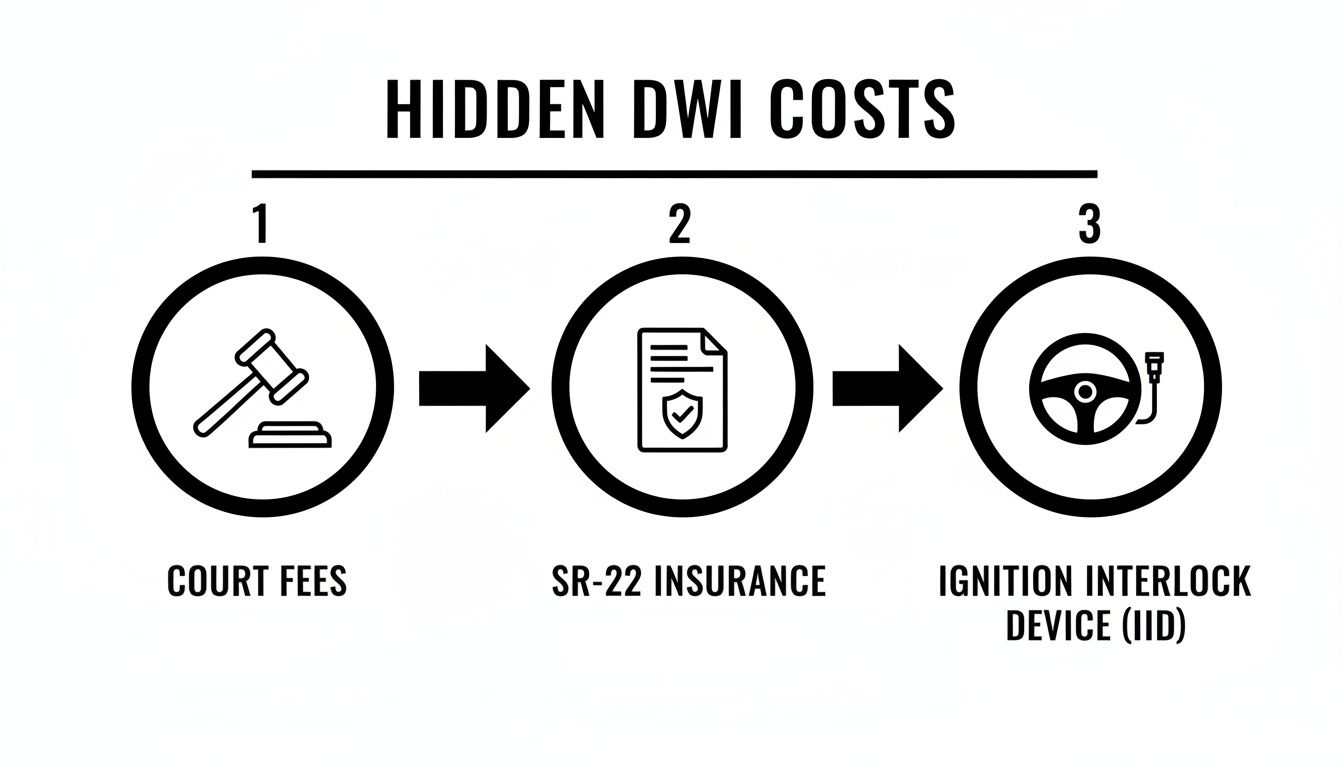
As you can see, you're looking at a mountain of expenses from court fees and high-risk SR-22 insurance to mandatory devices like an IID. It’s a stark reminder of why a strong defense from day one is so essential.
Challenging the State's Case
Armed with all the evidence from discovery, your attorney can start punching holes in the prosecutor's case using pre-trial motions. A common and powerful tool is a "Motion to Suppress," which argues that key evidence—like that breath test result—was obtained illegally and should be thrown out of court completely.
If a motion like this is successful, it can gut the state's case, often forcing a dismissal. Throughout this entire process, it's vital to have open and honest communication with your lawyer. Understanding the basics of attorney-client privilege rules helps ensure your conversations stay confidential and protected.
At the same time, your lawyer will engage in plea negotiations with the prosecutor. They'll explore every possible avenue for getting the case dismissed or reduced to a less serious charge. The final outcome often depends on the strength of the evidence, the quality of the legal arguments, and even the dynamics of that specific courthouse.
With DWI arrest volumes in Harris County topping 12,000 in a single year, prosecutors are often swamped with cases. This creates real opportunities for a skilled negotiator to find weaknesses and secure a much better outcome for their client. By breaking down each stage, you can see how an experienced attorney becomes your best and only advocate, fighting to protect your rights at every turn.
Common Questions After a Texas DWI Arrest
Getting pulled over and charged with a DWI in Texas unleashes a storm of questions. The unknown can feel crippling, but getting straight answers is the first step to taking back control. We’ve laid out the answers to the questions we hear most often, giving you the clear information you need to move forward.
Can I Refuse a Breathalyzer or Blood Test in Texas?
Yes, you have the right to refuse a chemical test in Texas. But this isn't a get-out-of-jail-free card; refusing triggers immediate and automatic penalties under the state's "implied consent" law.
Here’s how it works: just by having a Texas driver's license, you've already agreed to provide a breath or blood sample if an officer lawfully arrests you for DWI. If you refuse, the state will move to suspend your license through an Administrative License Revocation (ALR). For a first-time refusal, that means an automatic 180-day suspension.
While refusing keeps the prosecutor from getting what is often their most powerful evidence—your BAC—it doesn’t stop them from filing charges. They can still build a case using the officer's testimony about your driving, your appearance, how you did on the field sobriety tests, and anything you said. An experienced DWI lawyer is critical to fighting the license suspension at the ALR hearing while also building a defense against the criminal charge itself.
Is It Possible to Get a DWI Charge Dismissed or Reduced?
Absolutely. An arrest is just the beginning of the legal process, not the end. A skilled DWI defense attorney can attack the state's case from every angle, aiming for a complete dismissal or a reduction to a much less serious charge.
A successful defense often comes down to digging into the details of the arrest. Practical advice for people facing charges like this often centers on these strategies:
- Challenging the Traffic Stop: Did the officer even have a legal reason to pull you over? If the stop was invalid, any evidence gathered after that moment—including the arrest itself—could be thrown out.
- Questioning the Field Sobriety Tests: These tests are notoriously subjective and prone to error. They have to be administered under strict, standardized guidelines. Any misstep by the officer can make the results worthless in court.
- Contesting the Chemical Test Results: Breathalyzers need constant, precise calibration. Blood samples must be drawn, handled, and stored according to rigid protocols. Any mistake in these procedures can get the results thrown out.
Many DWI cases get resolved through smart negotiation. A good attorney can use weaknesses in the prosecution's case to negotiate a plea bargain for a lesser charge, like Obstruction of a Highway. An offense like that carries lighter penalties and won't haunt your record the way a DWI conviction does.
"A DWI arrest feels like the end of the road, but it’s really the beginning of a legal fight. With the right strategy, many paths can lead to a dismissal, a reduction, or a not-guilty verdict at trial."
How Long Will a DWI Stay on My Record in Texas?
This is a huge question because the answer can impact you for the rest of your life. In Texas, a DWI conviction is permanent. It stays on your criminal record forever and will show up on background checks unless you can get it legally removed, which is only an option in very rare situations.
Your best-case scenario is getting the case dismissed or being found not guilty at trial. If that happens, you may be eligible for an expunction. An expunction is a court order that completely destroys all records of the arrest. It's as if it never happened.
In some limited first-offense cases where you complete a special probation called deferred adjudication, you might be able to get an order of non-disclosure. This seals your record from the public, though law enforcement and certain government agencies can still see it.
But if you are convicted, that DWI is there to stay. This is exactly why it is so critical to hire a defense attorney and fight the charge from day one. Your best opportunity to protect your future is to stop a conviction from ever happening.
If you’ve been charged with a crime in Texas, call The Law Office of Bryan Fagan, PLLC for a free and confidential consultation. Our defense team is ready to protect your rights. Visit us at https://texascriminallawyer.net.