Being arrested in Texas can be terrifying. One moment you're in a traffic stop, outside an apartment, or standing in your own kitchen. The next, you're in handcuffs wondering whether a small amount of drugs just turned into a felony, whether you'll lose your job, and what happens when you go to court.
That fear is real. So is the confusion. Many people charged with possession of a controlled substance in Texas have never been in serious trouble before, and they don't know if they should talk, plead, or wait.
You don't have to guess your way through it. A drug case has pressure points. The stop can be challenged. The search can be challenged. The lab work can be challenged. In shared homes and cars, even the basic claim that you possessed the substance can be challenged. If you're also dealing with related charges such as DWI, theft, or assault, the strategy has to account for the whole picture, not just the drug allegation.
Arrested for Drug Possession in Texas? Here Is What Happens Next
A common scene looks like this. Police say they found something in your pocket, center console, backpack, or bedroom. You hear words like "controlled substance," "felony," or "state jail." Nobody explains much. You get booked, your phone is gone, and your family is trying to figure out where you are.
At that point, a common mistake is to focus only on the amount. Amount matters, but it isn't the whole case. Whether police had the right to stop you, whether they searched lawfully, whether the substance was really under your control, and what the lab can prove all matter too.
Practical rule: The first hours after an arrest can shape the rest of the case. The safest move is usually to stay calm, use your right to remain silent, and ask for a lawyer.
Texas drug cases move fast in some counties and slowly in others, but the same basic questions come up early:
What exactly am I charged with
The label matters. Simple possession is different from intent to deliver, and a misdemeanor is very different from a felony.Am I eligible for bond
In many cases, the court will address release conditions quickly, but the terms can affect your job, travel, and family life.Can this be dismissed or reduced
Sometimes yes. Sometimes the better goal is keeping a conviction off your record through a negotiated result.What if this isn't even mine
That issue comes up more often than people think, especially in shared apartments, borrowed cars, and group settings.
For many readers, the search starts with "possession of controlled substance Texas" because you need direct answers now. You need to know what possession means, how penalties are set, what the court process looks like, and whether there's a path to protect your future. There is. A strategic defense starts with understanding exactly what the State must prove.
What Legally Constitutes Possession in Texas
Under Texas law, possession doesn't just mean "it was on you." Prosecutors generally try to prove that you had care, custody, control, or management of the substance and that you knew what it was. Those ideas sound simple until they show up in a real case.
Actual possession and constructive possession
Actual possession is the easier example. Police say the substance was in your hand, your pocket, or another place directly on your person.
Constructive possession is where many cases become dangerous. Texas cases can be filed even when the drugs were not physically on you. According to this discussion of Texas possession law, constructive possession allows charges when drugs are in a place you control or manage, such as a bedroom with a locked closet. That matters in Houston and Dallas, where shared rentals are common and many people don't realize that sharing space with drugs can still lead to felony charges.
That is the trap. Police don't have to find the substance in your pocket if they believe they can tie it to your control over the space.
What the prosecutor usually tries to show
In plain English, the State will often try to connect you to the substance through facts like these:
Access to the location
You lived there, slept there, drove the car, or kept belongings nearby.Signs of control
The item was found with your personal property, inside your room, or in an area others couldn't easily access.Knowledge
The prosecutor may argue you knew the drugs were there because of statements, behavior, or surrounding items.
If you didn't know the substance was there, that isn't a minor detail. It can be the center of the defense.
A person can be near drugs without legally possessing them. That's especially true in houses with multiple roommates, in borrowed vehicles, or at parties where people move through common areas.
Why substance type and amount still matter
Even though possession starts with control and knowledge, the charge level is graded by the drug involved and the amount alleged. A general reference like Drug Possession Defense in Texas can help you see how Texas classifies possession charges by substance and amount.
If your case also involves a substance marketed as legal or herbal, it helps to understand what the product contains and how it may affect a case or treatment plan. This guide to kratom's risks gives useful background on effects, safety, and legal questions that often overlap with criminal cases and recovery decisions.
How Texas Penalties for Drug Possession Are Determined
A traffic stop can turn into a felony case in minutes. An officer finds a trace amount in a console, a pocket, or a backpack, sends it to the lab, and suddenly the question is not just whether the substance was yours. It is what Texas says that substance is, how much the State claims it weighed, and whether any enhancement factors push the punishment range higher.
That is why two possession cases that sound similar can carry very different exposure. Texas grades these charges by penalty group, weight, and sometimes by surrounding facts such as where the arrest happened or whether you have prior convictions. The charge is driven by the Texas Health and Safety Code. If you want a broader explanation of how possession, trafficking, and distribution offenses are classified, this Texas drug law overview on possession, trafficking, and distribution offenses is a useful starting point.
Penalty groups and weight drive the charge
For many controlled substances, the first question is the penalty group. Penalty Group 1 includes drugs such as cocaine, heroin, and methamphetamine. From there, the alleged weight usually controls the offense level and punishment range.
Texas also often uses aggregate weight, including adulterants and dilutants. In plain English, the State may count the entire mixture, not just the pure drug. That can matter a great deal in close cases because a small difference in lab weight can move a charge into a harsher range.
Texas Controlled Substance Penalties
| Amount Possessed | Offense Level | Potential Jail/Prison Time | Maximum Fine |
|---|---|---|---|
| Less than 1 gram | State jail felony | 6 months to 2 years | $10,000 |
| 1 to under 4 grams | Third-degree felony | 2 to 10 years | $10,000 |
| 4 to under 200 grams | Second-degree felony | 2 to 20 years | $10,000 |
| 200 to under 400 grams | First-degree felony | 5 to 99 years or life | Not specified here |
| 400 grams or more | First-degree felony | 10 to 99 years or life | $100,000 |
Those ranges track the Penalty Group 1 framework described in this summary of Texas possession penalties.
A tiny amount can still mean a felony
This catches people off guard more than almost anything else in drug cases. Under Texas Health and Safety Code §481.115(b), possession of less than one gram of a controlled substance such as cocaine, methamphetamine, or heroin is a state jail felony, punishable by up to 2 years in confinement and a fine of up to $10,000, as explained by the Texas Criminal Justice Coalition's review of the smallest possession offenses.
That same source reports that in 2011 and 2012, Texas sentenced 16,262 people to state jail for drug convictions, and 88% were convicted for possessing less than one gram without intent to deal or distribute. It also reports an annual incarceration cost per person of nearly $16,000, putting the two-year spending on those low-quantity possession cases at about $260 million.
Small amount cases still need a serious defense. I treat them that way because prosecutors often do too.
The coalition also points out a technical issue that can matter in trace-amount cases. For substances under 0.02 grams, a crime lab may not have enough sample to conduct repeat testing. In the right case, that becomes more than a scientific footnote. It can become a real evidentiary problem for the State.
Marijuana follows a different scale
Marijuana is charged under a different structure than Penalty Group 1 substances. Under the same penalty summary noted earlier, possession of under 2 ounces is a Class B misdemeanor with up to 180 days in jail and a $2,000 fine. Higher weights can increase the charge dramatically, including felony ranges for very large amounts.
For someone trying to size up the case, that distinction matters early. The alleged substance and the alleged weight usually set the floor for plea negotiations, motion strategy, and the amount of risk you are facing if the case goes to trial.
The Difference Between Simple Possession and Intent to Deliver
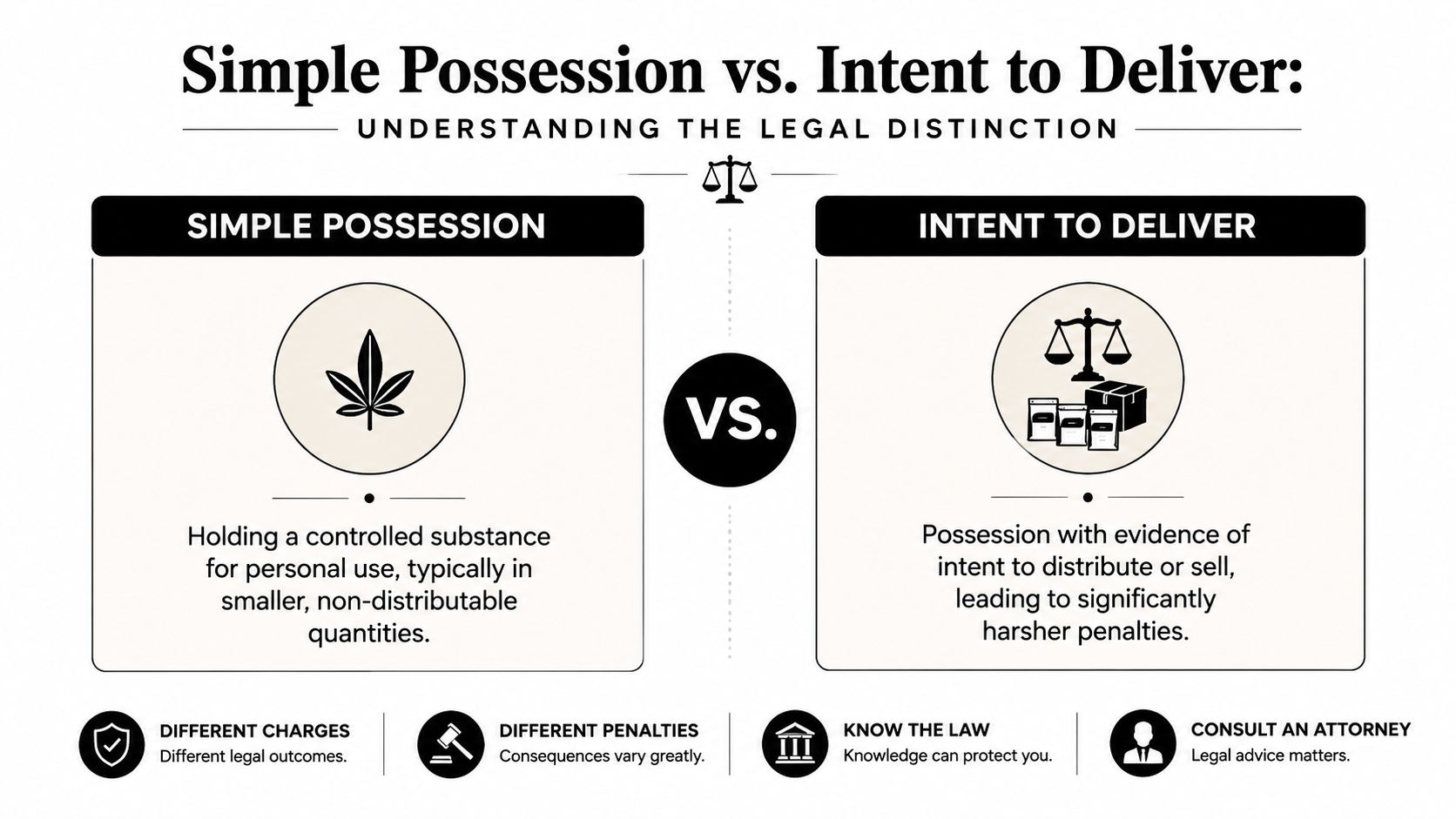
Simple possession and intent to deliver are not the same accusation. In a simple possession case, the State claims you had a controlled substance for personal possession. In an intent-to-deliver case, the State says the facts show distribution, sale, or planned transfer.
What usually pushes a case upward
Prosecutors rarely rely on one fact alone. They tend to build an intent argument from a collection of circumstances, such as:
Packaging
Multiple small baggies can be used to argue the substance was separated for sale rather than personal use.Scales or measuring tools
A digital scale often becomes a centerpiece in the State's theory.Cash
Large amounts of cash may be presented as evidence of drug sales, especially if officers also claim the cash was bundled or found with packaging materials.Messages or lists
Phone contents, handwritten notes, or alleged ledgers can become major evidence.Quantity
A larger amount may lead prosecutors to argue the amount was inconsistent with personal use.
Why this distinction matters in practice
Strategy changes accordingly. A possession case often focuses on control, knowledge, and the legality of the search. An intent case adds a second battle over what the surrounding items supposedly mean.
A scale doesn't automatically prove delivery. Cash doesn't automatically prove sales. Even quantity does not speak for itself. Context matters. Was there shared access? Was the item legal for another purpose? Did officers make assumptions before testing or reviewing the evidence carefully?
For a closer look at how defense counsel attacks those assumptions, this resource on Texas drug case defense strategies from evidence challenges to trial tactics is a useful starting point.
The State still has to prove its theory. Suspicious-looking items are not the same thing as proof beyond a reasonable doubt.
Your Case from Arrest to Resolution A Step-by-Step Guide
You get pulled over, a search follows, and by the end of the night you are in handcuffs wondering whether one bad stop is about to cost you your job, your license, or your freedom. That fear is real. So is the fact that a possession case usually turns on a series of decisions made over weeks or months, not just what happened on the roadside.
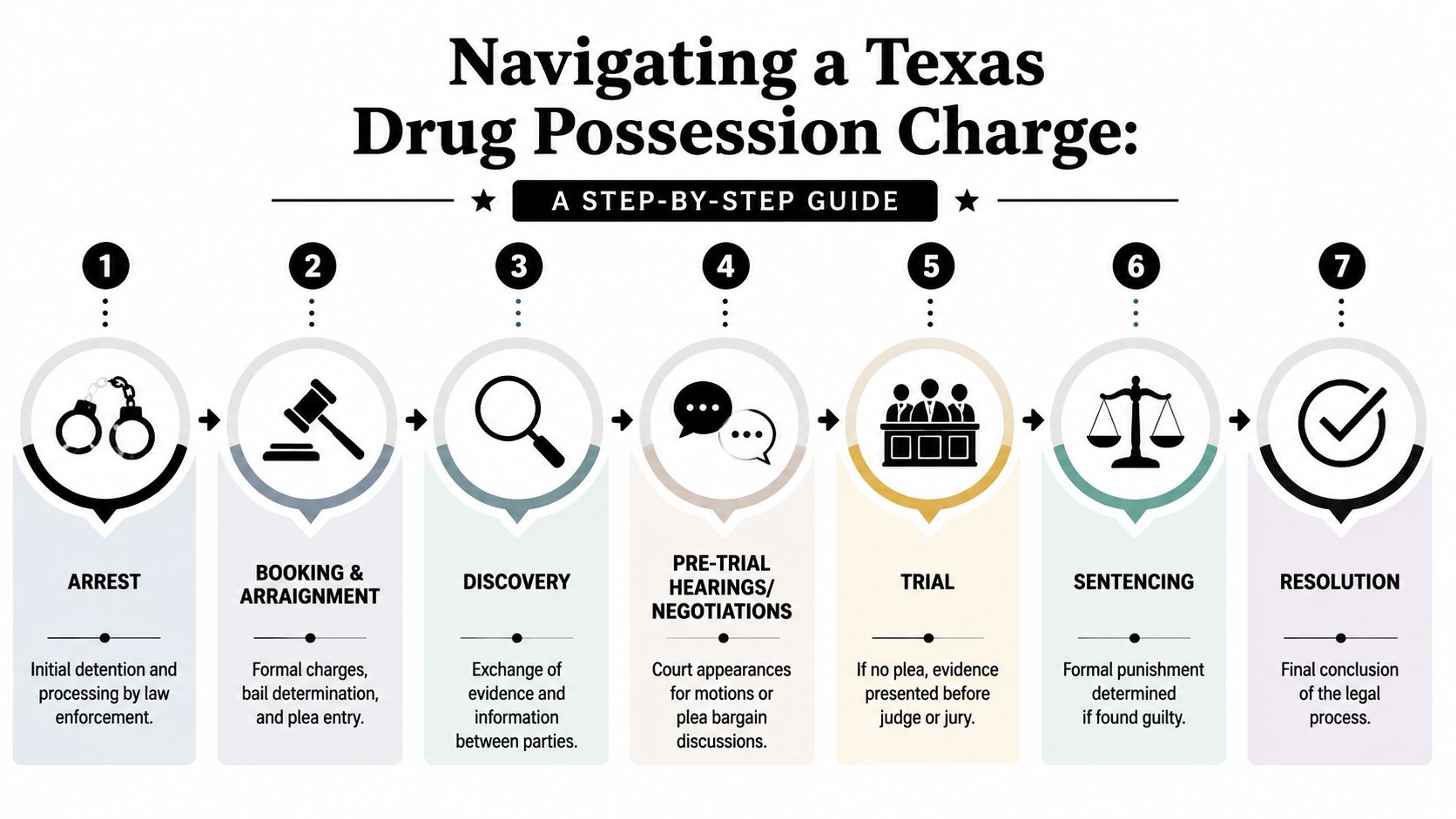
Each stage creates risk, but each stage also creates an advantage for the defense. Good case work starts early and stays focused all the way through resolution and, if needed, what comes after.
Step 1 through Step 3
Arrest and booking
Officers take you to jail, log your property, and enter the charge. The practical rule is simple. Do not try to talk your way out of the case after the arrest. Statements made in a frightened moment often become evidence the prosecution uses later.Magistrate warning and bond
A magistrate advises you of the accusation, your rights, and the bond amount or conditions. Release can come with drug testing, travel restrictions, reporting requirements, or orders that affect where you can go and who you can see. Those conditions matter. A bond violation can make the case harder to resolve.Arraignment or first court setting
The court addresses the charge and a plea is entered. In many cases, a not guilty plea is the right first move because it keeps every defense on the table while your lawyer reviews the evidence, the stop, the search, and the lab work.
Step 4 through Step 5
Discovery and case review
During this stage, a defense lawyer starts testing the case instead of accepting the police report at face value. That means reviewing body camera footage, dash cam video, offense reports, search warrant paperwork, lab submissions, chain-of-custody records, and witness statements. Sometimes the weakness is obvious. Sometimes it is buried in a missing signature, a vague timeline, or a video that does not match the officer's account.Pretrial hearings and motions
Many of the most important fights happen here. A motion to suppress can challenge an illegal stop, an unlawful detention, a search that exceeded consent, or a warrant problem. Other motions may target lab issues, statements, or undisclosed evidence.
This phase often decides whether the State keeps strong evidence, loses it, or has to reassess the whole case.
If substance use is part of the larger picture, treatment can affect strategy, bond terms, negotiations, and sentencing options. Families also ask whether treatment can be required over someone's objection. For background on that issue outside Texas, understanding California rehab laws explains forced-treatment questions and legal limits. It is not Texas criminal law, but it helps families separate treatment choices from criminal court pressure.
Step 6 through final resolution
Plea negotiations
Some cases should be tried. Some should be negotiated. The right answer depends on the evidence, your record, your immigration status if applicable, professional licensing concerns, and what outcome protects your future. A negotiated result might involve a reduction, deferred adjudication, drug court, treatment conditions, or a sentence structured to limit long-term damage. The wrong plea can create problems long after the case leaves the courtroom.Trial, sentencing, or dismissal
If negotiations do not produce an acceptable result, the case proceeds to trial before a judge or jury. If the defense wins a suppression issue or the State cannot prove possession, the case may be reduced or dismissed before that point. If there is a plea or conviction, sentencing follows, and the court looks at the charge level, the facts, your history, and your compliance while the case was pending.
A possession arrest can also trigger parallel problems that need to be handled together. A traffic stop may produce both a drug case and a DWI allegation. A chaotic arrest can lead to accusations involving assault, resisting, or theft. Strategy has to account for the full picture because fixing one case while ignoring the others can backfire.
The Law Office of Bryan Fagan, PLLC handles criminal defense matters that often overlap this way, including drug possession, DWI, assault, theft, and post-conviction relief.
Common Defenses for a Texas Drug Possession Charge
A charge is not a conviction. In many possession of controlled substance Texas cases, the defense starts by questioning the assumptions in the police report.
Search and seizure challenges
If police stopped you illegally, searched without valid consent, exceeded the scope of a warrant, or prolonged a traffic stop without lawful cause, the evidence may be suppressed. That can change the entire case.
This defense often turns on details. What did the officer claim to smell or see? When did the search start? Was consent clear, or was it pressured and vague? Body camera footage can matter more than the report.
Possession and knowledge defenses
Constructive possession cases are often very defendable because the State must connect you to the drugs, not just to the room or vehicle. Shared houses, shared cars, and borrowed belongings create doubt when several people had access.
Good defense work often focuses on questions like these:
Who else had access
If several people used the same space, the State may struggle to prove the drugs were yours.What did you actually know
A person can't knowingly possess something they didn't know existed.Where exactly was it found
A locked area, hidden compartment, or item mixed with someone else's belongings may weaken the State's theory.
Lab issues and chain of custody
The prosecution must prove the substance was what police say it was and that the item tested is the same one taken in the arrest. Lab paperwork, storage logs, and handling gaps can all become part of the defense.
Here is a short video overview that helps explain why challenging the State's proof matters:
Fighting enhancements and pursuing alternatives
One issue people miss is the Drug-Free Zone enhancement. The Texas drug-free zone explanation from Doug Murphy Law states that a misdemeanor possession charge can automatically be upgraded to a state jail felony if it occurs within 1,000 feet of a school or playground, adding a mandatory minimum of five years and doubling fines. Defense lawyers must examine whether the location was measured correctly and whether the statute applies to the facts.
Beyond straight defenses, some people may qualify for diversion-style outcomes, deferred adjudication, or negotiated terms focused on treatment and rehabilitation. These options depend on the county, the charge, your record, and the facts. They are not automatic, but they can be powerful when used carefully.
Clearing Your Record After a Drug Case
A drug case doesn't only affect the courtroom. It can follow you into job applications, housing searches, school admissions, and professional licensing. That is why post-case relief matters.
Expunction and nondisclosure
An expunction removes qualifying records from public view and is the strongest form of record clearing. It is often available when a case was dismissed, you were acquitted, or you qualified under another narrow rule.
An order of nondisclosure is different. It seals qualifying records from the general public, but it doesn't erase the case entirely. Some government agencies may still see it.
Clearing a record is not just paperwork. It can change how employers, landlords, and licensing boards see your future.
When post-conviction relief may help
Eligibility depends on how the case ended. Deferred adjudication can sometimes create later sealing opportunities. A conviction may limit your options, but it doesn't always end them. In some situations, timing requirements and filing rules are just as important as the underlying case result.
If you're trying to move forward after an arrest or completed case, this guide on how to get a record expunged in Texas is a practical place to start.
People also ask whether one criminal case affects another area of life. It can. A pending drug case may overlap with family law, protective orders, custody concerns, or professional consequences. The best long-term strategy looks beyond the next court date and asks what outcome protects your life six months and six years from now.
If you've been charged with a crime in Texas, call Law Office of Bryan Fagan PLLC for a free and confidential consultation. Our defense team is ready to protect your rights.