Being arrested in Texas can be terrifying—but you don’t have to face it alone. The state's law on gun ownership for felons is notoriously confusing. On one hand, Texas creates a very narrow exception: a person with a felony conviction can possess a firearm inside their private residence only after five full years have passed since their release from prison or parole. But here’s the problem: that Texas-specific rule is dangerously misleading because federal law imposes a strict, lifetime ban. No exceptions.
Facing a Gun Charge in Texas After a Felony Conviction
An arrest for any crime is a terrifying experience. But when you have a prior felony conviction, a new charge for possessing a firearm can feel like the world is collapsing. The clash between Texas and federal law creates a legal minefield where even well-intentioned people can find themselves facing years behind bars. It's critical to remember that an arrest is not a conviction. You have rights, and the first step toward building a powerful defense is understanding them.
At The Law Office of Bryan Fagan, PLLC, we understand the anxiety and confusion you're feeling right now. Our job is to bring immediate clarity to your situation, explain your legal rights and options in plain English, and help you see the path forward. We’re here to help you understand the charges, protect your constitutional rights, and fight for the best possible outcome.

A Charge Is Not a Conviction
The single most important thing to grasp right now is that a charge of unlawful possession of a firearm by a felon is just an accusation, not a final judgment. The prosecutor carries the heavy burden of proving every single element of their case beyond a reasonable doubt. This is where a strategic, aggressive defense can completely change the game.
Your case isn't just about whether a gun was found nearby. It comes down to the specific details:
- Did you knowingly possess the firearm?
- Was the search that uncovered the gun even legal?
- Can the state actually prove you had control over the weapon?
An experienced criminal defense attorney will meticulously pick apart every piece of evidence, looking for weak spots in the prosecution's case.
Navigating State vs. Federal Law
The conflict between Texas and federal gun laws is a trap that snares far too many people. Countless Texans with old felony convictions honestly believe they are acting within their rights to own a gun for home protection once the five-year waiting period is over. They have no idea they are committing a federal crime that carries incredibly severe penalties.
This legal gray area is precisely why you need a knowledgeable guide in your corner. The process after an arrest can be intimidating, but you don’t have to go through it alone. To get a better sense of the initial steps, you can learn more about what happens when you get arrested in our detailed guide. An attorney can help you navigate both state and federal jurisdictions, ensuring your rights are defended at every single turn. A strong legal strategy is your best and only defense against these complex and potentially life-altering charges.
Understanding the Unlawful Possession of a Firearm Law
If you’re facing a charge for possession of a firearm by a felon in Texas, it’s easy to feel like the deck is stacked against you. But to fight back effectively, you first have to understand the law the state is using: Texas Penal Code § 46.04, "Unlawful Possession of a Firearm." For a prosecutor to get a conviction, they have to prove two things beyond a reasonable doubt.
First, they have to show you have a prior felony conviction. This is usually the easy part for them, as court records are simple to pull. The real fight almost always comes down to the second element: proving you knowingly possessed a firearm. This is where a sharp defense can make all the difference.
What Does "Possession" Mean in Texas?
The word "possession" sounds simple, but in the eyes of the law, it’s a lot more complicated than just holding a gun. Texas law splits possession into two categories: actual and constructive.
- Actual Possession: This is exactly what it sounds like. The firearm was on your person—in your hand, tucked into your waistband, or in a pocket. It’s direct, physical control.
- Constructive Possession: This is the more common and trickier type of possession prosecutors try to prove. It means you knew a firearm was present and had the ability to take control of it, even if you weren't touching it.
Think of it like this: if a handgun is sitting in the center console of a car you're driving, a prosecutor will argue you had constructive possession. Why? Because you knew it was there and could easily reach for it. Their entire case often boils down to forging these "links" between you and the weapon. An experienced attorney’s job is to break those links and show you either didn't know about the gun or had no control over it.
A prosecutor's case often hinges on proving you knew about the gun and could access it. A skilled defense attorney works to create reasonable doubt around these "links" connecting you to the weapon.
The Five-Year Rule Explained
Here’s where things get really confusing for a lot of people. There's a common and dangerous myth that your firearm rights are automatically restored in Texas five years after you get out of prison. That is not true, and believing it can land you right back in trouble.
Here’s how Texas Penal Code § 46.04 actually works. It says a felon commits an offense if they possess a firearm:
- Before the fifth anniversary of their release from prison or from supervision (parole, probation), whichever date is later.
- After that five-year period, but at any location other than the home where they live.
Let's unpack that. The five-year clock doesn't start ticking the day you walk out of the prison gates. It only begins after you are completely done with your sentence. That includes every last day of parole or probation. If you get out of prison with three years of parole ahead of you, your five-year waiting period doesn't even start for another three years.
So, in reality, you could be looking at eight years or more after your prison release before this Texas exception even kicks in. And even then, state law says you can only possess the firearm inside your own home—a rule that gets completely wiped out by much stricter federal laws, which offer no such exception.
The Critical Conflict Between Texas and Federal Gun Laws
This is easily one of the most dangerous legal traps in the Texas criminal justice system. A massive difference between state and federal law on firearm possession by a felon has ensnared countless well-intentioned Texans. They believe they're following the rules, only to find themselves facing devastating federal charges they never saw coming.
It's a classic case of one law offering a small exception while a much more powerful law slams the door shut. Understanding this conflict isn't just important—it's essential for protecting your freedom. A simple misunderstanding here can lead to a new felony conviction and years in a federal prison.
The Texas Exception That Isn't Really an Exception
As we've covered, Texas law carves out a very narrow window for someone with a felony conviction to possess a firearm. Under Texas Penal Code § 46.04, you can legally have a gun, but only if you meet two strict conditions:
- At least five full years have passed since you were released from confinement and/or discharged from parole or probation—whichever date is later.
- The firearm possession is exclusively inside the private residence where you live.
On the surface, this sounds straightforward. It feels like Texas is offering a second chance to protect your home and family once you've paid your debt to society. Unfortunately, this state-level rule is dangerously misleading because it completely ignores the federal government.
The infographic below shows the very limited path Texas law seems to offer.
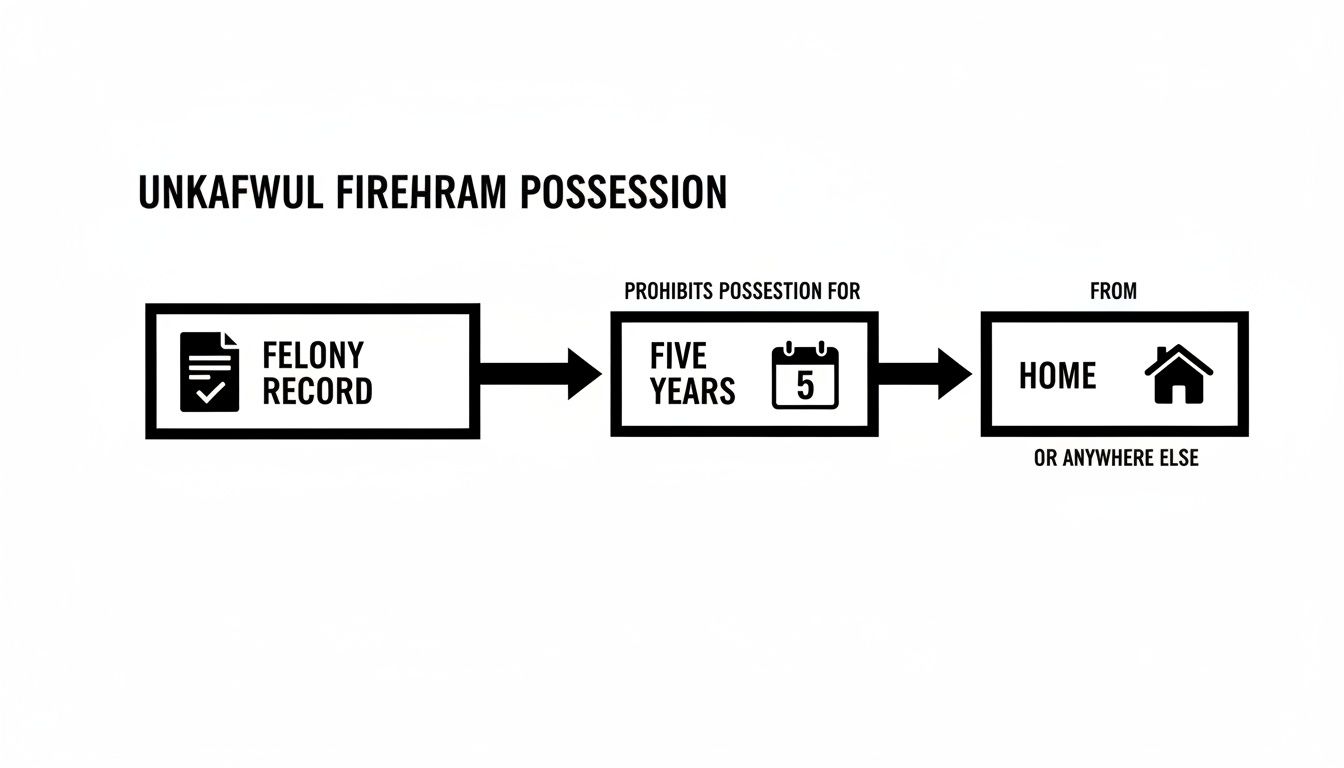
This visual breaks down the Texas-only rule, showing how a felony record triggers a five-year waiting period, after which you can supposedly have a firearm at home. But this is only half the story.
The Federal Law That Overrides Everything
Now for the harsh reality. Federal law, specifically 18 U.S.C. § 922(g), makes it illegal for anyone convicted of a crime punishable by more than one year in prison (which covers all felonies) to possess a firearm or ammunition. Period.
There is no five-year waiting period. There is no exception for having a gun in your own home for self-defense. The federal ban is absolute and it lasts for a lifetime.
Think of it this way: Texas law cracks open a small window, but federal law has permanently bolted the front door. Trying to climb through that window is still breaking the law in a big way.
This is where the legal doctrine of supremacy kicks in. When a state law directly conflicts with a federal law, the federal law wins. Every single time. This means that even if you follow the Texas rule perfectly, you are still committing a serious federal crime the moment you pick up a firearm.
Many people are arrested for possession of a firearm by a felon in Texas believing they are compliant, only to be shocked when they're indicted federally. The penalties are severe. A state charge is a third-degree felony carrying 2 to 10 years in prison. But a federal conviction under § 922(g) can land you in federal prison for up to 10 years with fines up to a staggering $250,000. You can learn more about how these overlapping laws are applied by reviewing more about firearm possession laws in Texas.
Because of this direct conflict, you absolutely must have an attorney who is experienced in both state and federal court. A defense strategy that only looks at Texas law is dangerously incomplete and leaves you wide open to federal prosecution. An attorney who understands how these two systems intersect can build a defense that protects you on all fronts.
If you're charged with unlawful possession of a firearm by a felon in Texas, it's easy to get lost in the legal jargon. But make no mistake, the stakes are incredibly high. A conviction can slam the brakes on your life, which is why you need to understand exactly what you’re up against. This isn't a minor slap on the wrist; it's a serious felony charge with life-altering consequences.
In Texas, the default charge for unlawful possession of a firearm by a felon under Penal Code § 46.04 is a third-degree felony. That alone is a big deal, but it’s often just the starting point.
A conviction for a third-degree felony in Texas carries a punishment of 2 to 10 years in a state prison and a fine of up to $10,000.
This sentencing range shows just how seriously the state treats firearm violations, especially when someone already has a felony on their record. Even at the low end, a two-year prison sentence is a devastating event.
How Your Criminal History Can Make Things Much Worse
Here’s where a bad situation can quickly become a nightmare. Texas law has "enhancement" provisions, which are designed to hit repeat offenders with much harsher penalties. If you have other felony convictions, the prosecutor can—and likely will—use them to bump up your current charge.
- One Prior Felony: If you have just one other felony conviction on your record (not counting the one that makes your gun possession illegal), that third-degree felony can be enhanced to a second-degree felony. The punishment suddenly jumps to 2 to 20 years in prison.
- Two or More Prior Felonies: With two or more prior felony convictions, you can be labeled a "habitual offender." This skyrockets a third-degree felony all the way to a first-degree felony, with a staggering punishment range of 25 to 99 years, or life in prison.
Think about that. A charge that started with a 10-year maximum could now land you in prison for life, all because of your past. This is exactly why having a strategic defense isn't just a good idea—it’s absolutely essential.
Federal Penalties vs. Texas State Penalties
Just when you think it can’t get more complicated, the federal government enters the picture. Federal law has its own set of rules and punishments that are often even more severe than the state’s. It's not at all unusual for the feds to take over a gun case that started with a local arrest.
Weapons offenses are a top priority for law enforcement, and how these firearm possession laws impact Texas residents is clear from incarceration statistics. When federal prosecutors get involved, it almost always means the consequences just got steeper.
This table gives you a clear side-by-side look at the trouble you could be in.
State vs. Federal Penalties For Firearm Possession By A Felon
| Aspect | Texas State Law (Penal Code § 46.04) | U.S. Federal Law (18 U.S.C. § 922(g)) |
|---|---|---|
| Standard Penalty | Third-Degree Felony: 2-10 years in prison, up to a $10,000 fine. | Federal Felony: Up to 15 years in federal prison, up to a $250,000 fine. |
| Enhancements | Can be enhanced to a first-degree felony with 25 years to life for habitual offenders. | The Armed Career Criminal Act (ACCA) mandates a minimum of 15 years if you have 3 prior violent felony or serious drug offense convictions. |
| The Exception | Allows possession at home 5 years after your sentence is fully discharged. | No exceptions. Federal law imposes a lifetime ban on possessing any firearm or ammunition. |
This comparison drives home the massive risks involved. It also highlights the critical need for a lawyer who knows how to fight charges at both the state and federal levels. Your entire future could depend on it.
How a Lawyer Can Defend You Against a Firearm Charge
Getting arrested for unlawful possession of a firearm by a felon can feel like the end of the road. But here’s the reality: an arrest is just the beginning of the legal fight, not a guilty verdict. With the right legal defense, you have a real chance to challenge the charge and protect your future. A sharp criminal defense lawyer’s job is to pick apart the prosecution's case, detail by detail.
The state carries the burden of proof, and a good attorney makes them prove every single element. There are several powerful defense strategies that can be used in these cases, and an experienced lawyer knows exactly which ones fit the unique facts of your situation.

Challenging the Element of "Possession"
One of the most common and effective ways to fight this charge is to attack the very idea that you "possessed" the firearm. Remember, possession isn't just about physically holding a gun. If the weapon wasn't on your person, the state has to prove constructive possession—meaning they have to show you knew the gun was there and you had the ability to control it.
This is where a skilled attorney can create significant reasonable doubt.
- Practical Advice: Imagine police find a pistol in the center console of a car you borrowed from your cousin. An attorney can argue you had absolutely no idea the gun was there. If the car isn't registered to you and multiple people have access to it, it becomes incredibly difficult for a prosecutor to prove you knowingly possessed that weapon.
Arguing Lack of Knowledge
Closely related to challenging possession is the defense of "lack of knowledge." You can't be found guilty of "knowingly" possessing something if you were genuinely unaware of its presence. A strong defense often centers on showing you had no reason to know a firearm was in your vicinity.
For instance, if you were just a passenger in a friend’s truck and police find a firearm tucked under the driver's seat, your lawyer has a powerful argument that you had no knowledge or control over it. The prosecutor’s job is to link the gun specifically to you—not just the vehicle you happened to be in.
Filing a Motion to Suppress Evidence
This is a game-changer in many criminal cases. If the police found the firearm by violating your constitutional rights, the evidence can be thrown out completely. The Fourth Amendment protects every citizen from unreasonable searches and seizures.
A successful motion to suppress can gut the prosecution’s entire case. If the gun is excluded as evidence, the state often has no choice but to dismiss the charges completely.
Your lawyer will meticulously review the police reports, body cam footage, and every other piece of evidence to find procedural errors, such as:
- An illegal traffic stop: Did the officer even have a valid reason to pull you over in the first place?
- An unlawful search: Did you give valid consent to a search, or did the officer go beyond what was legally allowed?
- A faulty warrant: Was the search warrant based on shaky information or executed improperly?
If your rights were violated, a motion to suppress is filed. To get a deeper understanding of this critical legal tool, you can learn more about a motion to suppress evidence in Texas in our detailed article. Building the strongest possible defense often involves a combination of deep legal experience and sophisticated tools, including cutting-edge AI legal software for advanced research and case analysis. By putting every resource to work, your attorney can build an aggressive and comprehensive defense designed for your specific case.
Can You Ever Restore Your Firearm Rights in Texas?
For anyone with a felony conviction, the question of whether you can ever legally own a gun again is deeply personal. The desire to protect your family or simply enjoy hunting is a powerful motivator, but it's important to be brutally honest about the legal realities in Texas.
The path to restoring your firearm rights is incredibly narrow. For most people, that path is completely blocked. Understanding this from the start is the best way to avoid making a mistake that could land you in even more legal trouble.
The Governor's Pardon: The Only Real Path
In Texas, the only way to fully restore your civil rights—including the right to own a firearm—is to receive a full pardon from the Governor. This isn't a standard legal procedure; it's an extraordinary measure reserved for exceptional cases.
Think of it less as forgiveness and more as a formal declaration by the state that you've been completely rehabilitated.
A pardon is granted incredibly rarely. The process is long, requires a positive recommendation from the Texas Board of Pardons and Paroles, and ultimately depends entirely on the Governor's personal discretion.
What About Expunctions and Nondisclosures?
Many people ask if they can just get their record cleared to get their gun rights back. It's a logical question, but unfortunately, for most felony convictions, the answer is no.
- Expunctions: This legal process essentially destroys the records of an arrest and conviction. However, an expunction is generally only available if your case was dismissed, you were found not guilty, or you received that rare full pardon. It doesn't apply to a standard conviction.
- Orders of Nondisclosure: This process seals your criminal record from the general public, but law enforcement and state agencies can still see it. Critically, nondisclosure is not available for most felony convictions and it absolutely does not restore your firearm rights.
Even if you beat the microscopic odds and had your state rights restored through a pardon, you'd immediately run into another wall: federal law. The lifetime ban under federal statute 18 U.S.C. § 922(g) remains in effect regardless of what Texas does. This federal law slams the door shut on any crack Texas law might open.
Because the rules are so unforgiving and the penalties are so high, you can learn more about this difficult process in our guide to firearm rights restoration. Before you ever think about possessing a firearm, you must speak with an attorney to understand exactly where you stand.
Frequently Asked Questions About Texas Firearm Laws
If you’re facing a charge for possession of a firearm by a felon in Texas, your mind is probably racing with questions. It’s a confusing and stressful situation, especially when state and federal laws seem to contradict each other. We get it. Here are some straightforward answers to the questions we hear most often from people in your shoes.
What If the Gun Was in My Car But Not Mine?
This comes up all the time. The prosecutor isn’t going to just take your word for it—they'll almost certainly argue that you were in “constructive possession” of the gun. That’s a legal term that means you didn’t have to be physically holding the firearm. All they have to prove is that you knew it was there and had the ability to grab it.
But that’s an assumption, and assumptions can be challenged. A good defense attorney will start digging into the details to break that link. Who actually owns the car? Do other people drive it regularly? Where, exactly, did the police find the gun? By asking these tough questions, we can build a strong case that you had no knowledge—and no control—over that weapon.
I Only Have a Misdemeanor, Can I Own a Gun?
For most standard misdemeanors in Texas, the answer is generally yes, your gun rights are intact. But there’s a huge, often-missed exception that triggers a federal ban. If your misdemeanor conviction was for a crime of domestic violence, federal law steps in and imposes a lifetime ban on possessing a firearm.
This is a critical point many people don't realize. Even a Class A Misdemeanor for Assault Family Violence in Texas can strip you of your Second Amendment rights forever under the federal Lautenberg Amendment. This federal rule completely overrides state law, creating a serious legal trap for anyone unaware of this specific prohibition.
The most crucial takeaway is this: the conflict between Texas and federal law makes it illegal for virtually any person with a felony conviction to possess a firearm, at any time, in any place.
So When Can a Felon Legally Own a Gun in Texas?
This is the million-dollar question, and the answer is not what most people hope to hear. Texas law does carve out a very narrow exception. It says a person with a felony conviction can possess a firearm inside their own home but only after five years have passed since they were released from prison or parole.
Here’s the problem: that state law doesn’t matter. Federal law, specifically 18 U.S.C. § 922(g), slams the door shut with a lifetime ban for anyone with a felony conviction. There is no five-year waiting period. There is no exception for being in your own home. And because federal law trumps state law, that narrow Texas exception is a legal landmine. Following Texas law here will land you in federal trouble. For all practical purposes, it’s illegal for a felon to have a gun, period.
If you’ve been charged with a crime in Texas, call The Law Office of Bryan Fagan, PLLC for a free and confidential consultation. Our defense team is ready to protect your rights. https://texascriminallawyer.net