Skip to content
Being arrested for possession of weed in Texas can be terrifying — but you don’t have to face it alone. Even for what seems like a small amount, the consequences can feel overwhelming. Your first and most important step is to understand the legal journey ahead, and this guide is here to walk you through it, providing the clear, practical advice you need.
What Happens After a Marijuana Arrest in Texas

From the flashing lights to the cold reality of a jail cell, the moments during and after a marijuana arrest are filled with confusion and fear. The process can feel intimidating, but knowing what to expect can empower you to protect your rights and start building a strong defense from the very beginning.
It all starts with your interaction with law enforcement. Whether it’s a routine traffic stop or a knock on your door, your constitutional rights are your most powerful shield. The most important things you can do are remain silent and state clearly, "I want to speak with an attorney."
From Handcuffs to Booking: The First Steps
Once you're under arrest, you’ll be transported to a local police station or county jail for booking. This is an administrative process that officially records your arrest and gets you into the system. It’s not an interrogation, but you must remain vigilant.
During booking, here’s what you can expect:
- Personal Information: Police will ask for your name, address, and date of birth. You should provide this basic identifying information.
- Mugshot and Fingerprints: They will take your photograph and record your fingerprints.
- Property Collection: Your personal items—like your wallet, phone, and keys—will be cataloged and stored until you’re released.
It is absolutely crucial that you don’t answer any questions about the alleged crime during this process. Anything you say can and will be used against you, so continue to politely assert your right to have a lawyer present.
The Initial Appearance and Setting Bail
After booking, you will have an initial appearance before a magistrate or judge, which usually happens within 24 to 48 hours of your arrest. At this hearing, the judge will read the charges against you, inform you of your rights, and set your bail amount.
Bail is not a punishment. It’s a financial guarantee that you will show up for your future court dates. Getting out on bail should be your top priority, as it allows you to get back to your family and job while you work with your attorney to fight the charges.
When navigating the system after a Texas marijuana arrest, you also need to understand the details of bail. For instance, it's helpful to know the difference between criminal bail bonds and immigration bonds, as the process can change depending on your circumstances. A compassionate and experienced attorney can argue for a reasonable bail amount or even a personal recognizance (PR) bond, which allows your release without paying money upfront.
Think about how quickly things can escalate. A minor traffic stop in Houston can spiral into a Class B misdemeanor for possessing under two ounces of marijuana—a charge carrying up to 180 days in jail and a $2,000 fine. This happens all the time. In fact, simple possession makes up a vast majority of all marijuana-related arrests in Texas, clogging our justice system with minor cases that still carry major consequences.
Understanding Texas Marijuana Laws and Penalties
If you're facing a marijuana possession charge in Texas, the first thing you need to know is that a single factor drives the entire case: weight. The Texas legal system can be unforgiving, and the penalties climb steeply based on how much marijuana you are accused of having. The more it weighs, the higher the potential consequences.
It's also critical to understand that Texas law, specifically the Texas Penal Code, draws a sharp and often devastating line between marijuana plant material and THC concentrates. While possessing the flower, leaves, or stems is a serious offense, having THC concentrates—like those in vape pens, edibles, or waxes—is treated far more harshly.
Concentrates fall under Penalty Group 2 of the Texas Controlled Substances Act. This puts them in the same legal category as drugs like ecstasy. This means a single brownie or vape cartridge can land you with a felony charge, while the same amount of plant material might only be a misdemeanor. It’s a brutal distinction that catches many everyday Texans by surprise.
How Marijuana Weight Determines Your Charge
In Texas, the penalties for marijuana possession are spelled out in the Texas Health and Safety Code, and they scale dramatically with weight. Even a trace amount can result in jail time and a criminal record that follows you for life if the case isn't handled correctly.
The table below breaks down exactly how the amount of marijuana translates into criminal charges and potential penalties in plain English.
Texas Marijuana Possession Penalties by Weight
| Amount of Marijuana | Offense Level | Potential Jail/Prison Time | Potential Fine |
|---|---|---|---|
| Less than 2 ounces | Class B Misdemeanor | Up to 180 days in county jail | Up to $2,000 |
| 2 to 4 ounces | Class A Misdemeanor | Up to 1 year in county jail | Up to $4,000 |
| 4 ounces to 5 pounds | State Jail Felony | 180 days to 2 years in state jail | Up to $10,000 |
| 5 to 50 pounds | Third-Degree Felony | 2 to 10 years in prison | Up to $10,000 |
| 50 to 2,000 pounds | Second-Degree Felony | 2 to 20 years in prison | Up to $10,000 |
| Over 2,000 pounds | First-Degree Felony | 5 to 99 years in prison | Up to $50,000 |
As you can see, the four-ounce mark is the breaking point where a misdemeanor becomes a life-changing felony. To learn more about this critical threshold, our guide on how much weed is a felony in Texas digs deeper into what separates a misdemeanor from a felony conviction.
The Hemp vs. Marijuana Gray Area
A major shift in Texas law has created a powerful defense against marijuana charges. With the legalization of hemp—defined as a cannabis plant with less than 0.3% Delta-9 THC—prosecutors now face a much tougher battle in court.
Before 2019, any cannabis plant was automatically presumed to be illegal marijuana. Now, the tables have turned. The burden of proof is on the State to prove—through slow and expensive lab testing—that a substance's THC concentration is above the legal hemp limit.
This testing requirement is a game-changer. An officer's sight or smell is no longer enough to secure a conviction. A skilled defense attorney can use this legal requirement to challenge the State's evidence, creating opportunities for delayed cases, reduced charges, or even complete dismissals.
Compounding Offenses Like Paraphernalia
On top of the possession charge itself, officers will often add a separate charge for possession of drug paraphernalia. Texas law defines this as anything used to grow, process, store, or consume a controlled substance.
Common examples include:
- Bongs or pipes
- Grinders
- Rolling papers
- Baggies
- Scales
A drug paraphernalia charge is usually a Class C Misdemeanor, punishable by a fine of up to $500. While it might seem minor, prosecutors use these add-on charges as leverage in plea bargaining. A good attorney will work to get these secondary charges dismissed as part of an overall defense strategy.
Protecting Your Rights During a Traffic Stop or Search
For most people, a charge for possession of weed in Texas doesn't start with a dramatic raid. It starts with flashing blue and red lights in the rearview mirror during a routine traffic stop. What you do in those next few tense minutes can make or break your case.
It’s human nature to want to be cooperative. Many people think that just going along with what an officer asks will make things easier. But when it comes to a search, being "helpful" can accidentally strip you of your most powerful legal protection: your Fourth Amendment right against unreasonable searches.
What Is Probable Cause?
Before an officer can legally search your car without a warrant or your permission, they need probable cause. This isn't just a hunch or a gut feeling. It has to be based on specific, observable facts that would make a reasonable person believe a crime is happening. In Texas, the most common justification police use for a vehicle search is the smell of marijuana.
Even if an officer insists they have probable cause, you don't have to make their job any easier. Don't admit to anything, and most importantly, never agree to a search.
The most powerful phrase you can use is simple and direct: "Officer, I do not consent to any searches." Say it politely but firmly. You might have to repeat it. When you consent, you give up your constitutional rights, making it almost impossible for your lawyer to challenge the legality of the search later on.
If the police search your car anyway after you've clearly said no, don't physically resist. Just make sure it’s clear you are not agreeing to the search. This is critical because it preserves your attorney's ability to fight the evidence in court. If the police violated your rights, we can file a motion to suppress the evidence, which could get the entire case thrown out. You can learn more about what makes a police search unlawful by reading about an illegal search and seizure.
The whole point of these searches is to find evidence, and as the chart below shows, the penalties for weed possession in Texas climb fast depending on the amount found.
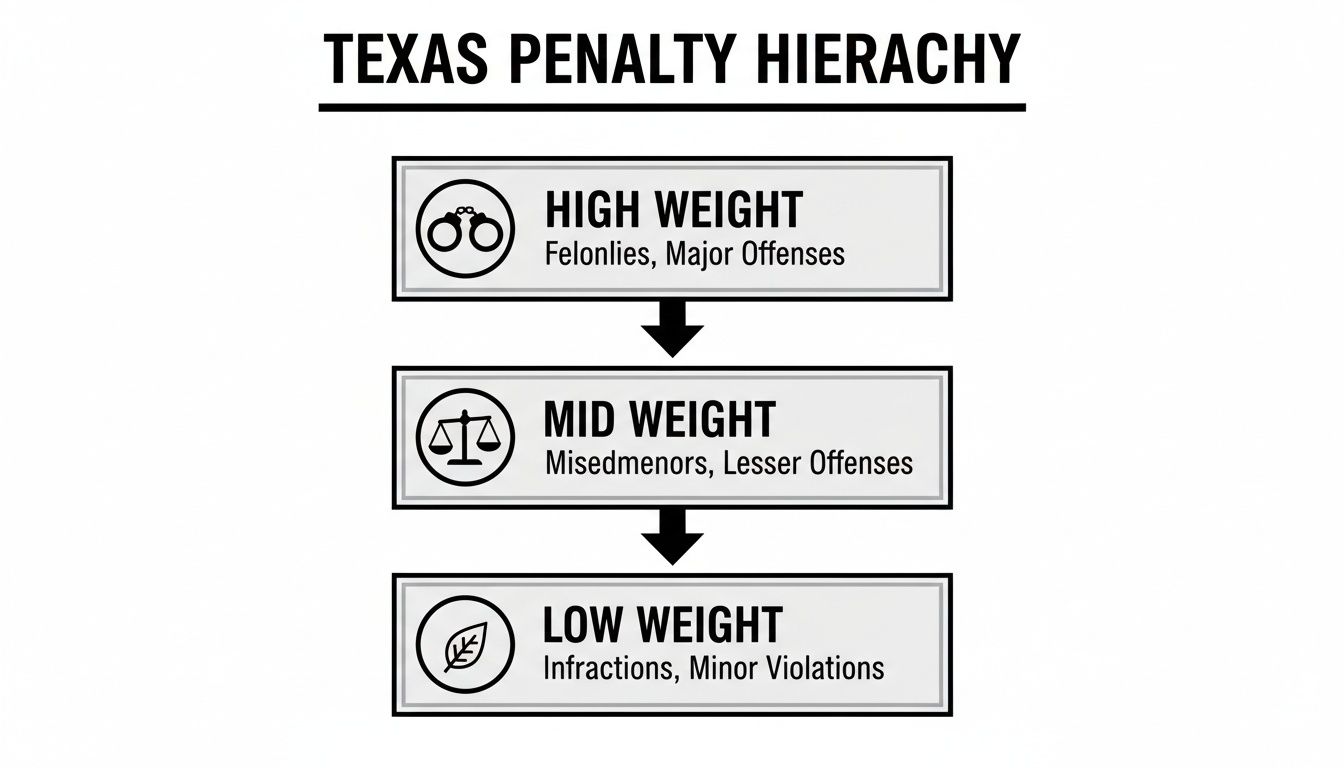
As you can see, the stakes get higher with every gram, escalating from a simple misdemeanor to a life-altering felony based entirely on weight.
Consensual vs. Warrant-Based Searches
It’s vital to know the difference between an officer asking for permission and an officer having the legal authority to search.
- Consensual Search: This is you giving the officer a verbal "yes" to search your property. You are never, ever required to do this.
- Warrant-Based Search: A judge has reviewed the evidence and signed a legal document authorizing police to conduct a search.
- Probable Cause Search: This is a warrantless search an officer performs on the spot because they see or smell something that gives them immediate, solid evidence of a crime (like seeing drugs sitting on the passenger seat).
By saying no to a search, you force the officer to act on their own authority. They either need to prove they had legitimate probable cause or go get a warrant. This creates an official record for your attorney to pick apart later. If their probable cause was weak or nonexistent, any marijuana they find can be ruled inadmissible.
Protecting your rights on the side of the road isn't about being difficult; it's the first and most important step in building a defense that can win.
Building a Strong Defense Against Possession Charges
Getting arrested for marijuana possession in Texas can feel like the end of the world. It’s easy to feel cornered and powerless, but an arrest is just the beginning of the legal process—it's not a conviction. A powerful defense is a strategy built from the ground up, based on the specific facts of your case.
Our first move is always to take a hard look at every single detail of your arrest. We're looking for the cracks in the prosecution's story, from the moment the officer first approached you to the way the evidence was handled. This is where we start fighting to protect your freedom and your future.
Challenging the Legality of the Stop and Search
Most possession cases don't start with a big raid. They start with something small, like a traffic stop. But here’s something most people don’t know: police can't just pull you over because they have a "hunch." They need a legitimate reason—what the law calls "reasonable suspicion"—like spotting a traffic violation. If that initial stop was illegal, any evidence they found after that, including marijuana, can be thrown out of court.
Even if the stop itself was legal, the search that followed might not have been. Police need a warrant or "probable cause" (like seeing drugs in plain sight on your dashboard) to search your car. Otherwise, they need your permission. As we've said before, you should never consent to a search. If law enforcement overstepped and violated your Fourth Amendment rights, we can file a Motion to Suppress. This single motion can get the entire case dismissed before it ever reaches a trial.
Actual Possession vs. Constructive Possession
To get a conviction, the prosecutor has to prove—beyond a reasonable doubt—that you actually "possessed" the marijuana. In Texas, "possession" is more complicated than it sounds. The law breaks it down into two types.
- Actual Possession: This is the obvious one. It means the marijuana was found directly on your person—tucked in your pocket, inside your backpack, or in your hand.
- Constructive Possession: This is where things get tricky for the prosecution. This applies when the substance wasn't on you, but in a place you had control over, like your car or your home. Crucially, they also have to prove you knew it was there.
Think about it like this: if an officer finds a joint in your jacket pocket, that's a clear case of actual possession. But what if that same joint is found under the passenger seat of a car you're driving with three friends? Now the state has a much bigger problem. They must prove that joint belonged to you and not one of the other people in the car. Were you just a passenger? Did someone else own the car? Attacking a constructive possession theory is often one of the most effective ways to create doubt and win a case.
A key element of a possession of weed in Texas charge is proving you knowingly and intentionally had control over the substance. If you were just in the wrong place at the wrong time, you should not be held criminally responsible.
Leveraging the Texas Hemp Law
The 2019 Texas Hemp Farming Act completely changed the game for marijuana defense. This law made hemp—which is just cannabis with less than 0.3% THC—legal. The problem for law enforcement? To the naked eye, a bag of legal hemp and a bag of illegal marijuana look and smell exactly the same.
This creates a massive roadblock for prosecutors. An officer's field test or sense of smell is no longer enough to prove a substance is illegal marijuana. The State must now send the evidence to a certified lab for a quantitative analysis to measure the exact THC percentage. These tests are expensive, and state crime labs are notoriously backlogged, sometimes for months or even years.
An aggressive Houston criminal lawyer uses this to your advantage. We can pressure the district attorney for a dismissal or a much better plea offer instead of having them wait for lab results that might not even prove their case. This legal gray area has become one of the most powerful tools we have to get charges dropped.
How a Conviction Impacts Your Future and How to Fix It

A conviction for possession of weed in Texas is more than a one-time penalty. It doesn’t just end with a fine or probation; it creates a criminal record that follows you for life, casting a long shadow over opportunities you never thought you’d have to worry about.
These are what lawyers call "collateral consequences," and they can be absolutely devastating. Many people are blindsided when they discover how a minor drug charge can slam doors shut. Suddenly, passing a background check for a new job, renting an apartment, or even volunteering at your kid’s school becomes a major hurdle.
For students and licensed professionals, the stakes are even higher. A conviction can threaten your eligibility for federal student loans, putting your entire education at risk. It can also be grounds for denying or revoking professional licenses needed for careers in nursing, teaching, real estate, and countless other fields.
Texas Laws Disproportionately Affect Young Adults
These consequences hit young people the hardest. Data shows that in Texas, marijuana laws disproportionately impact young adults, with nearly half of all possession arrests targeting individuals between the ages of 17 and 24.
This means college students and young professionals just starting their careers in cities like Austin, Houston, and Dallas are facing life-altering penalties for a single mistake. As detailed in reports on state marijuana arrests, this trend jeopardizes the futures of an entire generation, making a proactive defense—and clearing your record later—absolutely essential. You can read the full analysis of Texas marijuana arrests from NORML to see the full scope of the issue.
Wiping the Slate Clean with an Expunction
The good news? A mistake doesn't have to define you forever. Texas law provides a powerful legal tool for a truly fresh start: an expunction. This is a form of post-conviction relief that can permanently clear your record.
Think of an expunction as hitting the "delete" button on your arrest record. When a judge grants an expunction, every government agency involved—from the arresting police department to the court clerk—is ordered to physically destroy or erase all files related to your case. Legally, it’s as if the arrest never happened.
You are generally eligible for an expunction if:
- Your case was outright dismissed.
- You were found "not guilty" at trial (acquitted).
- You successfully completed a pretrial diversion program.
Once your record is expunged, you can legally deny that you were ever arrested or charged with that crime. It’s the closest thing to a complete do-over the law allows.
Sealing Your Record with an Order of Nondisclosure
What if an expunction isn’t an option? You may still be able to seal your record from public view with an Order of Nondisclosure. This remedy doesn't destroy your record, but it makes it confidential.
Think of a nondisclosure like putting your criminal record in a locked filing cabinet. Law enforcement and certain government agencies can still see it if needed, but potential employers, landlords, and the general public cannot.
You might qualify for an Order of Nondisclosure if you successfully completed a deferred adjudication program. This is a special type of probation where you plead "no contest," but the judge puts off a finding of guilt. If you complete the probation terms successfully, the case is dismissed, and you can then petition the court to seal the record.
Navigating the complex rules for expunctions and nondisclosures is tricky. The process requires filing a detailed petition and arguing your case at a court hearing. To learn more about the specifics, check out our guide on how to get a record expunged in Texas. An experienced attorney can determine your eligibility and manage the entire process, ensuring your petition is filed correctly to give you the best shot at protecting your future.
Local Marijuana Policies in Major Texas Cities
Think Texas has one set of rules for marijuana? Think again. While the Texas Penal Code is the law of the land, how it's enforced can feel like you’ve crossed into a different state just by driving over a county line. The legal reality changes dramatically from one courthouse to another.
What lands you in a jail cell in one part of Texas might only get you a ticket in another. This patchwork of local policies can make facing a marijuana charge confusing and incredibly stressful. For anyone arrested, understanding these local differences isn't just helpful—it's critical practical advice.
Cite and Release Policies
In more progressive cities like Austin (Travis County), law enforcement has adopted what’s known as a “cite and release” policy for low-level marijuana possession. Instead of arresting you on the spot, cuffing you, and taking you to jail for a small amount of weed, the officer might just write you a citation.
It feels a lot like getting a traffic ticket. You’re given a court date and sent on your way. But here's the kicker: this is not decriminalization. You are still being charged with a Class B misdemeanor and you absolutely must show up for your court date.
Diversion Programs and Prosecutorial Discretion
Other big cities are taking a different route. In Harris County (Houston), the District Attorney’s office has rolled out diversion programs aimed at first-time offenders. These programs offer a clear path to getting your charge dismissed entirely, usually after completing an educational class or some community service.
This move toward diversion isn't happening in a vacuum. It was heavily influenced by the 2019 hemp law, which complicated marijuana prosecutions. Since labs couldn't easily tell the difference between legal hemp and illegal marijuana, cities like Houston and Dallas leaned on these programs to clear low-level cases. Still, racial disparities in arrest rates continue to be a problem, showing that these policies haven't fixed the underlying systemic issues. Read more about how Texas cities are handling marijuana prosecution on texastribune.org.
The bottom line is that local knowledge is power. The final outcome of your case will hinge on the specific policies of the county, the attitudes of the local prosecutors, and even the judge you end up in front of.
This is exactly why you need an attorney who practices law right there in the county where you were arrested. A local lawyer understands the unwritten rules, knows the prosecutors, and has built relationships with the court staff. That inside knowledge is what they use to negotiate a much better result for you, protecting your record and your future.
Frequently Asked Questions About Marijuana Charges
When you’re facing a marijuana charge, the questions and "what-ifs" can feel overwhelming. We understand your anxiety. Below, we’ve cut through the legal jargon to give you direct, plain-English answers to the most common questions we hear from clients every day.
Can I get my charge dismissed if it’s my first offense?
Yes, a dismissal is definitely on the table for a first-time offense, but it’s never automatic. An experienced attorney can often use your clean record to negotiate your entry into a pretrial diversion program.
These programs are designed to give you a second chance. They usually require you to complete a few conditions, such as:
- An educational drug course
- A set number of community service hours
- Staying out of trouble for a specific period
Once you successfully complete the program, the court will dismiss the charge entirely. This is always our primary goal for first-time offenders because it keeps your record clean and protects your future.
What is the difference between decriminalization and legalization?
These two terms get thrown around a lot, but they mean very different things under Texas law. It's a critical distinction to understand.
Decriminalization means reducing the penalties for possessing a small amount of marijuana. The offense often becomes a civil infraction, like a traffic ticket, instead of a criminal charge. Legalization, on the other hand, means the state has created a system for the regulated sale and use of marijuana.
While some Texas cities have adopted "cite and release" policies that resemble decriminalization, possession of weed in Texas remains a criminal offense under state law. You can still be arrested.
The bottom line is this: no matter where you are in Texas, you are still at risk of getting a criminal record for marijuana possession. Local policies might help you avoid jail on the day of your stop, but they don't change the law.
What should I do if my child was arrested?
If your son or daughter has been arrested for marijuana possession, the most critical first step is to hire a criminal defense attorney immediately. Before you do anything else, tell your child not to answer any questions from the police until their lawyer is in the room with them.
The juvenile justice system works differently than the adult one. It is supposed to focus more on rehabilitation than punishment. A skilled lawyer who understands this system can work to keep the case in juvenile court and fight for outcomes that allow the record to be sealed, protecting your child's future educational and career opportunities.
If you’ve been charged with a crime in Texas, call The Law Office of Bryan Fagan, PLLC for a free and confidential consultation. Our defense team is ready to protect your rights. https://texascriminallawyer.net