Being accused of embezzlement in Texas can feel like your life split in two overnight. One day you're going to work, answering emails, and trying to keep your head above water. The next, you're hearing words like theft, felony, indictment, restitution, and prison.
Those facing embezzlement charges aren't hardened criminals. They're scared. They're worried about their job, their family, their professional license, and what will happen if the case reaches a courtroom. They also want one direct answer: Am I going to prison?
The honest answer is that prison sentences for embezzlement depend on where the case is filed, how much money is at issue, and how early your defense starts shaping the facts. In Texas, the law can look severe on paper. Real outcomes can look very different when the defense attacks value, intent, access, records, and witness credibility.
If you're also dealing with another charge, such as DWI, assault, theft, or drug possession, the same rule applies. Early legal strategy matters. A Texas DWI attorney, Houston criminal lawyer, or Texas assault defense lawyer isn't just there for trial. Important work often starts long before that.
An Embezzlement Charge Can Be Terrifying You Are Not Alone
A lot of embezzlement cases begin the same way. An employer runs an audit. A business partner notices missing funds. A bookkeeper gets blamed after a messy set of records. Then the phone rings, or an investigator asks you to "come explain a few things."
At that point, panic sets in fast.
You may be thinking about whether you'll be arrested at work, whether your bank records will be reviewed, and whether friends or coworkers already assume you're guilty. That's normal. An embezzlement accusation doesn't just threaten your liberty. It can also damage your reputation before a jury ever hears a word.
In plain English, embezzlement means taking money or property that was entrusted to you. The claim is not just that property went missing. The claim is that you had lawful access to it and then used that access in a dishonest way.
Practical rule: Don't try to "clear it up" alone with your employer, the police, or a federal agent. Statements made in a panic often become the backbone of the case.
Some clients are shocked to learn that a bad spreadsheet, sloppy accounting, informal reimbursements, shared passwords, or poor internal controls can create facts that look criminal even when the story is more complicated. Others know there was a mistake, but the amount being claimed is inflated or the timeline is wrong.
That difference matters. In white-collar cases, details control outcomes.
A theft allegation can be charged as a misdemeanor or a felony. A fraud investigation can stay in state court or move to federal court. A case that looks prison-bound at the start can sometimes be negotiated toward a far better result if the defense gets involved early and pushes back with records, context, and a disciplined strategy.
How Texas Law Defines and Punishes Embezzlement
A lot of clients walk into my office assuming "embezzlement" is its own charge with its own sentence. In Texas, that is usually not how it works. Prosecutors commonly file these cases under the general theft statute, Texas Penal Code § 31.03, and the punishment often starts with one question: how much money or property the State claims was taken.
For a broader look at related allegations, this overview of Texas Penal Code fraud offenses helps explain how these cases are grouped and charged.
Texas treats embezzlement as theft
In practice, embezzlement is usually theft involving entrusted property. The allegation is that someone had lawful access to money, inventory, accounts, cards, or business funds, then used that access in a dishonest way. That can involve an employee, bookkeeper, caregiver, treasurer, partner, or vendor.
That legal setup matters for a simple reason. The statute may say "theft," but the facts often involve accounting records, reimbursement disputes, payroll issues, shared access, and questions about consent. Those details can change both the charge and the outcome.
Texas theft penalty tiers for embezzlement
| Value of Stolen Property | Offense Level | Potential Prison/Jail Time | Potential Fine |
|---|---|---|---|
| Less than $100 | Class C misdemeanor | No jail time | Up to $500 |
| $100 to less than $750 | Class B misdemeanor | Up to 180 days in county jail | Up to $2,000 |
| $750 to less than $2,500 | Class A misdemeanor | Up to 1 year in county jail | Up to $4,000 |
| $2,500 to less than $30,000 | State Jail Felony | 180 days to 2 years in a state jail facility | Up to $10,000 |
Those are only the lower ranges. Higher alleged amounts can push a case into more serious felony levels with far steeper exposure.
The number listed by police, an employer, or an auditor is not always the number the State can actually prove in court.
Why the alleged amount matters so much
The claimed loss amount affects more than the label on the case. It can change whether the charge is a misdemeanor or felony, what bond conditions you face, how plea negotiations develop, and whether prison is a realistic risk or only a statutory possibility.
This is also where clients get misled. They read the maximum punishment and assume that is the likely result. In real Texas courts, the final outcome often turns on proof problems, disputed valuation, missing records, restitution efforts, criminal history, and how early the defense gets involved. The law gives the State a punishment range. It does not guarantee the worst end of that range.
Defense lawyers spend a great deal of time testing the amount. That means reviewing bank statements, accounting methods, reimbursements, offsets, permissions, timing, and whether the State is improperly grouping separate transactions into one larger total. I have seen cases change direction because the paper trail did not support the accusation as presented at the start.
For a plain-English explanation of offense levels, Felony vs. Misdemeanor Charges in Texas breaks down how Texas classifies crimes and the punishment range tied to each level.
When an Embezzlement Case Goes Federal
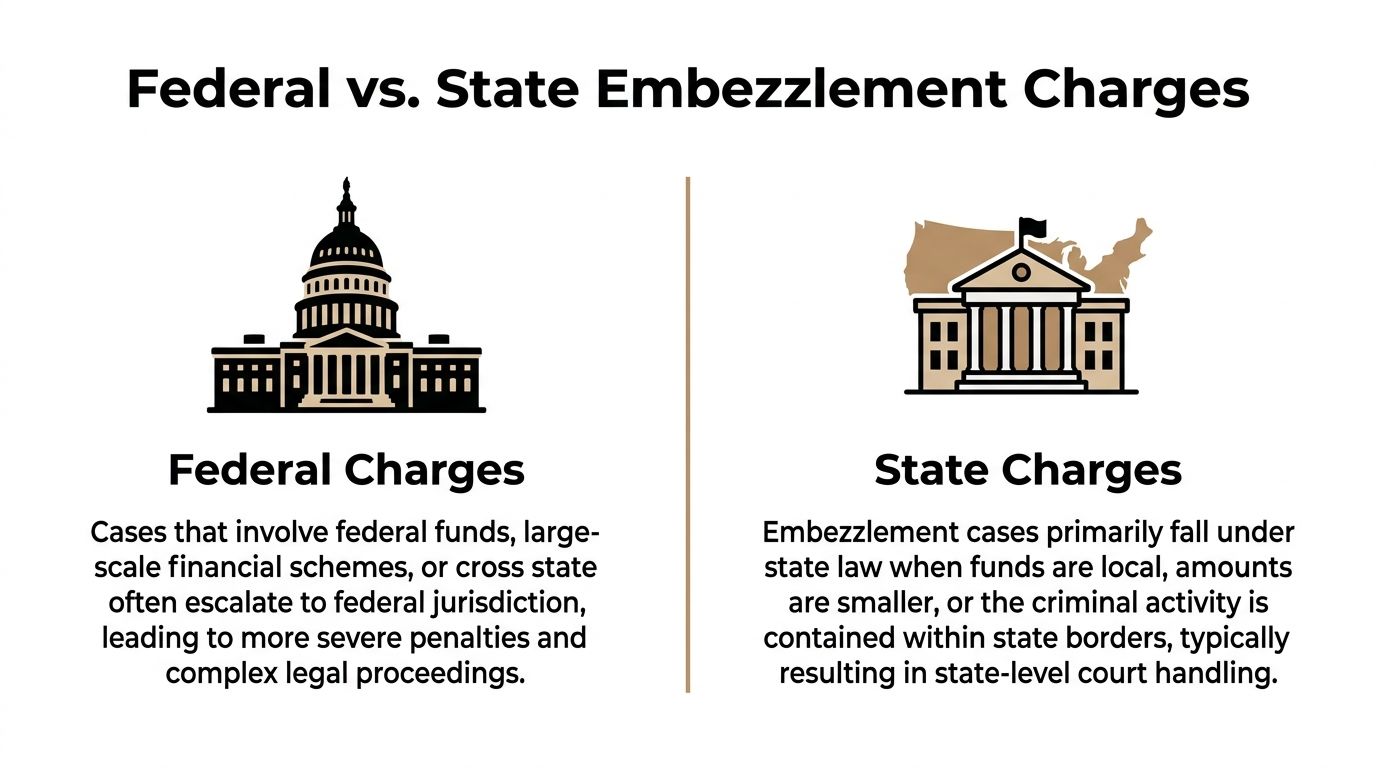
Some embezzlement cases stay in Texas state court. Others draw federal attention very quickly. That usually happens when the allegations involve government funds, a federally connected program, conduct across state lines, or records that suggest a larger financial scheme.
State court and federal court are not the same experience. Federal prosecutors often have more time, more paper, and more investigators behind the case. The sentencing process is also more structured.
State court versus federal court
A Texas theft case often focuses first on the local facts. Who handled the money. What authority they had. What amount the State can prove. Federal cases tend to layer those same questions into a guideline system that can increase punishment based on the amount involved and other case facts.
Under federal law, embezzlement of government property exceeding $1,000 is a felony punishable by up to 10 years in prison, and the federal sentencing guidelines tie the sentence to the amount involved. One verified source notes that stealing $50,000 typically results in a range of 21 to 27 months, while the average federal sentence for related fraud is about 1 to 2 years, as summarized by LawInfo's federal fraud sentencing overview.
Why federal cases feel harsher
Federal cases often create more pressure for three reasons:
- The guideline system is math-driven. Once the government fixes a loss number, that figure can shape the negotiation from the start.
- Investigations are usually document-heavy. Agents may build the case through financial records before an arrest ever happens.
- More factors can push the sentence upward. The verified data for federal cases also notes that the number of victims can increase the offense level.
If you learn that federal agents are involved, don't assume the case is unwinnable. But don't treat it like a routine local theft charge either. A federal white-collar defense needs a tight review of records, interview strategy, and a plan for loss calculation early.
In federal embezzlement cases, the government's number is often the battlefield. If that number drops, sentencing exposure can change with it.
Key Factors That Influence Sentencing Outcomes
Two people can face the same embezzlement charge and walk out with very different results. One gets a jail sentence. The other gets probation, restitution terms, and a chance to keep rebuilding a career. The statute sets the ceiling. The facts, the paperwork, and the defense strategy usually shape what happens in the courtroom.
That difference matters. Many clients read the punishment range online and assume the worst-case number is the likely outcome. In practice, Texas sentencing is usually more nuanced, especially in non-violent property cases where the defense can contest the loss amount, explain the context, and present strong mitigation.
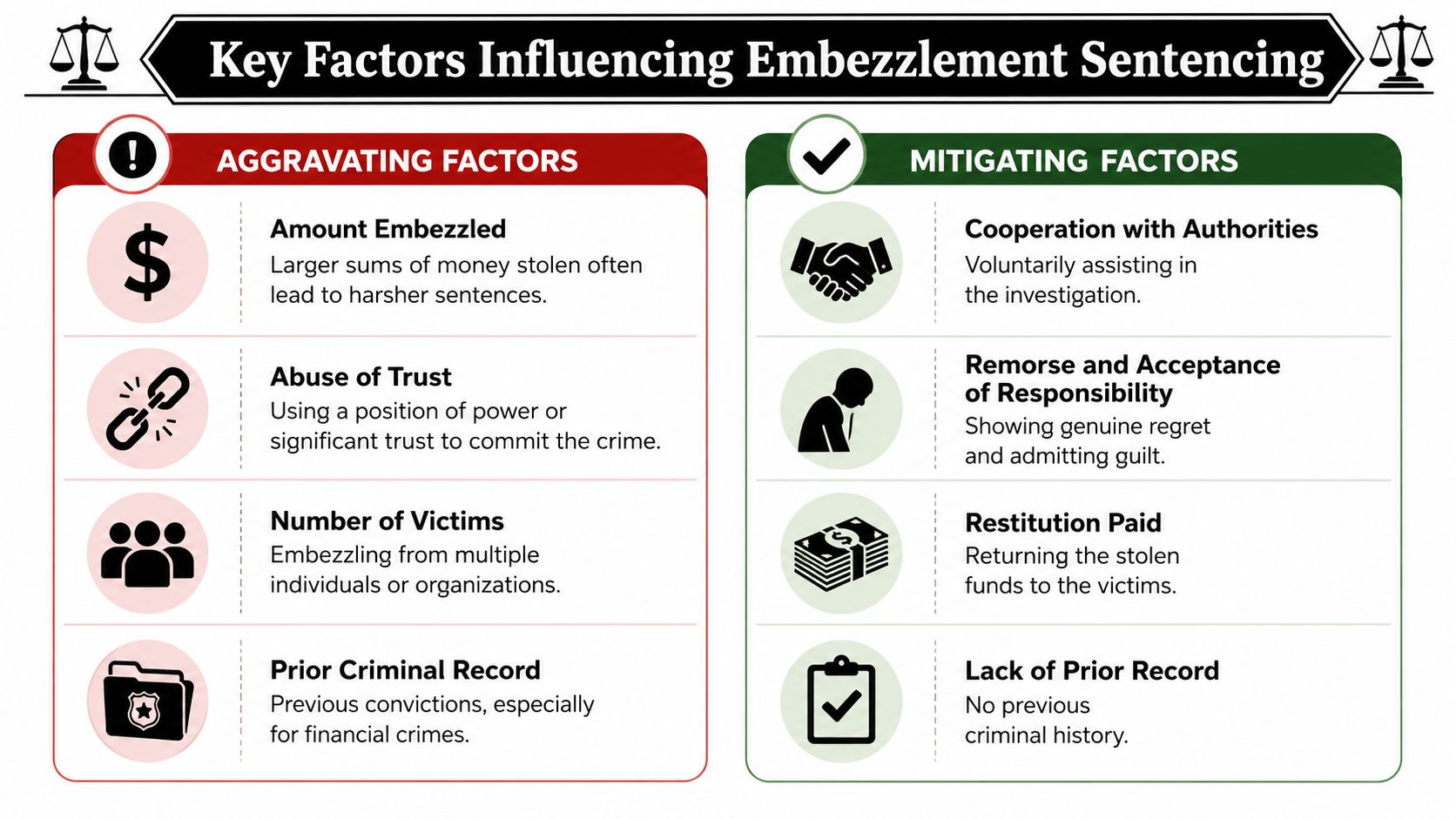
What tends to make a sentence worse
Prosecutors and judges often focus on a core set of facts:
- Higher alleged loss amounts: The bigger the claimed loss, the harder the sentencing conversation usually becomes.
- Abuse of a trusted position: Access to payroll, company accounts, or bookkeeping authority can make the case feel more serious to the court.
- Prior criminal history: Even an older record can shrink the room for leniency.
- Repeated conduct or multiple victims: A pattern over time usually draws a harsher response than one disputed incident.
- Poor conduct after accusation: Destroying records, contacting witnesses the wrong way, or violating bond conditions can damage a case fast.
What can improve the outcome
Several facts can move a case toward probation, deferred options when available, or a more favorable plea offer:
- No prior record: First-time defendants often have stronger arguments for a non-prison result.
- Restitution efforts: Repayment does not erase the allegation, but it can change how a prosecutor and judge evaluate remorse and risk.
- A smart plea strategy: Some cases are won at trial. Others are improved through early, disciplined negotiation after the defense identifies weaknesses in the State's proof.
- Strong mitigation evidence: Work history, caregiving duties, treatment, military service, and credible community support can all matter.
- A realistic explanation of the records: Sentencing often turns on whether the court sees theft, sloppy internal controls, or a mix of both.
I tell clients this often. Sentencing is not only about what the law allows. It is also about what the defense can prove, what the prosecutor can establish, and how credible your side looks once the records are examined closely.
In some cases, the employer's own systems become part of the story. Weak oversight, shared passwords, informal reimbursements, and poor bookkeeping do not excuse theft, but they can affect how clearly the State can prove intent, loss, and personal responsibility. Businesses dealing with these problems often face the same control failures discussed in these risk management strategies.
The charge level also matters because theft grading drives sentencing exposure in many embezzlement-style prosecutions. If you want a clearer picture of how value affects punishment ranges, this guide to felony theft charges and punishment levels in Texas gives useful background.
The practical point is simple. The number written in the statute is not the same as the number a person serves. A careful defense can sometimes reduce the loss figure, narrow the timeline, strengthen the case for restitution, and put probation on the table where it did not seem possible at the start.
How to Build a Strong Defense Against Embezzlement Charges
A charge isn't a conviction. In an embezzlement case, that isn't a slogan. It's a practical reality because these prosecutions often depend on inference, accounting choices, and witness interpretation.
The defense usually starts with the paper trail
A strong defense often attacks the case at its foundation:
- Challenge the amount: The employer's loss calculation may include mistakes, assumptions, or transactions you were allowed to make.
- Challenge intent: Bad bookkeeping is not the same thing as theft. A mistake, a messy reimbursement practice, or unclear approval process can matter.
- Challenge access and control: If several people used the same accounts, passwords, drawer, or software, the State may have trouble tying the conduct to you alone.
- Challenge the narrative of trust: The prosecution may claim you had exclusive authority when the system was informal and poorly managed.
A useful defense question is often simple: can the State prove this was theft, or can it only prove that the records are a mess?
Businesses can also learn from prevention failures. If you run a company or manage a team, these risk management strategies on internal controls show how weak oversight can create both financial loss and false assumptions about who is responsible.
What usually does not work
Some responses hurt more than they help.
Don't delete records. Don't contact witnesses to "get the story straight." Don't try to repay money discreetly and assume the case will disappear. And don't sit for an interview because you think honesty alone will fix it.
If your case involves broader allegations of fraud or financial misconduct, the defense may overlap with White Collar Crime Defense in Texas and Texas Felony Defense. Those pages give more detail on how felony-level investigations are defended in state court.
The practical goal is to narrow the claim, test the records, protect your statements, and decide early whether the best path is dismissal, negotiation, or trial.
What Happens Next A Step-by-Step Guide to the Legal Process
Once a case begins moving, fear usually comes from not knowing what happens next. A clear timeline helps.
Early in the process, this visual roadmap can help you see the sequence.
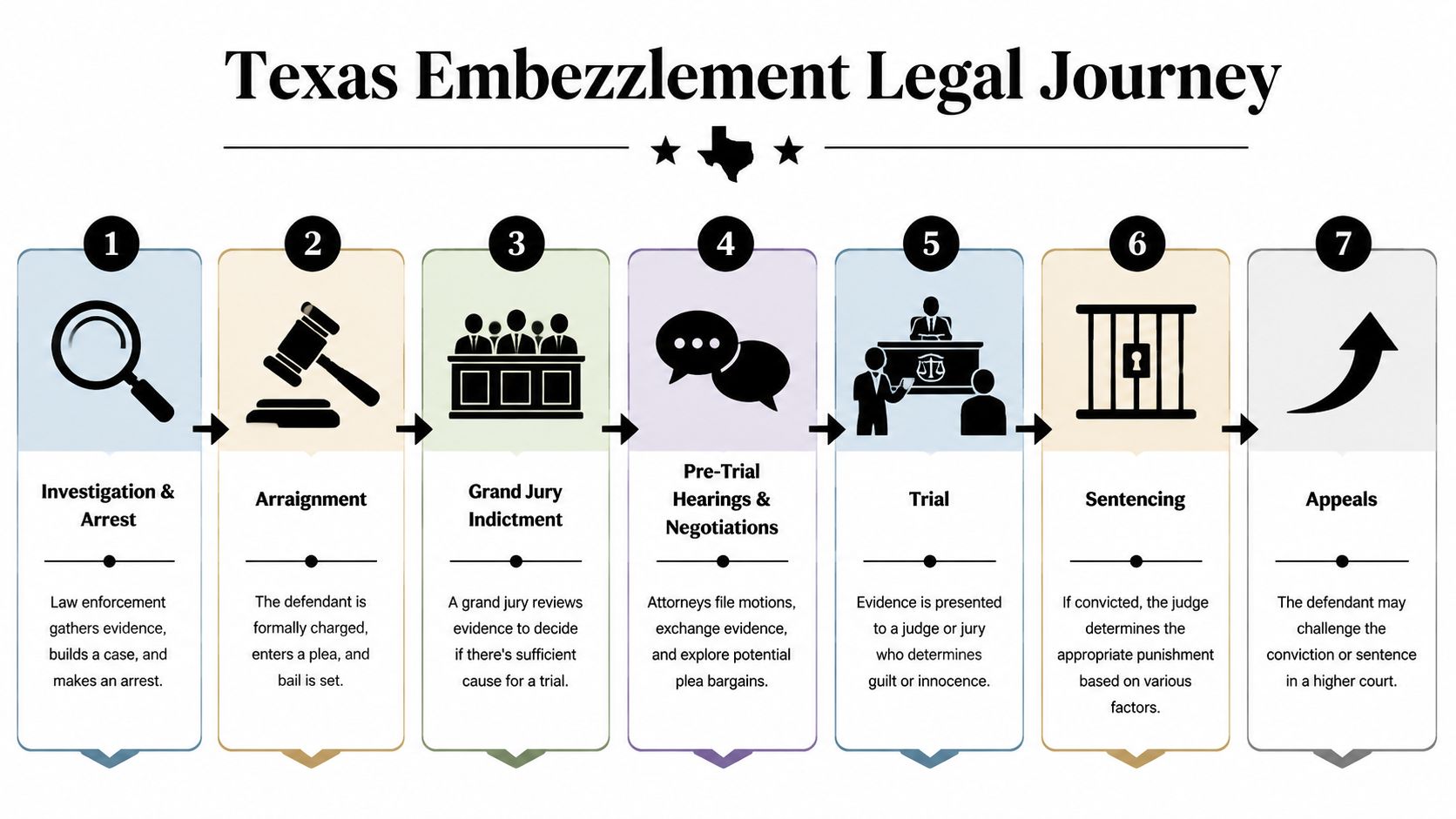
The first stages after arrest
A verified Texas practice summary explains that after an embezzlement arrest, you can face a bail hearing within 24 to 48 hours, then an arraignment to enter a plea, followed by plea bargaining, and if needed, trial and sentencing, and that the case can take many months to resolve, as described by Texas Criminal Lawyer's explanation of the process.
That timeline usually looks like this:
Investigation and arrest
Law enforcement gathers records, interviews witnesses, and decides whether to file or present charges.Bail hearing
The court addresses release conditions. What you say and what your lawyer presents here can affect the rest of the case.Arraignment
You are formally told the charge and enter a plea.
Here's a short video that walks through criminal case concerns many Texans have at this stage.
The middle of the case
A significant amount of essential defense work occurs.
- Discovery and document review: Your lawyer reviews reports, financial records, statements, and charging documents.
- Pretrial motions: The defense may challenge evidence, seek records, or attack the legal sufficiency of part of the case.
- Negotiations: Many cases are resolved here. A plea offer may improve if the defense exposes weaknesses in proof, valuation, or intent.
Trial sentencing and appeal issues
If the case doesn't resolve, it moves to trial. The State has to prove guilt beyond a reasonable doubt. In white-collar cases, juries often focus on whether the money trail really points to theft or whether the records leave too much doubt.
If there's a conviction or plea, sentencing follows. Then the case may still continue through post-conviction motions or appeal depending on the issues involved.
The legal process feels slow because it is slow. That delay can be frustrating, but it also gives the defense time to gather records, challenge assumptions, and improve your position.
Your Future After a Case Expunctions and Record Sealing
A criminal case doesn't always define the rest of your life. For many people, the next urgent question is what happens to their record after the case ends.
Texas offers tools that may help you move forward. For first-time embezzlement offenders, successful completion of probation can create an opening for post-conviction relief. Verified guidance on this issue explains that expunction can mean total record removal and nondisclosure can mean record sealing for certain offenses, which can help with rebuilding a career after the case concludes.
Two forms of relief that matter
- Expunction: This is the stronger remedy. It removes qualifying records.
- Nondisclosure: This seals qualifying records from most employers and the general public, though some agencies may still access them.
Not every case qualifies. Eligibility depends on how the case ended, the level of the offense, and your prior history. That's why it helps to think about record consequences at the start of the criminal case, not after everything is over.
If you want to learn more about clearing a record, this page on expunging a criminal record in Texas is a useful place to start.
A careful defense does more than focus on whether you avoid prison. It also looks at your license, your work, future background checks, and whether there is a path to a cleaner record later.
If you've been charged with a crime in Texas, call Law Office of Bryan Fagan PLLC for a free and confidential consultation. Our defense team is ready to protect your rights.