Being placed on probation in Texas—what the courts officially call community supervision—can be terrifying. It means you're serving your sentence out in the community instead of behind bars, and it feels like you’re walking on eggshells. The best way to think of it is a strict contract with the court. Follow all the rules, and you get to move on with your life. Break them, and you could be facing serious consequences, including jail time. But you don’t have to face it alone.
Your Guide to Texas Community Supervision

Getting arrested and sentenced to probation can feel overwhelming and confusing, but understanding how the system works is the first step toward taking back control of your life. Community supervision is a massive part of the Texas criminal justice system. In fact, the Texas Department of Criminal Justice's Fiscal Year 2024 Statistical Report shows a staggering 612,652 total cases under supervision. That's a huge number of Texans navigating these same rules every single day, just like you.
The purpose of community supervision is to let you keep your job, support your family, and stay connected to your community while still being held accountable. But let's be clear: this isn't just a slap on the wrist. It comes with a detailed list of conditions you have to follow perfectly.
Two Paths to Probation in Texas
When a judge sentences you to community supervision, it typically falls into one of two main categories. Knowing which one applies to you is absolutely critical, as it has a massive impact on your future and your criminal record.
- Regular Community Supervision: You might know this as "straight probation." With this type, you are formally convicted of the crime. The probation is your sentence, served as an alternative to jail. The downside? A conviction will appear on your permanent criminal record, which can affect job opportunities, housing, and more.
- Deferred Adjudication: This path gives you a chance to avoid a conviction entirely. Here, the judge "defers" or postpones a finding of guilt. If you successfully complete every single requirement of your probation, the case gets dismissed, and you are never actually convicted of the crime.
Deferred adjudication is a powerful tool for protecting your future, but it demands perfect compliance. A single violation while on deferred adjudication can expose you to the full range of punishment for the original charge—including the maximum possible prison sentence.
Community Supervision vs Deferred Adjudication at a Glance
This table breaks down the key differences between the two main types of probation to help you quickly understand your situation.
| Feature | Community Supervision (Regular Probation) | Deferred Adjudication |
|---|---|---|
| Finding of Guilt | Yes, you are found guilty and convicted. | No, the finding of guilt is postponed ("deferred"). |
| Criminal Record | Results in a permanent criminal conviction. | No conviction if completed successfully; case is dismissed. |
| Eligibility | Available for most offenses. | Not available for certain offenses, like DWI. |
| Consequences of Violation | Judge can impose the original jail/prison sentence. | Judge can impose the full range of punishment, up to the maximum. |
| Sealing the Record | Limited options; may require a pardon. | Eligible for an Order of Nondisclosure after a waiting period. |
Knowing where you stand is the first step. Each path has very different long-term consequences, so it’s essential to be clear on which one the court has ordered for you.
Probation vs. Parole: What's the Difference?
Many people use the terms "probation" and "parole" interchangeably, but in the eyes of the law, they are completely different. Understanding this distinction is important.
Probation is a sentence served instead of going to jail or prison. It's managed by the court system from the very beginning as part of your original sentencing for a crime like assault, theft, or drug possession.
Parole, on the other hand, is the supervised release of an inmate after they have already served part of their prison sentence. It’s a second chance to finish a sentence in the community.
You can learn more about these critical distinctions in our guide on the difference between parole and probation.
Getting these basics down is the foundation for successfully finishing your term. By knowing exactly what type of supervision you're on and the specific rules you must follow, you can build a clear roadmap for putting this chapter of your life behind you for good.
Understanding Your Probation Conditions
When a judge sentences you to community supervision, they are essentially handing you a rulebook. Think of it as a contract with the court. Following every single rule is your direct path to successfully finishing probation and putting this chapter behind you.
These rules, officially called conditions of probation, are laid out in the Texas Code of Criminal Procedure. They aren't random hoops to jump through; each one is designed to help with rehabilitation and keep the community safe. Your specific conditions will be spelled out in black and white on your court order, and your probation officer will go over them with you. There's zero room for guessing here—you need to know these rules inside and out.
The conditions you'll have to follow typically fall into two buckets: standard conditions that apply to nearly everyone, and special conditions added specifically for your case.
Standard Probation Conditions
Think of these as the baseline requirements for anyone on community supervision in Texas. While a judge can tweak things, Article 42A.301 of the Texas Code of Criminal Procedure sets the foundation. You can expect that most, if not all, of these will be on your list.
- Report to Your Probation Officer: You’ll have to meet with your community supervision officer (CSO) on a set schedule, whether that's weekly, monthly, or something else.
- Pay All Fees and Fines: This isn't just the fines from your case. It includes monthly supervision fees, court costs, and any money you owe to victims (restitution).
- Maintain Employment: The court expects you to find and keep a steady job.
- Stay Within a Specific Area: You can't just pack up and leave. Traveling outside your county or the state requires getting permission from your probation officer first.
- Avoid Criminal Activity: This one is huge. You absolutely cannot commit any new crimes. Getting arrested for something new is one of the quickest ways to get your probation revoked.
- Support Your Dependents: You have to keep up with your family obligations, like making child support payments.
- Submit to Testing: Be prepared for random drug and alcohol tests. They can happen at any time.
These are the non-negotiables of Texas probation. Slipping up on even one of them can count as a violation and put your freedom on the line.
Special Conditions Tailored to Your Case
On top of the standard rules, the judge will add special conditions based on the specific crime you were charged with. The goal here is to address whatever issues might have led to your arrest in the first place.
Special conditions aren't meant to be extra punishment. They are tools to help you get back on track. For example, a judge orders counseling to give you better coping skills or an ignition interlock to make sure you're driving sober. It’s all about tackling the root cause of the behavior.
Here are a few common examples of practical advice for people facing charges such as DWI, assault, theft, or drug possession:
- DWI Cases: If you were charged with a DWI, you can expect to be ordered to complete a DWI education class, install an ignition interlock device (IID) in your car, and attend a Victim Impact Panel.
- Drug Possession Cases: For a drug charge, a judge will almost certainly order substance abuse counseling, frequent drug testing, and sometimes even an inpatient or outpatient treatment program.
- Assault or Family Violence Cases: If your case involved assault, you might have to complete an anger management program or a Batterer's Intervention and Prevention Program (BIPP). A no-contact order, which legally bars you from communicating with the victim, is also extremely common.
- Theft or Fraud Cases: Conditions for these crimes often focus on making things right. This usually means paying back the victim (restitution) and taking an anti-theft or financial literacy class.
Your list of conditions is your personal roadmap for the next few months or years. The single most important thing you can do is understand every requirement and make a solid plan to meet each one. If you're ever fuzzy on a rule, don't wait—ask your probation officer or your attorney for clarification right away.
What Happens If You Violate Your Probation
The biggest fear for anyone on probation is slipping up and facing a violation. It’s a stressful thought, but understanding what actually happens next can take away some of that anxiety. A violation doesn't automatically mean you’re going back to jail; it means the prosecutor has started a process to ask the judge to take action.
Your first step is to understand that not all violations are created equal. The court will look at your situation very differently depending on the nature of the alleged mistake. Knowing where you stand is critical.
Technical Violations vs. New Law Violations
Probation violations in Texas fall into two main categories, and the difference between them is huge.
- Technical Violations: These happen when you break one of the specific rules of your probation that isn't a new crime. Think of things like missing a meeting with your probation officer, failing a drug test, not paying your fees on time, or traveling out of the county without permission. While still serious, the court may be more willing to work with you on these.
- New Law Violations: This is the most serious type of violation. It means you have been arrested and charged with a new criminal offense while on community supervision. Whether it's a minor misdemeanor or a serious felony, picking up a new charge signals to the court that you may not be a good candidate for staying in the community.
No matter the type, any alleged violation gives the prosecutor the right to file a formal document with the court called a Motion to Revoke Probation (MTR).
The Motion to Revoke Process
Once the MTR is filed, a warrant is typically issued for your arrest. You will be taken into custody and will have to wait for a hearing before the judge who originally sentenced you. This isn't a new criminal trial where the state has to prove your guilt "beyond a reasonable doubt."
In a probation violation hearing, the prosecutor's job is much easier. They only need to prove by a "preponderance of the evidence" that you likely violated at least one condition. This is a much lower legal standard, essentially meaning "more likely than not."
This lower burden of proof makes fighting a probation violation challenging, which is why having an experienced Houston criminal lawyer in your corner is so important. You have the right to legal counsel, the right to see the evidence against you, and the right to a formal hearing where your lawyer can present your side of the story.
This infographic breaks down the types of conditions that can lead to a violation.
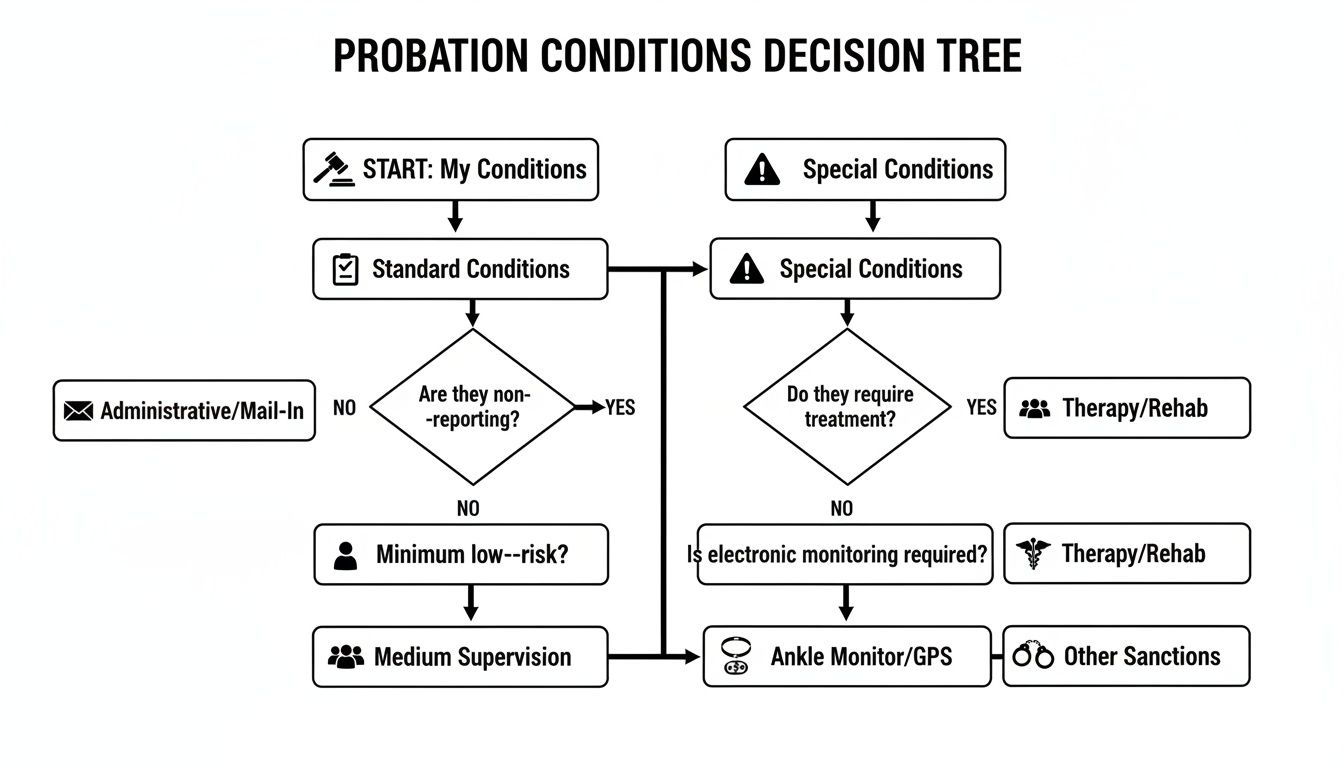
As the chart shows, both standard and special conditions are mandatory. A failure to comply with either can trigger the revocation process.
What Are the Potential Outcomes
The judge has several options at a revocation hearing. If they find you did violate your probation, they can:
- Reinstate and Continue Probation: The judge might decide to give you another chance, sometimes with the exact same rules.
- Modify Your Conditions: The judge could add stricter rules, like more frequent check-ins, an ankle monitor, or a short stay in jail (known as "shock" time) before letting you continue probation.
- Revoke Your Probation: This is the most severe outcome. If your probation is revoked, the judge can sentence you to serve time. For regular probation, they can impose the original sentence. For deferred adjudication, they can sentence you to anywhere within the full range of punishment for the original crime.
Texas probation rules are strict, and violations often lead to high revocation rates that send people back to jail or prison. According to a Texas Department of Criminal Justice report, in FY2024, there were 75,297 parolees actively supervised. Of those, a staggering 12,885 were in a pre-revocation status, which highlights just how many people are facing potential violations at any given time.
An alleged violation is a serious legal challenge, but it is not the end of the road. With a strong defense, it's often possible to negotiate an outcome that keeps you out of jail and on track to successfully complete your term. You can explore more about the potential consequences of a probation violation in our detailed guide.
Managing the Costs and Time of Probation
Probation is more than just a set of rules you have to follow—it's a massive commitment of both your time and your money. While community supervision is always a better outcome than jail time, it’s crucial to go in with your eyes open about the logistical and financial weight it carries. Getting a handle on these responsibilities from day one is the key to navigating your term without getting blindsided.
What surprises most people is the financial side of things. Probation isn't free. In fact, the court expects you to cover the costs of your own supervision and any programs it orders. These expenses can stack up fast, creating a ton of pressure if you haven't planned for them.
Breaking Down the Financial Obligations
The price tag for probation in Texas shifts depending on your specific case and county, but there are several standard fees that almost everyone on community supervision has to pay. Knowing what they are ahead of time lets you build a realistic budget.
Here’s a look at common probation costs:
- Monthly Supervision Fees: This is the big one—a recurring fee you pay directly to the community supervision department. It’s typically between $60 and $100 per month and covers the cost of your officer's time and administrative overhead.
- Court Costs and Fines: These are the original fines and administrative fees tied to the criminal case that got you here in the first place.
- Restitution: If your offense caused a financial loss to a victim, the judge will order you to pay that money back as a condition of your probation.
- Class and Program Fees: Any required classes—like DWI education, anger management, or substance abuse counseling—come out of your pocket.
- Testing Fees: You’re on the hook for the cost of every mandatory drug or alcohol test.
- Equipment Fees: If the court orders an ignition interlock device for your car or an ankle monitor, you’ll be paying the installation and monthly monitoring fees.
These costs can become a heavy burden, especially when you're also trying to hold down a job and take care of your family. If you start struggling to make payments, it is absolutely critical that you talk to your probation officer immediately. Just ignoring the problem is a surefire way to get a violation filed against you.
Simply being unable to pay is not the same as refusing to pay. A judge cannot revoke your probation solely because you don't have the money, but they can and will if you willfully ignore your financial obligations. Always be proactive and honest about financial hardship.
Managing Your Time and Responsibilities
Beyond the money, probation demands a huge chunk of your time. Juggling all these requirements with work, school, and family takes serious planning and organization.
Your time commitments will likely include:
- Regular Check-ins: Those scheduled meetings with your probation officer can easily take a few hours out of your workday, especially with travel and wait times.
- Community Service: Completing your required hours often means giving up weekends or evenings for months on end.
- Court Appearances: You might have to show up in front of the judge for periodic reviews of your progress.
- Classes and Counseling: These appointments are mandatory, not optional, and have to be worked into your regular schedule.
The best way to tackle this is to treat your probation requirements like a second job. Get a detailed calendar and plug in every single appointment, payment deadline, and community service shift. Staying organized not only helps you avoid slipping up, but it also shows your probation officer that you’re taking your responsibilities seriously. It’s a challenge, no doubt, but managing these duties is an essential part of proving you’re ready to finish your term and finally move on.
Your Path to Early Termination and a Clean Record

Finishing your probation is a massive achievement, but let's be honest—the real goal isn't just to survive it. It's to end it as fast as possible so you can actually move on with your life. The good news? Texas law gives you a way to do exactly that.
You don't have to be stuck just counting down the days for years on end. If you're committed and have a smart legal strategy, you can take back control of your future. The process starts with seeking an early termination of your probation and then, once that's done, working to clear your record. This isn't just about ending supervision; it’s about putting this entire chapter behind you for good.
Can You Get Off Probation Early in Texas?
Yes, absolutely. The legal tool for this is a Motion for Early Termination of Community Supervision. When your attorney files this motion, you’re officially asking the judge to review your case and cut your probation term short. But it's not automatic. You have to prove you’ve earned it.
To even be considered for early termination, you generally have to meet a few key requirements:
- Serve Part of Your Sentence: For most cases, you must have completed one-third of your probation term or two years, whichever is less.
- Complete All Conditions: This means you've finished all your classes, paid every fine, fee, and restitution dollar, and completed all your community service hours.
- Stay Out of Trouble: You can't have any new arrests or violations while you've been on supervision.
It’s critical to know that some offenses, like DWI or anything that requires sex offender registration, are flat-out ineligible for early termination.
A judge is never required to grant early termination. They have total discretion. Your motion has to do more than just check a few boxes—it needs to tell a compelling story about your rehabilitation and convince the judge you're no longer a risk to anyone.
Hiring an attorney to file this motion for you can make a huge difference. We know how to gather the right documents, build a persuasive argument, and stand up for you in court to show the judge why you deserve a second chance.
It's a fact that probation rules in Texas can lead to some of the longest supervision terms in the entire country. The national average was just under two years back in 2018, but Texas terms often drag on much longer, causing our probation population to triple since 1980. This matters because longer terms mean more people under supervision for longer periods. Research shows that in 14 states where probation terms got longer, it added almost 300,000 extra years of supervision, while states that shortened terms actually saw their probation numbers go down. You can check out more of these findings on probation terms from Pew Research.
Life After Probation: Sealing Your Record
Getting off probation is a huge step, but for many people, that criminal record still hangs over their head. It can make it tough to pass a background check for a good job, get approved for an apartment, or even get a professional license. This is where Texas law offers some powerful tools for post-conviction relief to help you get a truly fresh start.
Your options for cleaning up your record depend entirely on how your original case was resolved.
-
Expunction: Think of an expunction (or expungement) as the complete destruction of your criminal record. It's like the arrest never even happened. This is usually only an option if your case was dismissed without probation (like in a pretrial diversion program), you were found not guilty at trial, or you received a pardon.
-
Order of Nondisclosure: This is what most people mean when they talk about "sealing" a record. An Order of Nondisclosure doesn't erase your record, but it hides it from the public. This means private employers, landlords, and nosy neighbors can't see it on a background check. It's still visible to law enforcement and certain government agencies, but for most practical purposes, it’s gone.
If you successfully completed a deferred adjudication probation, you are very likely eligible for an Order of Nondisclosure after a certain waiting period. This is one of the biggest advantages of deferred adjudication—it gives you a clear path to sealing the record and protecting your future. You can learn more about how to clear your record in Texas and figure out which path makes the most sense for you.
Common Questions About Texas Probation Rules
When you're facing community supervision, a million questions can run through your head. The uncertainty is often one of the most stressful parts of the whole ordeal. Here, we've answered some of the most common questions we hear from clients about the day-to-day reality of navigating the probation rules in Texas.
Our goal is to give you clear, plain-English answers so you can feel more prepared and in control. Knowledge is your best tool for successfully finishing your term and finally moving forward.
Can I Drink Alcohol While on Probation?
This is one of the first questions almost everyone asks, and the answer is almost always a hard no. While the judge sets your specific probation conditions, the vast majority of community supervision orders in Texas include a clause that flat-out prohibits consuming alcohol. This is especially true for any alcohol-related offense like a DWI.
Even if your probation order doesn't explicitly forbid alcohol, drinking is still a huge risk. If you drink and find yourself in any situation that leads to police contact—even for something minor like public intoxication—it can trigger a probation violation. The safest and smartest approach is to just abstain from alcohol entirely for the duration of your probation. Don't give the prosecution a reason to file a motion to revoke.
Can I Travel Outside of Texas?
You can't just pack a bag and leave the state whenever you want. Your probation conditions will restrict your travel, typically to your home county and maybe the ones immediately surrounding it. To go anywhere outside this approved area, especially out of state, you must get written permission in advance from your probation officer.
To ask for permission, you’ll need to have your details ready:
- Your exact destination address
- The reason for your trip (e.g., work, family emergency)
- The specific dates you'll be gone and when you'll return
- Contact information for where you'll be staying
Never, ever travel without getting this permission first. Unauthorized travel is a technical violation that can land you in serious trouble and lead to a Motion to Revoke your probation. It's a simple rule, but breaking it has major consequences.
What Happens If I Can't Pay My Fines and Fees?
Falling behind on payments can be terrifying, but it’s critical to handle it the right way. The most important thing you can do is be proactive and talk to your probation officer immediately. A judge cannot revoke your probation solely for being unable to pay if you are truly facing a financial hardship.
However, they can and will revoke it if you willfully ignore the payments. When you talk to your officer, be ready to show proof of your financial situation, like recent pay stubs or a termination letter. They might be able to set up a different payment plan, or in some cases, your attorney can ask the judge to waive certain fees. Ignoring the problem is not an option—it will only make things worse.
Will My Employer Find Out I'm on Probation?
Generally, you are not required to tell a current or potential employer that you're on probation. The exceptions are for jobs that specifically require it, like those needing a security clearance or certain professional licenses.
That said, probation can impact your job in very practical ways. You'll need to take time off for meetings with your officer, court dates, and any mandatory classes or counseling.
If you are on deferred adjudication, successfully completing your term means you avoid a final conviction, which is a huge help on future background checks. If you were convicted and placed on regular probation, that conviction will show up on your public record.
How Often Will I Have to Report to My Probation Officer?
How often you have to check in depends entirely on your supervision level, which is set by the court and your probation department based on their assessment of your case.
- High-Risk: You might have to report in person every single week.
- Moderate-Risk: Reporting could be every two weeks or just once a month.
- Low-Risk: As you prove you're reliable, you might only need to check in every few months or even just by mail or phone.
Your reporting schedule isn't set in stone. If you follow all the rules and show you're taking your responsibilities seriously, your officer has the discretion to reduce how often you have to come in.
When seeking legal advice regarding your probation, it's essential to understand the basics of communication with your attorney. Conversations with your legal counsel are protected, and understanding your rights under the law is a key part of building a strong defense strategy. Learning about attorney-client privilege rules can help you feel more confident when discussing the sensitive details of your case.
Every person's journey through probation is unique, but these questions touch on the core challenges many people face. Staying informed and keeping the lines of communication open with your probation officer and your attorney are the two most powerful things you can do to get through your term successfully.
If you’ve been charged with a crime in Texas, call The Law Office of Bryan Fagan, PLLC for a free and confidential consultation. Our defense team is ready to protect your rights. Visit us at https://texascriminallawyer.net.