Being accused of a probation violation can be terrifying. One moment you are rebuilding your life in the community, and the next, you could be facing the possibility of going back to jail or prison. In Texas, the stakes are incredibly high, but you don't have to face this alone. Your first step is to understand exactly what you're up against and know that you have rights.
What is a Probation Violation in Texas?

When a judge sentences you to probation—which Texas law officially calls community supervision—they are giving you an opportunity to serve your sentence outside of a jail cell. This is a second chance, but it comes with a strict set of rules, known as "conditions," that you must follow precisely.
Think of your probation as a legal agreement between you and the court. As long as you fulfill your obligations, you can remain in the community. However, if the state believes you have broken any of the rules, they can file a motion to revoke your probation, putting your freedom on the line.
The Two Main Types of Violations
Probation violations in Texas are generally categorized into two types. It's crucial to understand which category your alleged violation falls into, as a judge will view them very differently.
- Technical Violations: These are the most common and occur when you break one of the specific rules of your supervision that is not a new crime.
- Substantive Violations: This is a much more serious violation. It means you have been arrested and charged with a new criminal offense while on probation.
A technical violation might seem minor, such as missing a meeting with your probation officer, failing a drug test, or not completing your community service hours on time. However, the court sees any failure to comply as a disregard for its orders.
A substantive violation is a completely different matter. For example, if you were on probation for a DWI and get arrested for assault, that new charge is a substantive violation. This tells the judge that community supervision may not be effective, which often leads to much more severe consequences.
Common Probation Conditions and How They Are Violated
To help you understand better, here are some standard probation conditions and examples of how they can be violated.
| Probation Condition | Example of a Violation |
|---|---|
| Report to a probation officer as directed | Missing a scheduled appointment or arriving late without a valid reason. |
| Pay fines, fees, and restitution | Failing to make payments on time or falling significantly behind on your payment plan. |
| Abstain from alcohol and illegal drugs | Failing a urinalysis (UA) or a breathalyzer test from your probation officer. |
| Commit no new criminal offenses | Getting arrested for any new crime, from a minor traffic offense to a serious felony. |
| Complete community service hours | Not finishing your required hours by the court-ordered deadline. |
| Stay within a specified geographic area | Traveling outside your county or the state of Texas without first getting permission from your PO. |
| Attend required counseling or classes | Skipping mandatory anger management, substance abuse, or DWI education classes. |
These are just a few examples. Your specific conditions are unique to your case, so it is vital to know them inside and out.
Facing an accusation of a probation violation can feel isolating and overwhelming. The most important thing to remember is that an allegation is not a conviction. You have the right to a hearing and the right to defend yourself against these claims.
Whether your alleged violation is technical or substantive, the process begins when the prosecutor files a document called a Motion to Revoke Probation (MTR). This is a formal request asking the judge to send you to jail or prison to serve your original sentence. Things move quickly from this point, so you should immediately contact a skilled Houston criminal defense attorney. It’s the single most important step you can take to start building a defense and protecting your future.
Understanding a Motion to Revoke Probation
When a probation officer believes you have violated your conditions, they can’t just send you back to jail. A formal legal process must take place, and it all starts with a document called a Motion to Revoke Probation, or MTR.
An MTR is the state’s official notification to the judge that your community supervision isn't working. It's a legal document filed with the same judge who originally sentenced you, and it details exactly how the state believes you broke the rules.
An MTR is a serious warning sign. It is the prosecutor's way of saying, “We gave this person a chance to stay in the community, they didn't hold up their end of the bargain, and now we want the court to revoke that privilege.”
What Triggers the Filing of an MTR?
A Motion to Revoke Probation doesn't just appear out of nowhere. It is triggered by a specific violation reported to the prosecutor, almost always by your probation officer (PO). Your PO’s job is to monitor your compliance, and if they find a violation, they document it and forward it to the District Attorney's office.
Some of the most common triggers for an MTR include:
- A Failed Drug or Alcohol Test: This is one of the most common and straightforward reasons an MTR is filed. A positive test is considered hard evidence.
- An Arrest for a New Crime: Being arrested on a new charge—from minor theft to serious assault—is a major violation that will almost certainly trigger an MTR.
- Failure to Report: Avoiding your PO is a serious mistake. If you miss your scheduled check-ins without a valid, documented excuse, you will be reported for non-compliance.
- Non-Payment of Fines and Fees: If you fall far behind on court costs, restitution, or probation fees, the court may view it as a willful disregard of your sentence.
- Failure to Complete Required Programs: The judge ordered you to complete DWI classes, anger management, or a substance abuse program for a reason. Not finishing by the deadline is a clear violation.
It’s crucial to understand that sometimes, even one mistake is enough for the state to file an MTR. This is why maintaining open communication with your PO and having a Texas criminal defense attorney you can call is so important.
Receiving Notice and the Possibility of a Warrant
Once the prosecutor files the MTR, the judge will review it. If the allegations appear credible, they will sign it. From there, the court must notify you of the motion, but how you receive this news can vary.
In the best-case scenario, you might receive a summons in the mail ordering you to appear in court on a specific date for a hearing. However, it is far more common for the judge to issue an arrest warrant immediately after signing the MTR.
The issuance of a warrant means you can be arrested on the spot—at a traffic stop, at home, or even at work. In most probation violation cases, you will not be eligible for bond, which means you could be stuck in jail until your hearing.
This is why you can never ignore a notice or even a rumor that an MTR has been filed against you. If you have any reason to suspect a violation has been reported, your very first move should be to call an experienced attorney. We can find out if there's an active warrant, help you arrange a safe way to turn yourself in to avoid a public arrest, and start building your defense right away. Those first few hours after an MTR is filed are absolutely critical, and acting fast is your best chance to avoid the worst-case scenario.
Navigating Your Probation Violation Hearing
Once a Motion to Revoke Probation (MTR) is filed and you are either arrested or ordered to appear in court, the next major step is your probation violation hearing. This isn't just another court date; it is the critical proceeding where a judge will decide your fate. It is essential to understand how this hearing works because it follows different rules than a standard criminal trial.
At this hearing, the prosecutor must prove their allegations, and you and your attorney will have the chance to challenge their claims. The stakes couldn't be higher—the outcome determines whether you walk out on probation or are sent to jail or prison to serve out your original sentence.
This flowchart breaks down the two main paths things can take after an MTR is filed: either an immediate arrest on a warrant or a notice to appear in court.
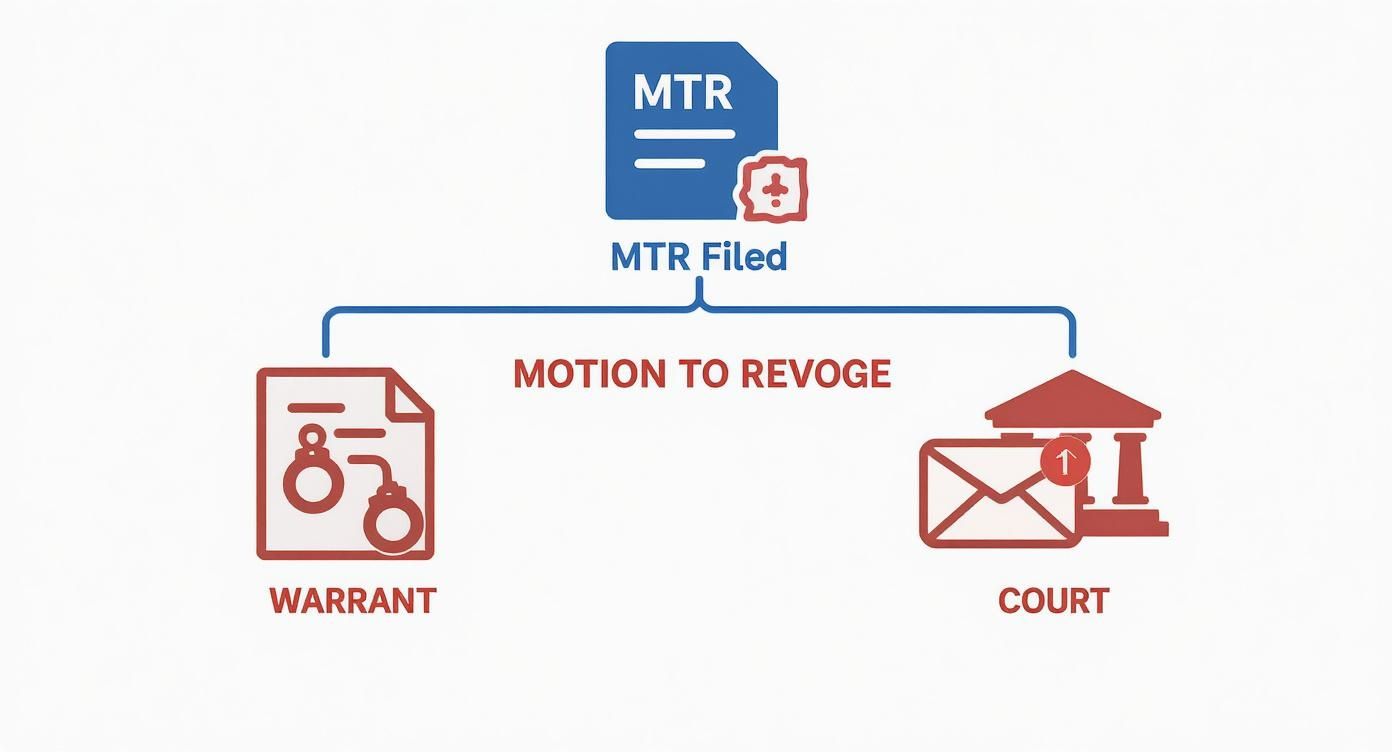
As you can see, a warrant is a very common outcome, meaning you could be picked up and held until your hearing. This is why it’s so critical to get an attorney on the phone the moment you know there's a problem.
The Burden of Proof Is Different
This is perhaps the biggest difference between a criminal trial and a probation violation hearing: the burden of proof. In a criminal case, the state must prove you are guilty "beyond a reasonable doubt." That is the highest standard in our legal system, requiring evidence so strong that there is no other logical explanation for the facts.
However, in a probation violation hearing, the standard is much lower. The prosecutor only needs to prove the violation by a "preponderance of the evidence."
A "preponderance of the evidence" means the prosecutor just has to show that it’s more likely than not that you violated a condition. Think of it as 51% certainty. This lower standard makes it far easier for the state to win.
This is a complete game-changer. Evidence that would not be strong enough to convict you of a new crime might be more than sufficient for a judge to revoke your probation.
What Happens During the Hearing
A probation violation hearing is a formal proceeding before a judge—there is no jury. However, your constitutional rights are still protected. You have the right to an attorney, the right to see the evidence against you, and the right to present your own evidence and witnesses.
The hearing typically follows this structure:
- The State Presents Its Case: The prosecutor begins by calling witnesses—usually your probation officer—to testify about your alleged violation. They may present evidence like a failed drug test report, a police report from a new arrest, or records showing missed payments or classes.
- Your Attorney Cross-Examines Witnesses: This is a crucial opportunity for your defense. Your lawyer will question the state's witnesses, challenge the accuracy of their evidence, and create doubt about whether a violation actually occurred or if it was intentional.
- You Present Your Case: After the state rests, it’s your turn. Your attorney can call witnesses to share your side of the story. For example, a family member could testify about an emergency that caused you to miss a meeting, or your employer could confirm you were at work. You also have the right to testify, but this is a major strategic decision that should be made with your lawyer.
- The Judge Makes a Ruling: After hearing both sides, the judge will decide if the prosecutor has met their burden of proof. If the judge finds that you did violate probation, the hearing moves to its final phase: determining the punishment.
The entire process is much quicker and more direct than a full trial. To see how these hearings fit into the larger criminal justice process, you can learn more about the procedural steps of Texas criminal cases in our detailed guide. An experienced lawyer knows how to navigate this structure to your advantage, building a strong, organized defense aimed at protecting your freedom.
The Full Range of Probation Violation Consequences
If the judge finds the state has proven its case against you, the hearing shifts to its final, most critical phase: deciding what happens next. This is where a judge’s discretion is key, and the outcomes can range dramatically. The consequences you face will depend on the nature of the violation, your history on probation, and whether you were on regular probation or deferred adjudication.
A Texas judge has a wide range of options, from giving you a second chance to imposing the maximum sentence for your original offense. Understanding this spectrum is essential to grasping what is at stake. Your attorney's job is to advocate for the least restrictive outcome, using evidence and persuasive arguments to convince the judge you deserve another opportunity.
From a Second Chance to a Prison Sentence
After finding a violation to be "true," the judge has several paths they can take. The decision often hinges on whether your violation was a minor technical mistake or a serious new crime, and how well you have otherwise complied with your probation. A strong defense at this stage can make all the difference.
Here are the most common outcomes, from best-case to worst-case scenario:
- Reinstate and Continue Probation: This is the best possible result. The judge essentially gives you a warning, dismisses the state's motion, and allows you to continue your original probation terms as if nothing happened. This is often achievable for minor, first-time technical violations where your attorney can show it was an isolated mistake.
- Modify and Extend Probation: Instead of a simple warning, the judge might decide to impose stricter conditions. This could mean adding more community service hours, ordering substance abuse treatment, or extending the length of your probation. While not ideal, it keeps you out of jail.
- Impose a Short "Shock" Incarceration: Under Texas law, a judge can order a short jail stay—up to 180 days—as a condition of continuing your probation. This "shock" probation is intended to get your attention before you are returned to supervision.
- Revoke Probation and Impose Sentence: This is the most severe consequence. The judge completely revokes your probation and sentences you to serve time for the original offense for which you were on probation.
When a probation violation hearing concludes, the judge's decision will fall into one of several categories. The table below breaks down the common outcomes you might face, offering a clear snapshot of what could happen next.
Possible Outcomes of a Probation Violation Hearing
| Outcome | Description of Consequence | Best/Worst Case |
|---|---|---|
| Probation Continues | The judge dismisses the violation allegation and allows you to continue on your original probation terms without any changes. | Best Case |
| Probation is Modified | Your probation continues, but the judge adds stricter conditions, such as more community service, counseling, or a longer supervision period. | Middle Case |
| "Shock" Probation Imposed | You are ordered to serve a short jail sentence (up to 180 days) as a condition of being allowed to continue on probation afterward. | Middle Case |
| Probation is Revoked | The judge ends your probation and sentences you for the original crime, which could mean serving the full range of punishment, including prison time. | Worst Case |
Each of these outcomes carries a different weight, and your attorney's goal is to steer the judge's decision as far up this chart as possible.
The Critical Difference Between Probation and Deferred Adjudication
The type of community supervision you are on has a massive impact on the potential consequences of a violation. It’s a distinction many people don’t fully appreciate until it’s too late.
If you are on regular probation (also known as "straight probation"), you have already been convicted and sentenced. If the judge revokes your probation, they can sentence you to any term of confinement within the original punishment range for your crime. For example, if you were on probation for a third-degree felony (which carries a punishment range of 2-10 years), the judge can sentence you to up to 10 years in prison.
If you are on deferred adjudication, you have not been formally convicted of a crime. However, if you violate the terms, the judge can "adjudicate" you guilty and sentence you to the full range of punishment for the original offense—all the way up to the statutory maximum. This means the consequences can be even more severe.
This reality makes a probation violation a high-stakes national issue. Across the country, nearly 200,000 people were sent to prison in 2023 for probation or parole violations alone. Understanding the fine points of sentencing policies and rehabilitation strategies in Texas can provide more context on how these outcomes are determined. It also highlights the urgent need for a strong defense to avoid becoming another statistic.
How to Build a Defense Against a Violation Allegation

Hearing that the state has accused you of violating probation can be devastating. But it is critical to remember: an allegation is not a conviction. You have the absolute right to challenge the state’s claims, and a smart legal defense can protect your freedom.
A strong defense starts with a simple but powerful principle: the prosecutor must prove you willfully and intentionally violated your probation. This means they have to show you knew the rules and chose to break them. Your attorney’s job is to dismantle that argument.
A skilled criminal defense attorney can use several proven strategies to challenge the state's case. The goal is to show the judge that the alleged violation was not a deliberate act of defiance but rather the result of a mistake, a misunderstanding, or circumstances beyond your control.
Challenging the State's Evidence
The first line of defense is often to attack the prosecutor’s evidence directly. Just because your probation officer says something happened does not automatically make it true in court.
A sharp attorney will scrutinize every piece of evidence. For instance, a failed drug or alcohol test might seem conclusive, but these tests are not foolproof.
Common ways to challenge the evidence include:
- False Positives: We can argue that a positive drug test was caused by a legal prescription medication, certain foods, or even a procedural error at the lab. We can demand records to verify the chain of custody and calibration of the testing equipment.
- Lack of Proof: If you are accused of failing to report, we might present phone records, text messages, or witness testimony showing that you attempted to contact your PO.
- Mistaken Identity: In cases where the violation is a new criminal charge, we can challenge whether you were correctly identified as the person who committed the offense.
These are just a few examples. The goal is to create reasonable doubt and show that the state's claims are not as solid as they appear.
Proving the Violation Was Not Willful
Even if you technically broke a rule, the prosecutor must still prove you did it intentionally. If your attorney can show that your actions were not willful, the judge may decide not to revoke your probation.
This defense strategy focuses on your intent. It acknowledges that a condition was violated but provides the judge with a valid, justifiable reason for it.
A powerful defense can hinge on demonstrating a legitimate excuse. For instance, if you missed a probation meeting because you were in the hospital for a medical emergency, your violation was not willful. With proper documentation, like hospital records, we can prove you had no choice.
Similarly, if you fell behind on fines because you were unexpectedly laid off from your job, we can show you were not deliberately ignoring the court's order. To learn more about how these arguments are structured, you can explore the different types of criminal defenses, justifications, and excuses recognized under Texas law.
Arguing Substantial Compliance
Another effective strategy is to show the judge that you have been doing everything else right. This is known as the “substantial compliance” argument, and it highlights your overall positive performance on probation.
This approach is about painting a complete picture for the judge. We can present evidence that you have:
- Paid all or most of your fines and fees on time.
- Attended every meeting with your PO until the alleged violation.
- Successfully completed all required classes or treatment programs.
- Maintained a steady job and supported your family.
By demonstrating that one minor, technical violation is an outlier in an otherwise excellent record, we can argue that revoking your probation would be an unjust and excessive punishment. This strategy asks the judge for a second chance and reinforces that you take your community supervision seriously. It’s a human approach that recognizes that people make mistakes.
Your First Steps After a Violation Accusation
The sinking feeling you get when you're accused of violating probation is real. Panic can set in, your mind races, and it's easy to feel lost. But what you do in these first few hours and days is critical.
Taking smart, deliberate action right away can protect your rights and lay the foundation for a much stronger defense. Think of this as your immediate action plan—a way to regain control and prepare for the legal fight ahead.
A 5-Step Guide to Responding Effectively
When you find out a Motion to Revoke Probation (MTR) has been filed, or even if you just suspect one is coming, it’s time to act. Do not wait for the situation to get worse.
-
Do Not Ignore Any Notice or Warrant: This is the worst mistake you can make. Ignoring the problem will only lead to an embarrassing and unexpected arrest—at your home, your job, or during a traffic stop. Facing the issue head-on is the only way to have any control over the outcome.
-
Gather All Your Probation Documents: Collect every piece of paper related to your community supervision. This includes your original sentencing paperwork, the list of probation conditions, receipts for fees paid, community service logs, and any correspondence from your probation officer. These documents are invaluable to your attorney.
-
Write Down Your Side of the Story: As soon as possible, write a detailed account of what happened from your perspective. Memories fade, especially under stress. A clear, immediate record of dates, times, conversations, and potential witnesses is incredibly helpful for building your defense. Keep this information strictly confidential and share it only with your lawyer.
Do not discuss your case with anyone—not your friends, not your family, and especially not law enforcement or your probation officer—until you've spoken to an attorney. Anything you say can and will be used against you in court.
-
Preserve Any Supporting Evidence: Think like a detective. What evidence supports your story? If you missed a meeting because of a medical emergency, find those hospital records. If the violation alleges you weren't at work, save your pay stubs or timesheets. Collect any text messages, emails, or phone logs that could prove your case.
-
Immediately Contact an Experienced Texas Criminal Defense Attorney: This is, without a doubt, the most important step. A lawyer can get to work right away—investigating the allegations, checking for an arrest warrant, and starting to build a defense strategy. The sooner you get legal help, the better your chances are of achieving a positive outcome.
Common Questions We Hear About Probation Violations in Texas
When you’re facing a probation violation, your mind is likely filled with questions and "what-ifs." It's a stressful and uncertain time. Getting clear, straightforward answers is the first step toward deciding your next move.
Here are some of the most common questions we hear from people in your situation.
Can I Get a Bond for a Probation Violation in Texas?
This is often the first and most urgent question people ask. In most cases, when a judge issues a warrant for a probation violation, you will not be eligible for bond. This means that if you are arrested, you will likely remain in jail until your hearing.
However, that is not always the final answer. An experienced attorney can file a motion asking the judge to set a reasonable bond, arguing that you are not a flight risk or a danger to the community. There are no guarantees, but it is a critical step to take if you want a chance to get out of jail while your case is pending.
What’s the Difference Between Revoking and Modifying Probation?
It is essential to understand these two terms, as they lead to very different outcomes. One is a warning; the other is the end of your probation.
-
Modifying Probation: This is the less severe option. The judge decides to keep you on probation but changes the rules, usually making them stricter. This could mean adding more community service, ordering inpatient treatment, or extending your supervision period. Think of it as a second chance with a shorter leash.
-
Revoking Probation: This is the most serious consequence. The judge completely takes away your probation and imposes the original jail or prison sentence that was suspended. This means you will be sent to prison or jail.
Do I Have to Go to My Final Hearing if I Hired a Lawyer?
Yes, absolutely. You must appear for all of your court dates, especially your final probation violation hearing, even with an attorney. Your presence is legally required.
If you fail to appear, the judge will issue another warrant for your arrest, which will only make your situation worse. Your lawyer will be there to stand with you and speak for you, but you have to be physically present in the courtroom.
Probation violations aren't just a local issue; they're part of a much larger global conversation about criminal justice. The worldwide prison population is over 11.5 million people, and a significant number are incarcerated for supervision violations. This points to systemic challenges in how we balance punishment with rehabilitation. To create better outcomes, legal systems must focus on reforms that support people on community supervision. You can discover more insights about global prison trends and rehabilitation challenges.
If you’ve been charged with a crime in Texas, call The Law Office of Bryan Fagan, PLLC for a free and confidential consultation. Our defense team is ready to protect your rights. https://texascriminallawyer.net