Being arrested for domestic violence in San Antonio can be terrifying — but you don’t have to face it alone. If you've been accused, you aren’t just facing a legal charge; you're facing a crisis that threatens your freedom, reputation, and family. The experience is overwhelming, with potential jail time, fines, and a lasting stain on your career.
An experienced San Antonio domestic violence attorney is your guide through the maze of the Bexar County legal system. Having a strong defender and trusted guide in your corner is absolutely critical to protecting your rights and your future.
Understanding the Stakes of a Domestic Violence Accusation

Getting arrested for domestic violence in San Antonio can turn your world upside down in an instant. The fear and uncertainty are real, but remember this: an accusation is not a conviction. This guide is here to provide clear, plain-English explanations of Texas law and give you practical advice during what is undoubtedly a difficult and confusing time.
We will walk you through how serious these charges are under the Texas Penal Code, where they can range from misdemeanors to life-altering felonies. Our goal is to pull back the curtain on the Bexar County legal process, address your most immediate concerns, and show you exactly how a skilled legal team can start protecting your rights today.
The Challenge of the Bexar County System
The legal landscape right here in San Antonio has its own unique set of challenges. Our local courts are swamped with a massive and persistent volume of domestic violence cases, and that backlog has a direct impact on how your case will be handled.
As of early 2025, the Bexar County District Attorney’s office was staring down a staggering backlog of 6,205 domestic violence cases. Of those, 2,211 were classified as serious felonies. This logjam means cases can sit in limbo for months—sometimes years—leaving you in a state of prolonged uncertainty. You can find more details about the Bexar County case backlog and its real-world impact on our local justice system.
This reality makes proactive legal representation essential. An attorney who knows the local system can work to prevent your case from getting lost in the shuffle and advocate for a timely and fair resolution.
Understanding your situation is the first step toward building a strong defense. With the right guidance, you can confront the allegations head-on, protect your name, and start working to get your future back on track.
Understanding Texas Family Violence Laws
When you're hit with a domestic violence accusation in San Antonio, the specific words the law uses are everything. To build a defense that works, you first need to understand exactly what you're being charged with. The Texas Penal Code uses the term “family violence,” and it has a very precise legal meaning that goes far beyond a simple argument.
In plain English, family violence is an act against a family member that is meant to cause physical harm, bodily injury, assault, or sexual assault. It also covers threats that make a person fear those things are about to happen. This definition is intentionally broad and can include a whole range of situations and relationships.
What Counts as a Family Relationship
The law’s idea of "family" is probably wider than you think. It's not just about spouses or blood relatives. Under Texas Family Code § 71.004, the prosecution has to prove a specific type of relationship existed between you and the accuser.
A "family" or "household" relationship includes:
- Spouses and Former Spouses: Anyone you are or were married to.
- Blood Relatives: Parents, kids, siblings, and other relatives by blood or marriage.
- Individuals with a Child in Common: You don't have to be married; if you share a child, the law considers it a family relationship.
- Dating Relationships: A continuing romantic or intimate relationship. The court will look at how long you were together and the nature of the relationship to decide if it counts.
- Household Members: People who live together now or have lived together in the past.
Grasping these definitions is critical. They are often the single factor that turns a simple assault charge into a much more serious family violence case with tougher penalties.
Misdemeanor Assault Versus Felony Charges
An initial family violence charge usually starts as a Class A Misdemeanor under Texas Penal Code § 22.01. That’s serious enough, carrying a penalty of up to one year in jail and a fine of up to $4,000. But the situation can get much worse, and fast.
A key factor prosecutors look at is your criminal history. A prior conviction for family violence can automatically upgrade a new misdemeanor charge to a third-degree felony. This is known as Continuous Violence Against the Family under Texas Penal Code § 25.11.
Suddenly, you're not looking at a year in county jail anymore. A third-degree felony comes with a potential sentence of two to ten years in a state prison. This huge jump in penalties shows just how seriously Texas law treats repeat offenses. The prosecutor doesn't even have to prove the injury was severe—just that you have a prior conviction and committed another assault against a family member.
Here’s a quick look at how these charges stack up.
Texas Domestic Violence Charges and Potential Penalties
The table below breaks down the common domestic violence charges you might see in Texas, along with the penalties they carry. It’s a stark reminder of how quickly the consequences can escalate.
| Offense | Texas Penal Code Section | Classification | Potential Jail/Prison Time | Potential Fines |
|---|---|---|---|---|
| Assault – Family Violence | § 22.01 | Class A Misdemeanor | Up to 1 year in jail | Up to $4,000 |
| Continuous Violence Against the Family | § 25.11 | 3rd Degree Felony | 2 to 10 years in prison | Up to $10,000 |
| Assault – Family Violence by Impeding Breath (Choking) | § 22.01(b)(2)(B) | 3rd Degree Felony | 2 to 10 years in prison | Up to $10,000 |
| Aggravated Assault – Family Violence | § 22.02 | 2nd Degree Felony | 2 to 20 years in prison | Up to $10,000 |
As you can see, certain actions immediately trigger a felony charge. If the alleged assault involved choking or impeding breathing, it's automatically a third-degree felony, even for a first offense. If a deadly weapon was used, it becomes aggravated assault—a second-degree felony.
Navigating these complexities is not a DIY project. You can get a better sense of the legal landscape by reviewing a detailed guide to Texas domestic violence assault law and seeing how it applies to real cases. Knowing exactly what the prosecution has to prove is the very first step in building a powerful defense strategy with your San Antonio domestic violence attorney.
Navigating the Bexar County Legal Process After an Arrest
The moments after a domestic violence arrest in San Antonio can feel like a blur of confusion and fear. Suddenly you're in a system you don't understand, and what comes next is a total unknown. This step-by-step guidance will help you understand the process and regain some control.
While every case is different, the Texas criminal justice system follows a specific path. Knowing the key stages can help demystify the process and prepare you for the road ahead.
Immediately after an arrest, you’ll be taken to a local jail for booking. This is standard procedure. They'll take your fingerprints, snap a mugshot, and record your personal information.
The Initial Court Appearances
Your first real taste of the court system will likely be a magistrate’s hearing, which usually happens within 48 hours of your arrest. Here, a judge will officially tell you the charges you're facing, read you your rights, and set your bail amount.
Shortly after that comes the arraignment. This is a more formal court proceeding where you'll be asked to enter a plea—"guilty," "not guilty," or "no contest." Pleading "not guilty" is almost always the right move at this stage. It preserves all of your legal rights and gives your attorney the crucial time needed to dig into the evidence and start building your defense. To learn more about this critical step, read about what happens at an arraignment hearing.
Understanding the Emergency Protective Order
One of the most immediate and impactful things you'll face is the Emergency Protective Order (EPO). A judge will almost certainly issue one against you during the magistrate's hearing. Think of an EPO as a set of strict, court-ordered rules designed to protect the alleged victim.
The conditions of an EPO are not suggestions; they are commands. They typically include:
- No Contact: You are legally forbidden from communicating with the alleged victim. That means no calls, texts, emails, or even messages passed through friends or family.
- Stay Away: You must keep a certain distance from the person's home, work, or school. This often means you can't go back to your own house if you live with your accuser.
- No Firearms: You will be prohibited from possessing a firearm for as long as the order is in effect.
Breaking an EPO is a separate crime. Even a single text message that says "I'm sorry" can lead to a new arrest and a Class A Misdemeanor charge. This makes your legal situation exponentially worse, so it is absolutely critical to follow the EPO's terms to the letter.
Adding to the pressure is the sheer volume of cases flooding the San Antonio courts. In 2023 alone, local authorities filed over 22,000 family violence offense reports, putting an immense strain on the entire system. This high caseload makes it all too easy for your case to get lost in the shuffle, highlighting just how vital it is to have a dedicated attorney fighting to make sure you get the attention you deserve.
The infographic below shows just how quickly a domestic violence charge can escalate from a simple misdemeanor to a life-altering felony.
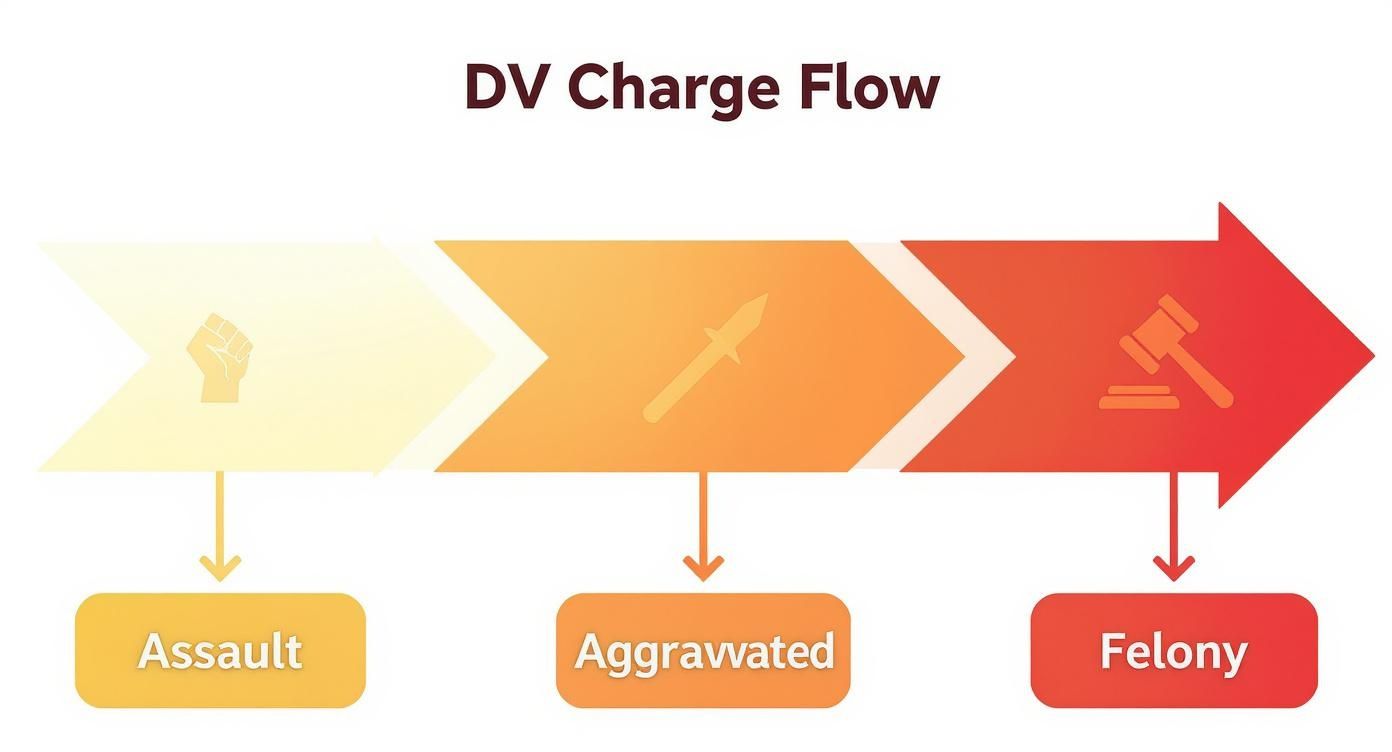
As you can see, things like a prior conviction or the presence of a weapon can rapidly turn a bad situation into a catastrophic one. From the arraignment all the way through pre-trial motions and plea negotiations, every single step is a critical opportunity for a skilled San Antonio domestic violence attorney to step in, challenge the evidence, and fight for a better outcome on your behalf.
Building a Strong Defense Against Your Charges

Being accused of domestic violence in San Antonio can feel like the world has turned against you. But it's critical to remember one of the core principles of our justice system: an accusation is not a conviction. The burden is entirely on the prosecution to prove its case beyond a reasonable doubt. A skilled defense is your most powerful tool for making sure your side of the story gets heard.
Building that defense isn’t about making up excuses. It’s about methodically presenting facts, poking holes in weak evidence, and holding the state to its high legal standard. A proactive and strategic approach can be the deciding factor between a devastating conviction and the freedom to move on with your life.
Investigating Every Detail of Your Case
The bedrock of any solid defense is a relentless, thorough investigation. Your San Antonio domestic violence attorney essentially becomes your private investigator, digging deep into the facts and searching for crucial details the police may have missed or misinterpreted. This goes far beyond just reviewing the evidence the prosecutor hands over; it’s about uncovering new evidence that tells a completely different story.
This investigative process is meticulous. We leave no stone unturned in the pursuit of the truth.
Key areas of our investigation often include:
- Scrutinizing Police Reports: We examine every single line of the police report, looking for inconsistencies, procedural mistakes, or signs of bias. Did the officers follow proper protocol when they arrived on the scene? Did they interview every witness fairly, or did they just take one person's word for it?
- Interviewing Witnesses: We don't just take the police's version of events at face value. Our team will identify and speak with anyone who might have witnessed the incident or who can provide important context about your relationship and character.
- Gathering Physical and Digital Evidence: This could mean tracking down photos, videos, text messages, or emails that directly contradict the accuser’s story or back up your version of events. We also look for evidence that might offer an alternative explanation for alleged injuries, like a pre-existing medical condition.
Common Defense Strategies in Domestic Violence Cases
Every case is different, but there are several powerful defense strategies that are frequently used to fight domestic violence allegations in Texas. Your attorney’s job is to figure out which approach is the best fit for the specific facts of your situation.
Challenging the Accuser’s Credibility
It’s an unfortunate reality that false or exaggerated allegations happen. They are often driven by anger, jealousy, or an attempt to get an advantage in a divorce or child custody battle. We can challenge an accuser's credibility by highlighting inconsistencies in their statements—what they told the police versus what they said in court or told others. We also investigate their background for any history of making false reports or a clear motive to lie.
Asserting Self-Defense
Texas law gives you the absolute right to defend yourself if you reasonably believe you are in imminent danger of harm. If you only used force to protect yourself or someone else, this can be a complete defense to an assault charge. To prove self-defense, we have to show that your actions were a reasonable and necessary response to a threat you perceived.
It is not illegal to defend yourself. If you were the one attacked and you responded with reasonable force to stop the assault, your actions may be legally justified. Our job is to gather the evidence needed to prove it.
Disputing the Prosecution's Evidence
Many times, the state's case hangs on little more than the accuser's testimony and a few photos of alleged injuries. A skilled defense attorney knows how to dismantle this type of evidence. We can bring in medical experts to question whether an injury is as severe as claimed or if it could have been caused by something accidental. We can also provide the context that explains what really happened, turning the prosecution's own evidence on its head.
A proactive, well-researched defense is your best shield. With a dedicated San Antonio domestic violence attorney in your corner, you can confidently challenge the charges and fight for your future.
Clearing Your Record and Rebuilding Your Future
Even when a domestic violence case is thrown out or resolved in your favor, the arrest record doesn’t just disappear. It lingers, casting a long shadow over your future. That one mark on your record can create serious roadblocks, making it tough to pass a background check for a new job, get approved for an apartment, or even volunteer for your kid's school.
For many people, it feels like a punishment that never ends.
But here’s the good news: Texas law offers a path forward. You don’t have to be defined forever by a past mistake or a false accusation. Legal tools like expunctions and orders of non-disclosure exist for this very reason—to help you clear your name and get the fresh start you deserve.
Expunction: Wiping the Slate Completely Clean
An expunction is the most powerful tool for clearing your record. Think of it like a legal eraser that permanently destroys every file and document related to your arrest. Once a judge grants an expunction, it’s as if the whole thing never happened. Legally, you can deny you were ever arrested for that offense.
This powerful remedy isn’t available to everyone. Generally, you can qualify for an expunction if your case ended in one of these ways:
- You were found "not guilty" at trial (an acquittal).
- The prosecutor dismissed your case.
- You were convicted but later received a pardon.
- You were arrested, but the prosecutor never formally filed charges.
Getting an expunction is a formal court process. It requires filing a detailed petition and navigating specific legal hurdles. An experienced San Antonio domestic violence attorney can quickly tell you if you're eligible and handle every step for you.
Sealing Your Record with an Order of Non-Disclosure
What if an expunction isn't on the table? You might still be able to seal your record with an order of non-disclosure. This process doesn't destroy the record, but it does hide it from public view. Once sealed, your record won’t show up on most background checks run by private employers, landlords, or licensing agencies.
Think of an order of non-disclosure like putting your records in a locked filing cabinet. Law enforcement and certain government agencies can still open it under specific circumstances, but for the rest of the world, it’s completely out of sight.
You may be eligible for an order of non-disclosure if you successfully finished a deferred adjudication community supervision program for certain offenses. The rules around eligibility and waiting periods can get pretty complicated, which is why talking to an attorney is so important. You can get a better sense of the details by exploring the expungement process in Texas and seeing how it differs from sealing a record.
Whether you qualify for an expunction or non-disclosure, clearing your record is a critical step in moving on from a domestic violence allegation. It reopens doors to opportunities and lets you rebuild your life without the constant weight of a past arrest holding you back.
Frequently Asked Questions About Domestic Violence Cases
When you're facing a domestic violence charge in San Antonio, it's natural for your mind to be racing with questions. The legal system is confusing, and the uncertainty can feel crushing. This section cuts through the noise to give you direct answers to the most common concerns we hear, helping you feel more prepared and in control.
Can the Alleged Victim Drop the Charges?
This is easily one of the biggest misconceptions out there. In Texas, only the prosecutor can decide whether to drop the charges—not the person who made the initial 911 call or complaint.
Even if the alleged victim has a change of heart and tells the prosecutor they don't want to move forward, the District Attorney's office can (and often does) proceed with the case. Their decision rests on the evidence they already have, like police reports, photos, 911 recordings, and witness statements. A sharp San Antonio domestic violence attorney can open a line of communication with the prosecutor to point out weaknesses in that evidence and argue for a dismissal on your behalf.
How Can I Fight a Protective Order?
An Emergency Protective Order (EPO) is almost always issued right after a domestic violence arrest, but it isn't set in stone. You have the right to a hearing to challenge a long-term protective order before it becomes permanent.
This hearing is your chance to tell your side of the story. Your attorney can present evidence and arguments to show the judge why the order is unnecessary. This isn't just a simple conversation; it's a formal legal proceeding that might involve:
- Cross-examining the person requesting the order to expose inconsistencies.
- Introducing text messages, emails, or other communications that contradict their claims.
- Calling witnesses who can testify about what really happened.
Successfully fighting a protective order is critical. It's about more than just a piece of paper; it's about restoring your freedom and your access to your home and family.
Will a Domestic Violence Charge Affect Child Custody?
Absolutely. A domestic violence charge can throw a huge wrench into child custody matters. A conviction, or even just a pending charge, can be used against you in a custody battle to paint you as a danger to your children. The result? You could lose custody entirely or be stuck with supervised visitation.
Clearing your name is the first step, but rebuilding your future often means navigating complex family dynamics, especially when kids are involved. It's helpful to understand joint custody agreements, as these arrangements are especially vulnerable when domestic violence charges are on the table. An attorney who handles both criminal defense and family law is invaluable here—they can build a strategy to protect your parental rights from all angles.
A domestic violence accusation puts your most important relationships at risk. It is not just a criminal matter; it is a family matter that requires a careful and comprehensive legal strategy to protect your future.
Getting answers to your questions is the first step toward building a strong defense and quieting your anxieties. Don't leave your future to chance.
If you’ve been charged with a crime in Texas, call The Law Office of Bryan Fagan, PLLC for a free and confidential consultation. Our defense team is ready to protect your rights. Learn more at https://texascriminallawyer.net.