Being arrested for driving while intoxicated in Texas can be terrifying, and the potential Texas DUI penalties can feel absolutely overwhelming. For a first offense alone, a conviction could mean fines up to $2,000, jail time, and losing your driver's license. It’s easy to feel like your world is spinning out of control.
Understanding exactly what you’re facing is the first, most critical step toward building a defense that protects your future. This guide is here to give you clear, straightforward answers and help you navigate the road ahead. You don’t have to face this alone.
Understanding a DWI Charge in Texas
Getting arrested in Texas can leave you feeling confused and isolated, but you don't have to go through this journey without help. A charge of Driving While Intoxicated (DWI) simply means the state believes you were operating a motor vehicle in a public place while legally intoxicated. It’s an accusation, not a conviction.
Under the Texas Penal Code, the term "intoxicated" is defined in two key ways. The first is the one most people know: having a blood alcohol concentration (BAC) of 0.08% or higher.
But the second definition is much broader and doesn't rely on a specific number. It means you have lost the "normal use of mental or physical faculties" because of alcohol or other substances.
This gives an officer a lot of room to make an arrest based on subjective observations like:
- Slurred speech or an unsteady balance
- Failing a Standardized Field Sobriety Test (SFST)
- Erratic driving, such as swerving or braking for no reason
The move to standardize the 0.08% BAC limit was a major shift in how Texas handled impaired driving cases. Before the late 1990s, inconsistent legal limits made enforcement a challenge. Spurred by a national movement, Texas adopted the 0.08% standard, creating a clear, objective line for law enforcement and strengthening public safety efforts. You can discover more insights about the evolution of these laws and their impact on Texas drivers.
A DWI charge is not a conviction. It is an accusation by the state, and you have the absolute right to challenge every piece of evidence presented against you. An experienced attorney will scrutinize every detail, from the reason for the initial traffic stop to how any chemical tests were administered.
Grasping these fundamentals is crucial. It helps you see the road ahead more clearly and understand why having a skilled legal advocate in your corner is so important. From here, we’ll break down the specific penalties for a first offense, what happens with repeat offenses, and other factors that can make the consequences even more severe.
Penalties for a First DWI Offense
Getting arrested for your first DWI is a jarring experience. The flashing lights in the rearview mirror are just the beginning; what comes next feels like a confusing and overwhelming blur. Your biggest fear is likely the unknown—what fines will you have to pay? Will you go to jail? Can you still drive to work?
Let’s cut through the confusion and break down exactly what you’re up against. In Texas, a first-time DWI is typically charged as a Class B Misdemeanor, assuming there are no “aggravating factors” like a child passenger or an accident causing injury. This classification comes with a specific set of potential penalties.
It’s also important to know how Texas law actually defines DWI. It’s not just about blowing over a .08.
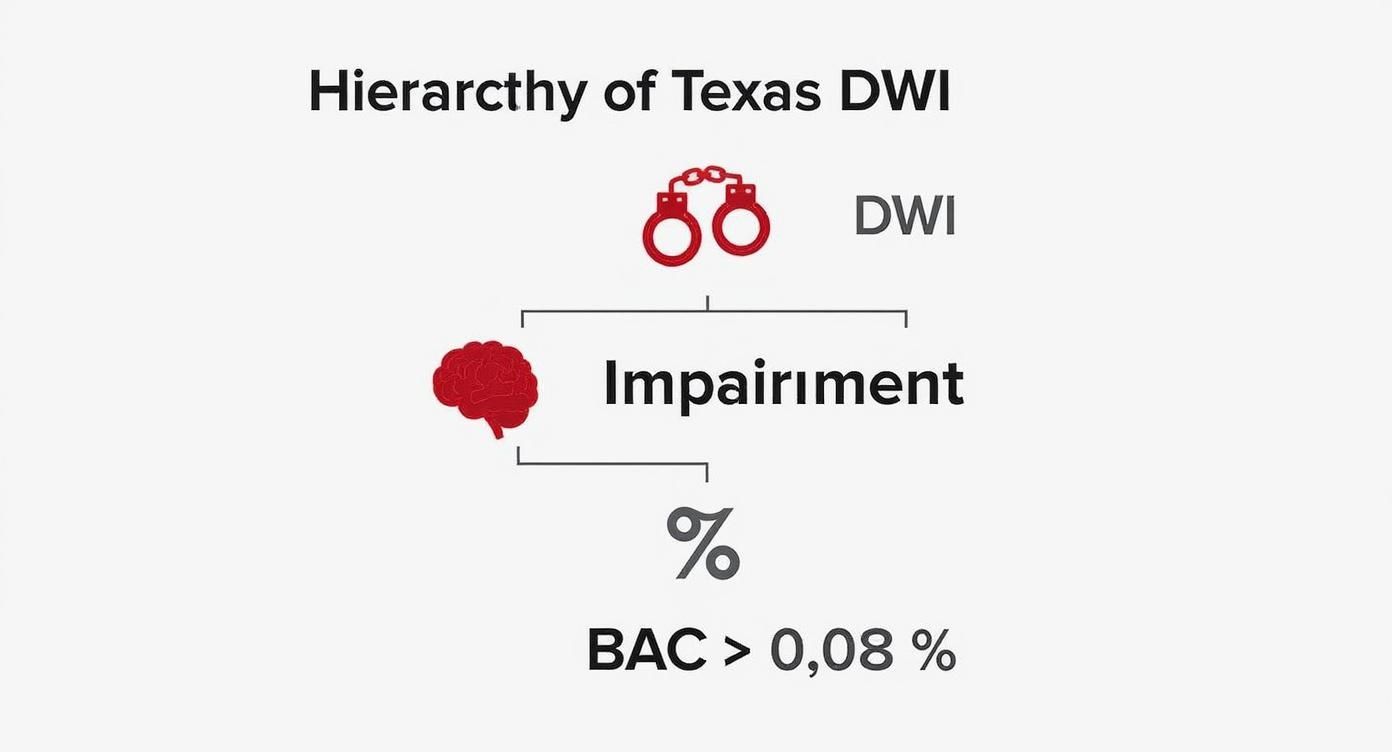
As you can see, you can be arrested even without a specific BAC number if an officer believes you’ve lost the normal use of your mental or physical faculties. This is a crucial point, because a strong DWI defense often focuses on challenging the officer’s subjective opinion of your impairment.
Jail Time and Fines
Let’s get right to the two biggest concerns for anyone facing a DWI charge: jail and money. Under the Texas Penal Code, the consequences for a Class B Misdemeanor are not something to take lightly.
- Jail Time: You could be sentenced to a minimum of 72 hours in county jail, with a maximum possible sentence of 180 days.
- Fines: The court can impose a fine up to $2,000. Keep in mind, this figure doesn't even include court costs and other administrative fees, which add up quickly.
These numbers are scary, but they represent the maximum penalties, not the mandatory ones. For a first offense, a skilled DWI lawyer can often negotiate for alternatives to jail time, such as probation.
Driver's License Suspension
Beyond the courthouse, a DWI charge triggers a separate, immediate threat to your daily life: the loss of your driver’s license. This isn’t handled by the criminal court but by the Texas Department of Public Safety (DPS) through an administrative process.
For a first DWI, you’re looking at a license suspension ranging from 90 days to a full year. This process kicks in automatically unless you fight it. You have only 15 days from the date of your arrest to request an Administrative License Revocation (ALR) hearing. If you miss this deadline, your license suspension will begin. For a deeper dive into your immediate next steps, our guide on the penalties for a first DUI provides more options.
Additional Court-Ordered Requirements
A conviction doesn’t just end with fines and potential jail time. A judge will almost certainly add a list of other conditions you must complete, either as part of your sentence or as terms of your probation.
A judge has a lot of discretion when it comes to sentencing. This is where a well-prepared legal defense can make a significant difference by presenting mitigating factors to the court, potentially leading to less restrictive probation terms and a smoother path forward.
Some of the most common requirements include:
- DWI Education Program: You will likely be ordered to complete a 12-hour class designed to educate you on the risks of impaired driving.
- Community Service: Courts frequently order anywhere from 24 to 80 hours of community service.
- Ignition Interlock Device (IID): You may be required to install an IID on your vehicle. This is a small breathalyzer that you must blow into to start your car, and it won't work if it detects alcohol.
Each of these penalties can disrupt your life, your schedule, and your finances. But remember, an arrest is not a conviction. A dedicated defense attorney can scrutinize the evidence, challenge the state’s case, and work to get these consequences reduced or even dismissed entirely.
How Penalties Escalate for Repeat DWI Offenses
If you're facing a second or subsequent DWI charge, the State of Texas dramatically raises the stakes. While a first offense is serious, the legal system views repeat offenses as a pattern of dangerous behavior, and the Texas DUI penalties reflect that. The consequences don't just increase—they skyrocket, quickly moving from a misdemeanor to a life-altering felony.
This isn't a new problem. Texas has long struggled with repeat DWI offenders. In fact, historical data shows that while first-time arrests saw a decline in the late 80s, arrests for repeat offenses actually jumped by about 15%. During that same period, repeat offenders grew from 33% to 38% of all DWI arrests, showing just how tough this cycle can be to break. You can read the full research on Texas's historical DWI data to see the trends for yourself.

The Jump to a Second DWI Offense
A second DWI isn't just another charge; it's an upgrade. The offense is elevated from a Class B to a Class A Misdemeanor, which brings a substantial increase in penalties. The system is designed to send a clear message: this behavior will be punished more severely a second time.
Here’s what that looks like in practice for a second DWI:
- More Jail Time: The potential sentence gets much more serious, ranging from a mandatory minimum of 30 days to a maximum of one year behind bars.
- Heavier Fines: The maximum fine doubles, reaching up to $4,000, before court costs and other fees.
- Longer License Suspension: Your license can be suspended for a much longer period, anywhere from 180 days to two full years.
These penalties are just the starting point. Judges are also far more likely to impose tougher probation terms, like more community service hours and a mandatory ignition interlock device (IID). Handling these heightened stakes requires a smart legal strategy. Our second DWI offense guide breaks down how to start building a solid defense.
Facing a Third DWI: A Life-Changing Felony
A third DWI arrest is a legal cliff. At this point, the charge is automatically classified as a Third-Degree Felony, regardless of how much time has passed since your last conviction. A felony conviction brings a cascade of lifelong consequences that impact your freedom, your career, and even your basic rights as a citizen.
A felony DWI conviction doesn't just mean harsher penalties—it means losing certain civil rights. You could lose your right to vote (while incarcerated and on parole/probation), your right to own a firearm, and face immense difficulty finding employment or housing for the rest of your life.
The penalties for a third-degree felony DWI are designed to be a powerful, final deterrent:
- State Prison Time: This isn’t county jail. A felony conviction means 2 to 10 years in a Texas state prison.
- Crushing Fines: The maximum fine climbs to a staggering $10,000.
- Extended License Suspension: You'll face a driver's license suspension of up to two years.
- A Permanent Shadow: A felony conviction stays on your record forever, unless you manage to secure a pardon, which is incredibly rare.
Because the penalties for repeat DWI offenses are so severe, the need for an experienced and aggressive legal defense is absolutely critical. A skilled attorney will scrutinize every detail of your case, from challenging the validity of prior convictions to examining the procedures followed in your latest arrest. Your freedom and your future are on the line.
Factors That Can Make DWI Penalties Harsher
Not all DWI charges are created equal. While a standard first-time DWI is a serious Class B Misdemeanor, certain situations can instantly enhance the charges and penalties. These are called "aggravating factors," and they signal to the court that the incident posed a much higher risk to the public.
Understanding these factors is critical, because they can turn a misdemeanor charge into a felony overnight.
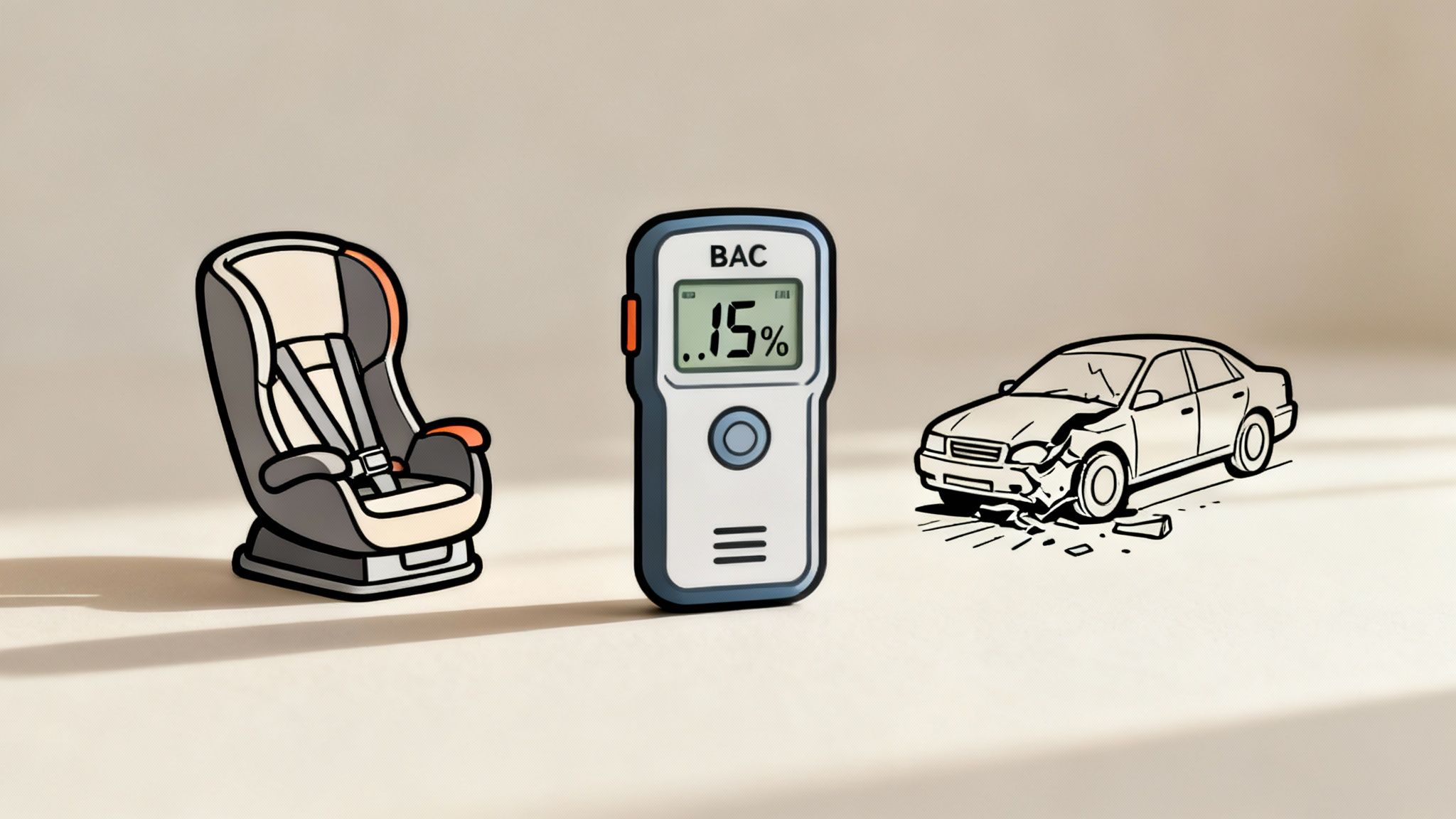
When an aggravating factor is involved, the state sees it as more than a simple lapse in judgment. It’s viewed as a level of recklessness that Texas law punishes severely, pushing the consequences far beyond what you might expect for a typical first DWI.
High Blood Alcohol Concentration (BAC)
One of the most common ways a DWI charge gets more serious is when your blood alcohol level is exceptionally high. While the legal limit is 0.08%, Texas law has a special enhancement for anyone caught driving with a BAC of 0.15% or higher.
This isn't a minor detail; it changes the entire charge. A first-time DWI with a BAC of 0.15% or more is automatically elevated from a Class B Misdemeanor to a Class A Misdemeanor.
This means the potential penalties suddenly look a lot like those for a second DWI, even if you’ve never been in trouble before:
- Fines: The maximum fine doubles, jumping from $2,000 to $4,000.
- Jail Time: The potential sentence increases to a maximum of one year in county jail.
The state’s logic is simple: a higher BAC means a greater level of impairment and a greater danger on the road.
DWI with a Child Passenger
The law is fiercely protective of children, and that’s especially true in DWI cases. If you are arrested for DWI while a child under the age of 15 is in your vehicle, the charge is automatically elevated to a State Jail Felony.
That is a massive leap in severity. A State Jail Felony conviction carries life-altering consequences:
- Jail Time: You're looking at 180 days to two years in a state jail facility.
- Fines: The maximum fine skyrockets to $10,000.
A conviction for DWI with a Child Passenger leaves you with a permanent felony record. This can devastate your ability to find a job, secure housing, or even maintain your parental rights. It's one of the most serious DWI-related charges you can face.
Causing an Accident with Injury or Death
When an impaired driver causes an accident that hurts someone, the legal fallout becomes catastrophic. The charges are no longer just about driving while intoxicated; they’re about the direct harm you caused to another person.
Intoxication Assault: If your driving results in "serious bodily injury" to another person, you’ll be charged with Intoxication Assault, a Third-Degree Felony. "Serious bodily injury" is an injury that creates a substantial risk of death or causes permanent disfigurement or loss of a bodily function. A conviction can land you 2 to 10 years in prison and a fine of up to $10,000.
Intoxication Manslaughter: If that accident results in someone's death, the charge becomes Intoxication Manslaughter. This is a Second-Degree Felony, which carries a potential prison sentence of 2 to 20 years and fines up to $10,000.
Texas has some of the highest rates of alcohol-related traffic fatalities in the country, which is why these penalties are so incredibly harsh. In fact, data shows the state leads the nation in deaths caused by drivers with a BAC of 0.15 or higher—a stark reminder of why these laws exist. You can learn more about Texas DUI statistics and their impact to understand the grim reality behind these statutes.
The Hidden Costs of a DWI Conviction
When a judge hands down a sentence for a DWI, most people focus on the immediate penalties—the fines, community service, or potential jail time. But the court-ordered punishment is just the tip of the iceberg. The true cost of a conviction often comes from the long-term consequences that can sabotage your finances, career, and personal life for years to come.
Many people are completely blindsided by the administrative penalties that kick in after the criminal case. These aren’t fines paid to the court; they’re annual fees demanded by the Texas Department of Public Safety (DPS) just to keep your driver's license.
The Financial Squeeze After a Conviction
One of the biggest financial shocks is the Driver Responsibility Program surcharge. If you're convicted of DWI, Texas requires you to pay an annual fee to the DPS for three straight years simply to maintain your driving privileges. It's a penalty on top of your penalty.
- For a first-time DWI, you're looking at $1,000 per year for three years.
- If it's your second DWI, or if your BAC was 0.15 or higher, that fee jumps to a staggering $2,000 per year for three years.
That’s an extra $3,000 to $6,000 piled on top of court costs, lawyer fees, and everything else. And if you don't pay? The DPS will automatically suspend your license, digging you into an even deeper hole.
On top of DPS surcharges, your auto insurance premiums are guaranteed to skyrocket. A DWI conviction flags you as a high-risk driver, and insurers will increase your rates drastically. It’s not unusual for premiums to double or even triple, costing you thousands of extra dollars over several years. To see how these numbers add up, check out our detailed guide on the full cost breakdown of a DWI.
Professional and Personal Fallout
The financial gut punch is only part of the story. A DWI conviction leaves a permanent mark on your criminal record, casting a long shadow that follows you everywhere.
A criminal record is public information. This means that anyone—a potential employer, a landlord, a loan officer—can run a background check and see your conviction. It creates barriers to opportunities you once took for granted.
Here are some of the most common ways a DWI conviction can disrupt your life:
- Job Loss or Difficulty Finding Employment: Many companies have strict policies against hiring people with criminal records, especially for jobs involving driving, heavy machinery, or sensitive information. If you hold a commercial driver's license (CDL), a DWI is often a career-killer.
- Housing and Loan Applications: Landlords and mortgage lenders routinely run background checks. A DWI on your record can easily lead to a denied rental application or make it much tougher to get approved for a home loan.
- Child Custody Issues: In a family court battle, a DWI conviction can be used as a weapon against you. The other parent could argue it proves you have poor judgment or a substance abuse problem, which can seriously impact your custody or visitation rights.
These hidden consequences are exactly why fighting a DWI charge is so critical. An arrest is not a conviction, and with a skilled defense, you have a chance to protect yourself from these devastating and far-reaching effects.
How to Navigate the Legal System and Protect Your Rights
After a DWI arrest, it feels like the system is moving a hundred miles an hour while you’re standing still. The good news is that you have rights, and understanding the process is the first step toward protecting them. The moments and days following your arrest are critical, and every choice you make can have a huge impact on your case.
The first and most urgent deadline you’ll face has nothing to do with the criminal courtroom. It’s the fight to save your driver’s license through a process called an Administrative License Revocation (ALR) hearing.
The 15-Day Deadline to Save Your License
When you were arrested, the officer likely took your physical license and handed you a piece of paper that serves as a temporary driving permit. What you may not realize is that you have only 15 days from the date of your arrest to request that ALR hearing with the Texas Department of Public Safety (DPS).
If you miss this deadline, your license will be automatically suspended.
Requesting the hearing, on the other hand, puts the suspension on hold. More importantly, it gives your attorney a vital first opportunity to challenge the evidence against you, including the reason for the traffic stop and the results of any chemical tests.
Walking Through the Criminal Case Process
While the ALR process is happening, your criminal case will start moving forward. Knowing the key stages can help reduce your anxiety and prepare you for what’s ahead.
Arraignment: This is your first official court appearance. The judge will read the charges against you, and you'll enter a plea—almost always "not guilty" at this early stage to keep all your legal options open. This is also when your bond conditions will be set, which might include things like installing an ignition interlock device.
Plea Bargaining: The vast majority of DWI cases are resolved through negotiations between your attorney and the prosecutor. Your lawyer will dig into every piece of evidence—from the officer's dashcam footage to the breathalyzer's calibration logs—to find weaknesses in the state’s case. Those weaknesses become leverage to negotiate for reduced charges or even a complete dismissal.
Trial: If a fair plea deal can't be reached, you have a constitutional right to take your case to trial. Here, the prosecutor must prove your guilt "beyond a reasonable doubt" to a jury. A skilled trial attorney knows how to challenge the state's arguments and present a compelling defense to fight for a "not guilty" verdict.
Protecting Your Future After a Case
Even if a case doesn't go your way, the fight for your future isn't over. Texas law provides paths for people to clear their records and move on with their lives.
An arrest record can follow you for life, impacting your ability to get a job, secure a loan, or find housing. But certain legal tools like expunctions and orders of nondisclosure can give you a clean slate and a fresh start.
Depending on the final outcome of your case, you may be eligible for an expunction, which completely destroys the public records of your arrest. Another possibility is an order of nondisclosure, which seals them from public view. An experienced DWI attorney doesn't just defend you in court; they guide you toward the best possible outcome for your long-term future.
Common Questions About Texas DWI Charges
Facing a DWI charge throws your whole world into a spin. It’s a blur of flashing lights, confusing questions, and a heavy dose of uncertainty. You’re probably worried about your license, your job, and what this means for your future.
Getting straight answers is the first step toward regaining control. Let's tackle some of the most common questions we hear from people who are in your shoes right now.
What Happens If I Refuse a Breathalyzer Test?
It’s a common misconception that refusing a breathalyzer will kill the case against you. Unfortunately, it's not that simple. Texas operates under an "implied consent" law. This means that by driving on a public road, you have legally agreed to take a chemical test if an officer lawfully arrests you for DWI.
Refusing the test triggers an immediate and automatic consequence: your driver's license gets suspended. This is an administrative penalty handled by the DPS, separate from the criminal case. More importantly, the prosecutor can still move forward. They will build their case using other evidence, such as the officer’s observations about your driving, your appearance, and your performance on field sobriety tests.
Will I Definitely Go to Jail for a First DWI?
Not necessarily. While jail time is a possibility for any DWI, it’s not a guaranteed outcome, especially for a first-time offense without aggravating factors. A standard first-time DWI in Texas carries a potential jail sentence of 72 hours to 180 days.
However, a skilled DWI defense lawyer can often negotiate for alternatives, like probation. This allows you to serve your sentence in the community under strict conditions, such as regular check-ins and completing DWI education courses. The goal is to show the court that you are a responsible person who made a one-time mistake, making probation a more constructive path than jail.
How Long Will a DWI Stay on My Record?
A DWI conviction in Texas is permanent. It does not automatically fall off your criminal record after a certain number of years. This public record can create major roadblocks when you’re applying for jobs, trying to rent an apartment, or seeking a professional license.
The only way to truly clear a DWI from your record is through an expunction or an order of nondisclosure. Eligibility for these options is very specific and depends on the outcome of your case. This is why fighting the charge aggressively from day one is so critical.
Can My DWI Be Reduced to a Lesser Charge?
Yes, it is sometimes possible to get a DWI charge reduced to a less severe offense through plea bargaining. An experienced attorney will scrutinize every detail of the prosecutor's case, looking for weaknesses. Was the traffic stop legal? Were there issues with how the breath test was administered? Any crack in the state's case can be used as leverage to negotiate a better deal.
A common reduction is to a charge like "Obstruction of a Highway." While still a misdemeanor, it is a non-alcohol-related offense. This can help you avoid the heavy stigma and automatic penalties of a DWI, like license suspension and annual surcharges. Achieving this result depends on the unique facts of your case and the strength of the lawyer fighting in your corner.
If you’ve been charged with a crime in Texas, call The Law Office of Bryan Fagan, PLLC for a free and confidential consultation. Our defense team is ready to protect your rights. https://texascriminallawyer.net