Being arrested for a Driving While Intoxicated (DWI) charge in Texas can be terrifying — but you don’t have to face it alone. One minute you're driving, the next you're facing a legal storm that threatens your finances, your driver's license, and even your freedom. The specific Texas DWI punishment you might face depends on many factors, like your blood alcohol concentration (BAC) and if this is your first encounter with the law. But remember this: an arrest is just the beginning of the story, not the end. You have rights, and an experienced attorney is here to help you protect them.
Your First Steps After a Texas DWI Arrest

It’s normal to feel confused and anxious after a DWI arrest in Texas. It feels like your world is spinning out of control, and you're suddenly trapped in a complex legal system you don't understand. This guide is your first step toward getting back in control. Our goal is to explain your situation in plain English, clarify your rights, and show you a clear path forward.
Let's be clear: Texas takes DWI charges very seriously. The state’s strict enforcement and harsh penalties are designed to send a powerful message. This aggressive approach is reflected in the numbers. While the national average of people with a DUI is around 2.27%, Texas sits significantly lower at about 1% to 1.5%. You can discover more about how Texas DWI laws impact national rates on LawCommentary.com.
Understanding the Two Battles Ahead
Here’s something most people don't realize until it's too late: a DWI arrest forces you to fight two separate legal battles at the same time.
- The Criminal Case: This is what you probably think of first. It’s the court proceeding where the State of Texas must prove you are guilty of the crime of DWI. A conviction here leads to penalties like fines, probation, community service, and jail time.
- The Administrative Case (ALR): This is a civil process handled by the Texas Department of Public Safety (DPS). This case is only about one thing: suspending your driver's license. You have a very short window—just 15 days from your arrest—to request an Administrative License Revocation (ALR) hearing to challenge this automatic suspension.
If you miss that 15-day deadline, you could lose your license long before your criminal case is ever resolved. Understanding the difference between these two fights is absolutely critical. For a step-by-step walkthrough of what to do immediately, check out our guide on what to do after a DWI arrest.
An arrest is not the end of the story. It is the beginning of a legal journey where the right guidance can make all the difference. Your future, freedom, and ability to drive are all on the line.
Fighting on two fronts requires a smart, coordinated defense. Every detail matters, from challenging the officer's reason for pulling you over to negotiating with prosecutors. A skilled DWI defense attorney knows how to manage both cases at once, protecting your rights in criminal court while fighting to keep you on the road.
Penalties For A First DWI Offense
For most people, a DWI charge is their first real experience with the Texas criminal justice system. It’s an overwhelming situation, but understanding what you’re facing is the first step toward building a strong defense. A first-time DWI is typically a Class B Misdemeanor under the Texas Penal Code, which comes with serious penalties.
Even for a first offense, the potential consequences are significant. A conviction for a Class B Misdemeanor DWI means you could face jail time, steep fines, and a driver's license suspension. The state sends a clear message: it does not take drinking and driving lightly.
This first charge also sets the stage for any future DWI issues, making it absolutely critical to handle it correctly from the start.
The Standard First DWI Penalties
When you are charged with a first-offense DWI, you face a specific range of penalties a judge can impose. These are not just numbers on a piece of paper; they represent real disruptions to your life, your job, and your family.
Here’s what a standard Class B Misdemeanor DWI conviction in Texas typically involves:
- Jail Time: You could face a minimum of 72 hours and up to 180 days in county jail.
- Fines: The court can order you to pay a fine of up to $2,000.
- License Suspension: Your driver's license can be suspended for 90 days to one year.
These punishments are the baseline. However, the specific facts of your case can either increase these penalties or open the door to alternatives that avoid the harshest outcomes.
When A First DWI Becomes More Serious
The stakes get much higher if your Blood Alcohol Concentration (BAC) was 0.15 or higher. Texas law includes an enhancement for first-time offenders with a BAC of 0.15 or greater. This one detail immediately upgrades the charge from a Class B to a Class A Misdemeanor.
That enhancement nearly doubles the potential penalties. Suddenly, you're facing:
- Increased Jail Time: Up to one full year in county jail.
- Heavier Fines: The maximum fine skyrockets to $4,000.
- Longer License Suspension: Your license could be suspended for up to two years.
This immediate escalation shows just how much the specific details of your arrest matter.
To make this crystal clear, let's compare the two tiers side-by-side.
Texas First DWI Punishment Tiers
| Penalty | Standard First DWI (Class B) | First DWI with BAC ≥ 0.15 (Class A) |
|---|---|---|
| Max Jail Time | 180 Days | 1 Year |
| Max Fine | $2,000 | $4,000 |
| License Suspension | 90 Days to 1 Year | Up to 2 Years |
As you can see, that BAC number carries enormous weight and can drastically change the path of your case.
Facing a DWI charge can feel like being lost in a legal maze. But every maze has a path through it. Understanding the penalties is your first step toward finding that path and fighting for a better outcome.
Alternatives to Jail: Community Supervision
The good news is that jail time is not a certainty for every first DWI. An experienced attorney can often negotiate for community supervision, which most people know as probation. This allows you to serve your sentence outside of jail, as long as you comply with a strict set of court-ordered conditions.
If a judge grants you community supervision, you will have to follow a list of rules for a specific period, usually one to two years. Common conditions of DWI probation include:
- DWI Education Program: You will almost certainly have to complete a state-approved 12-hour DWI education class.
- Ignition Interlock Device (IID): Many probation orders require installing an IID on your vehicle. This device is a small breathalyzer that prevents your car from starting if it detects alcohol on your breath.
- Regular Reporting: You must check in with a probation officer on a set schedule.
- Abstaining from Alcohol: You will be prohibited from drinking alcohol for the entire probation term.
Successfully completing community supervision keeps you out of jail and allows you to move forward with your life. However, violating any of these terms can lead the court to revoke your probation and send you to jail to serve out the original sentence.
When a DWI Becomes a Felony
While a first DWI is a serious misdemeanor, the jump to a felony is where a conviction can permanently change your life. The penalties don't just increase; they multiply, turning a mistake into a lifelong burden. It is critical to understand when and how this happens to grasp the true gravity of a Texas DWI charge.
A second DWI offense in Texas is elevated to a Class A Misdemeanor. This is a major escalation from a first offense, introducing mandatory jail time—a minimum of 72 hours and up to a full year behind bars. The potential fine also doubles to a maximum of $4,000. The state makes it clear: repeat offenses will not be treated lightly.
But the real line in the sand is the third offense.
Third DWI: A Third-Degree Felony
A third DWI conviction in Texas isn't just another misdemeanor—it's automatically charged as a third-degree felony. This is where the consequences expand far beyond jail cells and court fees. A felony conviction strips you of fundamental civil rights and saddles you with a permanent label that can impact your future for the rest of your life.
The penalties are severe. For a third DWI, you face a fine of up to $10,000 and two to ten years in a state prison. On top of that, your driver's license can be suspended for up to two years. You can find more details on the common penalties for a third DWI in Texas on TexasDWISite.com.
A felony conviction creates a ripple effect that touches every part of your future:
- Loss of Voting Rights: While you are serving your sentence (including probation or parole), you cannot vote.
- Loss of Firearm Rights: As a convicted felon, federal law permanently bars you from owning or possessing a firearm.
- Employment Barriers: That box on job applications asking about felony convictions can become an automatic disqualifier for many careers.
- Housing Difficulties: Landlords often run background checks. A felony can mean your rental application is immediately denied.
This is not just about paying a debt to society. It is about facing a lifetime of closed doors and lost opportunities.
A felony DWI conviction is more than a legal punishment; it's a permanent label that can limit your freedom, your career, and your place in the community long after you have served your time.
Other Ways a DWI Can Become a Felony
You do not need two prior convictions for a DWI to become a felony. Certain circumstances, known as aggravating factors, can elevate even a first-time offense straight to felony level. The Texas Penal Code is clear about these scenarios—if the risk of harm is high enough, the charges are immediately more severe.
DWI with a Child Passenger
If you are arrested for DWI with a passenger under the age of 15 in your vehicle, the charge is automatically a state jail felony, even if it is your first offense.
- Punishment: You face 180 days to two years in a state jail and a fine of up to $10,000.
Intoxication Assault
If your impaired driving causes an accident that results in serious bodily injury to another person, you will be charged with Intoxication Assault, a third-degree felony.
- Punishment: The penalties include two to ten years in prison and a fine of up to $10,000.
- What is "Serious Bodily Injury"? The law defines this as an injury creating a substantial risk of death, causing serious permanent disfigurement, or leading to the long-term loss or impairment of a body part or organ.
Intoxication Manslaughter
The most tragic and serious charge is Intoxication Manslaughter. If your impaired driving leads to someone's death, you will face this second-degree felony charge.
- Punishment: This carries a prison sentence of two to twenty years and a fine of up to $10,000.
These enhancements show that the presence of a child or an accident causing injury or death completely changes the legal equation. The possibility of a long prison sentence becomes frighteningly real, making an aggressive, experienced legal defense an absolute necessity.
Navigating Your Criminal and Civil Cases
Being arrested for a DWI in Texas doesn't just start one legal problem—it starts two, and they happen at the same time. This is a critical detail that surprises many people. You are not just fighting a single charge; you are battling on two separate fronts: a criminal court case and a civil administrative case.
Understanding the difference between these two is the first step toward protecting your freedom and your driver's license. The outcome in one does not automatically decide the other, which is why both demand immediate and strategic attention.
The Criminal Court Case
This is the case everyone thinks of when they hear "DWI." The criminal case unfolds in a county or district court, where a prosecutor representing the State of Texas must prove you are guilty of Driving While Intoxicated beyond a reasonable doubt.
The entire focus here is on Texas DWI punishment as outlined in the Penal Code. A conviction can result in criminal penalties including:
- Jail or Prison Time: The length depends on the severity of the charge.
- Significant Fines: These can easily run into the thousands of dollars.
- Probation: Known as community supervision in Texas, it comes with strict conditions.
- Mandatory Classes: This can include DWI education programs or victim impact panels.
This criminal case is where your long-term future hangs in the balance. A conviction means a permanent criminal record that can impact your job prospects, housing applications, and even your right to own a firearm.
The Civil ALR Hearing
Your second fight is with the Administrative License Revocation (ALR) process. This is a civil case managed by the Texas Department of Public Safety (DPS), completely separate from the criminal courts. Its only purpose is to decide whether to suspend your driver’s license.
This is where things move very quickly. A DWI charge puts your life on a slippery slope, and the ALR hearing is your first chance to regain your footing.
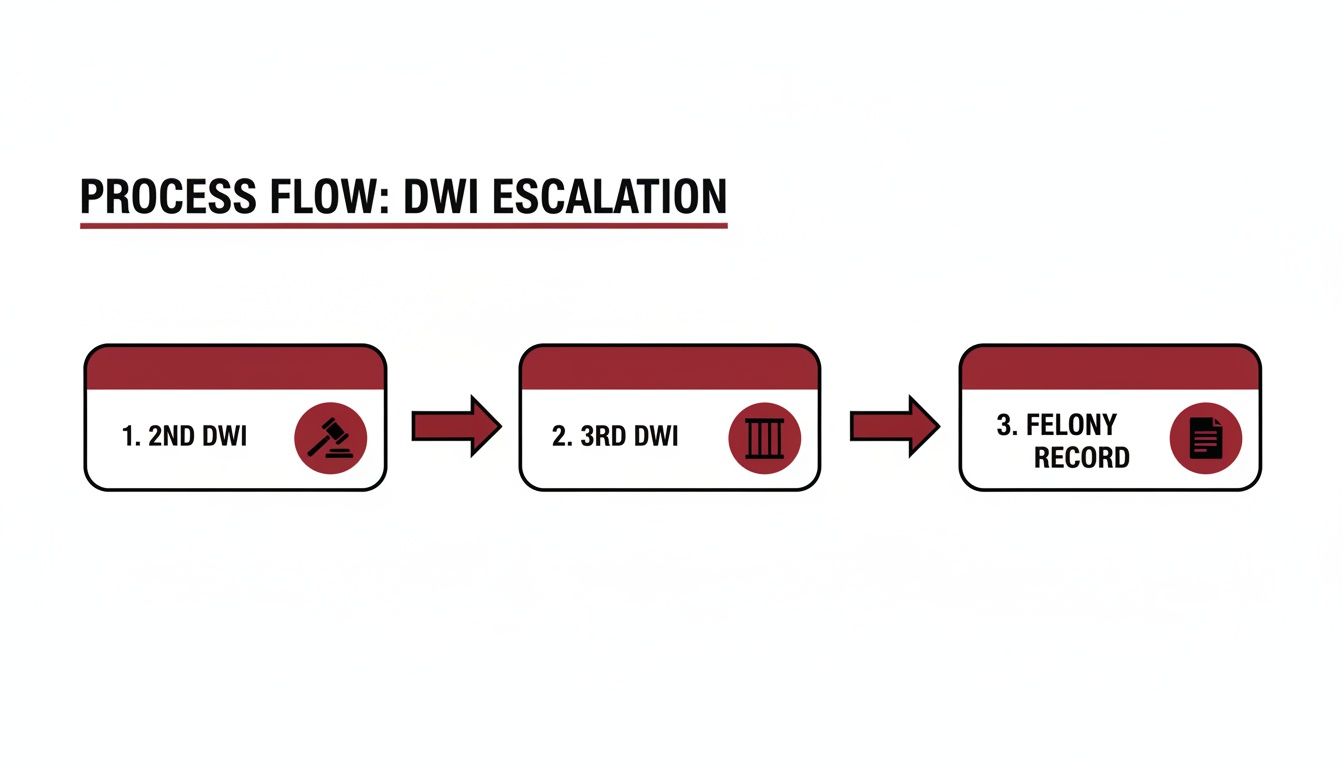
As you can see, a second DWI puts you one step away from a third, which automatically becomes a life-altering felony conviction. That’s why you have to fight every single battle.
The clock on your driving privileges starts ticking the moment you're arrested. You have only 15 days from the date of arrest to request an ALR hearing. If you miss that deadline, your license is automatically suspended.
This automatic suspension happens regardless of whether you are eventually found guilty in your criminal case. Fighting it at an ALR hearing is your first—and often best—opportunity to challenge the evidence and keep your license.
Keeping Your Life Moving With an Occupational License
Even if your license is suspended, either through the ALR process or as part of a criminal sentence, you may not be completely stranded. Texas law provides a path forward called an Occupational Driver's License (ODL), sometimes known as an essential needs license.
An ODL is a special, restricted license that allows you to drive to and from specific, essential locations during your suspension period. This typically includes:
- Driving to and from your job.
- Traveling for school or required educational classes.
- Handling essential household duties, like grocery shopping or taking your children to school.
Getting an ODL is not automatic; you must petition the court and prove that you have an essential need to drive. While it is not a full restoration of your driving privileges, it is a vital tool that allows you to keep your job and manage your daily life while the rest of your DWI case proceeds.
The Hidden Costs Of A DWI Conviction
When a judge hands down a sentence for a DWI, most people focus on the official fines and potential jail time. But that is just the beginning. The true punishment of a Texas DWI is not what you see on paper; it is the mountain of hidden costs that will follow you long after the court case is closed. These consequences create a ripple effect, touching every corner of your life for years.
Understanding this is critical because it highlights what is really at stake. A strong legal defense is not just about fighting criminal charges—it is about protecting your financial stability, your career, and your future.
The Financial Aftershock of a DWI
Beyond the court-ordered fines, a DWI conviction triggers a long list of mandatory expenses that can easily spiral into thousands of dollars. These fees are not optional. They are a standard part of the punishment, designed to create a significant financial burden.
Be prepared to face a series of bills for services and programs required by the court or the state:
- Court Costs and Fees: These administrative charges can add hundreds of dollars on top of your criminal fine.
- Probation Supervision Fees: If you receive community supervision, you will pay a monthly fee, typically $60 to $100, for the entire term.
- Mandatory DWI Education Classes: You must pay for and complete a state-approved DWI education or intervention program out of your own pocket.
- Ignition Interlock Device (IID): If one is ordered, you are responsible for installation (often $100-$200) and monthly monitoring fees (around $80-$100).
- License Reinstatement Fees: Once your suspension period ends, you still have to pay the DPS to get your driver's license back.
These expenses add up quickly, turning a single mistake into a prolonged financial challenge. For a deeper dive into these expenses, you can learn more by reading our complete DUI cost breakdown and its consequences.
Long-Term Damage to Your Personal and Professional Life
Frankly, the most damaging costs of a DWI conviction often don't come with a price tag. A DWI on your permanent criminal record creates a stigma that can close doors and limit your opportunities for the rest of your life. It is a label that is incredibly difficult to overcome.
This is where the punishment extends far beyond the courtroom, impacting your daily life in deeply personal ways.
A DWI conviction is more than a legal outcome; it's a permanent mark on your record that can impact your ability to earn a living, secure housing, and even maintain family relationships.
Consider how a conviction could affect your future:
- Skyrocketing Car Insurance Rates: Your insurance premiums will increase dramatically, often doubling or tripling. Some insurers may drop your coverage entirely, forcing you to find a high-risk provider at an exorbitant cost.
- Employment Challenges: A huge number of employers run background checks. A DWI can instantly disqualify you from jobs that require driving, operating machinery, or holding professional licenses (like for nursing, real estate, or commercial driving).
- Housing and Rental Difficulties: Landlords almost always run background checks on potential tenants. A recent DWI can lead to an automatic denial of your rental application.
- Impact on Child Custody: In family law cases, a DWI conviction can be used against you to argue that you are an irresponsible parent, potentially impacting custody or visitation arrangements.
These collateral consequences are a harsh, lasting form of Texas DWI punishment. They show exactly why mounting an aggressive defense is not just about avoiding jail, but about protecting your entire future.
How A DWI Defense Attorney Can Fight For You
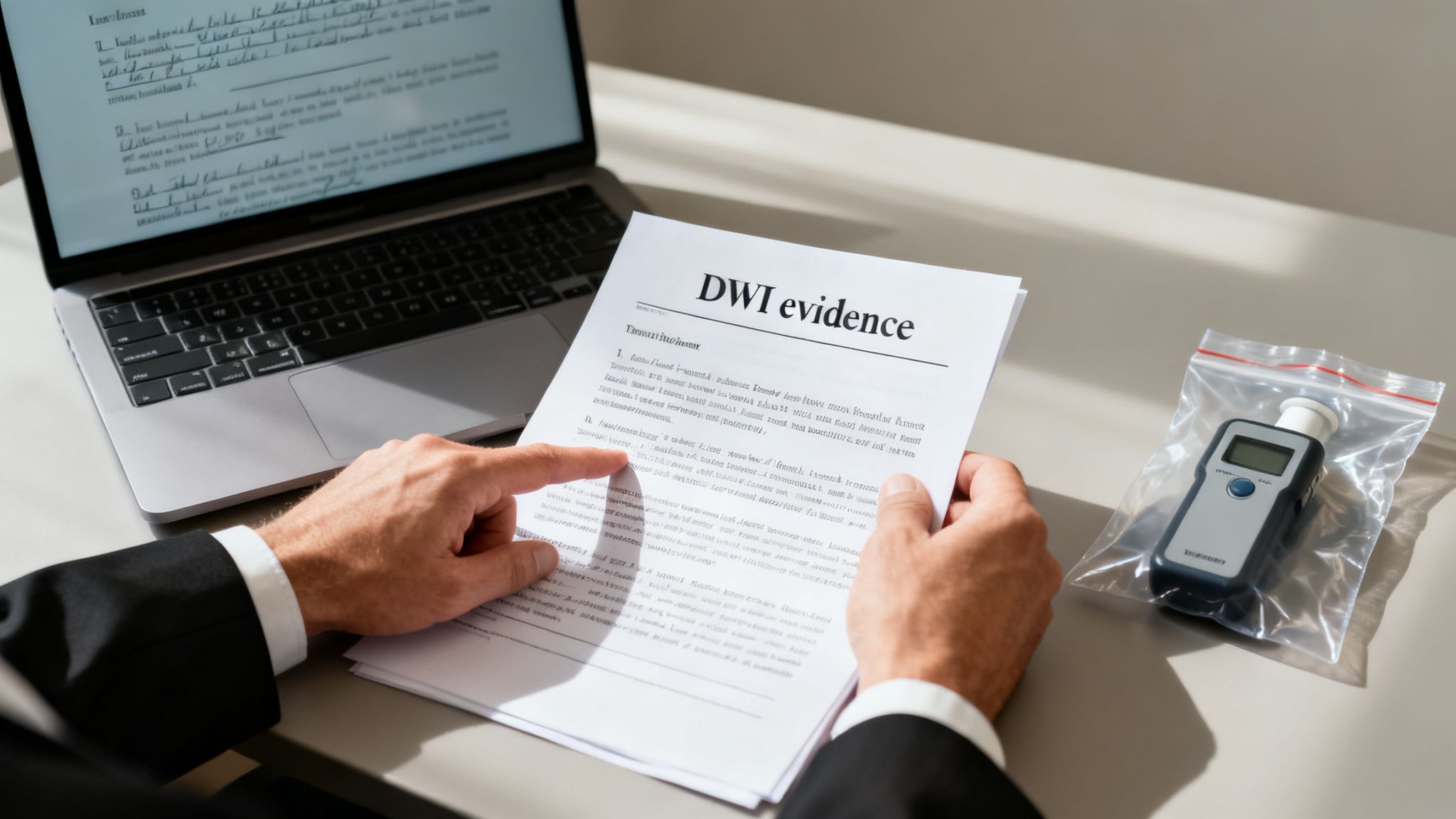
Facing the Texas justice system alone after a DWI arrest is an intimidating prospect. The laws are complex, prosecutors are aggressive, and the potential Texas DWI punishment can turn your life upside down. This is where a skilled DWI defense attorney becomes your most important ally. Remember, an arrest is not a conviction. Our job is to build a defense aimed at keeping it that way.
The key to a strong defense is knowing that almost every DWI case has weak spots. A good lawyer knows exactly where to look for them. From the moment you hire us, we investigate every detail of your arrest. We do not just accept the police report at face value—we challenge it at every turn.
Scrutinizing Every Piece of Evidence
Think of the prosecution's case like a chain. Our mission is to find the weakest link and break it. We start at the very beginning: the traffic stop. Did the officer have a legal reason, known as "reasonable suspicion," to pull you over in the first place? If not, everything that followed—the tests, the arrest—could be thrown out of court.
Next, we examine the "evidence" of intoxication. This is not a single attack; it is a battle on multiple fronts:
- Challenging Field Sobriety Tests: These tests are notoriously unreliable and difficult to perform perfectly even when sober. We investigate whether the officer administered them correctly and if other factors—like medical conditions, fatigue, or even bad weather—could have affected your performance.
- Questioning Breathalyzer and Blood Test Results: Breathalyzer machines must be properly calibrated and maintained to be accurate. We demand the service records. If the machine was faulty or the officer was not properly certified to use it, the results may be unreliable. With blood tests, we scrutinize the chain of custody from your arm to the lab to ensure the sample was not contaminated or mishandled.
Negotiating From a Position of Strength
Once we find these weaknesses, we gain powerful leverage to use in negotiations with prosecutors. When we show the state that their case is not as strong as they thought, they often become more willing to consider a better outcome for you. This could mean reducing the charge to something less severe, like reckless driving, or getting you into a diversion program that could lead to a full dismissal.
DWI arrests in Texas's major cities remain common. Harris County consistently leads the state, with over 12,000 DWI charges filed annually in recent years. These numbers prove that law enforcement is focused on DWI, which makes having a strong defense more critical than ever. You can discover more statistics about Texas DWI enforcement on ZealousAdvocate.com.
An arrest is just the prosecution's version of events. A skilled defense attorney is your storyteller, presenting the facts in a way that protects your rights and highlights the reasonable doubt in the state's case.
Our work doesn't stop at the courtroom door. We are your guide through this entire process, answering your questions, explaining your options, and helping you navigate the confusing administrative battle to save your driver's license. For a closer look at that process, check out our guide on getting DWI license help from a criminal defense attorney. We are your advocate in court and your trusted advisor every step of the way.
Answers to Your Most Urgent DWI Questions
When you are facing a DWI charge, the "what ifs" can be overwhelming. You need clear answers, not legal jargon. This section addresses the questions that are likely on your mind right now.
Our goal is to provide clarity on the practical matters that are most important to you.
Am I Guaranteed to Go to Jail for a First DWI in Texas?
Not necessarily. While the law allows for jail time on a first offense, it is not a foregone conclusion. Many first-time offenders are able to secure community supervision—what most people call probation.
An experienced lawyer can often negotiate this outcome, especially when there are no other aggravating factors. Probation allows you to serve your sentence outside of a jail cell, but you must follow a strict set of rules. This almost always includes a DWI education class and often means installing an ignition interlock device on your car. Achieving this result depends heavily on the specific facts of your case and the strength of your legal strategy.
A first-time DWI is incredibly serious, but it doesn't have to ruin your life. With a proactive defense that focuses on negotiation and highlights the positive aspects of your situation, we can often find alternatives to keep you out of jail.
How Long Does a DWI Stay on Your Record in Texas?
The hard truth is that a DWI conviction in Texas stays on your criminal record permanently. It does not fade away with time. This is a critical point because a permanent mark on your record can follow you for decades, creating challenges for jobs, housing, and professional licenses.
However, in some cases, you may be able to clear your record. There are two legal paths for this:
- Expunction: This is the ideal outcome. An expunction completely destroys the record of your arrest, as if it never happened. This is generally only an option if your case was ultimately dismissed, you were found not guilty at trial, or you successfully completed a specific pre-trial diversion program.
- Order of Nondisclosure: This is a form of record sealing. It does not erase the record, but it does hide it from the public and most private employers. This may be an option for certain first-time offenders after they successfully complete probation and a mandatory waiting period.
Neither of these outcomes is automatic. Both require navigating a complex legal process, and having an experienced attorney guide you is essential.
What Are the Consequences of Refusing a Breathalyzer Test?
Refusing a breath or blood test comes with its own immediate consequences due to Texas's "implied consent" law. By driving on a Texas road, you have legally agreed to provide a sample if you are lawfully arrested for DWI.
If you refuse, you trigger an automatic driver's license suspension. For a first-time refusal, that suspension lasts for 180 days. This is an administrative penalty, completely separate from your criminal DWI case. In fact, your license can remain suspended even if your criminal charges are later dropped.
While you have the right to refuse the test, the prosecutor can use that refusal against you in court, arguing that it is evidence of guilt. It is absolutely critical to contact an attorney immediately to fight this automatic suspension by requesting an ALR hearing within the 15-day deadline.
If you’ve been charged with a crime in Texas, call The Law Office of Bryan Fagan, PLLC for a free and confidential consultation. Our defense team is ready to protect your rights.