Skip to content
Being arrested in Texas can be terrifying, especially when you thought the law had changed in your favor. A lot of people hear “constitutional carry” and assume that means carrying a handgun is legal almost everywhere. Then a traffic stop, a misunderstanding, or a gun found in the wrong place turns into a criminal charge.
If that's where you are right now, take a breath. A UCW arrest does not automatically mean a conviction, and it doesn't mean your life is over. But it does mean you need a clear understanding of what texas penal code ucw says, where people get trapped, and what options may still be available to protect your record, your job, and your future.
An Arrest for Unlawful Carrying of a Weapon Can Be Terrifying
A UCW arrest often feels unfair because the law sounds simple from the outside. You may have believed you were following Texas gun laws. You may have kept the handgun in your vehicle, carried it for protection, or assumed that because permits are no longer required in many cases, there was nothing illegal about what you did.
That confusion is common. Texas expanded handgun carry rights when House Bill 1927 took effect on September 1, 2021, but Texas Penal Code 46.02 still contains several separate ways a person can be charged with unlawful carrying of a weapon, according to this Texas UCW overview.
The hardest part for many people is this. You can be a lawful gun owner and still get arrested under a narrow exception you didn't know existed.
Why good people still get charged
UCW cases often start with ordinary situations:
- A traffic stop where an officer sees a handgun in plain view
- A bag or console search where a firearm is found within reach
- A night out where alcohol becomes part of the story
- A past conviction that changes what would otherwise be a misdemeanor into something much more serious
Practical rule: The question usually isn't just “Did you have a gun?” The real question is “Where was it, how was it carried, and did any exception make that carry illegal?”
If you're worried about what happens next, you're not alone. A criminal case has stages, and each one matters. After an arrest, the focus usually turns to bail, charging decisions, arraignment, plea discussions, pretrial motions, trial preparation, and, if necessary, sentencing. In many cases, your defense starts long before trial by challenging the stop, the search, or the way the prosecutor reads the statute.
People facing UCW charges are often also dealing with fear about work, family, and reputation. That's understandable. A weapon charge on a background check can create immediate stress, even before the case is resolved.
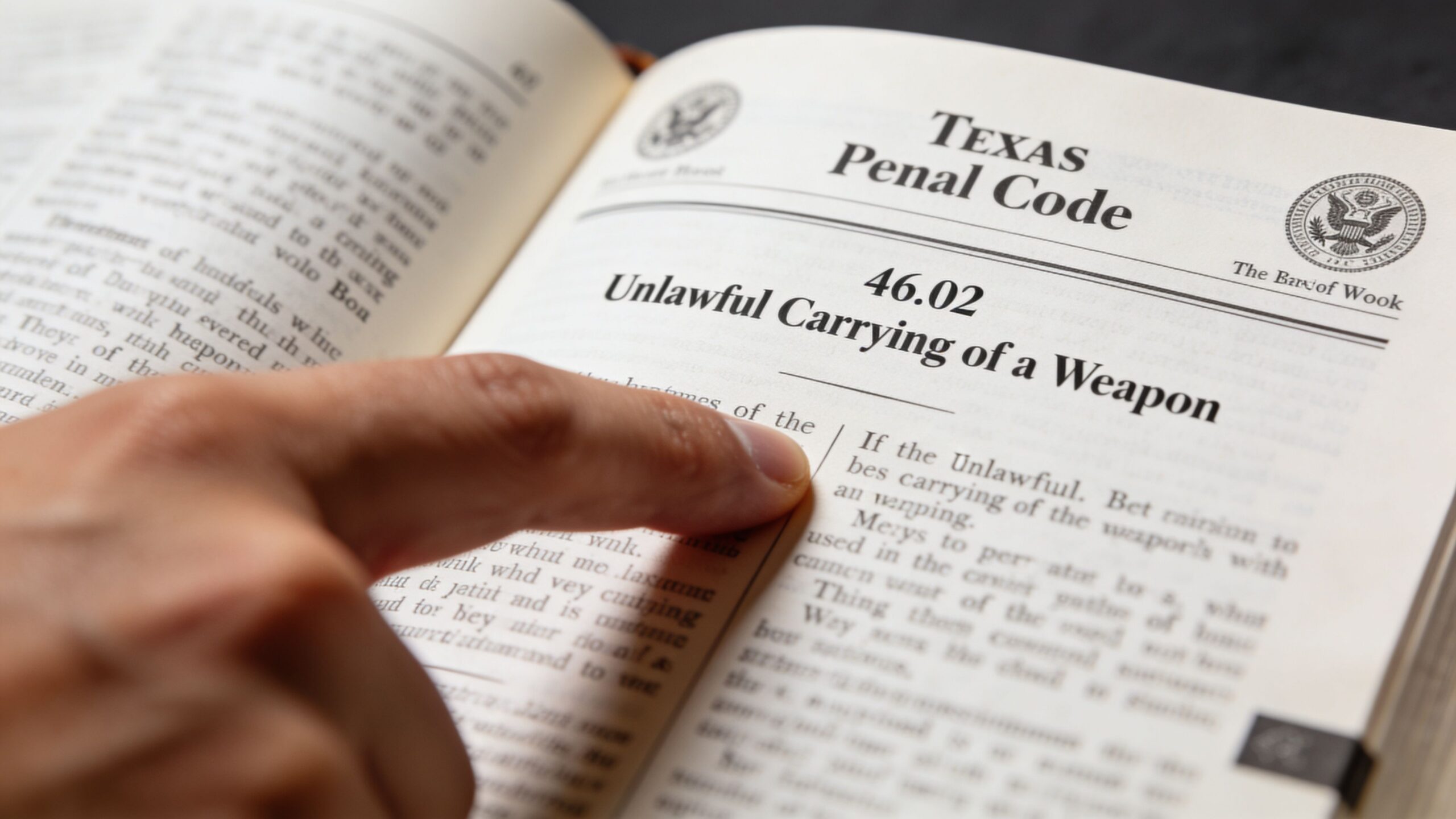
What Exactly Is UCW Under Texas Penal Code 46.02
A lot of Texans hear "constitutional carry" and assume UCW is old news. Then an arrest happens after a traffic stop, a handgun is found in a console or bag, and suddenly the law feels nothing like what they thought it was.
That confusion is common because Texas Penal Code 46.02 does not ban "having a gun" in one simple way. It lists specific situations where carrying a handgun becomes illegal. In other words, UCW cases usually turn on details. Where the gun was, how accessible it was, whether it was visible, whether alcohol was involved, and whether some other legal restriction applied.
What prosecutors usually have to prove
In plain English, the State usually must prove you carried a handgun intentionally, knowingly, or recklessly. That mental state matters, but it often surprises people because the law does not always require proof that you meant to break the law.
Reckless can be enough. A prosecutor may argue that you were aware of a risk and ignored it. For example, saying, "I forgot it was in the backpack," does not automatically end the case if the surrounding facts suggest you should have known it was there.
That is one reason UCW charges still catch otherwise careful gun owners. The legal question is often less about bad intent and more about whether the State can frame the carry as careless under the statute.
What “on or about your person” really means
This phrase causes trouble because it sounds narrower than it is.
A handgun can be "on or about" your person even if it is not in your hand or on your waistband. If it is close enough for ready access, police and prosecutors may treat it as within your possession for UCW purposes. In a vehicle, that can include a center console, glove box, door pocket, purse, backpack, or a bag on the passenger seat.
Your phone offers a useful comparison. If it is in the cupholder, you would still say it is within reach. Courts often apply similar practical reasoning to firearms.
That broad reading explains why vehicle cases come up so often. A person may believe the gun was stored, not carried. An officer may describe the same facts as immediate access to a handgun in a setting covered by the statute.
A UCW case does not require a handgun to be physically touching you. If officers say it was close enough to reach, that fact can drive the entire prosecution.
Why UCW is still confusing after the 2021 law change
Section 46.02 is hard to read because it addresses several different fact patterns in one statute. Some parts focus on age. Some deal with carry in a motor vehicle or watercraft. Others address public carry while intoxicated, intentional display in public, or situations involving prior convictions that change a person's legal status.
That is why two people arrested for UCW may have very different cases, even if both involved a handgun and a traffic stop. One case may center on whether the gun was in plain view. Another may rise or fall on intoxication. Another may involve a prior conviction that changes the charge level.
If you are trying to make sense of your own case, focus on the facts that usually matter first:
- Where the handgun was found
- Whether it was concealed, visible, or allegedly displayed
- Whether you were in a car, in public, or on private property
- Whether police claimed alcohol, another offense, or reckless conduct was involved
- Whether a past conviction or legal restriction changed your right to carry
Those details are the difference between "I thought this was legal" and what the prosecutor will try to prove in court.
How Constitutional Carry Changed Texas Gun Laws And How It Didn't
You are driving home after work with a handgun in your car. You are over 21. You have heard Texas is now a constitutional carry state, so you assume a traffic stop should be routine. Then the officer asks about weapons, sees the gun, and suddenly you are in handcuffs trying to understand how this can still be a crime.
That confusion is common. The 2021 law changed a lot, but it did not wipe out Unlawful Carrying of a Weapon charges under Penal Code 46.02. In practice, it removed one barrier for many adults. It also left behind a maze of exceptions that still catches careful, otherwise law-abiding gun owners.

What changed in 2021
House Bill 1927 expanded handgun carry rights for many adults 21 and older who are not otherwise prohibited from possessing a firearm. Before that change, many people focused on whether they had a license. After the change, many stopped asking the harder question, which is whether their specific facts still fit one of the remaining restrictions.
A helpful way to understand the law is this: constitutional carry changed the license rule for many people, but it did not erase the conduct rules. Texas still restricts carry based on age in some situations, criminal history in some situations, intoxication, manner of carry, and location. The summary of Texas UCW law and the post-2021 changes outlines several of those limits.
What stayed the same
The safest reading of the 2021 change is narrow. It gave many Texans broader rights to carry a handgun without a license. It did not create a general right to carry any weapon, in any place, under any condition.
That is why UCW cases still happen.
A charge can still grow out of facts such as:
- Age limits that still apply under the statute
- A recent qualifying conviction or another legal restriction
- Carrying while intoxicated
- Carrying in a manner the statute still prohibits
- Carrying a weapon other than a handgun under different rules, such as the rules on the legal knife length in Texas
Why vehicle cases still trip people up
Cars are where the confusion shows up most often. People hear "constitutional carry" and assume a handgun in a vehicle is automatically lawful if they are old enough and otherwise eligible to possess it. Real cases are rarely that simple.
Vehicle carry works a lot like a rule with footnotes. A person may be lawful in one traffic stop and charged in another because one added fact changes everything. The officer may claim the gun was in plain view. The State may argue the person was engaged in criminal activity beyond a mere traffic violation. Alcohol, another alleged offense, or the way the handgun was displayed can shift the case quickly.
That does not mean every arrest is proper. It means the answer often depends on details that get sorted out later, not on the roadside.
Why the 2021 change created more misunderstanding, not less
The public message was simple: Texas no longer requires a license for many adults to carry a handgun. The legal reality stayed technical. That gap between the headline and the statute is where many people get trapped.
A worried client will often tell me, "I thought they changed the law." Many times, that belief makes sense. The problem is that criminal statutes are not written like headlines. They are written with exceptions, cross-references, and categories that only show up after an arrest.
This short video helps illustrate how quickly these legal changes became confusing in practice.
The practical lesson
Constitutional carry removed one part of the old system. It did not remove the risk of a UCW charge. If you remember only one point, remember this one: the question is no longer just "Do I need a license?" The better question is "Do my exact facts still fit one of the exceptions?"
Many UCW arrests happen because someone relied on the broad public message about constitutional carry and never saw the narrower rules still in force.
If you were arrested after believing your conduct was legal, that belief may help explain what happened. It does not end the case by itself. A defense lawyer still needs to examine the stop, the search, the officer's description of the weapon, whether another offense was really present, and whether the charged subsection matches the facts.
Places Where Carrying a Weapon Is Always a Crime
A common arrest starts with an ordinary errand. Someone walks into a courthouse with a handgun they usually keep in the car, or steps into the wrong part of an airport, or meets friends at a place that turns out to be a 51% business. The person is not trying to commit a violent crime. Still, the location alone can trigger a weapons charge.
That is one of the biggest sources of confusion after the 2021 constitutional carry change. People heard, correctly, that many adults no longer needed a license to carry. They did not hear the second half clearly enough. Texas still bans weapons in certain places, and those location rules catch a lot of otherwise law-abiding gun owners.
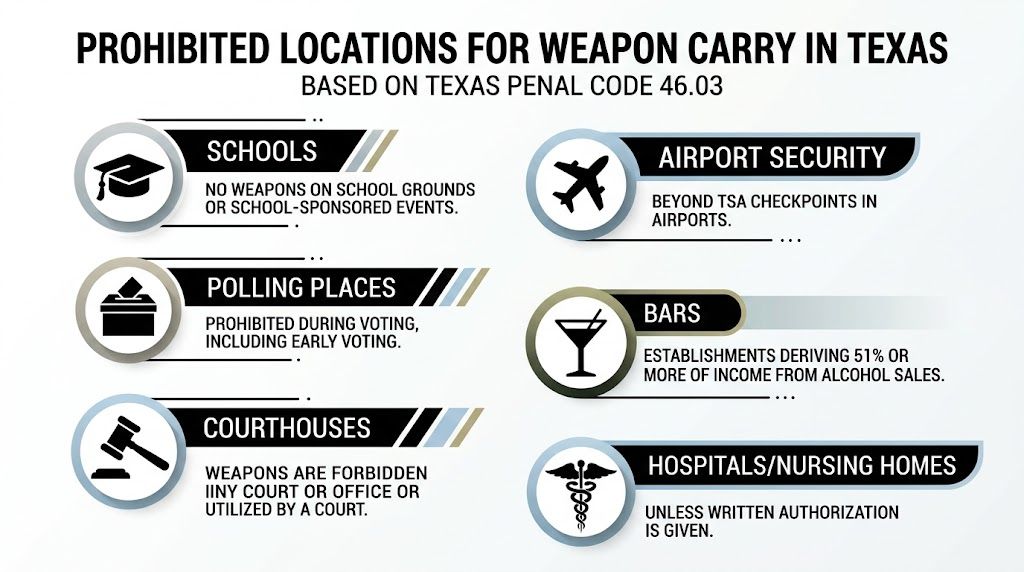
Common prohibited places
Some locations are treated almost like a bright red line. If the facts place you inside that line, the case often becomes much more serious, much faster.
Frequent problem areas include:
- Schools and school events. School grounds, school buildings, and many school-sponsored activities can create criminal exposure.
- Polling places during voting. Restrictions apply during voting and early voting periods.
- Courthouses and court offices. If the space is used by a court or court staff, carrying there can lead to immediate trouble.
- Airport secured areas. The checkpoint matters. Past that point, a mistake can become a criminal case.
- Correctional facilities. Visits, drop-offs, and transport situations can all create risk.
- Hospitals and nursing homes in some circumstances. These cases often turn on the exact property involved and whether legal notice was given.
Details matter here. A parking lot, a sidewalk, a connected office suite, or a leased part of a larger building can change the legal analysis. Clients are often surprised by how much turns on exactly where they were standing.
If you also carry a knife, learn those rules separately. Texas does not treat every weapon the same way, and the legal length of a knife in Texas can become a separate issue from a handgun case.
The 51 percent rule
The alcohol rule causes a lot of confusion because the building may look like an ordinary restaurant or entertainment venue. Under Texas law, some businesses make more than 51% of their income from alcohol for on-premises consumption. Carrying a handgun there can lead to very serious charges.
A simple way to understand it is this. The law focuses on how the business is classified, not on what you guessed it was. A place can serve food, host events, or look family-friendly and still fall into the restricted category.
Texas Penal Code §46.02 includes location-based handgun offenses tied to these alcohol-focused businesses. The current statutory text is available in Texas Penal Code §46.02 on Justia. Reported Texas court filings from 2024 showed an increase in these types of charges after the law changed, which matches what many defense lawyers have seen in practice. People assume the broad carry rule protects them, then learn too late that the address mattered more than the license issue.
Why these cases are so risky
Location cases are hard because they often sound simple when a prosecutor tells the story. "He had a gun in a prohibited place" is a short sentence, and short sentences can be powerful in court.
But the facts are often more complicated. Was the area part of the prohibited premises? Was there effective notice where notice matters? Was the officer correct about where your client entered, stopped, or stored the weapon? In many cases, the map matters as much as the gun.
Takeaway: If your arrest happened at a school, courthouse, airport secured area, polling place, correctional facility, hospital, nursing home, or 51% business, do not assume the case is straightforward. The exact location can control the entire defense.
What to do if you were arrested in a prohibited place
Start preserving facts right away. Memory fades quickly, and these cases often turn on small details.
- Write down exactly where you were. Include the entrance, room, parking area, or checkpoint.
- Describe any signs you saw, or did not see. Signage can matter.
- Save receipts, tickets, texts, and calendar entries. They help establish why you were there and when you entered.
- Do not post about the incident online. Prosecutors and police can look at social media.
- Talk to a defense lawyer early. A lawyer can compare the charged location to the statute and the actual property layout.
That early fact-gathering helps more than many people expect. In a prohibited-place case, a few feet, one doorway, or one missing sign can make a real difference.
Understanding the Penalties for a UCW Conviction
A lot of good people call my office after a UCW arrest and ask the same question: am I really facing jail over this?
Sometimes, yes. That is what catches people off guard after Texas changed its carry laws in 2021. Constitutional carry led many Texans to believe unlawful carrying charges had mostly disappeared. They have not. Prosecutors still file these cases because the exceptions still matter, and the penalty can change fast based on where the weapon was, how it was carried, and whether the person was legally barred from having a firearm.
The basic penalty structure
For many UCW cases under Texas Penal Code 46.02, the charge is a Class A misdemeanor. In plain terms, that means a case serious enough to bring possible county jail time, a substantial fine, a criminal record, and collateral problems with work, housing, and professional licensing.
Some cases are more serious from the start. If the allegation involves someone who is prohibited from possessing a firearm under Texas Penal Code 46.04, the case may be charged as a felony instead of a misdemeanor. That changes the risk in a major way. A misdemeanor can disrupt your life. A felony can reshape it for years.
A simple way to understand it is this. Texas law treats UCW like a traffic stop that can stay small or suddenly turn into a wreck. One extra fact, a prior conviction, prohibited possessor status, or the wrong location, can push the case into a much harsher punishment range.
Texas UCW Penalty Ranges
| Offense Type | Classification | Maximum Jail/Prison Time | Maximum Fine |
|---|---|---|---|
| Many UCW charges | Class A misdemeanor | Up to 1 year in county jail | $4,000 |
| UCW involving prohibited possessor status under Penal Code 46.04 | Third-degree felony | 2 to 10 years in prison | $10,000 |
| More serious prohibited possessor exposure under Penal Code 46.04 | Second-degree felony | 2 to 20 years in prison | $10,000 |
These are the outer limits, not an automatic sentence. The actual outcome depends on the facts, your history, the county, the prosecutor, and the quality of the defense.
Why prior history matters so much
Prior history affects more than punishment at the end of the case. It can shape the case from day one.
For example, a prior conviction may affect how the State views plea offers, whether the prosecutor pushes for stricter bond conditions, and whether a judge sees the allegation as an isolated mistake or part of a larger pattern. In weapons cases, your record often changes the temperature of the room before anyone even argues the legal issues.
That is one reason early case review matters. A defense lawyer is not only looking at the charge itself. Your lawyer is also looking at what facts the State may try to use to make the case sound worse than it is.
What the process usually looks like
A UCW case usually moves through several stages, and each stage creates opportunities to protect you.
- Arrest and booking. Police prepare reports, take property, and enter the charge.
- Bond and release. The court may impose conditions that limit firearm possession or travel.
- Initial court setting. You are formally advised of the accusation and given future court dates.
- Evidence review. Your lawyer examines the reports, body camera footage, witness statements, and the exact statutory language.
- Legal challenges. If the stop or search was unlawful, your lawyer may file motions to keep evidence out. This guide on how a motion to suppress evidence works in Texas explains why that can matter so much.
- Negotiation or trial. Some cases are reduced or dismissed. Others have to be fought in court.
- Sentencing, if there is a conviction. The judge or jury decides punishment within the legal range.
One sentence in a police report can matter here. So can one body camera clip. So can one mistaken assumption about where carry was legal.
The practical takeaway
A UCW conviction is not a minor paperwork problem. Even a misdemeanor can carry jail exposure and long-term record consequences. A felony raises the stakes much higher, including effects on civil rights, firearm rights, and future opportunities.
At the same time, a charge is still only an accusation. In Texas UCW cases, hidden exceptions and small factual details often decide whether the State has a strong case or a weak one. That is why people who believed they were following the law after constitutional carry still get arrested, and why some of those cases can be challenged successfully.
Building Your Defense Against a UCW Charge in Texas
An arrest is the State's accusation. It's not the final word.
UCW cases often look stronger at the moment of arrest than they do after a defense lawyer reviews the traffic stop, the search, the body camera footage, and the exact language of the statute. Small details matter in these cases because Texas Penal Code 46.02 has multiple moving parts.

Defense starts with the stop
Many UCW charges begin with a vehicle stop. If the officer didn't have a lawful reason to stop you, everything that followed may be challenged.
That includes the officer's observations, statements you made, and evidence found during the encounter. A weak stop can become the center of the defense.
Search issues can change the case
Police don't get unlimited access to your vehicle or your bags just because a weapon is involved. If the search violated the Fourth Amendment, the court may keep that evidence out.
A strong motion to suppress can be one of the most effective tools in a weapons case. If you want to understand that process better, this guide on what a motion to suppress evidence means in Texas explains how defense lawyers challenge illegally obtained evidence.
The strongest defense isn't always “I didn't do it.” Sometimes it's “The police weren't allowed to get that evidence in the first place.”
The facts may fit an exception
Some UCW cases fall apart because the prosecutor's version leaves out an important exception. Depending on the situation, the defense may focus on whether you were on your own premises, in a place under your control, or directly en route to your vehicle.
That kind of defense is fact-heavy. It may depend on timing, location, ownership, consent, and whether the officer correctly understood what you were doing.
Mental state still matters
Even though the law allows reckless conduct to satisfy the mental-state requirement, prosecutors still have to prove the facts fit the charged subsection. In some cases, what looks suspicious at first turns out to be misunderstanding, poor police assumptions, or missing context.
Your statements can matter here. So can whether the handgun was accessible, visible, or carried in the way the State claims.
Plea bargaining and trial strategy
Not every strong defense ends in a jury trial. Sometimes a careful investigation gives your lawyer an advantage to push for dismissal, reduction, deferred adjudication, or another outcome that protects your future better than a conviction would.
If the prosecutor won't back down, trial may become the right path. At trial, the defense can challenge:
- Whether the stop was lawful
- Whether the search was lawful
- Whether the gun was on or about your person
- Whether the statutory exception applies
- Whether the State charged the right subsection
- Whether the evidence proves the required mental state
What you should do right now
If you've already been arrested, your next moves matter:
- Stay off social media about the case.
- Don't try to explain everything to police after the fact.
- Keep all documents you received at arrest or release.
- Write down the timeline while it's still fresh.
- Talk to a defense lawyer before entering a plea if at all possible.
A UCW case can look straightforward from a distance. Up close, many of them are not.
Clearing Your Name After a UCW Case Expunction and Nondisclosure
For many people, the biggest fear isn't jail. It's the record.
Even when a UCW case ends without a conviction, the arrest itself can still show up on background checks. That's why post-case relief matters. Texas law gives some people a path to clear or limit public access to their criminal record, but the right option depends on how the case ended.
Expunction and nondisclosure are not the same
An expunction removes records of the arrest from public view in a much stronger way. In general terms, it's the cleanest outcome because it targets the record itself.
An order of nondisclosure is different. It seals the record from public view in many situations, but it doesn't erase the case in the same way an expunction does.
That distinction matters when you're applying for jobs, housing, or professional opportunities.
When expunction may be available
Expunction is often a possibility when a case is dismissed, when charges were never filed, or when the law otherwise allows the arrest record to be cleared. Eligibility depends on the exact outcome, the offense category, and whether waiting periods apply.
Some people assume they can file right away. That's not always true. Timing matters, and filing too early can create problems.
If your case was dismissed after a traffic stop, a search problem, or a weak prosecution theory, expunction may be a key next step. It can be just as important as winning the case itself because it helps you move forward without the arrest following you indefinitely.
When nondisclosure may be the better fit
If your case ended in deferred adjudication, nondisclosure may be the realistic option instead of expunction. This remedy can still be very valuable because it limits what the public can see.
The process is not automatic. You usually have to petition the court and show that you qualify.
If you're trying to understand that process, this guide to an order of nondisclosure in Texas is a useful starting point.
Clearing a record is often a second legal project after the criminal case ends. If you ignore it, an old arrest can keep causing new problems.
Why this matters for work and daily life
UCW defendants are often professionals, students, parents, and business owners who have never been in serious legal trouble before. Even a dismissed case can create awkward questions during a background check.
That can affect:
- Employment applications
- Professional licensing
- Apartment screening
- School admissions
- Volunteer opportunities
Post-conviction and post-case relief is part of the recovery process. It matters just as much as the courtroom outcome for many people.
A realistic path forward
If you're in the middle of a UCW case, focus first on the immediate defense. Get the charging documents reviewed. Understand the subsection involved. Evaluate the stop, search, and any available exceptions.
If the case ends favorably, don't stop there. Ask what can be done to clean up the record.
For readers dealing with related criminal concerns, the same general advice applies in other areas too. Whether you're facing a theft allegation, a drug possession charge, a DWI accusation, or an assault case, the process still moves through arrest, arraignment, negotiation, possible trial, and sentencing. And in many of those cases, expunction or record sealing may become the most important final step.
If you’ve been charged with a crime in Texas, call Law Office of Bryan Fagan PLLC for a free and confidential consultation. Our defense team is ready to protect your rights.