Being accused of stealing can upend your life fast. One moment you are leaving a store, ending a work shift, or dealing with a property dispute. The next, you are worrying about jail, your job, your family, and what a theft case could do to your record.
That fear is present. So is the confusion. Many people charged with theft of property texas have never been arrested before. They do not know what the State has to prove, what happens next in court, or whether a bad situation can still be contained.
The good news is simple. An accusation is not a conviction. Theft cases often turn on details that are easy to miss at first, including consent, intent, value, and how police or store personnel handled the investigation. If you understand the process early, you make better decisions and avoid mistakes that can hurt your case.
Facing a Theft Charge in Texas? You Are Not Alone
You walk out of a store after using self-checkout, and an employee stops you over an item they say was not scanned. Or a former partner reports that you took property after a breakup. Or an employer accuses you of taking cash, tools, or inventory. That is how many theft cases start in Texas. Fast, confusing, and far more serious than people expect.
Once an accusation turns into a police report or arrest, the pressure builds quickly. You may be worried about jail, your job, your family, or how a background check will read before you have even had a chance to explain what happened. I have seen that panic many times, especially from people with no prior record.

Texas courts see these cases often. In a recent fiscal year, the Texas Department of Criminal Justice reported 11,088 property crime convictions, and 2,511 involved larceny or theft, according to the TDCJ Fiscal Year 2025 statistical report.
That does not make your case hopeless. It means the State has a process, and you need one too.
Early strategy matters. A theft case can involve store reports, surveillance video, receipts, text messages, account records, witness statements, and property value disputes. Small facts can change the charge, the plea options, and the long-term damage to your record.
For a new client, I usually focus on four immediate priorities:
- Protect your rights: Do not give statements to police, loss prevention staff, or the complaining witness in an effort to clear things up.
- Preserve favorable evidence: Receipts, phone messages, location data, and video can help you, but they can also disappear.
- Measure the risk: The initial allegation does not always match what the prosecutor can prove.
- Look past the first court date: A good case plan considers dismissal, reduction, trial posture, and what can be done later to clear your record if you qualify.
Remember, a theft arrest is the start of a legal process, not the end of your future.
People often make three avoidable mistakes. They assume possession of the property ends the case. They believe returning the item will make the case disappear. Or they treat a misdemeanor as minor and wait too long to get legal advice, even though the record can affect employment, housing, immigration status, and professional licenses.
A steady response gives you better options. The goal is not just to get through the accusation. The goal is to protect your position at every stage, from the first report and court settings to any chance later for expunction or nondisclosure if the outcome allows it.
What Legally Constitutes Theft in Texas
A client will often say, "I had the item, but I was not stealing it." That is a fair starting point, because possession alone does not answer the legal question in Texas.
Under Texas Penal Code §31.03, the State has to prove two things. First, that you unlawfully appropriated property. Second, that you acted with intent to deprive the owner of it. If either part is weak, the case may be weaker than the police report makes it sound.
Unlawful appropriation in plain English
"Appropriation" means taking property or exercising control over it. It becomes unlawful if it was done without the owner's effective consent, if the property was known to be stolen, or if the facts fit another situation covered by the statute.
In real cases, the dispute is often less dramatic than people expect. It may involve borrowed tools, shared household property, employee purchases, family money transfers, business inventory, or a misunderstanding about who had permission to use what.
That is why I look closely at the relationship between the people involved. A stranger shoplifting from a store is one kind of case. A dispute between relatives, roommates, coworkers, or business partners can raise consent issues that are much harder for the State to prove.
Intent usually decides the case
Texas theft law does not punish an accident, a misunderstanding, or sloppy assumptions. The prosecutor still has to prove you intended to deprive the owner of the property.
That point matters because intent is rarely proven by a confession. It is usually inferred from conduct, timing, and surrounding circumstances.
A prosecutor may argue intent based on facts such as:
- Concealment: putting an item in a bag, purse, or clothing
- Leaving without paying: especially in a retail case
- Conflicting explanations: changing the story with store staff, police, or a witness
- Keeping the property: refusing to return it after notice
- Using the property like your own: selling it, transferring it, or hiding it
A defense lawyer studies the same facts from a different angle. Was there permission, or at least apparent permission? Was the item mixed with paid merchandise? Did store employees stop the person before the transaction was finished? Did a workplace policy create confusion instead of criminal intent?
Those details matter. They can affect whether a case is filed, how it is negotiated, and whether the accusation can later be cleared from your record.
Context changes everything
Theft cases are often stronger or weaker based on the setting.
If someone borrows a friend's equipment with permission and returns it late, that may be a personal dispute, not a crime. If someone takes the same equipment after being told not to, denies having it, and refuses to return it, the State has a much cleaner theft theory.
The same is true in workplace cases. Using a company card for an expense you reasonably believed was approved raises a very different defense question than hiding personal charges. In higher-value cases, the charge can quickly become more serious, and the issues discussed in this guide to felony theft in Texas often come into play.
Questions that shape the defense early
A theft defense starts with the legal elements, but it is built through facts. Early case review should focus on questions like these:
| Question | Why it matters |
|---|---|
| Did you have actual consent or a reasonable belief you had consent? | Consent can defeat unlawful appropriation |
| Did your actions show an intent to keep the property or withhold it from the owner? | Intent is a required part of the charge |
| Is this really a criminal case or a civil dispute dressed up as one? | Some property fights belong in civil court, not criminal court |
| Who reported the allegation, and what motive or bias may exist? | Family, business, and employment disputes often produce incomplete or slanted reports |
| What documents or digital records exist? | Texts, receipts, emails, payment apps, and account records often clarify permission and ownership |
A short text message can change the direction of a case.
So can a missing receipt, a store video with no audio, or a witness who assumed too much.
Mistakes that make theft cases harder
Trying to talk your way out of a theft allegation without seeing the evidence is risky. Innocent people often fill gaps in memory, make guesses, or agree with details they do not fully understand. Later, the prosecutor may treat those statements as proof of guilt or intent.
Returning the property also does not automatically erase the accusation. It may help in some negotiations, but it does not cancel the State's burden or guarantee a dismissal.
The better approach is disciplined and early. Preserve records, avoid casual explanations, and evaluate the case with the full timeline in mind. That includes not only the charge itself, but also what outcome may leave you in the best position later if you qualify for expunction or nondisclosure.
The Consequences Understanding Texas Theft Penalties
A theft case can look minor at first, then become much more serious once the State assigns a value to the property. I often tell clients that the dollar amount is not just a label. It can determine whether you are dealing with a fine-only case, possible jail time, or felony exposure that follows you long after court ends.
Even a modest dispute over value can change the charge level, plea options, and what record-clearing relief may be available later.
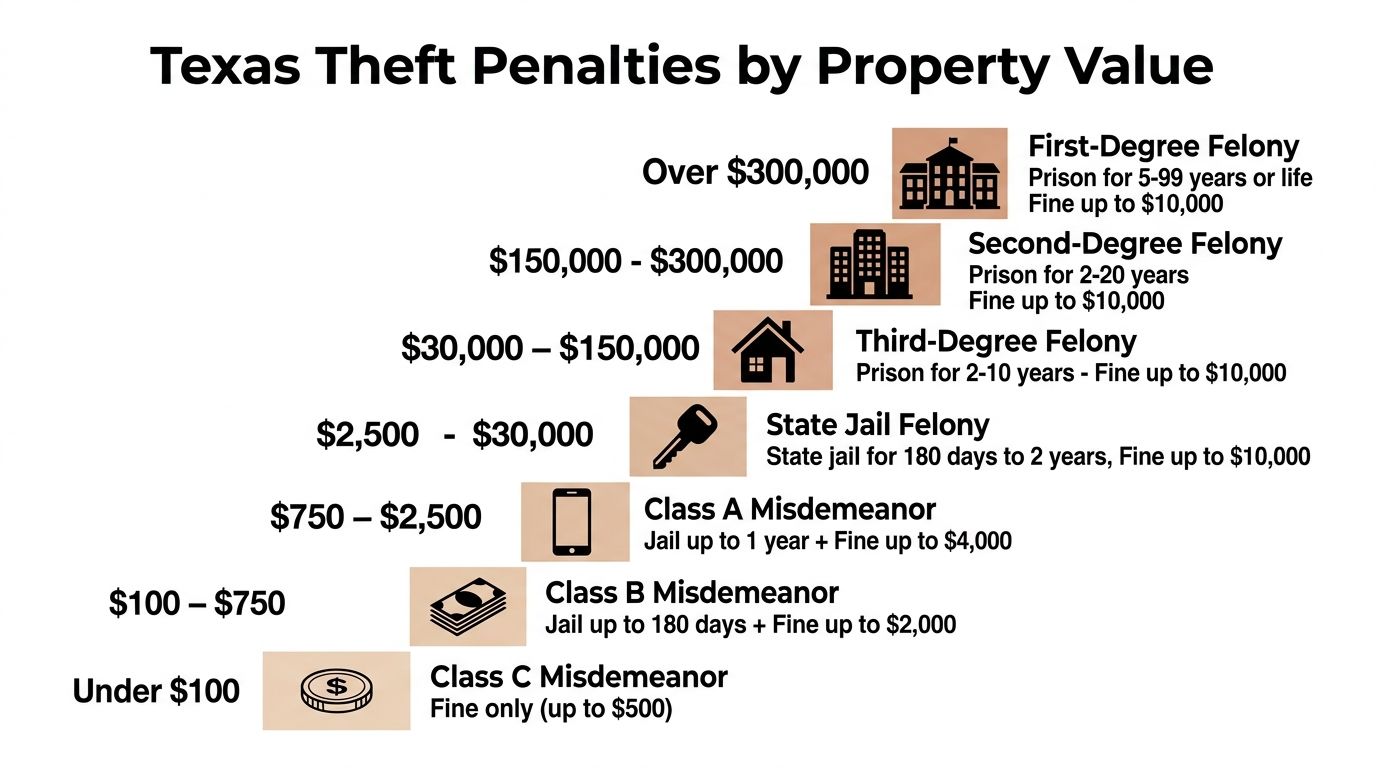
Theft levels by alleged value
Texas theft charges are generally graded by the alleged value of the property:
| Alleged value | Charge level |
|---|---|
| Less than $100 | Class C misdemeanor |
| $100 to $750 | Class B misdemeanor |
| $750 to $2,500 | Class A misdemeanor |
| $2,500 to $30,000 | State jail felony |
| $30,000 to $150,000 | Third-degree felony |
| $150,000 to $300,000 | Second-degree felony |
| $300,000 or more | First-degree felony |
Those ranges matter immediately. They affect the court process, the punishment range, and how aggressively the prosecutor is likely to handle the case.
Why valuation fights matter
The State's number is not automatically the right number.
In many theft cases, prosecutors rely on store pricing, replacement cost, inventory records, or broad estimates. That may overstate fair market value, especially if the item was used, damaged, partly recovered, or bundled together with other property in a way the defense can challenge.
That fight is often worth having. A lower value can mean the difference between a misdemeanor and a felony, or between a felony tier with different sentencing risks. If you want a closer look at higher-level charges, this guide on felony theft in Texas explains how those cases are typically charged and punished.
Penalties can increase for reasons beyond value
Value is only part of the picture. Some cases are enhanced because of the surrounding facts or a person's record.
Texas law can increase exposure if:
- There are prior theft convictions
- The property involved is a firearm
- The allegation fits organized retail theft
These cases often bring harder plea negotiations from the start. Prosecutors may view them as repeat conduct, public-safety concerns, or part of a larger scheme, even when the defense sees weaknesses in the proof.
Punishment is only one part of the risk
Clients usually ask about jail first. That makes sense. But the impact of a theft case often spreads further.
A pending theft charge or conviction can affect:
- Employment, especially positions involving cash, inventory, trust, or professional licensing
- Housing, because background checks can trigger denials before you ever explain the facts
- Reputation, including damage inside a business, school, or family setting
- Immigration status, where even a plea bargain can create serious problems
- Future record clearing, because the final outcome may determine whether expunction or nondisclosure is possible later
That last point gets missed all the time. The result that feels fastest today is not always the result that leaves you in the best position to rebuild your life after the case ends.
What helps and what does not
Helpful evidence includes receipts, repair records, appraisals, photos showing condition, proof of ownership history, and records showing what was returned or recovered. Those details give the defense something concrete to use in negotiations or at trial.
What hurts is guessing about value, relying on random online listings, or making casual statements to law enforcement or the prosecutor before the evidence is reviewed.
The worst move you can make is treating the charge filed on day one as final. In theft of property texas cases, early work on value, enhancements, and long-term record consequences can change both the immediate outcome and what options remain after the case is over.
How Theft Differs from Robbery Burglary and Other Offenses
A client walks into my office after being accused of taking property from a store. By the time the story reaches the police report, the accusation has grown into words like theft, burglary, or robbery. Those words are not interchangeable in Texas, and the difference can change the charge level, the defense strategy, plea options, and what record-clearing relief may still be available later.

Theft versus burglary
Theft is about property. The State generally has to prove unlawful appropriation with intent to deprive the owner of that property.
Burglary is about entry and intent. A person can face a burglary charge by entering a building, habitation, or certain vehicle-related structures without effective consent and doing so with intent to commit a felony, theft, or assault inside. Nothing needs to be taken for burglary to be alleged.
That difference matters in practice. In a theft case, I often examine ownership, consent, value, and whether the accused intended to keep the item. In a burglary case, the fight may center on why the person entered, whether entry was authorized, and what the evidence really shows about intent at that moment.
Theft versus robbery
Robbery starts with theft allegations but adds force, injury, or threats. Once the State claims someone caused bodily injury or placed another person in fear during the taking, the case moves well beyond an ordinary property offense.
That changes the risk quickly. Theft cases often rise or fall on receipts, surveillance, inventory records, and statements about ownership. Robbery cases usually bring harder issues, including eyewitness reliability, claimed injuries, alleged threats, and higher punishment exposure.
Shoplifting is usually charged as theft
“Shoplifting” is usually not a separate Texas offense. It is commonly prosecuted under the general theft statute.
That label can mislead people into underestimating the case. Even a lower-level retail theft allegation can affect employment, licensing, school discipline, and future background checks. For a broader explanation of how these charges are classified, see this guide to understanding Texas theft law.
Theft of service is different from theft of property
Texas also prosecutes certain conduct involving services rather than physical items. These cases can involve labor, accommodations, utilities, transportation, or rented property.
The legal fight often looks different from a standard property case. Instead of asking who walked away with an item, the dispute may focus on contract terms, notice, payment history, return dates, and whether the case is criminal or should have stayed a civil dispute.
One caution here. Lawyers and judges pay close attention to the wording of any statutory amendments in effect at the time of the alleged offense. If a rule change took effect in 2023, it should be described as a 2023 amendment. If lawmakers are considering changes for 2025, those are proposed 2025 amendments until they are enacted. That timing can matter when the State tries to rely on presumptions or notice provisions.
Here is a short video that helps explain how theft allegations can be treated under Texas law.
Why the distinction matters in practice
Each offense calls for a different defense plan, and early labeling can shape the entire life of the case.
- Theft cases often turn on intent, consent, value, ownership, and possession.
- Burglary cases often turn on entry, identity, location, and intent at the time of entry.
- Robbery cases often turn on force, threats, injury claims, and witness credibility.
- Theft of service cases often turn on notice, payment disputes, rental terms, and whether the facts support a criminal charge at all.
This is not just about trial strategy. The exact offense named in the charging document can affect plea negotiations, eligibility for reductions, and what options may remain after the case ends, including expunction or nondisclosure. Clients rebuild faster when the defense looks at the whole timeline, not just the first accusation on paper.
Navigating the Texas Criminal Justice System After an Arrest
After a theft arrest, individuals typically want to know one thing first. What happens now?
The answer depends on the court, the charge level, and whether the case is filed immediately, but the path usually follows a familiar pattern.
Arrest booking and release
After arrest, you are typically booked, photographed, and fingerprinted. Personal property is taken and stored. You may be released on bond, on a personal bond in some situations, or held until a magistrate sets conditions.
Bond conditions matter. Read them carefully. A no-contact condition, travel restriction, or reporting requirement can create new legal problems if you violate it.
The first court appearance
Your first appearance may involve hearing the accusation, receiving conditions, and addressing basic procedural issues. In some courts, a plea is formally entered at this stage. In others, the case begins moving through settings before major decisions are made.
What matters most at this stage is avoiding rushed choices.
Do not plead guilty just to “get it over with” before the evidence is reviewed. Theft cases often look stronger in the police report than they do after full discovery.
Discovery and case review
Discovery is the stage where the defense obtains and reviews the State’s evidence. In a theft case, that may include:
- Police reports
- Body camera footage
- Store surveillance
- Witness statements
- Receipts or inventory records
- Photos of the property
- Alleged value documentation
This stage often changes everything. A witness may be unsure. A timeline may not fit. A store video may show distraction rather than concealment. A value claim may be unsupported.
Practical tip: Keep a written timeline for your lawyer while events are still fresh. Small details about where you were, who spoke to you, and what you had with you can become important later.
Negotiation and plea discussions
A large number of theft cases resolve without trial. That does not mean you should accept the first offer. It means your lawyer should know when to push, when to document mitigation, and when to challenge the State’s proof before discussing resolution.
Depending on the facts, possible outcomes may include:
- Dismissal: This may happen when proof is weak, witnesses disappear, or the legal theory does not hold up.
- Reduction: A felony may be negotiated down, or a misdemeanor may be reduced to a lesser offense.
- Deferred adjudication: In some cases, this can protect long-term record options better than a straight conviction.
- Trial: If the State will not offer a fair result and the evidence can be challenged, trial may be the right move.
Trial and sentencing
If your case goes to trial, the prosecutor must prove every required element beyond a reasonable doubt. That includes the mental state, not just the presence of property.
If there is a conviction or plea, sentencing comes next. The court may consider the charge level, criminal history, the surrounding facts, and any mitigation presented by the defense.
The decisions that matter most
What works is disciplined case preparation. Preserve evidence. Follow bond conditions. Stay off social media about the case. Show up to court. Talk candidly with your lawyer.
What does not work is contacting witnesses, arguing with the complainant, or trying to “fix” the case through side conversations. In theft matters, those efforts often become new evidence for the prosecution.
Building Your Defense Against a Theft Charge
A strong theft defense starts early, often before the prosecutor has settled on a clean theory of the case. In my experience, the first job is to slow down the accusation and test the facts before a bad assumption turns into the State’s story.
Texas theft cases are often won or improved on details. Who had access to the property. What was said before the item was taken. Whether payment was attempted. Whether the value is accurate. Small facts can change both guilt and charge level.
Lack of intent
Intent is one of the first pressure points I examine. The State does not just need to show that property changed hands. It must prove a conscious intent to unlawfully deprive the owner of it.
That issue comes up in cases involving distraction, confusion at self-checkout, family disputes over ownership, temporary borrowing, and workplace misunderstandings. A person can look suspicious and still not be guilty of theft under Texas law. That distinction matters.
Consent or apparent permission
Permission defenses are more common than people expect. Property disputes between people who know each other rarely fit the clean version of theft that appears in a police report.
These cases often involve:
- family members
- dating partners
- roommates
- business partners
- employees who regularly handle company property
Texts, emails, prior practice, shared passwords, receipts, and witness statements can all support a claim that you had consent, or at least a reasonable belief that you did.
Mistake of fact
Sometimes the defense is simple. You believed the item was yours, already paid for, or approved for pickup.
That does not mean every explanation will persuade a judge or jury. The explanation has to match the evidence. Specific timelines, store records, transaction history, surveillance gaps, and witness accounts carry far more weight than a general denial.
Challenging proof of identity, value, and reliability
Many theft cases look stronger on paper than they do under close review. I look for weak identification, incomplete store reports, inconsistent witness statements, poor video quality, and inflated value estimates. In felony theft cases, value can drive the entire exposure, so a bad valuation is not a minor issue. It can change the level of the charge and the way the case should be defended.
Store investigators and complaining witnesses also make mistakes. They may assume intent from hurried behavior, rely on incomplete inventory data, or identify the wrong person from unclear footage. A defense that focuses on those flaws is often more effective than a broad claim that the client did nothing wrong.
Defense strategy should also protect your future record options
The goal is not only to answer the accusation in front of the court. It is also to make smart decisions that preserve what may be available later if the case is dismissed, reduced, or resolved without a final conviction. In theft cases, those choices can affect whether you may later qualify for record-clearing relief such as expunction or nondisclosure in Texas.
That is one reason early case planning matters. A quick plea can solve the immediate court date and still create long-term problems for work, housing, and licensing.
The Law Office of Bryan Fagan, PLLC handles theft defense, related property offenses, and post-case record issues. What matters in any defense team is disciplined preparation, a clear theory of the case, and advice that takes into account both the current charge and what comes after it.
A theft accusation is serious. It is also defendable in many cases. The right defense is built from the facts, the law, and a plan for your life after the case ends.
Clearing Your Record After a Theft Case Expunction and Nondisclosure
For many people, the case is not the only problem. The record is.
A theft arrest or theft conviction can follow you into job applications, housing screens, licensing reviews, and school opportunities. Texas law does offer ways to limit that damage, but the right path depends on how your case ended.

Expunction
An expunction removes qualifying records so the arrest and case are treated, in legal effect, as though they did not happen.
This remedy is often relevant when a case was dismissed, when you were acquitted, or when the law otherwise allows it. Eligibility is technical. Timing matters. So does the exact final disposition in your case.
Many first-time, low-level theft matters that end in dismissal or successful completion of deferred adjudication may qualify for post-case relief, and Texas courts grant over 15,000 theft-related expunction petitions annually, according to this discussion of misdemeanor theft charges and record clearing in Texas.
Nondisclosure
An order of nondisclosure does not erase the case. It seals qualifying records from public view.
That can be a major difference-maker for work and housing because many private background checks will no longer show the sealed matter. But nondisclosure is not available in every case, and some government entities may still access the record.
Which one applies
The answer usually depends on the final result:
| Case outcome | Possible record relief |
|---|---|
| Dismissal | Expunction may be available |
| Acquittal | Expunction may be available |
| Deferred adjudication successfully completed | Nondisclosure may be available |
| Conviction | Relief is more limited and case-specific |
This comparison of expungement vs nondisclosure in Texas gives a practical overview of the difference.
Common mistakes after the case ends
People often assume the record clears automatically. It usually does not.
Other common mistakes include:
- Waiting too long to check eligibility
- Filing the wrong type of petition
- Ignoring waiting periods
- Not identifying every agency that holds the record
- Assuming a dismissal always means immediate erasure
Important: A good outcome in court and a clean public record are related goals, but they are not the same thing. You often need a second legal step.
Why post-case planning should start early
Record-clearing options should influence case strategy from the beginning. In some theft cases, the difference between a conviction and deferred adjudication can shape your future far more than a short-term sentencing issue.
That is why lawyers should think beyond the plea hearing. If your case can be resolved in a way that improves your chances for expunction or nondisclosure later, that should be part of the defense conversation early, not as an afterthought.
Frequently Asked Questions About Texas Theft Charges
If I return the property, will the case be dropped
Not automatically. Returning property may help in negotiations, but it does not erase the allegation. The prosecutor can still pursue the case if they believe a theft was completed.
Can I be charged if I was just with the person who stole
Mere presence is not enough by itself. But if the State claims you helped, encouraged, planned, or acted with the other person, you may face criminal exposure. These cases often turn on statements, video, and whether your conduct looks knowing or accidental.
Is shoplifting different from theft of property texas
Usually, shoplifting is a retail form of theft charged under the general theft statute. The main legal issues are still intent, value, and proof.
What if this started as a civil dispute
That happens more than people realize. Property disagreements between relatives, partners, landlords, tenants, and business associates sometimes become criminal complaints. The existence of a civil dispute does not automatically stop a criminal case, but it can create strong defense issues about ownership, consent, and intent.
Can I be sued as well as charged criminally
Yes. The Texas Theft Liability Act allows someone who claims they were damaged by theft to sue in civil court for actual damages, court costs, and additional statutory damages, creating a parallel track alongside the criminal case, as explained in this overview of the Texas Theft Liability Act.
That matters because a plea in criminal court can affect the civil side. You should not evaluate one without considering the other.
Should I talk to the store, landlord, or complainant directly
Usually, no. People often think they can calm things down with an apology or explanation. In practice, those conversations can become evidence. Let your lawyer evaluate whether communication helps or hurts before any contact happens.
Do misdemeanor theft cases really matter that much
Yes. Even low-level theft allegations can affect work, housing, school, licensing, and your reputation. A misdemeanor is still a criminal case, and the record consequences can last much longer than the court process itself.
If you’ve been charged with a crime in Texas, call Law Office of Bryan Fagan PLLC for a free and confidential consultation. Our defense team is ready to protect your rights.