 Skip to content
Being arrested in Texas can be terrifying — but you don’t have to face it alone. Understanding the “three strikes” law, officially known as **habitual offender enhancements**, gives you a clear path to protect your rights. No matter the felony—DWI, assault, theft, or drug possession—you deserve a strong defense from a seasoned Texas DWI attorney or Houston criminal lawyer.
## Understanding Three Strikes Law In Texas

In plain English, Texas doesn’t call it “three strikes.” Chapter 12 of the Texas Penal Code (§ 12.42) ramps up penalties when you have repeat felony convictions.
This guide walks you through:
- What triggers a habitual offender enhancement
- How penalties increase with each felony “strike”
- Common defenses and relief options
- Practical next steps after an arrest
Under Section 12.42, a third felony conviction can carry **25 years to life**, provided you have two prior final felonies. A second felony with one prior can mean **2–20 years**. But you still have rights—technical challenges and mitigation can soften these enhancements.
No matter your charge, from DWI to drug possession, early legal help matters. See our [Texas DWI defense](https://texascriminallawyer.net/dwi/) and [Texas assault defense](https://texascriminallawyer.net/assault-defense/) pages for targeted guidance.
### Who Qualifies as a Habitual Offender
You qualify if:
- You’re an adult
- You have two final felony convictions before a new offense date
- Misdemeanors don’t count (unless deferred adjudications meet specific rules)
Timing is critical: each prior must be fully final—appeals over, probation complete—before your next conviction.
### Typical Punishment Range Comparison
| Number of Priors | Enhanced Range |
|------------------|---------------------|
| 0 | Standard Class range|
| 1 | 2–20 years |
| 2 | 25 years to life |
Read also: [Understanding the Texas Penal Code Structure Key Provisions and Offense Classifications](https://texascriminallawyer.net/understanding-the-texas-penal-code-structure-key-provisions-and-offense-classifications/)
## History of Three Strikes Law in Texas
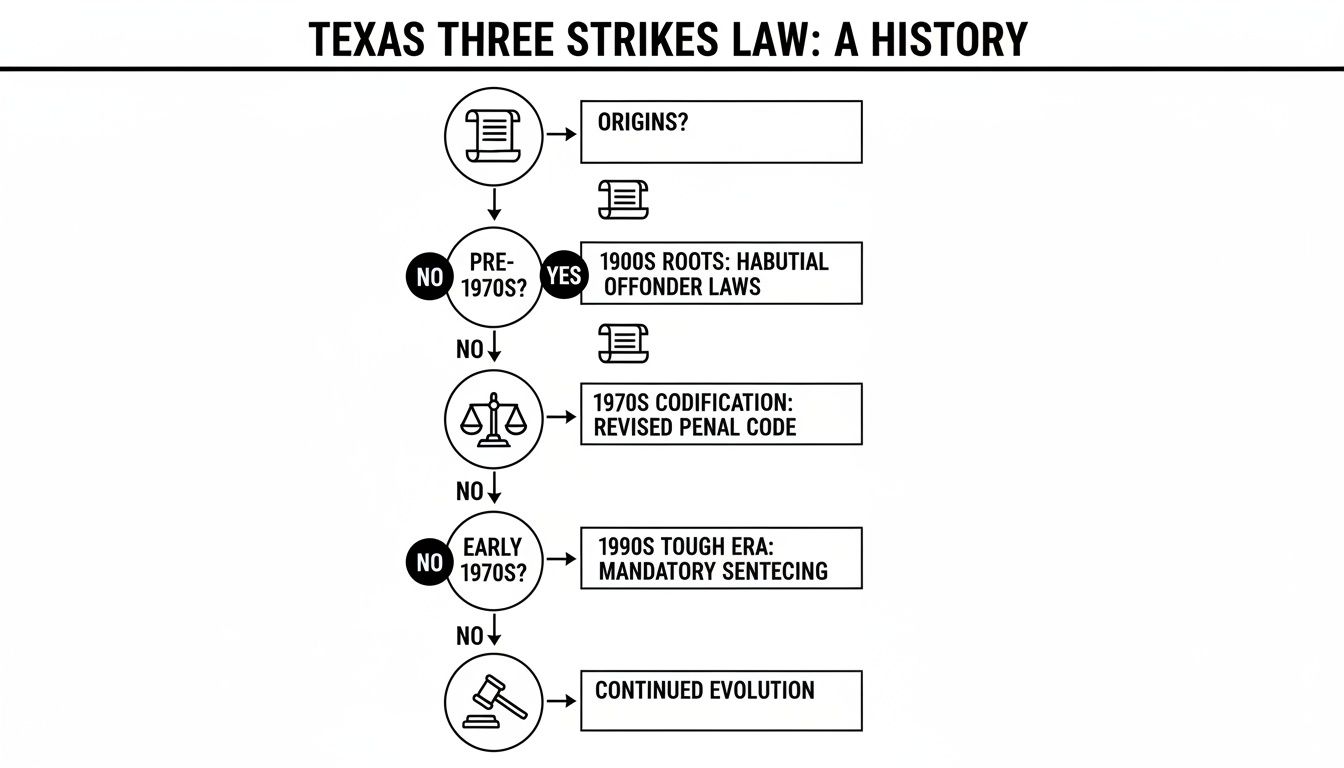
Texas’s habit-offender enhancements trace back over a century. Early laws borrowed harsh ideas from eugenics and social-control theories.
[Read the full research on these early origins](https://www.sentencingproject.org/reports/the-eugenic-origins-of-three-strikes-laws-how-habitual-offender-sentencing-laws-were-used-as-a-means-of-sterilization/)
- Early 1900s: First habitual-offender statutes
- 1970s: Codification of Chapter 12 enhancements
- 1990s: Tough-on-crime expansions, folding nonviolent crimes into the mix
Unlike California, Texas included both violent and nonviolent crimes. By the 1990s, a third felony—any qualifying offense—meant **25 years to life**.
Reform debates now push to limit strikes to violent crimes and allow proportionality reviews.
## What To Expect After an Arrest
Once you’re arrested, these steps usually follow:
1. Arraignment: You hear the charges, enter a plea, and discuss bail.
2. Bail and Bond: You may post bail or await a bond hearing.
3. Discovery: Your attorney reviews police reports, witness statements, and prior records.
4. Plea Bargaining: You and the prosecutor negotiate to reduce charges or penalties.
5. Trial: If no deal, you can ask for a jury or bench trial.
6. Sentencing: If convicted, the judge imposes a sentence based on current and prior offenses.
At each stage, a Houston criminal lawyer can fight enhancements, challenge errors, and push for alternatives like treatment or probation.
## Key Provisions of Three Strikes Law in Texas
Under Penal Code § 12.42:
- One prior final felony → second offense range **2–20 years**
- Two prior final felonies → third offense range **25 years to life**
- Deferred adjudications usually don’t count unless specific criteria are met
### Sentencing Range by Number of Priors
| Number of Priors | Enhanced Range | Judge Discretion Notes |
|------------------|--------------------|------------------------------------------------------|
| 0 | Standard Range | Follows the class of the current offense |
| 1 | 2–20 years | Judge weighs timing and severity of prior conviction |
| 2 | 25 years to life | Very limited parole eligibility, often after 30 yrs |
Prosecutors decide enhancements based on finality of priors, victim impact, and local policies. Finality means appeals over, probation complete, and no pending motions.
> “Finality can be the make-or-break detail in a habitual-offender case.”
Check [felony classifications and enhanced penalties in Texas](https://texascriminallawyer.net/felonies-in-texas/) for crime-by-crime details.
## Practical Impacts and Enforcement Variations
Local patterns shape outcomes. In Harris County, prosecutors file enhancements in 80% of eligible cases, while Travis County does so in 40%. That difference can decide plea offers or trials.
| County | Strike Eligible Cases | Strike Allegations Filed | Local Crime Change |
| -------------- | --------------------- | ------------------------ | ------------------ |
| Harris County | 1,200 | 960 (80%) | –10% |
| Travis County | 800 | 320 (40%) | –3% |
| Dallas County | 900 | 630 (70%) | +2% |
| Bexar County | 750 | 375 (50%) | –1% |
National studies show 25–50% of eligible enhancements get dropped for weak cases.
[Read the full research about three-strikes implementation](https://www.ojp.gov/pdffiles1/nij/grants/194106.pdf)
### Negotiation Strategies
1. Pull recent enhancement data in your county
2. Highlight policies that favor dropping weak strikes
3. Emphasize rehabilitation steps to push for probation or treatment
For deeper insight, see [sentencing policies and rehabilitation strategies in Texas](https://texascriminallawyer.net/sentencing-policies-and-rehabilitation-strategies-in-texas-analyzing-guidelines-mandatory-minimums-and-probation-practices/).
## Common Defenses and Mitigation Strategies
Challenging three strikes focuses on whether priors really count and if a life term is fair.
- Challenging Finality of Priors: Appeal deadlines or pending motions can undo a strike.
- Identity and Record Errors: Mix-ups in names, dates, or docket numbers can erase priors.
- Disproportionate Punishment: Under the Eighth Amendment, life for a nonviolent third strike can shock the conscience.
Mitigation steps judges respect:
- Treatment or sobriety certificates
- Community service and work records
- Character letters from employers or mentors
Post-conviction relief:
1. Expunction under Article 55.01 of the Code of Criminal Procedure
2. Nondisclosure (record sealing) under Chapter 411 of the Government Code
See our guide to common felony defenses for more.
## Real Texas Case Examples Under Three Strikes Law
### Case One: Avoiding Life Exposure
- Issue: Three strikes could mean life.
- Strategy: Found a prior conviction never became final.
- Outcome: Sentencing range cut to **2–20 years** under § 12.42.
### Case Two: Mitigation to Reduce Enhancement
- Issue: Drug possession with two priors → **2–20 years**.
- Strategy: Compiled 200 hours of community service and treatment completion.
- Outcome: Judge returned sentence to standard range for the drug offense.
### Case Three: Strategic Plea Bargain
- Issue: Assault arrest with two priors → life risk.
- Strategy: Used local plea data to negotiate waiver of habitual-offender allegations.
- Outcome: State jail felony plea, no enhancements.
| Case | Initial Exposure | Final Outcome |
|------------------------|-------------------------|---------------------------------|
| Avoiding Life Exposure | 25 years to life | 2–20 years under § 12.42 |
| Mitigation Reduction | 2–20 years | Standard range for drug felony |
| Plea Bargain Success | 25 years to life | State jail felony, no strikes |
These stories show how technicalities, mitigation, and local trends can turn a life threat into a second chance.
## FAQ on Three Strikes Law in Texas
### When Is a Conviction Final for Enhancement?
A conviction is final once all appeals are over or appeal deadlines have passed. Only final convictions count under Penal Code § 12.42.
### Can Juvenile Adjudications Count as Strikes?
Generally, juvenile cases don’t count—unless converted to adult felonies. Timing of conversion matters.
### What Qualifies as a Serious Felony?
- Aggravated Assault
- Burglary of a Habitation
- Drug Trafficking
- Offenses causing bodily harm
Minor felonies like petty theft rarely trigger enhancements.
### How to Expunge or Seal Records?
- Expunction: Article 55.01, Code of Criminal Procedure
- Nondisclosure (Sealing): Chapter 411, Government Code
Check eligibility based on offense type and case outcome.
---
If you’ve been charged with a crime in Texas, call The Law Office of Bryan Fagan, PLLC for a free and confidential consultation. Our defense team is ready to protect your rights.
[Law Office of Bryan Fagan PLLC](https://texascriminallawyer.net)
Categories and Tags
Share this Article:


At the Law Office of Bryan Fagan, our team of licensed attorneys collectively boasts an impressive 100+ years of combined experience in Family Law, Criminal Law, and Estate Planning. This extensive expertise has been cultivated over decades of dedicated legal practice, allowing us to offer our clients a deep well of knowledge and a nuanced understanding of the intricacies within these domains.
