Skip to content
Being arrested in Travis County can be terrifying—but you don’t have to face it alone. The first 24 to 48 hours are a blur of confusion, anxiety, and one big question: what happens now? Even more pressing, how do you get out of jail? This is where Travis County Pretrial Services steps in, an agency that plays a critical role in determining if you can be released without posting a massive cash bond.
What To Expect Immediately After A Travis County Arrest
The moments after an arrest feel chaotic, but a set process unfolds every single time. Knowing these steps can help you feel less overwhelmed and more in control, because your experience in these first few hours can set the stage for your entire case.
Once you're in custody, you'll be taken to the Travis County Correctional Complex. This is where the booking process begins.
The Booking and Intake Process
Booking isn't a punishment; it's the administrative process of officially recording your arrest. During this stage, law enforcement will:
- Take your mugshot and fingerprints.
- Record your personal information (name, date of birth, etc.).
- Run a background check for any prior criminal history.
- Allow you to make a phone call.
That phone call is critical. Remember, all phone calls from the jail are recorded. You should only use this call to contact a family member or a criminal defense attorney. Never discuss the details of your arrest over the jail phone—those words can and will be used against you by prosecutors.
The first few days are a whirlwind, but they follow a predictable timeline. Here's a breakdown of what to expect.
Your First 48 Hours After A Travis County Arrest
The table below outlines the key events that happen right after an arrest, explaining what each step is for and why it matters to your case.
| Stage | What Happens During This Stage | Why This Step Matters |
|---|---|---|
| Arrest & Transport | You are taken into custody and transported to the Travis County jail. | This is the official start of the legal process. Anything you say from this point on can be used by the prosecution. |
| Booking | Your personal information, photo, and fingerprints are recorded. You're allowed a phone call. | This creates the official record of your arrest. The phone call is your first chance to get legal help. |
| Pretrial Services Interview | An officer from Pretrial Services interviews you about your life—job, family, residence, etc. | This interview is used to create a report for the judge to help decide if you can be released without paying cash bail. |
| Magistration Hearing | You appear before a judge who informs you of the charges, your rights, and sets release conditions (bond). | This is your first court appearance and where the judge decides if you get out of jail and under what conditions. |
Understanding this sequence helps demystify the process and allows you to focus on the most important steps, like contacting an attorney.
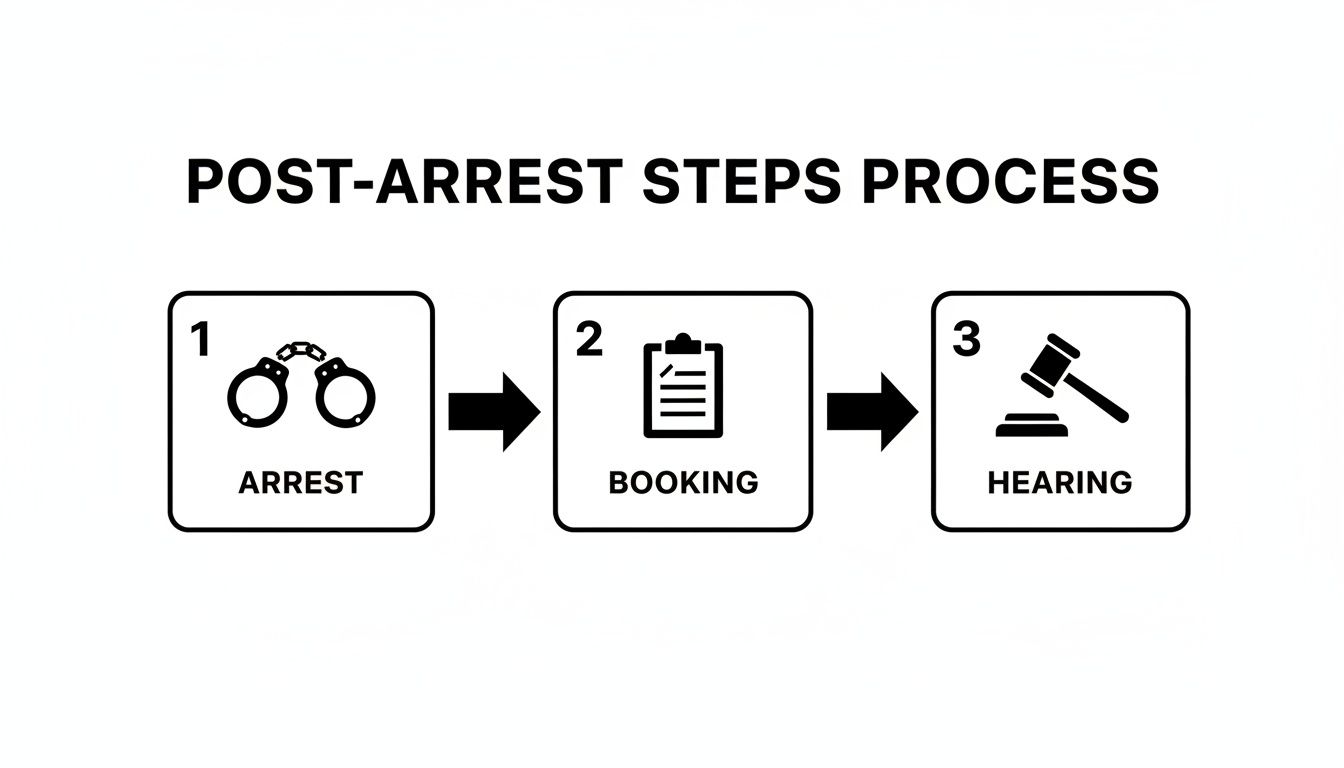
This simple flow—arrest, booking, and hearing—is the path everyone takes after being arrested in Travis County.
Your First Appearance Before a Magistrate
Within 48 hours of your arrest, you’ll have your first court appearance. It's called magistration (or sometimes an arraignment), and it’s overseen by a magistrate judge. Unlike many other places, Travis County has judges on duty 24/7, which helps move things along much faster.
During this hearing, the judge will:
- Formally tell you what charges you're facing.
- Advise you of your constitutional rights, like the right to an attorney and the right to remain silent.
- Decide if there was probable cause for your arrest.
- Set the conditions for your release from jail, including the bail amount.
This hearing is the first time Travis County Pretrial Services gets involved in your case. A Pretrial Services officer will have already interviewed you to gather information about your life—your job, where you live, your family connections in the area, and your criminal history.
Based on that interview, they prepare a report and make a recommendation to the judge about whether you're a good candidate for a personal recognizance (PR) bond.
A personal bond is a game-changer. It allows you to be released from jail without having to pay any money upfront. Instead, you sign a contract with the court, promising to show up for all future court dates and follow any rules the judge sets.
Getting a personal bond can save you and your family thousands of dollars that would otherwise go to a bail bondsman. You can learn more about bail and bond in Texas in our article on the subject. Having an experienced lawyer by your side this early can make all the difference in convincing the judge to grant you a PR bond.
Understanding The Role Of Travis County Pretrial Services
After an arrest in Austin, you'll likely hear the term "Pretrial Services," and it's easy to assume they're just another arm of law enforcement. That's a common mistake, but it's a critical one to avoid. Travis County Pretrial Services is an independent agency that works for the courts—not for the police or the District Attorney's office.
Think of them as neutral fact-finders for the judge. Their entire job revolves around answering one crucial question: Can you be safely released from jail while your case is pending, without needing to post a hefty cash bond? The report they create will land directly on the judge's desk and heavily influence the decision about your freedom.
Who Are They and What Do They Do
The agency’s first and most important role is to gather information. The first person you’ll meet from this department is an officer from the Pretrial Investigations Unit, who will interview you shortly after your arrest, usually while you’re still in jail.
They aren't there to grill you about the alleged crime. Instead, they’ll ask questions about your life—your job, your family, and your ties to the community. These details help them build a profile that shows whether you're likely to return for your court dates.
The core purpose of the Pretrial Services interview is to assess your risk of failing to appear in court and any potential danger to the community. It is not an interrogation about the alleged crime.
Knowing they are a neutral party can take some of the pressure off. Their report is a key piece of evidence the judge uses to make a fair and informed decision about whether to release you on a personal bond.
How Pretrial Services Gathers Information
During your interview, the Pretrial Services officer is looking for specific indicators of stability. This is your opportunity to demonstrate that you have strong roots in the Austin area and aren't a "flight risk."
They will ask about:
- Your Residence: Where you live, how long you've been there, and who you live with.
- Your Employment: Whether you have a job, your role, and how long you’ve been employed.
- Your Family: If you have family members in the area who rely on you or can support you.
- Your Criminal History: Any previous arrests or convictions will be part of their review.
All this information is gathered into a formal report. The officer then uses a risk-assessment tool to analyze these factors and makes a direct recommendation to the magistrate judge. A positive report can be your best shot at getting a personal bond and getting out of jail.
The agency is set up to make this happen quickly. Travis County Pretrial Services is staffed 365 days a year for 20 hours daily, from 6:00 AM to 2:00 AM. This incredible availability ensures they can conduct interviews and help judges make bond decisions around the clock, even on weekends and holidays.
Beyond the initial interview, the department also has a Case Management Unit to supervise individuals who have been released and specialized units like the Alcohol Monitoring Unit for cases involving DWI. You can explore the details on the Travis County website to see their full scope. This is exactly why having a criminal defense attorney who knows how to work with Pretrial Services is so important—they can help you put your best foot forward from the very beginning.
How The Pretrial Interview Impacts Your Release
After a Travis County arrest, you’ll have a conversation that could be worth thousands of dollars. It’s not an interrogation about the crime—it’s an interview with a Pretrial Services officer, and it’s one of the most critical moments you'll face. Your answers directly influence whether a judge lets you out of jail for free on a personal bond or makes you pay for a costly surety bond.
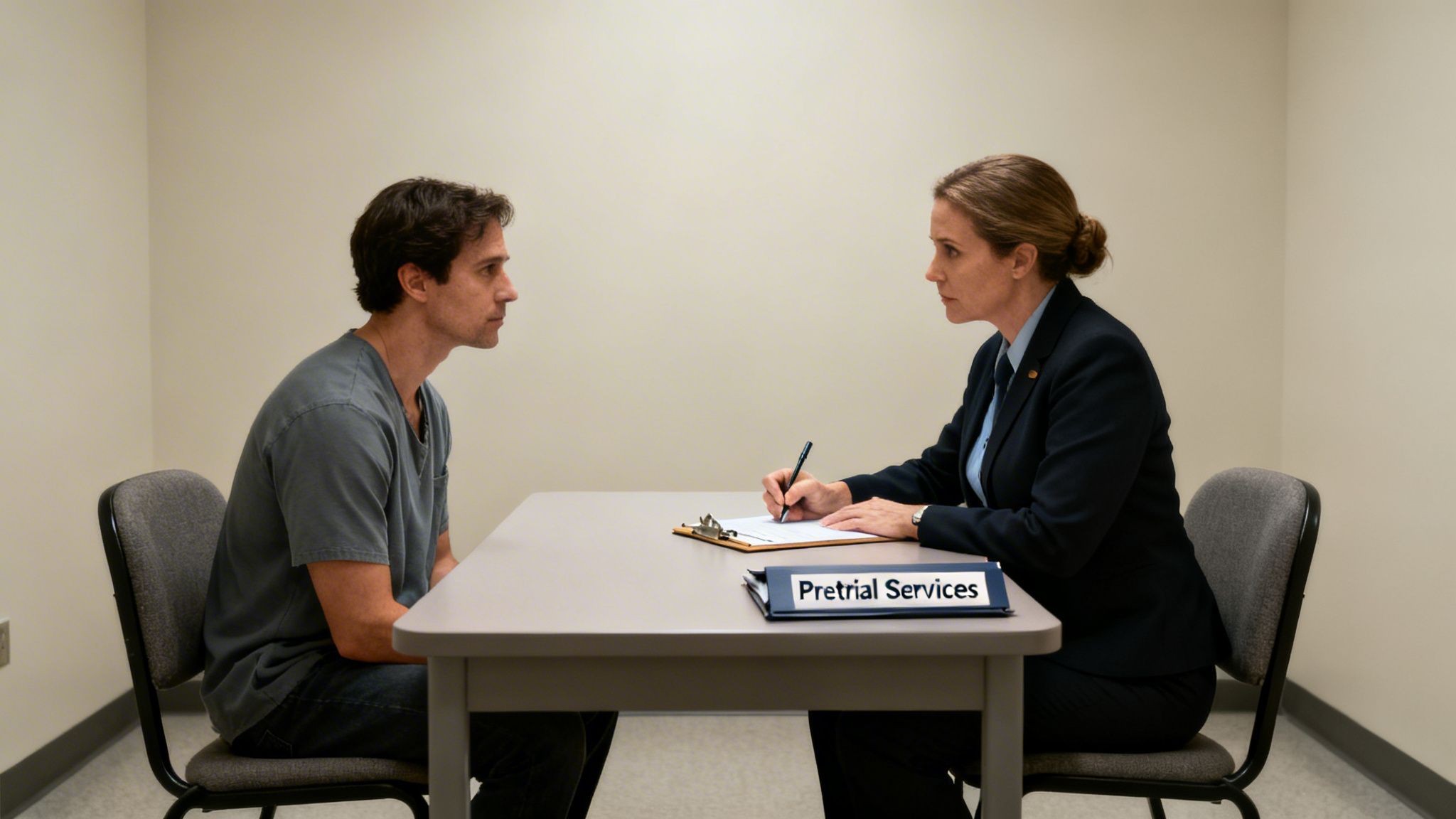
Think of this interview as your first and best opportunity to prove you’re not a flight risk. The officer is simply trying to build a snapshot of your life to gauge your reliability. Walking into this conversation prepared can make all the financial difference for you and your family.
What Questions Will The Pretrial Officer Ask?
The officer's job is to gather facts, not opinions. They're focused on your stability, not your guilt or innocence. Be ready for straightforward questions about:
- Your Residence: How long have you lived at your current address? Are you in the Austin area? Do you rent or own, and who lives with you?
- Your Employment: Do you have a job? How long have you been with your employer, and what’s your role?
- Your Community Ties: Do you have a spouse, children, or other family members living in Travis County? Is anyone depending on you for care?
- Your Criminal History: The officer will already have your record. They’re looking for any past arrests, convictions, and especially any failures to appear in court.
Your answers feed into a risk assessment that generates a score. That score, along with the officer’s own impressions, becomes their recommendation to the judge. The key is to be honest and cooperative, but it’s critical not to discuss any details of the current charge.
Personal Bond Versus Surety Bond At A Glance
The outcome of your pretrial interview directly impacts the type of bond you'll be offered. The difference isn't just a matter of paperwork—it has major financial consequences. Securing a personal bond is almost always the best-case scenario.
This table breaks down exactly what's at stake.
| Key Feature | Personal Bond (PR Bond) | Surety or Cash Bond |
|---|---|---|
| Upfront Cost | $0. You pay absolutely nothing to be released from jail. | Expensive. You must pay a bail bondsman a non-refundable fee (usually 10% of the total bond) or post the full cash amount yourself. |
| How It Works | You sign a legal promise to show up for all court dates and follow the judge's conditions. | A bail bond company—or you—provides the money as a financial guarantee that you won't disappear. |
| Who Qualifies | Eligibility is decided by Pretrial Services based on your community ties, criminal history, and the specific charge. | Anyone who can afford the bondsman's fee or post the full cash amount can use this option to get out. |
| Key Benefit | Saves you thousands of dollars, freeing up your money for your legal defense instead of a bondsman's pocket. | Guarantees release once the money is paid, but the fee you pay a bondsman is gone forever. |
As you can see, a personal bond keeps your money where it belongs—with you. It also sends a strong signal that the court trusts you to handle your responsibilities while the case is pending. The entire process of navigating the what happens at a pretrial hearing in Texas is delicate, and this interview is the first step.
Your goal is simple: present yourself as a responsible and stable community member who will not disappear. Having an attorney guide you through this process can help ensure your positive attributes are highlighted effectively for the Pretrial Services officer and the judge.
A smart lawyer can speak with the pretrial officer beforehand. They can add context to anything that might look bad on paper, like a recent job change, and make sure your strengths are front and center. That advocacy can easily be the deciding factor between walking out of jail for free or forcing your family to scramble for thousands to pay a bondsman.
Navigating The Rules Of Pretrial Supervision
Getting out of jail on a personal bond is a massive relief, but it’s just the first step. That release comes with a whole new set of rules, and this is where your relationship with Travis County Pretrial Services begins. Think of them as the gatekeepers who make sure you hold up your end of the deal while your case winds its way through the system.

Successfully managing these rules is the only way to stay out of jail. It demands your full attention and a crystal-clear understanding of what's expected of you, day in and day out.
Common Conditions Of Pretrial Supervision
When a judge grants you a personal bond, they will order you to follow a strict set of conditions. These aren't random punishments; they’re guardrails designed to ensure you show up for court and don’t pose a risk to the community. Your specific rules will hinge on your charges and background, but some requirements are pretty standard across the board.
Most people can expect to see conditions like these:
- Regular Check-Ins: You'll be assigned a Pretrial Services case manager and must check in with them on a set schedule, either by phone or in person. Do not miss these.
- Substance Abuse Testing: Random drug and alcohol testing is extremely common, especially in DWI or drug-related cases. You have to be ready to provide a sample at a moment's notice.
- Maintaining Employment or School: The court wants to see stability. You’ll almost certainly be required to keep your job or prove you’re enrolled in school.
- Attending Required Classes: Depending on the offense, you could be ordered to attend anger management, a substance abuse education program, or a victim impact panel.
- No New Offenses: This is the golden rule. Getting arrested for anything—even a minor misdemeanor—while on bond is the fastest way to land right back in a jail cell.
These rules create a framework for your life while the case is open. Following them perfectly is your best bet to show the court you're taking this seriously.
Special Conditions For Charges Like DWI
If you’re facing a charge like DWI, your pretrial conditions will get much more specific and, frankly, more intrusive. The court takes these cases very seriously and will impose rules aimed directly at preventing alcohol use.
For instance, a judge will often order you to install an Ignition Interlock Device (IID) in your vehicle. This is basically a small breathalyzer wired into your car’s ignition. You have to blow into it to start the engine. If it detects even a trace of alcohol, the car won’t start, and the device reports the failure directly to your case manager.
Another common tool is a Portable Alcohol Monitor (PAM). This is a handheld device that prompts you for breath samples at random times throughout the day, proving you're sober. In some cases, you might even be placed on a SCRAM (Secure Continuous Remote Alcohol Monitor) ankle bracelet, which tests for alcohol consumption through your skin 24/7.
Complying with every single one of these conditions is non-negotiable. A single missed check-in, a failed drug test, or an IID violation can trigger an immediate warrant for your arrest.
The Consequences Of A Violation
The court has zero patience for people who break the rules of pretrial release. If your case manager reports any violation, the prosecutor can immediately file a Motion to Revoke Bond.
Once that motion is filed, the judge will issue a warrant. After you're arrested, you'll be brought back to court for a hearing where the judge decides whether to send you back to jail to wait for your case to be resolved. This isn't a slap on the wrist—it could mean sitting in the Travis County jail for weeks or months.
Think of your pretrial supervision as your playbook for staying free. The only winning strategy is to follow every instruction to the letter. This not only keeps you out of jail but also shows the prosecutor and judge you're responsible—a factor that can be a huge asset when it's time to negotiate a resolution for your case.
How A Defense Attorney Improves Your Pretrial Outcome
Getting caught up in the Travis County court system can feel like being thrown into a maze blindfolded. The rules for Travis County Pretrial Services are complex, and every single report, check-in, and conversation can have a huge impact on your freedom. You should never have to navigate this system by yourself.
Hiring a skilled criminal defense attorney right from the start is the single most important move you can make to protect your rights. We step in immediately to become your advocate, making sure your side of the story is heard loud and clear before crucial decisions are made.
Your Advocate From The Moment Of Arrest
The minute you hire our firm, we get to work. Our first call is to Pretrial Services to let them know we are representing you. This isn't just a formality—it sends a powerful signal that you're taking this seriously and have a professional in your corner.
We open a direct line of communication with your assigned pretrial officer. This allows us to share positive information about you that a standard intake interview might miss. We'll highlight your ties to the community, your job, and your family support system while pushing back on any misleading or negative details in the police report.
Our goal is simple: to show the court who you are as a person, not just a defendant defined by a single accusation. This early advocacy is often what convinces an officer to recommend a personal bond with the fewest restrictions possible.
Fighting For The Best Possible Release Conditions
Getting a personal bond is a big win, but the fight doesn't stop there. The conditions of your release can be incredibly disruptive, interfering with your job, your family life, and your daily routine. An overly harsh condition, like being forced to wear a 24/7 SCRAM alcohol monitor for a charge that has nothing to do with drinking, feels more like a punishment than a precaution.
We go before the judge and argue for conditions that are fair, reasonable, and directly related to the offense you're accused of. If you're already on pretrial supervision and stuck with an unmanageable condition, we can file a motion to amend your bond, asking the judge to give you some relief.
Having an experienced attorney means you have a skilled negotiator fighting to minimize the disruption to your life. We work to ensure that your pretrial supervision is fair, not punitive.
This is all part of a broader defense strategy. A good defense attorney in Travis County looks at every piece of evidence to build the strongest case, often long before a trial date is even set. That might even involve digging into complex forensic evidence, like understanding how private autopsies in Travis County could be relevant to a client's case.
Protecting You From Violations
Even with the best intentions, mistakes happen. A missed phone call or a glitch with a GPS monitor can trigger a bond violation and a warrant for your arrest. If you're accused of a violation, having an attorney is your best line of defense.
We can jump in immediately to:
- Get your case manager on the phone to clear up the situation before a small misunderstanding blows up.
- Arrange a "walk-through" to handle the warrant without you being re-arrested and booked back into jail.
- Represent you at the bond revocation hearing, fighting to keep you out of custody while your case is ongoing.
The system is set up to act fast when a violation is reported, but with an attorney, you have a buffer. You can read also about the important questions to ask a criminal defense attorney to make sure you have the right advocate ready to step in for you.
Travis County has long been recognized for focusing on rehabilitation instead of just punishment. A probation reform initiative that started back in 2005 actually led to a 19.6 percent drop in felony revocations to prison by 2008—a time when the statewide average was going up. This success proves that the system can work for people who have proper guidance, and you can learn more about these transformative findings in Texas. Our job is to make sure you get the full benefit of this approach, positioning you for a successful outcome from day one.
Common Questions About Travis County Pretrial Services
When you're suddenly dealing with Travis County Pretrial Services, a million questions start racing through your mind. It's completely normal to feel overwhelmed and unsure of what’s next. Getting straight answers can make all the difference in helping you stay compliant and reduce your stress. Let's tackle some of the most common questions we hear from clients in your exact situation.
Are There Fees For Pretrial Supervision?
This is one of the first and most important things people ask. The short answer is no—unlike formal probation, there isn't a direct "supervision fee" for being on a personal bond with Pretrial Services. The biggest win with a personal bond is that you get to avoid paying a bail bondsman a non-refundable fee that can easily run into the thousands.
But that doesn't mean it's entirely free. Your release will come with conditions, and some of those conditions have costs you'll have to cover.
For example, you might be responsible for:
- Ignition Interlock Device (IID): If you're facing a DWI, you’ll likely need an IID installed in your car. This comes with installation and monthly monitoring fees, typically costing $70 to $150 per month.
- Drug and Alcohol Testing: Any required urinalysis or other substance tests will be out-of-pocket expenses.
- Mandatory Classes: If a judge orders you to take a specific course, like a drug offender education program or an anger management class, you'll have to pay for enrollment.
So, while the supervision itself is a condition of your release, these related costs are on you. This is exactly why a good attorney will argue for the least restrictive conditions possible—it can save you a significant amount of money in the long run.
How Long Will I Be On Pretrial Supervision?
There's no fixed sentence for pretrial supervision. Its duration is tied directly to how long your criminal case takes to resolve. Simply put, you will be under the supervision of Travis County Pretrial Services from the day you walk out of jail until your case is officially closed.
This could mean a few months, or for more complicated felony cases, it could be a year or even longer. Your supervision ends only when one of these things happens:
- Your charges get dismissed.
- You accept a plea agreement and resolve the case.
- Your case goes to trial and a verdict is reached.
The bottom line is that the fastest way to end your pretrial requirements is to resolve your case. Your attorney's job is to push for the best possible outcome as efficiently as possible.
What Happens If I Can't Meet A Condition?
Life happens. Maybe you get sick and can't make a check-in, or your car breaks down on the way to a required class. If you find yourself in a bind, the absolute worst thing you can do is stick your head in the sand and ignore it. Hiding the problem is a fast track to a violation report and a warrant for your arrest.
Instead, you need to be proactive. Here’s the two-step plan:
- Contact Your Case Manager Immediately: Call or email your Pretrial Services officer before you miss the appointment. Be honest about the situation and ask what you need to do to fix it.
- Call Your Attorney: We are your advocates. Let us know what's going on so we can communicate with your case manager, provide proof if needed (like a doctor's note), and help smooth things over.
If you face a legitimate obstacle, communication is your best defense. A pretrial officer is far more likely to work with someone who is honest and trying to comply than with someone who disappears.
If a condition is truly impossible for you—for instance, you can't afford a required device, or a class schedule conflicts with your job—your attorney can file a motion to modify your bond conditions. We can go to the judge and ask for a more reasonable alternative that still addresses the court's concerns.
Can What I Say To My Officer Be Used Against Me?
This is a critical point that you absolutely must understand. Your Pretrial Services officer is not your lawyer, your friend, or your therapist. They are neutral employees of the court, but they are also officers of the court. Any incriminating statements you make to them can—and likely will—be documented and shared with the prosecutor.
You should always be polite and cooperative. Answer direct questions about your compliance truthfully (e.g., "Did you take your drug test?" or "Are you still working at the same job?").
However, you should never discuss the facts or details of your criminal case with your case manager. If they ask what happened the night you were arrested, the only correct response is, "My attorney has advised me not to discuss the details of my case." This isn't you being difficult; it's you protecting your constitutional right to remain silent. Your lawyer is the only person you should talk to about the specifics of the allegations. Following this one rule is essential to protecting your defense.
If you’ve been charged with a crime in Texas, call The Law Office of Bryan Fagan, PLLC for a free and confidential consultation. Our defense team is ready to protect your rights. Contact us today.