Being arrested in Texas can be terrifying — but you don’t have to face it alone. When you're facing a criminal charge, the legal jargon alone can feel overwhelming. Hearing the words "Class A misdemeanor" is serious, and your first step toward taking back control is understanding exactly what that means for you and your future.
Think of Texas criminal offenses on a ladder. A Class A misdemeanor sits on the highest rung for non-felony crimes. It's the most serious type of misdemeanor, just one step below a state jail felony. An arrest is not a conviction, and with the right legal strategy, you can fight for a much better outcome.
Understanding the Most Serious Misdemeanor Charge in Texas
When prosecutors label a crime a Class A misdemeanor, it signals that they believe the alleged offense is serious enough to justify significant punishment. This is where a trusted guide and a strong defender can make all the difference. Our goal is to help you navigate the court system and protect your rights.

What Sets a Class A Misdemeanor Apart?
In Texas, crimes are grouped by severity. At the bottom are Class C misdemeanors—usually just fine-only offenses like a speeding ticket. Class B misdemeanors are a step up, but Class A charges represent the highest level before an offense is considered a felony.
The biggest difference lies in the potential punishment. Misdemeanor sentences are served in county jail, while felony convictions lead to state prison. Grasping the difference between a felony and misdemeanor is crucial to understanding what's at stake.
We’ve compiled the information here using proven research practices. If you're interested in the nuts and bolts of how legal arguments are built, you can learn more about effective legal research methods.
To give you a clearer picture, here’s a quick breakdown of how Texas classifies misdemeanors.
Texas Misdemeanor Classifications at a Glance
This table provides a clear comparison of the three misdemeanor levels in Texas, helping you quickly understand where a Class A charge fits in the legal landscape.
| Misdemeanor Class | Maximum Jail Time | Maximum Fine |
|---|---|---|
| Class A | Up to 1 year | Up to $4,000 |
| Class B | Up to 180 days | Up to $2,000 |
| Class C | No jail time | Up to $500 |
As you can see, the penalties for a Class A misdemeanor are substantially higher than for other non-felony offenses.
The Penalties Defined by Texas Law
The stakes are high with a Class A misdemeanor. The Texas Penal Code lays out punishments that are designed to reflect the seriousness of the crime, and they can change your life in an instant.
A Class A misdemeanor in Texas carries a statutory maximum penalty of up to one year in county jail and a fine as high as $4,000. This classification places it as the most serious non-felony offense under state law.
Offenses like assault causing bodily injury or a second DWI are routinely punished within this range. It’s this combination of potential jail time, significant fines, and a lasting criminal record that makes defending against a Class A charge so critical. An experienced criminal defense attorney can dive into the specific facts of your case and build a strategy to protect your freedom and your future.
What Does a Class A Misdemeanor Look Like in the Real World?
Legal definitions can feel abstract, so let's shift from the textbook to real-life situations you might face. To really get a handle on what a Class A misdemeanor is, it helps to see how these charges play out. These aren’t just words in the Texas Penal Code; they are specific actions that can turn a bad day into a serious legal battle.
It’s critical to remember that the specific details of an incident are what drive the level of the charge. A simple mistake or a heated argument can quickly escalate based on factors like your criminal history, the dollar value of property involved, or whether someone got hurt.
Common Offenses That Land in the Class A Category
While dozens of offenses can be filed as a Class A misdemeanor, some pop up far more often than others. Understanding what makes these charges stick is the first step toward building a defense, because it tells you exactly what a prosecutor has to prove beyond a reasonable doubt.
Here are a few common examples of Class A misdemeanors in Texas:
- Second DWI Offense: A first-time DWI is usually a Class B misdemeanor. But if you’re arrested for a second one, the charge gets bumped up to a Class A. This is a perfect example of how Texas law penalizes repeat offenses much more harshly. If you need a Texas DWI attorney, it's vital to act fast.
- Assault Causing Bodily Injury: An assault charge becomes a Class A misdemeanor the moment it results in bodily injury. In plain English, this doesn’t have to mean a broken bone; legally, it can be anything from a visible bruise to simply causing physical pain.
- Theft of Property ($750 – $2,500): If you are accused of stealing property or services valued between $750 and $2,500, you will face a Class A misdemeanor theft charge.
- Burglary of a Vehicle: Breaking into someone's car to steal something isn't just a minor theft. It’s a serious crime that lands squarely in the Class A category.
- Unlawful Carrying of a Weapon (UCW): Carrying a handgun on you or in your vehicle without the right license or in a place where it’s prohibited can easily lead to a Class A charge.
These examples show how specific circumstances matter. You can find more detail on the legal criteria for Class A misdemeanors in Texas to see how the law defines these situations.
Why Every Single Detail of Your Case Is a Big Deal
The good news is that the prosecutor carries the entire burden of proof. They have to convince a judge or jury that you committed every single element of the alleged crime. This is exactly where a sharp defense attorney can completely change the outcome of a case.
For instance, in a theft case, the state must prove the stolen property's value is between $750 and $2,500. If your lawyer can introduce evidence showing the value is actually less than $750—say, by finding the original receipt or an expert appraisal—the charge could be knocked down to a less severe misdemeanor.
The same logic applies to an assault case, where the definition of "bodily injury" can be fuzzy and open to interpretation. Every piece of evidence, from shaky witness statements to sloppy police reports, creates an opportunity to pick apart the prosecution's story. Never assume the facts are stacked against you. A skilled analysis is the key to protecting your rights.
What a Conviction Really Costs You
When you're facing a Class A misdemeanor, the immediate fears are jail time and fines. But the truth is, the court-ordered penalties are often just the beginning. The real damage from a conviction happens long after the case is closed, creating a ripple effect that can touch every corner of your life for years to come.
These hidden penalties, sometimes called "collateral consequences," stem from one simple fact: a conviction creates a permanent criminal record. This isn't something that just fades away. It follows you, acting like a constant roadblock when you're trying to move forward. Background checks will show the conviction when you apply for a new job, try to rent a decent apartment, or even seek a loan for a car or home.
The Long-Term Professional and Personal Hit
For many hardworking Texans, a Class A misdemeanor conviction can be a career-ender. Many jobs require a professional license to practice—think nurses, teachers, real estate agents, even cosmetologists. State licensing boards have the power to deny or even revoke your license because of a conviction, effectively slamming the door on the career you spent years building.
The fallout doesn't stop with your job. A conviction can strip away some of your most basic rights. For example, depending on the charge, you could permanently lose your right to own a firearm. And for anyone who isn't a U.S. citizen, a conviction can trigger devastating immigration consequences, including deportation or being barred from re-entering the country.
A criminal record isn't just a mark against you; it's a cycle. It limits your ability to earn a living, find a safe place to live, and enjoy the freedoms you once took for granted. It makes rebuilding your life incredibly difficult.
It's crucial to understand these risks. You can explore detailed criminal justice research to see the data for yourself. This is why a good Texas assault defense isn't just about minimizing fines or jail time—it's about fighting to avoid a conviction altogether.
Why Your Defense Strategy Is Everything
The single most effective way to protect your future is to prevent a final conviction from ever hitting your record. An experienced Houston criminal lawyer knows how to fight for outcomes that keep your record clean. The goal is to find a path forward that doesn't leave a permanent stain.
Here are a few ways we work to protect our clients' futures:
- Getting the Case Dismissed: We scrutinize every piece of evidence and police procedure. If we find a weakness or a violation of your rights, we can file a motion to get the charges dropped entirely.
- Negotiating for Reduced Charges: Often, the best strategy is to negotiate with the prosecutor to get the offense knocked down to a lesser charge, like a Class C misdemeanor, which has far fewer long-term consequences.
- Arguing for Deferred Adjudication: This is a special kind of probation. If you complete it successfully, the case is dismissed, and you can honestly say you were never convicted of the crime.
A smart defense is about looking beyond the courtroom. It's about protecting your tomorrow.
What to Expect From the Texas Court Process
Walking into a Texas criminal court can feel like stepping into a labyrinth. If you've been charged with a Class A misdemeanor, understanding the road ahead can make all the difference. It’s not a journey you should take alone; a skilled defense attorney is your guide every step of the way. Here is a step-by-step breakdown of what happens.
The process kicks off the moment you're arrested. The first stage is booking, where police take your fingerprints, snap a mugshot, and record your personal information. Soon after, you'll have a bail hearing where a judge sets the amount of money needed for your release while the case is pending.
Your First Day in Court: The Arraignment
Your first official court appearance is the arraignment. This is a quick but critical hearing where the judge formally reads the charges against you and asks for your plea. At this early stage, you will plead "not guilty." This simple step preserves all your legal rights and gives your attorney time to review the evidence and build your defense. Having your lawyer beside you here is essential. They will handle the formalities and demand all the evidence the prosecutor has against you—a step known as "discovery."
The consequences of a conviction are no small matter. They can seriously impact your ability to find a job, secure housing, or even keep your driver's license.
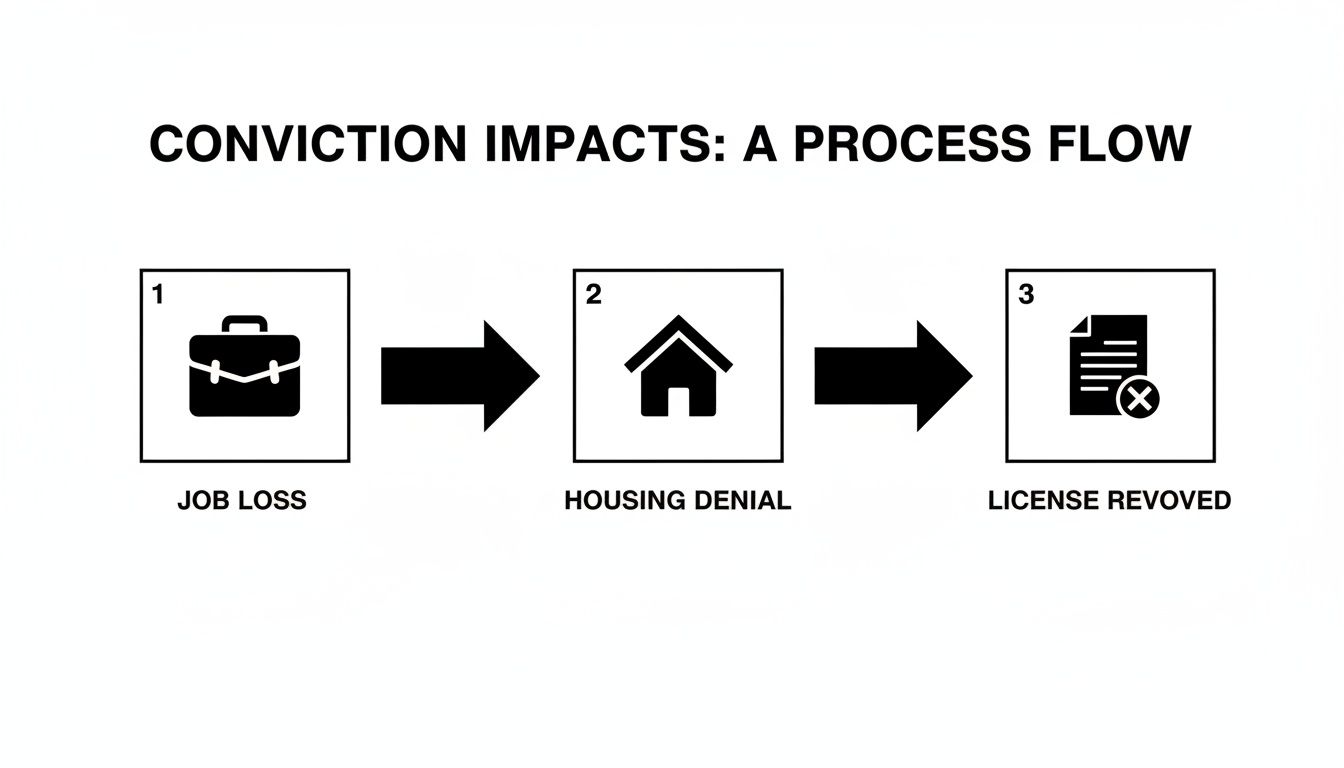
As you can see, one conviction can set off a chain reaction of negative outcomes, which is why it's so vital to fight the charges right from the start.
The Pre-Trial Phase: Plea Bargaining and Building Your Defense
After the arraignment, your case moves into the pre-trial phase. This is where your defense attorney works relentlessly behind the scenes. Key actions include:
- Investigating the Case: Your lawyer will scrutinize police reports, watch body cam footage, interview witnesses, and hunt for any evidence that weakens the prosecution's story.
- Filing Pre-Trial Motions: If law enforcement violated your rights—say, with an illegal search—your attorney can file a motion to suppress that evidence. A successful motion can get key evidence thrown out, often leading to a complete case dismissal.
- Plea Bargaining: Armed with a solid defense, your attorney enters negotiations with the prosecutor. This could result in a plea bargain for a lesser charge, an agreement for deferred adjudication to keep a conviction off your record, or even an outright dismissal of the case.
The overwhelming majority of criminal cases are resolved during this pre-trial phase, without ever seeing a jury. This is where an experienced Houston criminal lawyer makes the biggest difference in your case.
Getting familiar with the steps in the criminal justice process can help you feel more in control. If a fair agreement isn't reached, your case will be set for trial, where a judge or jury will ultimately decide your guilt or innocence.
Building a Strong Defense Against Your Charges
Getting charged with a Class A misdemeanor feels overwhelming. It’s easy to think the fight is already lost, but here’s a critical fact to hold onto: an arrest is not a conviction. In our justice system, the prosecutor carries the entire burden of proving every single element of their case against you beyond a reasonable doubt. That’s an incredibly high bar to clear, and it’s where a sharp Texas criminal defense attorney can completely change the game.
A solid defense isn't about making up excuses. It's about holding the prosecution accountable to the strict legal standards they must meet. We start by digging into every shred of evidence. Was the traffic stop that led to your DWI arrest even legal? Did the police have a legitimate reason to search your car? These aren't just minor details—they're the foundation of your constitutional rights.
Challenging the Prosecution's Narrative
Every case, no matter how solid it seems on paper, has weak points. Our job is to find them and use them to your advantage. A powerful defense is built by questioning the state’s evidence and presenting a counter-narrative that creates reasonable doubt. We methodically pick apart the prosecution's case, piece by piece.
This can look different depending on the specifics of your charge:
- Questioning the Evidence: In a drug possession case, we might challenge the lab results or the chain of custody of the evidence.
- Challenging Witness Testimony: Eyewitness accounts are notoriously unreliable. We can investigate witnesses for credibility issues, find inconsistencies in their stories, or uncover biases that could taint their testimony.
- Exposing Procedural Errors: From an officer improperly collecting evidence to sloppy mistakes in a police report, any procedural error can be used to weaken the prosecution’s case and give us leverage during negotiations.
An experienced lawyer knows that a case is rarely as open-and-shut as the police report makes it seem. By analyzing every detail, we can turn the tables and put the prosecution on the defensive.
Protecting Your Constitutional Rights
Beyond the specific facts of your case, some of the most powerful defenses come directly from the U.S. and Texas Constitutions. Law enforcement officers have to follow strict rules when they investigate a crime, and any violation can have a massive impact on your case.
For instance, the Fourth Amendment protects you from unreasonable searches and seizures. If an officer searches your car or home without a warrant or probable cause, any evidence they find can be thrown out of court through a motion to suppress. This can cripple the prosecutor's case, often forcing them to dismiss the charges altogether.
Ultimately, a charge is just an accusation. With a strategic defense, you can fight back, protect your freedom, and work toward the best possible outcome—whether that’s a dismissal, a reduction in charges, or a not-guilty verdict at trial.
Pathways to a Clean Record After an Arrest
Many people assume an arrest automatically ruins their future, but Texas law offers powerful opportunities for a fresh start. Facing a Class A misdemeanor charge can feel like the world is crashing down, but with the right legal game plan, you can pursue outcomes that protect your reputation and keep your record clean. This is where post-conviction relief options like expunctions become so important.
Remember, an arrest is not a conviction. The Texas legal system has specific pathways designed to help you move past this difficult chapter without a permanent stain on your name. These options are built around rehabilitation and second chances, acknowledging that one mistake shouldn't define your entire life.
Avoiding a Conviction with Deferred Adjudication
One of the most valuable tools in a Texas criminal defense attorney's arsenal is deferred adjudication. Think of it as a special kind of probation with a huge reward waiting at the end. Instead of finding you guilty, the judge "defers" a finding of guilt and places you on community supervision for a set period.
During this time, you'll have to follow a specific set of rules, which often includes things like:
- Regular check-ins with a probation officer.
- Completing a certain number of community service hours.
- Attending mandatory classes, like anger management or substance abuse counseling.
- Paying all required fines and court costs.
If you successfully complete your probation, the judge dismisses the case entirely. Here's the best part: you can legally say you were never convicted of the crime. This is a game-changing outcome that keeps your record clean and protects your future opportunities.
Erasing the Arrest with Expunctions and Record Sealing
Even when a case gets dismissed, the record of the arrest itself can still pop up on background checks. That’s where two powerful legal tools come into play: expunctions and orders of non-disclosure (record sealing). These options can give you a truly clean slate.
An expunction is a legal process that completely destroys the records of your arrest. It's as if the arrest never happened. An order of non-disclosure, often called record sealing, hides your record from the public, though law enforcement can still see it.
Eligibility is strict and depends heavily on how your case was resolved. For example, you might qualify for an expunction if your case was dismissed outright or if you were found not guilty at trial. If you successfully finished deferred adjudication for a Class A misdemeanor, you are often eligible to petition for an order of non-disclosure. Learning the details of how to clear your record in Texas is a critical next step toward reclaiming your future.
These legal solutions provide hope and a clear path forward. You don’t have to let an arrest haunt you forever. By exploring these options with a skilled defense attorney, you can take control of your situation and work toward putting this chapter behind you for good.
Answering Your Questions About Class A Misdemeanors
When you’re staring down a Class A misdemeanor charge in Texas, your mind is probably racing with questions. Getting clear, plain-English answers is the first step toward calming your anxiety and figuring out how to protect your future. Here are some of the most common questions we hear.
Can a Class A Misdemeanor Be Dropped to a Lesser Charge?
Yes, absolutely. An experienced criminal defense attorney can often negotiate with the prosecutor to get the charge reduced to a Class B misdemeanor or even a Class C offense, which is a fine-only offense similar to a traffic ticket. This often happens when your lawyer finds a weak spot in the prosecutor's case—maybe the evidence is shaky, or perhaps the police violated your rights during the arrest.
Is Jail Time Guaranteed if I’m Convicted?
Not necessarily. While the law allows for up to one year in county jail, it is not a mandatory sentence. For many people, especially first-time offenders, a skilled lawyer can make a strong case for alternative punishments instead of jail. These alternatives often include probation (community supervision), deferred adjudication, or a combination of fines and required classes. The outcome depends on the specific facts of your case and the quality of your legal defense.
How Long Does a Class A Misdemeanor Stick on My Record?
A final conviction for a Class A misdemeanor stays on your permanent criminal record forever. The only way to remove it is with a pardon from the governor, which is incredibly rare.
However, if your case ends without a conviction, you have options. If your case is dismissed, you're found not guilty, or you successfully finish deferred adjudication, you may be eligible to clear your record. This is done through a legal process called an expunction, which destroys the record, or an order of non-disclosure, which seals it from public view.
If you’ve been charged with a crime in Texas, call The Law Office of Bryan Fagan, PLLC for a free and confidential consultation. Our defense team is ready to protect your rights. Visit us at https://texascriminallawyer.net.