Being arrested in Texas can be terrifying. You may have spent days or weeks waiting for your first court date, answering worried calls from family, missing work, and wondering whether a DWI, assault, theft, or drug possession case is about to change your life.
Then the call comes. Your lawyer tells you the charges were dropped before court.
That news usually brings instant relief. It should. But if you're asking what happens if charges are dropped before court in Texas, you also need to know this: the criminal case may be over for now, but your work may not be finished. Your record, your bond, and your future opportunities can still be affected if you don't handle the next steps correctly.
The Phone Call You Have Been Waiting For
For many people, this moment happens in a rush.
You see your attorney's number on your phone. You brace for bad news. Instead, you hear that the prosecutor isn't moving forward, or that the case has been dismissed before your first court date. Your shoulders drop. You breathe for the first time in days.
That reaction is normal. So is the confusion that follows.
You may be wondering whether you still have to go to court, whether your bond money comes back, whether your job will find out, or whether the State can bring the case back later. Those are the right questions to ask.
Texas handles a huge number of cases. The Texas judiciary's FY 2023 annual report says judges disposed of nearly 7.5 million cases and recorded an overall case clearance rate of 100 percent. Early case resolution is part of how that system works, so a case ending before a courtroom appearance is not unusual.
A dropped case before court often feels like the end. In practice, it's the start of a different phase: protecting your record and making sure the problem doesn't come back.
Why this moment matters so much
If your case ends early, you avoid a public court fight. You also avoid the stress of arraignment, plea discussions, trial preparation, and possible sentencing. That matters whether the accusation involved a Texas assault defense issue, a first-time theft allegation, a drug possession arrest, or a DWI investigated by police.
Still, early relief can make people let their guard down. They stop checking paperwork. They don't ask whether the case was never filed or later dismissed. They assume an arrest disappears on its own.
That assumption causes problems later.
The first question to ask
Ask your lawyer one simple question: “Was this a no-file or a dismissal?”
The answer changes what your paperwork should look like, whether the State might try again, and when you may be able to pursue record clearing. If you don't know the exact status, you don't yet know what this result really means.
Understanding Dropped Charges No-File vs Dismissal
When people say charges were “dropped,” they usually mean one of two things in Texas. The terms sound similar, but they are not the same.
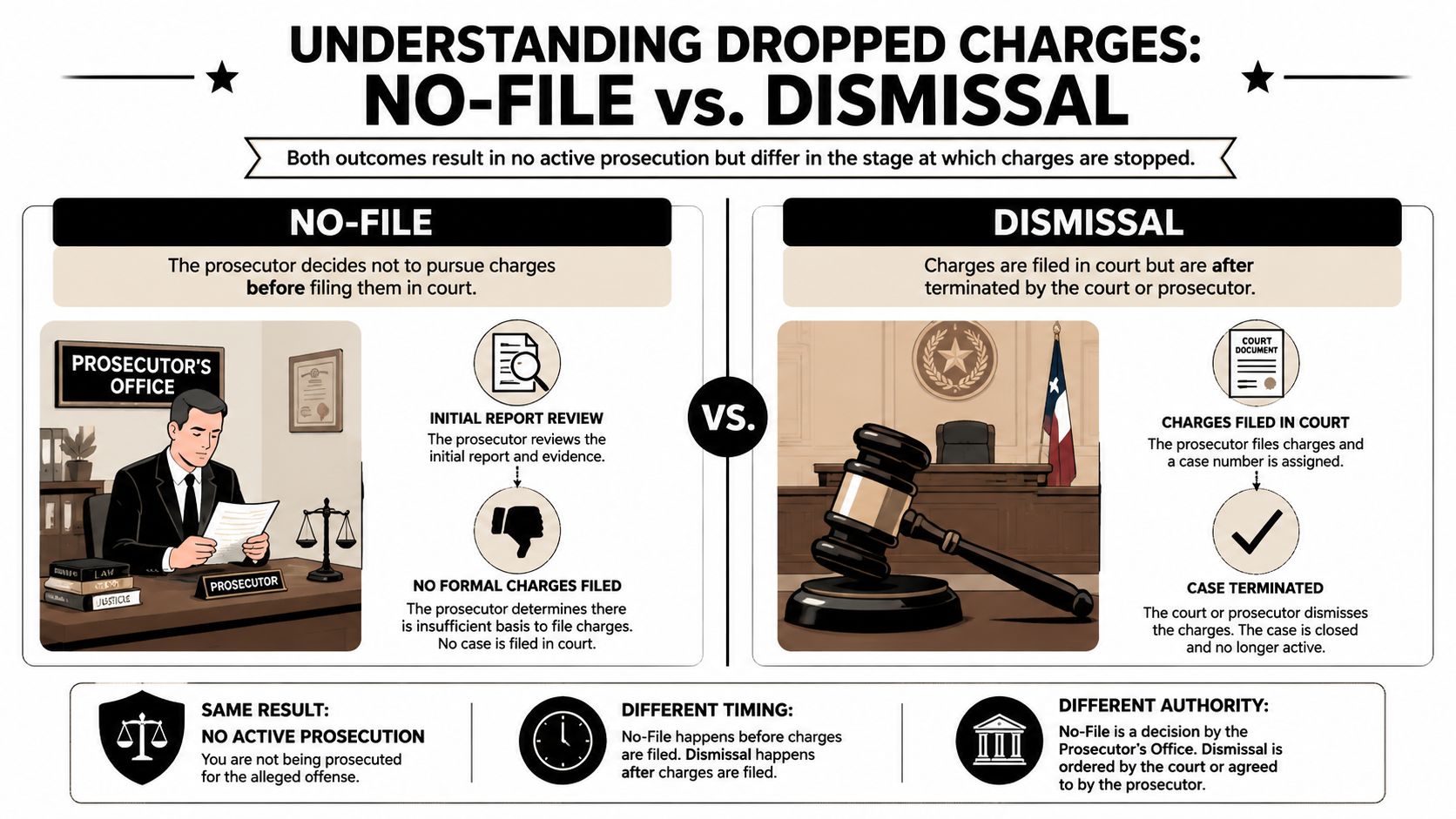
What a no-file means
A no-file means the prosecutor reviewed the arrest information and decided not to file formal charges in court.
Here's how it works. Police make the arrest, but the prosecutor is the person who decides whether the case should move forward in the court system. If the prosecutor stops it at that stage, the case never becomes a formally filed prosecution.
That can happen for many reasons:
- Weak evidence that doesn't support the accusation
- Witness problems if an important person won't cooperate or can't be found
- Legal defects in the arrest, search, or investigation
- New information that changes how the prosecutor views the case
If you want a closer look at that screening process, this discussion of how prosecutors decide whether to file charges in Texas can help.
What a dismissal means
A dismissal means the charge was filed, but later ended before trial.
That's different from a jury finding you not guilty. A dismissal is not an acquittal. It means the prosecution stopped, but not because a judge or jury decided you were innocent after trial.
Some dismissals happen because the defense exposes a problem in the State's case. Some happen because a witness issue develops. Some happen after a person completes diversion requirements. Others happen because the prosecutor decides the case shouldn't continue.
Practical rule: “Dropped” is everyday language. Your legal paperwork should say whether the case was never filed or whether it was dismissed after filing.
Why “without prejudice” matters
One of the biggest points of confusion is the phrase without prejudice.
A Texas case can be dropped through a no-file decision or through dismissal after filing. A dismissal without prejudice allows prosecutors to refile until the limitations period expires, which is often 2 years for misdemeanors and 3 years for many felonies according to this Texas defense explanation of charges dropped before court.
Here's the plain-English version:
| Outcome | What it usually means | Can it come back? |
|---|---|---|
| No-file | Prosecutor never filed the case in court | Sometimes, if the State later chooses to file within the legal time limit |
| Dismissal without prejudice | Filed case was ended, but not permanently | Yes, potentially |
| Dismissal with prejudice | Filed case was ended permanently | No, refiling is barred |
A simple example
Suppose you were arrested after a bar argument and accused of assault. If the prosecutor reviews the report and decides the evidence is too thin, the office may no-file the case. If the prosecutor files the case first but later loses a witness, the case may be dismissed.
Both results feel similar because you don't have an active prosecution. But legally, the path matters. It affects your paperwork, your strategy, and what you do next.
Immediate Effects Getting Your Life and Money Back
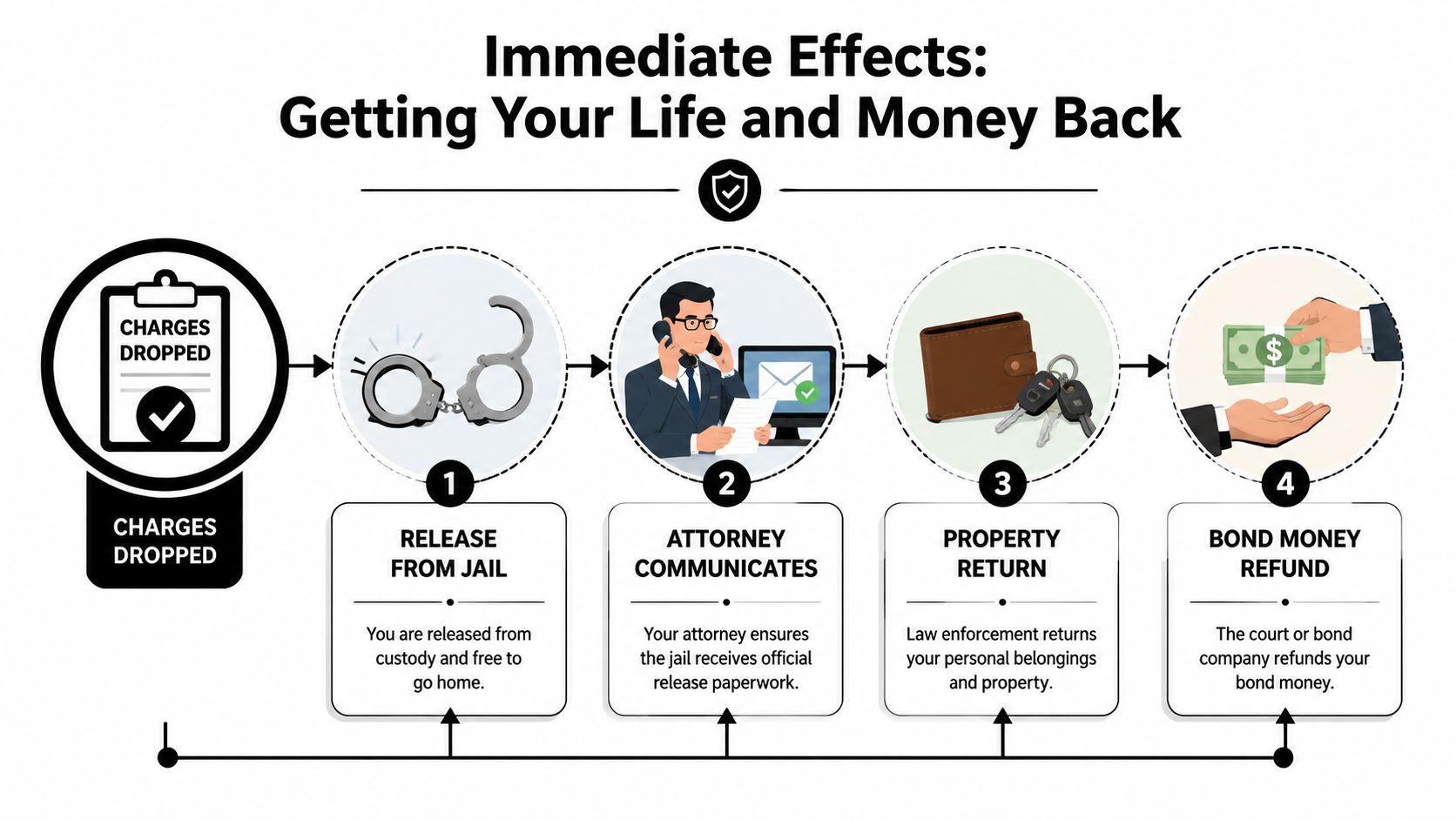
Once charges are dropped, the first changes are practical. You want to know whether you're free, whether you still owe anything, and how to get your money or property back.
If you are still in custody
If you're still in jail when the case is dropped, release should follow after the jail receives the right paperwork. That doesn't always happen instantly. Jails process paperwork on their own schedule, and delays can happen.
Your attorney usually tracks that process and makes sure the release order or dismissal paperwork reaches the right office. If there's a hold from another case or another county, that can slow things down, so don't assume one dropped case automatically means immediate freedom in every situation.
If you posted bond
Bond issues depend on how the bond was posted.
- Cash bond with the court: The court or county begins the refund process after the case ends.
- Bail bond through a bondsman: The fee you paid to the bond company usually isn't returned, but the bond obligation ends.
- Collateral posted for a bond: Property such as a title or deed should be returned once the bond is exonerated.
This is one reason people should keep every receipt, bond form, and case document. You may need them when following up.
A short video explanation may also help if you're trying to sort out the practical side after a case ends:
What else should happen right away
You should also start collecting documents before memories fade and offices get harder to reach.
- Get written proof of the no-file or dismissal.
- Confirm court settings were removed.
- Ask about personal property if police took anything at booking or during the investigation.
- Save contact names for the clerk, jail, or bonding company in case follow-up is needed.
Keep a paper and digital copy of every release-related document. Months later, that paperwork may matter more than the relief you feel today.
Lingering Risks Even After Charges Are Dropped
The danger in these cases is not panic. It's false confidence.
A lot of people hear “dropped” and believe every legal consequence vanished. Sometimes that's close to true. Often it isn't. The biggest risk is that the case can return.
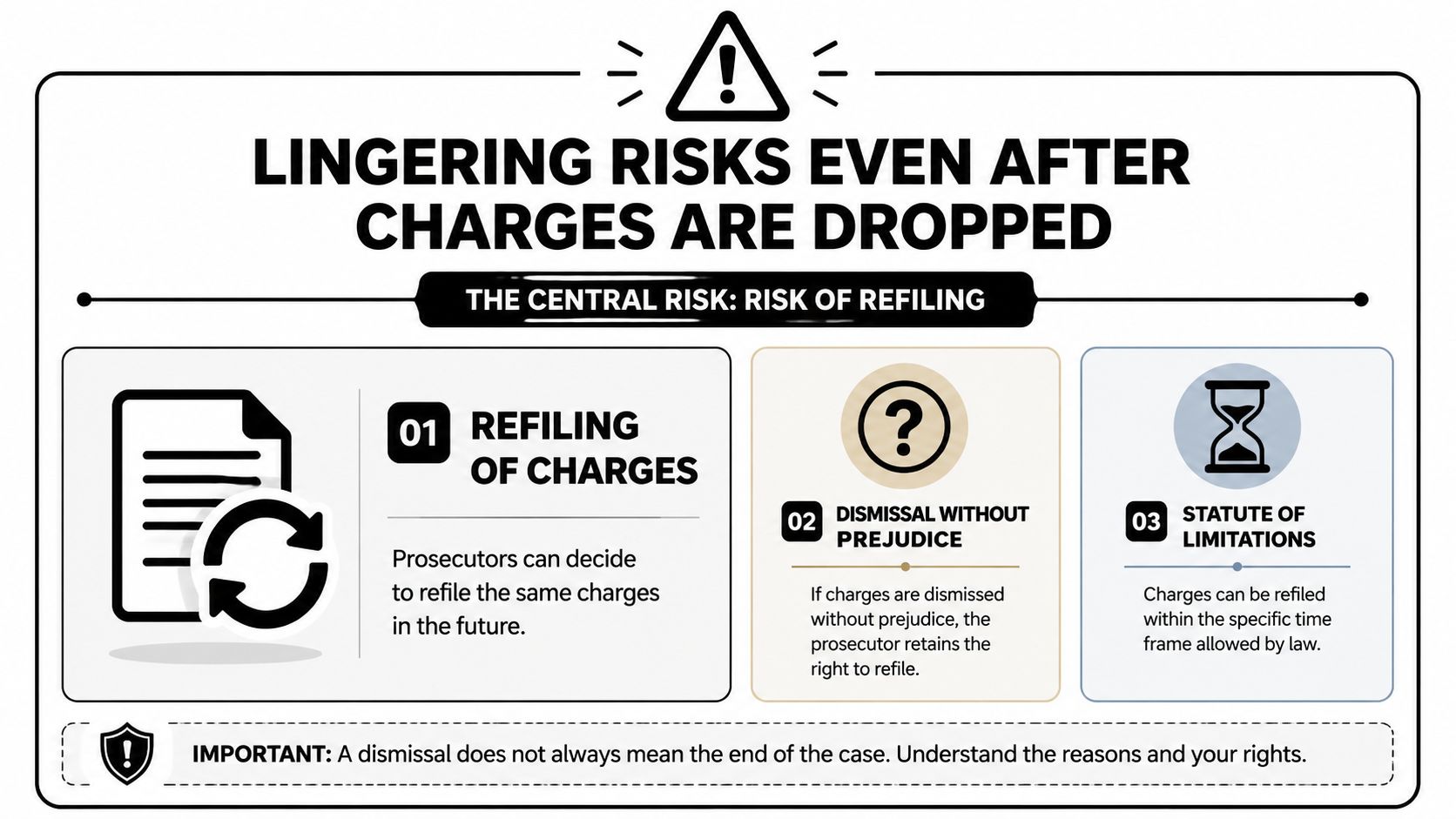
Refiling is the issue many people miss
A dismissal without prejudice leaves the State able to refile if new evidence emerges and the statute of limitations has not expired, as explained in this Texas criminal defense discussion of charges dropped before trial.
That means a weak case today may not stay weak forever.
A witness who disappeared may come back. A video may surface. A lab result may arrive later. A person who first refused to cooperate may change course. When that happens, a case that felt finished can come back to life.
Why this matters in common Texas charges
This issue comes up in many everyday cases:
| Type of allegation | Why a case might pause or drop | Why it might return |
|---|---|---|
| DWI | Evidence issue, paperwork issue, witness problem | New review of reports or evidence |
| Assault | Witness recants or becomes unavailable | Witness later cooperates |
| Theft | Store evidence is incomplete | Better documentation appears |
| Drug possession | Search problem or testing delay | Prosecutor reevaluates the file |
That's one reason skilled defense lawyers push hard on the details early. A Houston criminal lawyer or Texas DWI attorney isn't just trying to get the case stopped. They're also trying to make sure the result is stable and documented.
Other risks outside the criminal case
Even when the prosecution stops, the consequences may continue in other places.
- Civil exposure: If the allegation involved injury or property loss, another person may still try to sue you.
- Immigration concerns: Non-citizens can face immigration questions based on the arrest history even if the criminal charge was dropped.
- Firearm issues: Certain allegations, especially those tied to family violence, may still raise separate concerns.
- Professional licensing problems: A licensing board may ask about arrests, not just convictions.
Dropped charges end an active prosecution. They don't automatically erase every legal or personal consequence tied to the arrest.
What to do if you're worried about refiling
If you're anxious that the State may bring the case back, ask your attorney for a direct assessment. You want to know:
- whether the case ended with or without prejudice
- whether any evidence is still being tested or reviewed
- whether a complaining witness is still in contact with law enforcement
- how long the refiling window may remain open in your situation
That conversation is especially important in assault, drug, and DWI cases where facts can shift after the arrest.
How a Dropped Case Still Affects Your Record
This is the part that surprises people most. Your case can be dropped and your record can still cause trouble.
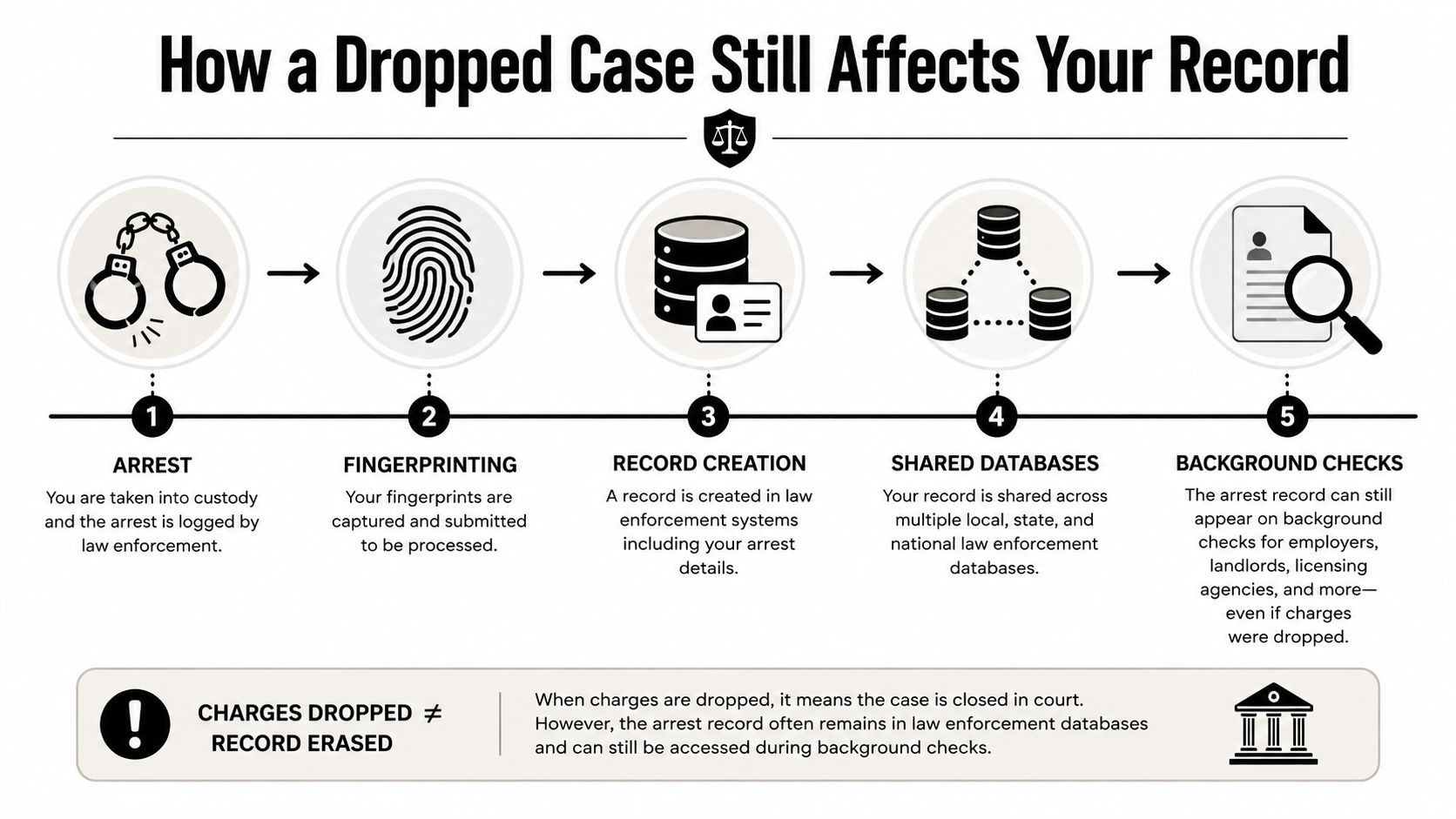
The arrest record usually remains
When police arrest you, they create records. Booking, fingerprinting, and agency reporting all leave a trail. Even after a dismissal, the arrest record remains public and visible on background checks. To clear it, you must pursue an expunction after a waiting period, which can be two years for misdemeanors and four years for some felonies after the statute of limitations expires according to this Texas explanation of dismissed charges and expunction timing.
That means “case dropped” and “record gone” are two different things.
Why this causes real-life problems
Employers, landlords, banks, and licensing boards may see the arrest history. Some reports clearly show the case outcome. Some are incomplete or slow to update. Either way, the fact that you were arrested can raise questions you thought were behind you.
If you want a plain-language overview of how background checks function, that resource can help you understand why old arrest information may still appear in screening systems.
Here's the practical effect:
- Employment: A hiring manager sees an arrest and asks questions before you get to explain.
- Housing: A landlord may focus on the accusation, not the dismissal.
- Licensing: A board may require disclosure even if the case ended early.
- Financial screening: Some institutions examine public records during approval reviews.
Expunction is a separate legal process
Texas gives some people a way to clear eligible arrest records, but it does not happen automatically. You have to ask for it through the court system.
For many readers, this is the point where the work starts. If you need a clearer picture of that process after a case ends, this guide on clearing your record after dismissal in Texas is a useful next step.
A dropped charge changes your prosecution status. It does not clean up your background check by itself.
Your Action Plan to Truly Clear Your Name
Once the immediate relief settles in, focus on the part that protects your future. You want proof the case ended, a review of whether it can come back, and a plan for clearing the record if you qualify.
Start with documents
Get every document tied to the result.
Ask for the dismissal order, no-file confirmation, bond paperwork, release records, and any court notice showing settings were removed. If you apply for a job or have to answer questions later, those papers may be the difference between a quick correction and a long problem.
If you don't already have counsel helping with this stage, firms such as Law Office of Bryan Fagan PLLC handle criminal defense matters and record-clearing issues throughout Texas.
Ask the right follow-up questions
Don't stop at “the case was dropped.” Ask these instead:
- Was it no-filed or dismissed?
- If dismissed, was it with prejudice or without prejudice?
- Is there any remaining risk of refiling?
- When might I qualify for an expunction?
- Which agencies may still have my arrest record?
Those answers shape everything that comes next.
Prepare for expunction
An expunction is a court process that asks for eligible records of the arrest to be destroyed. This is often what people think happens automatically when charges are dropped. It doesn't.
The process usually includes:
- Reviewing eligibility: Timing matters, and the facts of your case matter.
- Preparing the petition: The filing has to identify the right arrest and agencies.
- Filing in the correct court: This is usually done in the county connected to the arrest.
- Serving agencies: Multiple law enforcement and records agencies may need notice.
- Getting the order entered and enforced: The signed order is what tells agencies to destroy records.
If you're ready to look at the filing process itself, this resource on how to get a record expunged is a helpful place to begin.
Don't ignore county-by-county differences
The basic law is statewide, but procedure can feel local. A filing in Harris County may move differently than one in Dallas County, Travis County, or Bexar County. Clerk requirements, scheduling practices, and paperwork expectations can vary.
That's why careful follow-through matters. A dropped case gives you an opening. Expunction is often what turns that opening into a clean slate.
If you've been charged with a crime in Texas, call The Law Office of Bryan Fagan, PLLC for a free and confidential consultation. Our defense team is ready to protect your rights.