Skip to content
Being arrested or receiving a citation in Texas can be terrifying—but you don’t have to face it alone. It’s easy to feel overwhelmed, confused about what to do next, and worried about what it means for your future. The first step is to understand exactly what you're up against, and that's where we can help.
A Class C misdemeanor is the lowest level of criminal offense in Texas. The key thing to know is that it's punishable only by a fine of up to $500, with no possibility of jail time. This single fact separates it from more serious charges and completely changes how your case will be handled.
Understanding Texas Class C Misdemeanors

Let's be honest—being charged with any crime, no matter how minor it seems, is scary. You’re probably anxious about what’s next and what this means for your record. The good news is that you don’t have to figure this out alone.
While a Class C misdemeanor is the least severe charge you can face, taking it seriously from day one is the smartest way to protect yourself. A knowledgeable Texas criminal defense attorney can guide you through the process and fight to keep your record clean.
The Legal Definition and Penalties
Under the Texas Penal Code, crimes are sorted by severity, and Class C misdemeanors sit at the very bottom of the ladder. If felonies are the top floor of a building, Class C offenses are on the ground floor. Unlike more serious charges that come with the threat of jail and thousands in fines, a Class C conviction has one main penalty.
The absolute maximum punishment for a Class C misdemeanor in Texas is a fine not to exceed $500, according to Texas Penal Code §12.23. There is zero jail time associated with this level of offense.
Here’s where many people make a mistake. They assume that just paying the fine makes the whole thing go away. But in the eyes of the law, paying the fine is the same as pleading guilty. It results in a final conviction that goes on your permanent criminal record, which can cause unexpected problems long after you've paid that ticket.
To give you a clearer picture, here’s a quick summary of what a Class C misdemeanor entails in Texas.
Texas Class C Misdemeanor at a Glance
This table provides a quick summary of the key features of a Class C misdemeanor in Texas, helping you understand the basics of your charge.
| Characteristic | Description |
|---|---|
| Maximum Fine | Up to $500 |
| Jail Time | None |
| Statutory Basis | Texas Penal Code §12.23 |
| Court Jurisdiction | Municipal Courts or Justice (JP) Courts |
| Effect of Paying Fine | Results in a final conviction on your criminal record |
| Record Clearing Options | Expunction or Orders of Nondisclosure may be possible |
This table helps put the charge in perspective. While the immediate penalties are low, the long-term impact of a conviction is what you really need to be thinking about.
Where These Cases Are Handled
Understanding the court system can also take some of the anxiety out of the process. Class C misdemeanor cases aren't handled in the same imposing courtrooms you see on TV. Instead, they go through local courts designed for minor offenses.
- Municipal Courts: These are city-level courts that handle violations of city ordinances and state laws happening within city limits, like a traffic ticket from a Houston police officer.
- Justice Courts (JP Courts): These are county-level courts that manage minor civil cases and Class C misdemeanors occurring outside a city's jurisdiction, often cited by a sheriff's deputy or a state trooper.
Because these offenses are handled in municipal or justice courts, the process is different from more serious cases. The most critical takeaway is that paying the fine is a guilty plea that creates a permanent criminal record. However, you have other options, like deferred adjudication, that could keep your record clean.
If you're looking to get a better handle on the legal landscape, exploring broader criminal law concepts can give you valuable context on how different offenses are classified and prosecuted.
Common Offenses That Lead to a Class C Charge
You might be surprised by how many everyday situations can result in a Class C misdemeanor citation in Texas. Most people think of traffic tickets, but the list is much broader. Understanding these common offenses shows how easily someone can find themselves facing a charge—and why knowing your rights is so important.
The Texas Penal Code lists dozens of offenses, but nearly all Class C misdemeanors fall into a few key areas: traffic violations, public order offenses, minor theft, and alcohol-related infractions.
Traffic and Driving Offenses
This is, by far, the most common way people encounter a Class C charge. Almost every driver in Texas has had that sinking feeling when they see flashing lights in their rearview mirror. These aren't just minor annoyances; they are formal charges that can have a real impact if you don't handle them correctly.
Common traffic-related Class C offenses include:
- Speeding: Exceeding the posted speed limit.
- Running a Red Light or Stop Sign: Failing to obey traffic signals.
- Driving Without a Valid License: Operating a vehicle without a current, valid driver's license.
- Failure to Maintain Financial Responsibility: The legal term for driving without state-required auto insurance.
While these seem cut-and-dry, defenses often exist. Was the speed limit sign visible? Was the officer's radar gun properly calibrated? An experienced Houston criminal lawyer knows exactly what questions to ask.
Public Order Offenses
These charges involve actions that disturb public peace or safety. They are often subjective, meaning an officer’s personal interpretation plays a huge role in whether you get a citation. That subjectivity, however, can often be challenged in court.
Some of the most frequent public order offenses are:
- Disorderly Conduct: A catch-all category under Texas Penal Code §42.01 that can cover anything from using abusive language to making unreasonable noise.
- Public Intoxication: You can be charged with this if you're in a public place while intoxicated to a degree that you might be a danger to yourself or others.
- Assault by Contact: This isn't like more serious assault charges. It involves physical contact that another person would find offensive or provocative, like an unwanted touch or a light shove that doesn't cause bodily injury. A skilled Texas assault defense attorney can help you fight these subjective allegations.
Because these charges often boil down to one person's word against another, having a strong advocate on your side is critical to making sure your version of events is heard.
Theft and Drug-Related Charges
Most people think of theft as a serious felony, but stealing something of low value is a Class C misdemeanor. At the same time, Texas has several common drug and alcohol offenses that fall into this lowest tier.
Under Texas Penal Code §31.03, theft of property valued at less than $100 is a Class C misdemeanor. But any theft conviction, no matter how small, can be devastating on a background check.
Other examples in this category include:
- Issuing a Bad Check: Writing a check when you know you don't have the funds to cover it.
- Minor in Possession of Alcohol (MIP): Anyone under 21 who possesses, consumes, or transports alcohol can be cited.
- Possession of Drug Paraphernalia: Having items intended for drug use—even if no actual drugs are found—is a Class C offense.
Every one of these charges carries consequences that go far beyond a fine. A theft conviction can stop you from getting a job. An MIP can lead to a driver's license suspension. This is why it’s so critical to explore every single option to avoid having a conviction on your record.
What Happens After a Citation: A Step-by-Step Guide
Getting a Class C misdemeanor citation in Texas is more than an inconvenience; it’s the start of a formal court process. The moment that ticket is in your hand, a legal clock starts ticking. Understanding the steps involved is the best way to keep a small mistake from turning into a big problem.
The citation is a legal summons. It contains key information you can't afford to overlook: the exact offense, the court you must report to, and the date of your arraignment. This is your first official court appearance, and you must show up.
Your First Court Appearance: The Arraignment
The arraignment is your first stop in the court system. It’s a formal hearing where the judge reads the charge against you and asks you to enter a plea. You have three basic choices, and each one sends your case down a very different path.
- Guilty: Pleading guilty means you are admitting to the offense. The judge will find you guilty, and the charge becomes a final conviction on your permanent record.
- Not Guilty: Pleading not guilty is your formal way of telling the court you deny the charge. This sets the case for a future date, giving you and your attorney time to build a defense and negotiate with the prosecutor.
- No Contest (Nolo Contendere): You are not admitting guilt, but you are not fighting the charge either. Legally, the outcome is the same as a guilty plea—it results in a final conviction on your record.
Many people think paying the fine online is the easiest way out. But be warned: paying the fine is the legal equivalent of walking into court and pleading guilty. It’s an automatic conviction. To learn about the entire journey from arraignment to trial, you can review the steps in the criminal justice process in Texas.
The Consequences of Ignoring a Citation
The absolute worst thing you can do with a Class C citation is ignore it. Missing your court date triggers immediate and serious consequences.
If you fail to appear, the judge will almost certainly issue a warrant for your arrest. You will then face a "Failure to Appear" or "Violate Promise to Appear" charge, which is a new criminal offense on top of the original one. What started as a minor ticket can now lead to your arrest during a routine traffic stop, at home, or at work.
Ignoring a court date slams the door on resolving the original offense favorably. You lose all credibility with the court and can say goodbye to options like deferred disposition, which could have kept the charge off your record.
This flowchart shows some of the common ways people find themselves facing a Class C misdemeanor citation.
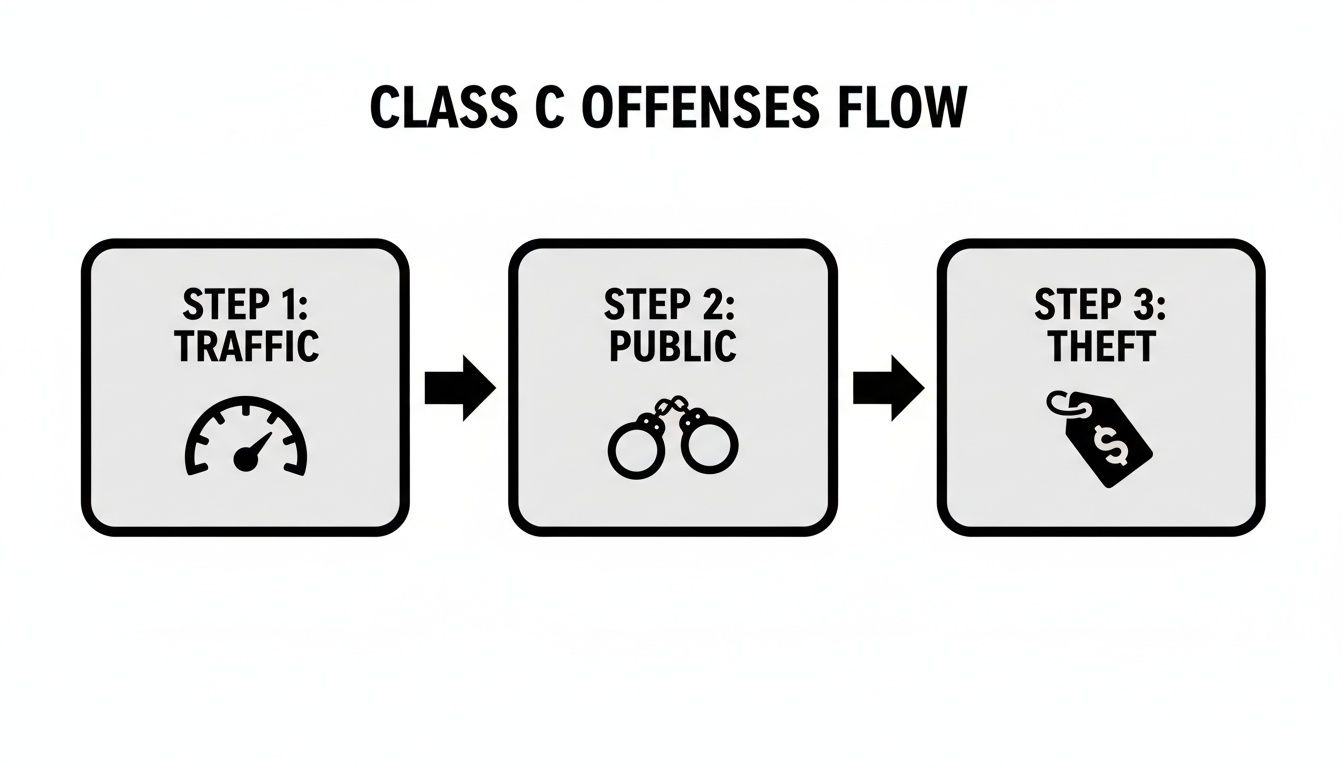
As you can see, everyday situations—from driving your car to being out in public—can unexpectedly lead to a criminal citation.
Why Your Plea Matters So Much
Your plea is your first strategic move. Pleading guilty might seem fast, but it creates a permanent criminal record that can haunt you for years. A conviction shows up on background checks, which can be a dealbreaker when you're trying to get a job, rent an apartment, or get a professional license.
Pleading "not guilty" is not confrontational—it is your constitutional right to make the state prove its case. This simple step opens the door for your attorney to scrutinize the evidence, find weaknesses, and negotiate for a much better outcome. Often, it leads to a dismissal or a deal like deferred disposition, which keeps the conviction off your record.
The Hidden Costs of a Class C Conviction
The phrase "no jail time" is reassuring, but it's also misleading. When you get a ticket for a Class C misdemeanor in Texas, it's easy to think paying the fine is the simplest solution.
Unfortunately, that's rarely true. Paying that fine is an admission of guilt. That admission puts a permanent criminal conviction on your record, triggering hidden costs that follow you for years, long after you've paid the court. These penalties aren't written on your ticket, but they can impact your life far more than a $500 fee.
Your Criminal Record and Background Checks
Once you have a conviction, it becomes a permanent part of your public record. This means it will almost certainly appear on any standard background check run by employers, landlords, or licensing agencies.
A conviction for something that seems minor, like theft under $100 or public intoxication, can be an instant red flag.
- Job Opportunities: Many companies have strict policies against hiring people with criminal records, especially for theft or drug-related offenses.
- Professional Licenses: If you work in a field that needs a state license—like nursing, teaching, or real estate—a conviction could put your license and career in jeopardy.
- Housing Applications: Landlords almost always run background checks. A criminal record can lead to an automatic denial of your rental application.
This is why fighting the charge is so critical. Even a "minor" conviction creates a permanent barrier you'll have to explain for the rest of your life.
Financial and Personal Consequences
Beyond background checks, the ripple effects of a Class C conviction can hit you in other unexpected ways. These consequences show how quickly a simple ticket can spiral into something far more complicated.
For example, traffic-related convictions almost always lead to higher car insurance premiums. Your insurance company sees the conviction as proof that you're a riskier driver and will raise your rates, sometimes for years.
The penalties don't always stop with the initial fine. Failing to comply with court orders or payment plans can lead to more severe consequences, escalating a minor issue into a much larger legal problem.
And while Class C misdemeanors don't carry jail time now, that could change. Texas lawmakers are constantly reassessing penalties. A recent bill seeks to enhance penalties for retail theft offenses—offenses that are currently Class C misdemeanors—potentially upgrading them to carry jail time. You can learn more about these proposed legislative changes and how they might affect future cases.
The Risk of Future Enhancements
Perhaps one of the most serious hidden costs is how a Class C conviction can haunt you if you ever face another criminal charge. Under Texas law, some offenses can be "enhanced" if you have prior convictions on your record.
This means a new charge that would normally be a misdemeanor could be upgraded to a more serious offense with much harsher penalties, including mandatory jail time. A prior theft conviction, for instance, can turn a new petty theft charge from a simple ticket into a Class B misdemeanor, which is punishable by up to 180 days in jail.
By simply paying the fine on that first offense, you unknowingly set a trap for yourself down the road. This is why it’s absolutely essential to treat every charge seriously and fight for a dismissal. Protecting your record today is the best way to safeguard your freedom tomorrow.
Strategic Options for Defending Your Case
Learning about the hidden costs of a conviction can be jarring, but it should also empower you. It’s a clear signal that you need a real strategy—not just a plan to pay a fine. You have powerful legal options to fight a Class C misdemeanor in Texas and keep your permanent record clean. This isn't about surrendering; it's about taking back control.
The system has built-in pathways to help you avoid a conviction entirely. The main goal in almost every case is simple: get the charge dismissed so you can later have it expunged from your record for good.
The Best Outcome: Deferred Disposition
One of the most common and effective tools for resolving a Class C misdemeanor is deferred disposition. You can think of it as a second chance from the court. Instead of finding you guilty, the judge essentially hits "pause" on your case for a set period.
During this probationary window, usually between 90 and 180 days, you'll have to meet a few conditions. If you do everything you’re supposed to, the charge against you is dismissed.
Common conditions for deferred disposition often include:
- Staying Out of Trouble: You cannot be arrested for any new offenses during the probation period.
- Paying Court Costs: This is an administrative fee, which is completely different from paying the fine for a guilty verdict.
- Taking a Relevant Course: Depending on the charge, you might be ordered to complete a class, like defensive driving for a traffic ticket or an alcohol awareness class for an MIP.
When you successfully finish deferred disposition, you are never actually convicted of the crime. This is a huge win because it keeps your record clean and makes you eligible for an expunction later on.
Negotiating for a Full Dismissal
Sometimes, the best move is to challenge the prosecutor's case head-on. An experienced criminal defense attorney can dig into every piece of evidence—or lack thereof—to find weaknesses.
Prosecutors are often juggling hundreds of these minor cases. A sharp lawyer can present compelling legal arguments, point out procedural mistakes the officer made, or highlight inconsistencies in the evidence. This pressure can persuade the prosecutor that taking your case to trial isn't worth their time, leading them to offer an outright dismissal. This is often the fastest and cleanest way to put the matter behind you.
To see how these negotiations work, you can explore the pros and cons in plea bargaining.
A "not guilty" plea is not just a denial; it's a strategic move. It forces the State to prove every element of its case beyond a reasonable doubt and opens the door for your attorney to negotiate from a position of strength.
Taking Your Case to Trial
If the prosecutor won't offer a fair dismissal or deferred disposition, your final option is to take your case to trial. While that might sound intimidating, it is your constitutional right to have your case heard by a judge or a jury.
At trial, your attorney gets the chance to:
- Cross-examine the police officer who wrote the ticket.
- Present your own evidence and witnesses.
- Make legal arguments demonstrating that the state has not met its burden of proof.
For many Class C misdemeanors, especially those based on an officer’s subjective opinion (like disorderly conduct), a trial can be a surprisingly effective strategy. The state has to prove you are guilty beyond a reasonable doubt, which is a high legal bar to clear. A "not guilty" verdict is often a very realistic goal.
How to Clear Your Record with an Expunction

Getting your Class C misdemeanor case dismissed is a massive victory. But a dismissal isn't the final step. Even after the case is thrown out, the record of your arrest and the original charge still exist in government databases, waiting to be found during a background check.
This is where an expunction becomes your most powerful tool. Think of it as a legal reset button.
An expunction is a court order that forces the complete destruction of all records related to your case. The records aren't just hidden; they are gone. Once a judge signs the order, every agency involved—from the police department to the court clerk's office—must physically destroy their files. Legally, it's as if the arrest never happened.
Who Qualifies for an Expunction in Texas
Not every case is eligible, but the good news is that most people who successfully resolve a Class C misdemeanor are. You can generally petition the court for an expunction if your case ended in one of these ways:
- You were found "not guilty" at trial (acquitted).
- The prosecutor dismissed your case.
- You successfully finished a deferred disposition program.
After a successful expunction, Texas law allows you to legally deny the arrest ever occurred on job applications, housing forms, and loan applications, without fear of penalty.
This process isn’t automatic. You have to formally petition the court. An experienced attorney can guide you through the complex paperwork and hearings to ensure everything is filed correctly, giving you the best possible shot at a fresh start. If you want to dive deeper, you can find more information on how to get criminal records expunged in Texas.
The Power of a Clean Record
An expunction is more than just a legal procedure; it’s about getting your life back, free from the shadow of one mistake. It removes the barriers that a criminal record creates, opening doors to opportunities that might have otherwise been slammed shut.
Your future shouldn't be defined by a single citation. An expunction makes sure it won't be.
Got Questions About Class C Charges? You're Not Alone.
When you're facing a Class C misdemeanor in Texas, it's normal to have questions. Let's tackle some of the most common concerns we hear from people in your exact situation.
Do I Really Need a Lawyer for a Class C Charge?
It’s a common mistake to think, "no jail time, no need for a lawyer." But an attorney’s goal isn’t just to avoid jail—it's to protect your permanent record. An experienced criminal defense lawyer can often negotiate with the prosecutor for a dismissal or secure a deferred disposition. This keeps a conviction off your record, which is crucial for future job applications, housing, and professional licenses.
What Happens If I Miss My Court Date?
Whatever you do, don't miss your court date. It's a serious mistake that instantly makes a bad situation worse. The moment you fail to appear, the judge will issue a warrant for your arrest. On top of that, you’ll be hit with a new criminal charge like "Failure to Appear." This complicates your original case and makes it much harder to get a good outcome. If you've already missed a date, call an attorney immediately to get the warrant handled.
Can a Class C Misdemeanor Become More Serious?
Absolutely. Texas has enhancement laws that can elevate the penalties for repeat offenses. For example, a second theft conviction—even for something small—could be bumped up to a Class B misdemeanor. Suddenly, you're facing up to 180 days in jail. A prior conviction makes any future charge far more severe.
A conviction is permanent. Unlike a speeding ticket that might eventually fall off your driving record, a criminal conviction for a Class C misdemeanor stays with you forever unless it is formally expunged by a court order.
This is why fighting for a dismissal from the very beginning is so critical. The only way to get your record expunged is if your case is dismissed or you are found not guilty.
If you’ve been charged with a crime in Texas, call The Law Office of Bryan Fagan, PLLC for a free and confidential consultation. Our defense team is ready to protect your rights. You can reach us at https://texascriminallawyer.net.