Being arrested in Texas can be terrifying — but you don’t have to face it alone. Suddenly, you're thrown into a confusing legal system, worried about your job, your family, and your reputation. In the middle of all that chaos, you might hear a term that offers a glimmer of hope: deferred adjudication.
Think of it as a second chance—a legal pathway that lets you avoid a permanent criminal conviction by successfully completing a period of community supervision, which works a lot like probation.
A Second Chance to Keep Your Record Clean
When you're facing a criminal charge in Texas, the idea of a permanent conviction hanging over your head is a heavy weight. It can slam the door on job opportunities, make it tough to rent an apartment, and even get in the way of going back to school. Deferred adjudication is a powerful tool designed to give people who qualify a chance to prove themselves and keep their records clean.
This guide is your roadmap to understanding how it all works. We'll cut through the legal jargon and explain everything in plain English so you can make smart decisions for your future. To really get a handle on deferred adjudication, it helps to know a few basics about how the courts operate, like understanding what is jurisdiction in law and how a court's authority over your case shapes everything from the very start.
What You'll Learn in This Guide
Our goal is to clear up the confusion and answer your most urgent questions. We’re going to walk through:
- The Basics: What deferred adjudication actually is and how it works in a Texas courtroom.
- Who Qualifies: How to know if you're eligible and which offenses are usually off the table.
- The Pros and Cons: An honest look at the benefits and the potential downsides you absolutely need to consider.
- Life After Deferred: The steps to truly clear your record for good after you’ve successfully completed the program.
Facing the justice system is not something you should do alone. Remember, an arrest doesn't have to define the rest of your life. By understanding your options, like deferred adjudication, you're taking the first step toward protecting your rights and fighting for your future. It’s a structured way to move past a mistake without being stuck with the lifelong burden of a criminal conviction.
How Deferred Adjudication Actually Works
So, what does deferred adjudication look like in the real world? Let’s strip away the legal jargon. Think of it as a contract with the court—a chance to prove that a single mistake doesn't have to define you.
When you and your lawyer accept a deferred adjudication offer, you will stand before a judge and enter a plea of "guilty" or "no contest." Now, that sounds final, but it’s not the end of the story. Instead of immediately finding you guilty, the judge hits the pause button. He or she defers—or postpones—a finding of guilt.
This single step is what makes deferred adjudication a game-changer. The court never enters a conviction on your record. Instead, you're placed on "community supervision," which is the official Texas term for probation.
Your Responsibilities During Supervision
This supervision period isn't a free pass. You'll have to follow a strict set of court-ordered conditions designed to keep you on the right path.
Common requirements often include:
- Regular Check-Ins: You will have to report to a community supervision officer (what most people call a probation officer) on a set schedule.
- Fines and Fees: All court costs, fines, and supervision fees must be paid on time and in full.
- Classes or Counseling: A judge might order you to attend specific programs, like drug and alcohol awareness classes, anger management courses, or counseling for assault or drug possession charges.
- Community Service: Completing a set number of volunteer hours is a very common condition.
- No New Offenses: This is the big one. You absolutely cannot be arrested for or charged with any new crimes.
Following these rules is non-negotiable. You can learn more by reviewing our guide on the probation rules in Texas.
The diagram below gives you a clear visual of how deferred adjudication creates a path to a second chance.
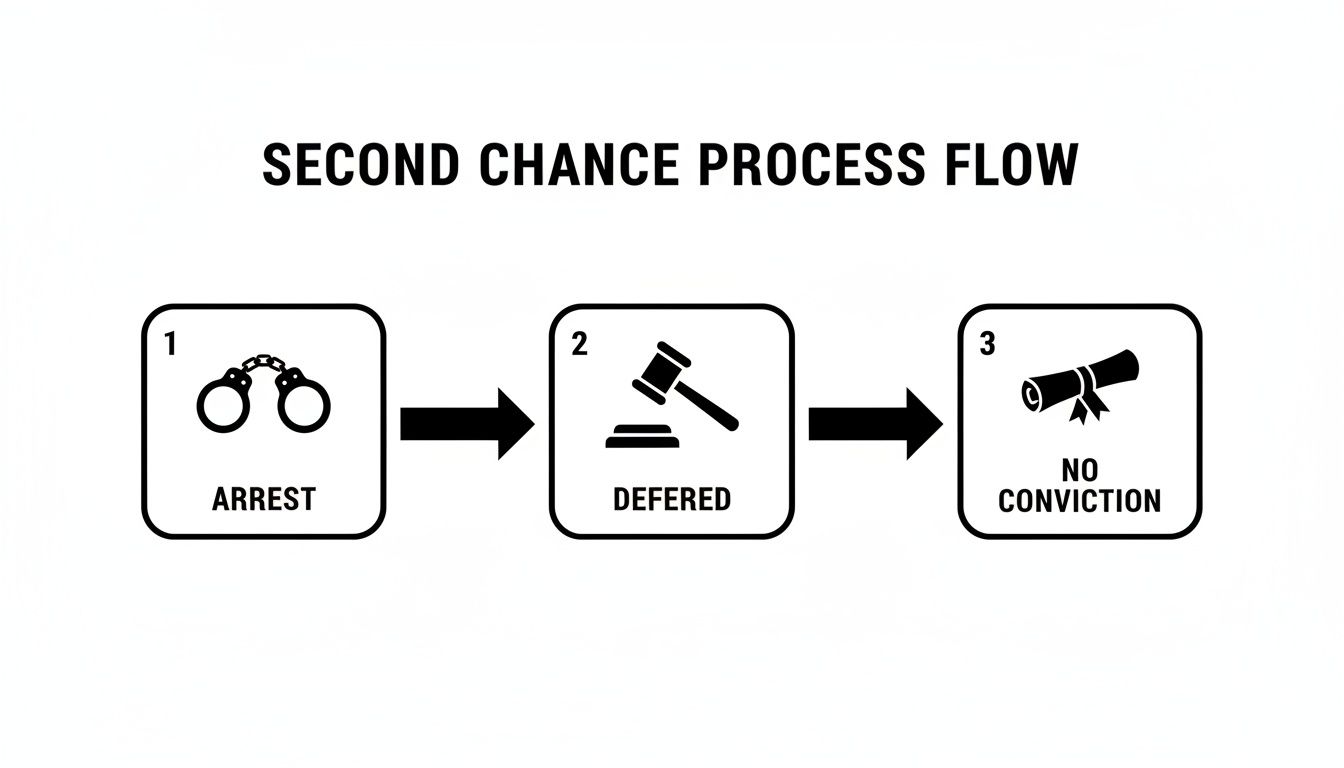
As you can see, the process is designed to steer an arrest away from a conviction, giving you a chance to keep your record clean.
The Final Outcome: Dismissal Without Conviction
If you successfully complete every single requirement for the entire supervision term—which could be anywhere from six months to several years—the judge will dismiss the case against you.
This dismissal is the most powerful benefit of deferred adjudication. Because the judge never formally found you guilty, you were never convicted of the crime. This means you can legally and honestly say that you have not been convicted of that offense when asked on job applications or other forms.
This is why deferred adjudication is such a widely used tool in the Texas justice system. It offers a lifeline to thousands of people who might otherwise be burdened by a permanent criminal record. In Harris County alone, around 7,000 deferred adjudication cases are handled each year for offenses ranging from DWI to theft, with an impressive 70% success rate. That means nearly 4,900 people a year get to walk away and rebuild their lives without a conviction standing in their way.
Determining Your Eligibility in Texas

Deferred adjudication can feel like a lifeline, but it's not on the table for everyone. Who gets this chance in Texas boils down to the crime you’re accused of and your criminal record. Figuring out if this path is open to you is the first step in building a smart defense.
Generally, deferred adjudication is a common route for first-time offenders facing misdemeanors and even some lower-level felonies. But it’s not an automatic right. The final decision is up to the judge, and getting there almost always involves negotiation with the prosecutor. This is where an experienced Houston criminal lawyer becomes your best asset, making a compelling case for why you are a good candidate for this second chance.
Who Is Typically Eligible
So, who is the ideal candidate? Prosecutors and judges are far more likely to agree to deferred adjudication for someone with a clean slate who’s been charged with a non-violent offense. They often see the situation as a one-time mistake, not a pattern of behavior.
You'll often see deferred adjudication come up in cases involving:
- Theft and Shoplifting: Especially for first-timers and lower-value theft charges.
- Simple Assault: Cases that don't involve serious injuries or weapons.
- Drug Possession: Possession of a small amount of a controlled substance for personal use.
- Credit Card Fraud and Forgery: Some non-violent white-collar crimes can qualify as well.
Just remember, nothing is guaranteed. A prosecutor can object, or a judge might simply decide it’s not the right fit for your case.
Offenses That Are Statutorily Barred
Texas law draws a hard line on certain crimes. The Texas Code of Criminal Procedure, Article 42A.054, lists specific offenses where deferred adjudication is legally forbidden. If your charge is on this list, there's no room for negotiation.
You are generally not eligible for deferred adjudication if you've been charged with:
- Driving While Intoxicated (DWI) with a Commercial Driver's License (CDL): The rules are incredibly strict for professional drivers.
- DWI with a BAC of 0.15 or Higher: Deferred adjudication is off the table if your blood alcohol was nearly double the legal limit.
- Intoxication Assault or Intoxication Manslaughter: These are serious felonies that involve injury or death and do not qualify.
- Certain Violent or Sexual Offenses: This list includes murder, capital murder, aggravated kidnapping, and many crimes that require sex offender registration.
These legal barriers are absolute. If you're facing one of these charges, your attorney will have to pivot to other defense strategies to protect your future.
The use of deferred adjudication has grown significantly across the country as a way to manage heavy caseloads and offer rehabilitation. Texas is a prime example of this trend, with around 20 states now widely allowing court-managed deferrals for offenses ranging from misdemeanors to felonies like drug trafficking or assault. The core idea remains consistent: you plead, comply with conditions for a set period (anywhere from 180 days to ten years), and earn a dismissal. Discover more insights about this national trend and its impact.
The Role of Your Criminal History
Even if your current charge qualifies, a prior criminal history can complicate things. Deferred adjudication is most common for first-time offenders, but it's not impossible if you have a record.
The nature of your past offenses—and how long ago they happened—will be scrutinized. A big one to remember: if you've already received deferred adjudication for a felony, you are almost always barred from getting it for another felony.
A sharp Texas assault defense attorney will dig into your complete history to see how it might affect your eligibility. Their job is to build the strongest possible argument on your behalf and present you to the court as someone who deserves another shot.
Weighing the Pros and Cons of This Path
Deciding to accept deferred adjudication is a huge decision with consequences that can follow you for years. It’s definitely not a "get out of jail free" card. Before you take this path, you and your attorney need to seriously weigh the powerful advantages against some significant risks.
Understanding both sides of this coin is essential. This is one of those moments where making a truly informed choice can protect your future.
The biggest benefit is crystal clear and life-changing: you get to avoid a final, permanent criminal conviction. A conviction is a massive roadblock. It can slam the door on your options for jobs, housing, and even getting into certain college programs. When you successfully finish a deferred adjudication, you can legally and truthfully say you were never convicted of that crime.
That single outcome can keep opportunities on the table that might otherwise be lost forever. For most people, that’s the number one reason to consider this option. It offers a structured way to move past a mistake without the lifelong baggage of a criminal record.
The Upside: A Path to a Cleaner Slate
The main "pro" of deferred adjudication is its potential to keep your record from being permanently stained by a conviction. This has a direct, positive ripple effect across your life.
- Employment Opportunities: Many job applications ask the dreaded question: "Have you ever been convicted of a crime?" A successful deferred adjudication allows you to honestly check "no." This keeps doors open that a conviction would slam shut.
- Housing Applications: Landlords almost always run background checks. A conviction for theft, assault, or a drug offense can get your application denied. Avoiding that conviction gives you a much better shot at securing a lease.
- Professional Licenses: If you're a nurse, teacher, or real estate agent, a conviction can trigger disciplinary action or stop you from getting licensed in the first place. Deferred adjudication can often help you sidestep these career-ending consequences.
- Educational Goals: Some universities and financial aid programs screen for criminal convictions. Keeping your record clean ensures your educational path isn't blocked by a past mistake.
At the end of the day, the goal is to resolve your case in a way that does the least amount of long-term damage. This is a huge part of plea bargaining, and it’s critical to understand the pros and cons of any plea bargaining before you agree to anything.
The Downside: The High Stakes of Non-Compliance
While the benefits are massive, the risks that come with deferred adjudication are just as serious. The entire deal hinges on one critical condition: you must follow every single rule of your community supervision perfectly.
If you slip up on any term—failing a drug test, missing a meeting with your probation officer, or getting arrested for a new offense—the hammer can come down hard. The prosecutor will file a "Motion to Adjudicate," asking the judge to revoke your deferred status.
At a revocation hearing, the prosecutor doesn't have to prove the original case all over again. You already pleaded "guilty" or "no contest," so the only question is whether you violated the rules. If the judge agrees you did, they can find you guilty and sentence you to any punishment within the full range for the original offense.
This is the biggest gamble you're taking. For example, if you got deferred adjudication for a third-degree felony, you could be sentenced to anywhere from 2 to 10 years in prison for one single violation. There's no new trial and no jury—your fate is completely in the judge's hands.
Other Long-Term Considerations
Even without a conviction, deferred adjudication isn't invisible. It still leaves a footprint and can create real complications in certain parts of your life. It's not a conviction, but it's not nothing, either.
Before you make a final decision, it's vital to understand these potential long-term impacts. The table below breaks down some of the most critical areas where deferred adjudication can still affect you, even after you've successfully completed it.
Potential Long-Term Impacts of Deferred Adjudication
| Area of Life | How Deferred Adjudication Can Impact You | Next Steps to Consider |
|---|---|---|
| Immigration Status | For non-U.S. citizens, deferred adjudication can be treated as a conviction for immigration purposes. This could lead to deportation, especially for offenses involving drugs, theft, or family violence. | Immediately consult with an experienced immigration attorney before accepting any plea offer. |
| Firearm Rights | Under federal law, receiving deferred adjudication for a felony or a Class A misdemeanor involving family violence will prohibit you from possessing a firearm. This is a permanent ban. | Understand that this right will be lost. There are few, if any, legal avenues to restore it after this type of deferred adjudication. |
| Professional Licenses | Some state licensing boards (for nursing, teaching, etc.) can still see the arrest and deferred disposition. You may be required to disclose it, and it could impact your license renewal or application. | Review your specific licensing board's rules on criminal history disclosures. Be prepared to explain the circumstances. |
| Background Checks | While not a conviction, the original arrest and the deferred adjudication will still appear on many background checks until you can get it sealed through an Order of Nondisclosure. | Talk to your attorney about your eligibility for nondisclosure and the timeline for sealing your record after you complete the supervision. |
As you can see, the implications go far beyond just staying out of jail. Making this choice requires a clear-eyed look at your ability to stick to very strict rules for a long time. An experienced Texas criminal defense attorney can give you the guidance you need to weigh these pros and cons and figure out if deferred adjudication is truly the right move for you.
What Happens After You Successfully Complete Deferred Adjudication?

Successfully finishing your deferred adjudication is a massive accomplishment. You followed every rule and proved to the court you deserved this second chance. The moment a judge signs that dismissal order is a huge relief—but your journey isn't quite over.
This is where a critical misunderstanding trips many people up. The common belief is that once the case is dismissed, the whole thing just vanishes. Unfortunately, that’s not how it works in Texas.
While you were never technically convicted, the record of your arrest and the deferred adjudication case itself still exists. It lingers in government databases and is very likely to pop up on background checks run by employers, landlords, and state licensing agencies. It won't show a conviction, but it will show the original charge, leaving you to answer some awkward questions.
The Final Step: Sealing Your Record
So, how do you truly put this behind you? The answer is a powerful legal tool under Texas law: a Petition for Nondisclosure. Think of it as the final chapter in clearing your name.
An Order of Nondisclosure legally seals your criminal record from the public. It’s a directive to government agencies, telling them not to disclose your case records to private entities. This means most private employers, apartment complexes, and background check companies will no longer be able to see it.
An Order of Nondisclosure is your key to moving on. It prevents a past mistake from shadowing your future job prospects, housing opportunities, and personal life by making the record confidential for most purposes.
Securing this order is a completely separate legal process. It happens after your deferred adjudication is successfully completed and dismissed, and it’s not automatic. You have to take proactive steps, almost always with an attorney, to file the correct legal paperwork and get it in front of a judge.
The Nondisclosure Process and Waiting Periods
Filing a Petition for Nondisclosure isn't something you can do the day after your case is dismissed. The Texas Code of Criminal Procedure, Chapter 55, lays out mandatory waiting periods you have to follow before you can ask the court to seal your record. The length of that wait depends on the type of offense you were originally charged with.
Here’s a general breakdown of the timelines:
- Most Misdemeanors: For many Class A and B misdemeanors, you may be eligible to file your petition immediately after the case is dismissed.
- Certain Other Misdemeanors: Some specific misdemeanors, like those involving assault or disorderly conduct, require a two-year waiting period from the date of dismissal.
- Felonies: If you completed deferred adjudication for a felony charge, you must wait a full five years from the dismissal date before you can petition for nondisclosure.
It's also critical to know that some offenses, even if resolved through deferred adjudication, can never be sealed. This includes charges involving family violence or those that require sex offender registration. An experienced attorney can give you a clear picture of what timeline applies to your specific case.
The process of getting a nondisclosure is detailed and requires precise legal work. You can learn more about the specifics in our comprehensive nondisclosure order Texas guide. Consulting with a lawyer who handles record sealing is the best way to ensure it’s done right, giving you the peace of mind that comes with a truly clean slate.
Frequently Asked Questions About Deferred Adjudication
When you're facing a criminal charge, your mind is racing with questions. It's completely normal. An option like deferred adjudication sounds good, but the details are what really matter. Let's walk through some of the most common questions our clients ask.
Can I Get Deferred Adjudication for a DWI in Texas?
This is one of the most common questions we hear, and the answer is "it depends." For years, deferred adjudication was a hard "no" for any DWI charge in Texas. Thankfully, the law has changed, but only for a very specific group of first-time DWI offenders.
The eligibility rules are incredibly strict. You are not eligible for DWI deferred adjudication if:
- You were driving a commercial vehicle at the time.
- Your blood alcohol concentration (BAC) was 0.15 or higher.
- You have any previous DWI-type convictions or deferred adjudications on your record.
Even if you clear those hurdles, there's another mandatory condition: you must have an ignition interlock device installed on your vehicle for the entire time you're on supervision. Because the rules are so specific, the only way to know for sure if this is an option for you is to have a skilled Texas DWI attorney dig into the details of your case.
What Happens if I Violate My Deferred Adjudication?
Violating your deferred adjudication is a serious matter with severe consequences. If you slip up on any condition—whether it's missing a meeting, failing a drug test, or getting arrested for something new—the prosecutor can file a "Motion to Adjudicate Guilt."
That motion kicks off a revocation hearing in front of the judge. Here's the critical part: the prosecutor doesn't have to prove you committed the original crime all over again.
You already pleaded "guilty" or "no contest" to get on deferred adjudication. So, the only thing the judge needs to decide is whether you broke the rules. If they find you did, they can find you guilty right then and there and sentence you to any punishment within the full range for the original offense.
Think about that. If you got deferred adjudication for a third-degree felony (which carries a punishment of 2 to 10 years in prison) and you violate the terms, the judge could send you to prison for a decade. The stakes couldn't be higher, which is why following the rules perfectly is absolutely non-negotiable.
Will Deferred Adjudication Show Up on a Background Check?
Yes, it will. This is a massive point of confusion. Until you take another legal step, the record of your arrest and the deferred adjudication case will pop up on most background checks run by employers, landlords, or licensing boards.
The background check won't say "conviction," but it will show the charge, that you went on deferred adjudication, and that the case was eventually dismissed. That's often enough to trigger awkward questions or even cost you an opportunity.
The only way to keep this information from being seen by the public is to get an Order of Nondisclosure. This is a separate court process that "seals" the record from public view. You can only start this process after you’ve successfully finished your supervision and any required waiting period has passed.
How Is Deferred Adjudication Different from Pretrial Diversion?
This is a great question. Both programs are designed to help you avoid a conviction, but they are completely different. The biggest difference is when they happen in the legal process and what they require from you.
Think of it this way:
| Aspect | Pretrial Diversion | Deferred Adjudication |
|---|---|---|
| Plea Requirement | No guilty plea is ever entered in court. It’s an agreement you make directly with the prosecutor's office. | You must plead "guilty" or "no contest" in open court before a judge. |
| Legal Process | It happens before the court case really gets going. You are literally diverted out of the system. | It happens inside the courtroom as a formal way to resolve your case. |
| Final Record | When you're done, the charges are dismissed, and you can usually get a full expunction—which completely destroys the record. | When you're done, the case is dismissed, but you can typically only get an Order of Nondisclosure (sealing the record), not destroy it. |
| Availability | Usually only offered for first-time offenders with minor, non-violent misdemeanors. | Available for a much wider range of offenses, including many felonies. |
Bottom line: pretrial diversion is almost always the better outcome because it can lead to your record being wiped clean. However, far fewer people qualify for it. An experienced criminal defense attorney can look at your situation and tell you which of these options, if any, might be on the table for you.
If you’ve been charged with a crime in Texas, call The Law Office of Bryan Fagan, PLLC for a free and confidential consultation. Our defense team is ready to protect your rights. https://texascriminallawyer.net