Being arrested in Texas can be terrifying—but you don’t have to face it alone. If you’ve just been arrested, your mind is probably racing with urgent questions. The big one is likely, “What exactly is a felony in Texas?”
Let’s cut through the legal jargon. A felony is the most serious category of crime you can be charged with in Texas. It’s set apart from lesser offenses, called misdemeanors, by one critical factor: the severity of the punishment. A felony conviction often means significant time in a state prison and fines that can easily hit $10,000 or more.
This isn’t just a legal label; it’s a life-altering event that demands your full attention from day one. Understanding what you are up against is the first step toward building a strong defense and protecting your future.
Understanding Your Texas Felony Charge
Facing a felony charge is overwhelming. But the first step to building a powerful defense is understanding what you’re up against. In Texas, the criminal justice system draws a hard line between felonies and misdemeanors.
Think of it like the difference between a severe thunderstorm and a hurricane. Both are serious, but one has the potential to cause far more lasting damage. The primary distinction comes down to the punishment.
A misdemeanor might land you in a county jail for up to a year and involve smaller fines. A felony, on the other hand, can result in years, decades, or even a life sentence in a state prison. And the consequences don’t end when the sentence is served. A felony on your record creates long-term hurdles that can follow you for the rest of your life.
Texas Felonies vs Misdemeanors at a Glance
To really grasp what's at stake, it helps to see a side-by-side comparison of the two main types of criminal offenses in Texas. The differences are stark.
| Characteristic | Felony | Misdemeanor |
|---|---|---|
| Potential Jail Time | Minimum of 180 days in state jail, up to life in prison | Up to one year in county jail |
| Maximum Fines | Typically up to $10,000, but can be higher | Generally up to $4,000 |
| Long-Term Impact | Loss of voting and firearm rights; major impact on jobs and housing | Can affect employment and professional licenses but is less severe |
As you can see, the long-term impact of a felony conviction is where the real weight of the charge becomes clear, affecting your fundamental rights and opportunities.
After an arrest, one of your very first moves should be to find legal help. Getting a clear picture of the client intake process with a law firm can prepare you for that first meeting, so you can walk in ready to share the critical details of your case.
This basic understanding of what a felony is provides the foundation you need. It defines the gravity of your situation and highlights why immediate, strategic action is so important. Now, we can explore the specific classifications of felonies in Texas to determine exactly what the charge against you means for your future.
A Breakdown of the Five Classes of Texas Felonies
When you're charged with a felony in Texas, it's not a one-size-fits-all situation. The Texas Penal Code sorts felonies into five distinct levels, each with its own set of rules and, most importantly, its own range of potential punishments. Figuring out which category your charge falls into is the first critical step to understanding what you’re up against and building a defense.
Think of these classes as a ladder. The most severe offenses with the harshest penalties sit at the top. As you move down each rung, the potential prison time and fines decrease. Knowing where your charge lands on this ladder helps cut through the legal jargon and clarifies the seriousness of the fight ahead. We’ll walk through each of these five classes, from the most severe to the least, and explain them in plain English.
The diagram below shows the clear hierarchy between serious felonies and less severe misdemeanor offenses.
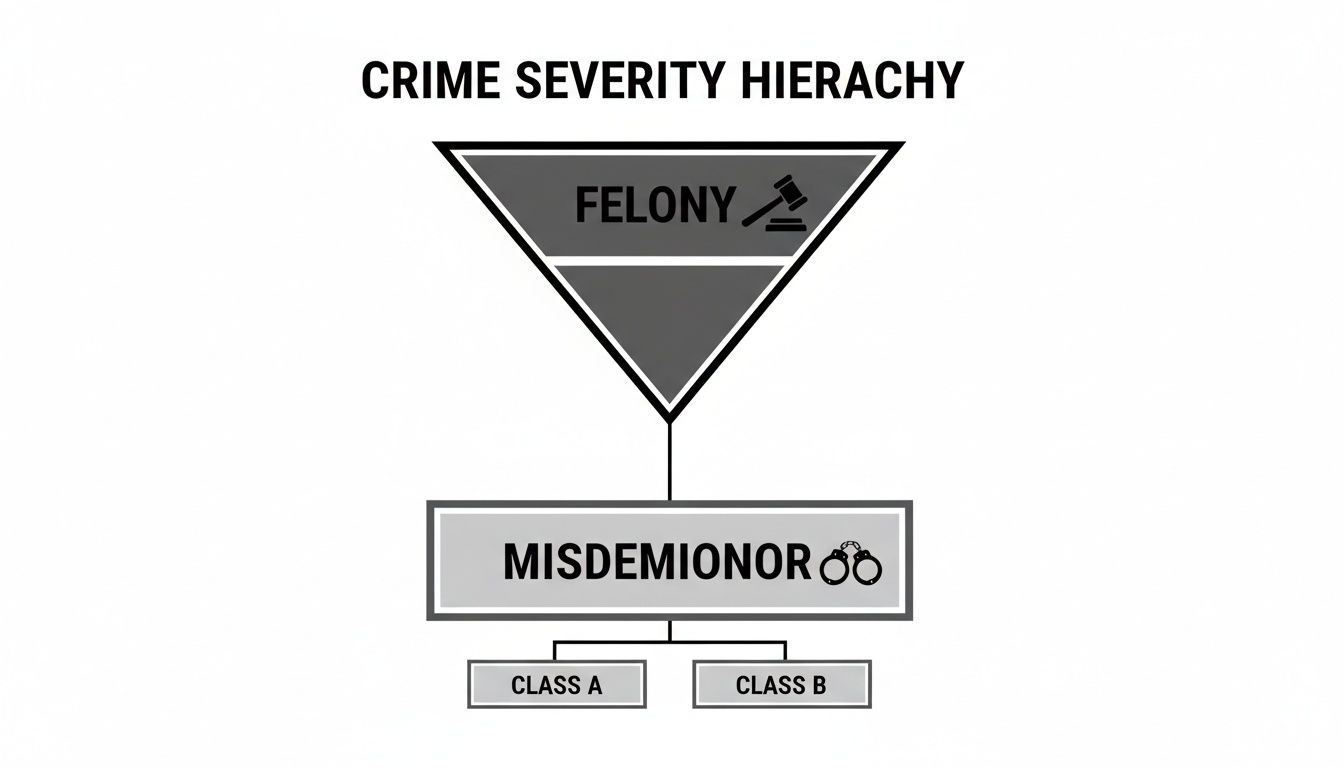
This visual highlights the significant jump from misdemeanors to felonies, which is why facing a felony charge is a fundamentally different and more critical legal challenge.
Capital Felonies: The Most Serious Offense
At the absolute top of the ladder is the Capital Felony. This is the most grave charge in the Texas justice system, reserved for only the most heinous crimes. The penalties are equally severe and are in a class of their own.
If you are convicted of a capital felony, there are only two possible sentences:
- Life in prison without the possibility of parole.
- The death penalty.
Crimes that fall under this classification are very specific, often involving murder with certain aggravating circumstances. Examples include murder of a police officer or firefighter, murder committed during another felony like robbery or kidnapping, and murder for hire.
First-Degree Felonies
Just below a capital felony is a First-Degree Felony. While these offenses don't carry the death penalty, they are still incredibly serious and come with the potential for decades behind bars. A conviction will permanently alter the course of your life.
The punishment range for a first-degree felony is:
- Prison Sentence:5 to 99 years, or life, in a state penitentiary.
- Fine: Up to $10,000.
Common examples of first-degree felonies include aggravated robbery (robbery involving a deadly weapon or causing serious injury), aggravated sexual assault, and trafficking large quantities of drugs.
Second-Degree Felonies
Next on the ladder are Second-Degree Felonies. These are still very serious crimes that carry the real possibility of a long prison sentence. Many common but severe offenses fall into this category.
If you are convicted of a second-degree felony, a judge can sentence you to between 2 and 20 years in prison and impose a fine of up to $10,000. This substantial prison time makes a vigorous defense absolutely essential.
Examples of second-degree felonies include aggravated assault, bribery, manslaughter, and possession of between 50 and 2,000 pounds of marijuana.
Third-Degree Felonies
Continuing down the scale, we find Third-Degree Felonies. While the penalties are less severe than first or second-degree charges, a conviction is still a life-changing event that results in a permanent felony record.
The sentencing guidelines for a third-degree felony are:
- Prison Sentence:2 to 10 years in a state penitentiary.
- Fine: Up to $10,000.
Common examples include tampering with evidence, stalking, a third DWI offense, and assault on a public servant.
State Jail Felonies: A Unique Category
Finally, the lowest level of felony in Texas is the State Jail Felony. This category was created to punish certain offenses without overcrowding the state's main prison system. While it's the least severe felony, it is still a felony—and far more serious than any misdemeanor. To learn more about the critical distinctions, you can read our guide on the difference between a felony and a misdemeanor.
A conviction for a state jail felony can result in:
- Jail Time:180 days to 2 years in a state jail facility.
- Fine: Up to $10,000.
Examples include credit card abuse, unauthorized use of a motor vehicle, and possessing smaller amounts of certain controlled substances. Understanding these classifications is power. It gives you a clear picture of the challenge ahead and underscores why having an experienced Houston criminal lawyer by your side isn't a luxury—it's a necessity.
How Common Actions Can Lead to Felony Charges
You might be surprised how quickly a situation can spin out of control and land you with a felony charge in Texas. Most people think felonies are reserved for violent, premeditated crimes, but the reality is that certain everyday actions can cross that legal line under the right (or wrong) circumstances.
It’s a huge misconception that you have to be a “bad person” or have malicious intent to get charged with a felony. A string of bad decisions or even a single terrible moment can have life-altering consequences. Let's connect the felony classes we've talked about to some real-world situations you might encounter.
When a DWI Becomes a Felony
A first-time Driving While Intoxicated (DWI) is usually a misdemeanor. But a few key factors can elevate this all-too-common offense into a felony with devastating penalties. You don't have to be a "hardened criminal" to find yourself in this terrifying position.
A DWI charge jumps to a felony in Texas if:
- It’s Your Third DWI Offense: If you have two prior DWI convictions on your record, your third arrest is automatically filed as a Third-Degree Felony.
- You Have a Child Passenger: Driving while intoxicated with a passenger under the age of 15 is a State Jail Felony, even if it’s your first offense.
- Someone Gets Seriously Hurt (Intoxication Assault): If your impaired driving causes serious bodily injury to another person, you’re looking at an Intoxication Assault charge—a Third-Degree Felony.
- Someone Dies (Intoxication Manslaughter): If a death results from your intoxicated driving, the charge becomes Intoxication Manslaughter, a Second-Degree Felony.
How Drug Possession Escalates
In Texas, drug charges all boil down to two things: the type of drug and the amount you have. While having a small amount of marijuana is a misdemeanor, possessing even a tiny, unusable amount of a more serious controlled substance is an automatic felony.
For instance, under the Texas Health and Safety Code, possessing less than one gram of a Penalty Group 1 drug—like cocaine, heroin, or methamphetamine—is a State Jail Felony. As the weight goes up, the felony level skyrockets, quickly getting into first-degree territory with the potential for life in prison.
From Assault to Aggravated Assault
A simple assault, like causing someone bodily injury in a fistfight, is typically a Class A Misdemeanor. But that same fight can become Aggravated Assault, a Second-Degree Felony, if just one of two elements is present.
Under Texas Penal Code §22.02, an assault becomes “aggravated” if you:
- Cause serious bodily injury to the other person.
- Use or exhibit a deadly weapon while doing it.
A "deadly weapon" isn't just a gun or a knife. Legally, it could be a baseball bat, a steel-toed boot, or even a beer bottle swung in a bar fight—anything capable of causing serious harm or death. A heated argument that gets physical can turn into a second-degree felony case in a heartbeat. A skilled Texas assault defense attorney can be crucial in these situations.
Theft and White-Collar Crimes
The line between misdemeanor and felony theft is all about value. Once the value of the stolen property hits $2,500, it becomes a State Jail Felony. From there, the felony degree climbs with the dollar amount.
For example, stealing property valued between $30,000 and $150,000 is a Third-Degree Felony. This applies to everything from shoplifting expensive electronics to complex white-collar schemes like embezzlement or fraud.
Texas doesn't mess around with these offenses. The state's approach reflects a broader trend where both violent crime rates and felony prosecutions consistently outpace national averages. In 2022, the violent crime rate in Texas hit 432 per 100,000 residents, which was a full 13 percent higher than the national average. You can see more of the data in a recent criminal justice snapshot for Texas.
Seeing how easily these common situations can lead to a felony charge hammers home just how critical a strategic legal defense is from the moment of arrest.
What to Expect from the Criminal Justice Process
Getting arrested for a felony in Texas can feel like being thrown into a maze blindfolded. The system is a tangle of confusing legal procedures and critical deadlines, and if you don't know the path ahead, it's easy to feel overwhelmed and powerless.
Let's walk through the roadmap of what happens after a felony arrest. Knowing the steps can help replace some of that uncertainty with a sense of control and empower you to make informed decisions.

Arrest and Your Initial Appearance
It all starts the moment you are taken into custody. You'll be booked and processed, which is a formal way of saying they'll take your fingerprints, snap a mugshot, and record your personal information.
Shortly after, usually within 24 to 48 hours, you'll have your first court appearance. This is often called an arraignment or magistration. At this stage, a judge will officially inform you of the charges, explain your rights (including your right to an attorney), and set your bail amount. Bail is a financial guarantee that you will show up for future court dates if you are released.
The Grand Jury and Indictment
This is where felony cases take a different path from misdemeanors. Before a prosecutor can formally charge you with a felony, your case must go before a grand jury. This is a group of citizens who meet in secret to hear the prosecutor’s evidence and decide if there's enough probable cause to move forward.
If the grand jury believes there's sufficient evidence, they issue an indictment. Think of an indictment as the official green light that moves your case into the trial court. If they don't find enough evidence, the case is "no-billed," and the charges are dropped right then and there.
The Texas justice system is swamped with serious cases. The Texas Judiciary's 2023 annual report revealed that new filings for capital murder, murder, and aggravated assault are 25 percent higher than just five years ago. This puts immense pressure on courts and highlights how aggressively these cases are pursued.
Pre-Trial Discovery and Plea Bargaining
Once you're indicted, your case enters the pre-trial phase. This is a critical time where your defense attorney really gets to work. They’ll file motions, investigate every detail of the case, and engage in discovery—the formal process of getting all the evidence the prosecution has against you.
This is also when plea bargaining usually happens. Your attorney and the prosecutor will negotiate a potential deal to resolve the case without going to trial. A plea bargain might mean pleading guilty to a lesser charge in exchange for a more lenient sentence.
A good lawyer will dissect every piece of evidence and give you straightforward advice on whether accepting a plea or fighting the charges at trial is the right move for your situation.
Trial and Sentencing
If your case doesn't get resolved with a plea deal, it heads to trial. In Texas, you have the right to a trial by a jury of 12 citizens, who will hear all the evidence from both sides and decide your fate.
The trial itself follows a structured process:
- Jury Selection: Both sides question potential jurors to pick a fair and impartial panel.
- Opening Statements: The prosecutor and your attorney each lay out a roadmap of what they intend to prove.
- Presentation of Evidence: The state presents witnesses and evidence to try and prove guilt beyond a reasonable doubt. Your attorney will cross-examine their witnesses and present your defense.
- Closing Arguments: Both sides summarize their case and make their final pitch to the jury.
- Jury Deliberation and Verdict: The jury goes behind closed doors to decide if you are guilty or not guilty.
If you are found guilty, the case moves to the sentencing phase. Here, the judge or jury determines your punishment based on the felony level, the specifics of your case, and your criminal history. An experienced defense lawyer is absolutely essential to guide you through the many steps in the criminal justice process and protect your rights at every single turn.
The Hidden Consequences of a Felony Conviction
When a judge hands down a sentence for a felony, the prison time and fines are just the beginning. The real sentence often lasts a lifetime. These “collateral consequences” are the hidden penalties that follow you long after your official debt to society is paid, creating permanent roadblocks in nearly every aspect of your life.

This is why understanding what’s truly at stake is so critical. A conviction doesn’t just close a chapter; it fundamentally rewrites the rest of your story. Fighting the charge now is the single most important thing you can do to protect your future.
Loss of Fundamental Civil Rights
Some of the most devastating consequences hit you immediately, stripping away rights most of us take for granted. These aren’t small inconveniences—they’re profound restrictions on your freedom and your voice in the community.
Two of the biggest losses are:
- The Right to Vote: In Texas, you lose your right to vote while incarcerated for a felony, on parole, or on probation. Your voting rights are only restored after you have fully completed your entire sentence, including any supervision period.
- The Right to Own a Firearm: This one is a big deal for many Texans. A felony conviction triggers a permanent, lifetime ban on possessing a firearm under both state and federal law. Getting caught with a gun after a felony conviction means facing a new, serious felony charge.
These aren't just symbolic losses. They fundamentally change your ability to participate in our democracy and to protect your family, which makes a strong initial defense absolutely essential.
Barriers to Employment and Housing
For many, the most relentless, day-to-day struggle after a felony conviction is finding a decent job and a safe place to live. In an era of near-universal background checks, a felony record can feel like a life sentence of rejections.
Countless employers have blanket policies against hiring people with felony records, especially for jobs involving money, trust, or working with vulnerable people. This can slam the door on entire career paths and cripple your earning potential for good.
The same goes for housing. Landlords routinely run background checks and can legally deny your rental application because of a felony. This makes finding stable housing a constant battle, affecting not just you but your entire family.
Professional Licensing and Immigration Issues
A felony conviction can be a career-killer for licensed professionals. State boards governing fields like nursing, real estate, teaching, or law often deny or revoke licenses for anyone with a felony record. The career you spent years building can vanish overnight.
For non-U.S. citizens, the stakes are even higher. Federal immigration law classifies many felonies as “deportable offenses.” A conviction could mean being removed from the country and permanently barred from coming back, tearing your family apart.
What starts as one criminal charge can quickly spiral out of control, threatening your job, your home, and even your ability to stay in the United States with your loved ones. The ripple effects are massive and permanent. This is exactly why you have to act decisively to protect yourself from the very start.
Can You Clear Your Record After a Felony Charge?
Even after your case is resolved, the arrest and charge don't just disappear. They linger on your public record, casting a long shadow that can follow you for years. A past mistake can pop up on a background check, making it incredibly difficult to get a good job, rent an apartment, or even volunteer at your child’s school.
But it doesn't have to be a life sentence. Texas law provides powerful legal tools to help you get a fresh start and put the past behind you for good.
Understanding your options for post-conviction relief is the first step toward reclaiming your life and reputation. This is about more than just filing paperwork; it's about clearing your name so you can finally build the future you deserve without that weight on your shoulders.
Expunction: The Power to Erase Your Record
The most powerful way to clear your name is with an expunction, which you might also hear called expungement. Think of it like a legal eraser. When a judge grants an expunction, they order every government agency—from the local police department to the court clerk—to completely destroy every single record tied to your arrest and charge.
Once the expunction is granted, it’s as if the arrest never happened. You can legally and honestly deny that you were ever arrested for that offense. It's a true clean slate.
However, getting an expunction isn’t easy, and the eligibility rules are very strict. Generally, you can only go down this path if your case ended in one of these ways:
- You were acquitted at trial (found not guilty).
- The prosecutor dismissed your case.
- You were arrested but never formally charged with a crime.
- You successfully finished a pre-trial diversion program.
Orders of Nondisclosure: Sealing Your Record From Public View
So what happens if you don't qualify for an expunction? All is not lost. The next best thing is an Order of Nondisclosure, which effectively seals your criminal record from the public. While an expunction destroys the records, a nondisclosure just hides them.
With an Order of Nondisclosure, private employers, landlords, and the general public won't see the offense on a standard background check. However, law enforcement and certain state licensing agencies can still access the information if they need to.
This is an excellent option for many people who successfully completed deferred adjudication probation. It allows you to move forward in your career and personal life without a past mistake constantly getting in the way.
The laws surrounding both expunctions and nondisclosures can get complicated fast. Learning about the requirements for expunging felony convictions in Texas is a crucial first step. Navigating this process correctly requires careful legal guidance to make sure every detail is handled perfectly, giving you the best possible shot at clearing your name and taking back control of your future.
Answering Your Questions About Texas Felonies
When you’re facing a felony charge, your mind is probably racing with questions. It’s completely normal to feel anxious and uncertain. Let’s cut through the noise and give you some clear, straightforward answers to the questions we hear most often.
Can My Felony Charge Be Reduced to a Misdemeanor?
Yes, and this is often one of the main goals for a skilled criminal defense attorney. Getting a felony knocked down to a misdemeanor is a huge win. It's not magic, though—it takes strategic negotiation with the prosecutor.
We can often get this done by finding weaknesses in the state’s evidence, presenting mitigating factors about your life or the situation, or negotiating a specific plea agreement. A reduction can literally save you from the lifelong baggage of a felony conviction, which is why it’s a critical strategy in so many cases.
What Is the Difference Between Parole and Probation?
People mix these up all the time, but they are fundamentally different concepts in the Texas justice system.
- Probation is what you get instead of going to prison. It's technically called "community supervision" here in Texas. You serve your sentence out in the community, but you have to live by a strict set of rules from the court.
- Parole is what happens after you’ve already served time in prison. It’s a supervised release that lets you finish the remainder of your sentence back in the community, but again, under very tight supervision.
Think of it this way: probation is an alternative to incarceration, while parole is an early release from it.
How Long Will a Felony Stay on My Record?
This is the hard truth: a felony conviction in Texas stays on your criminal record forever—unless you take legal action to have it cleared. It will not simply fall off after a certain number of years.
This is exactly why we explore every avenue for post-conviction relief, like an expunction (which destroys the record) or an order of nondisclosure (which seals it from public view). If you don't take one of these proactive steps, that conviction will pop up on background checks for the rest of your life.
Crucial Advice: Never speak to the police without your lawyer present. Anything you say can and will be used against you, even if you are completely innocent. The single most powerful thing you can do to protect yourself is to politely but firmly say, "I am exercising my right to remain silent, and I would like to speak with my attorney."
That simple phrase is your constitutional shield. Answering a detective's "quick questions" without legal counsel is one of the biggest and most damaging mistakes you can make.
If you’ve been charged with a crime in Texas, call The Law Office of Bryan Fagan, PLLC for a free and confidential consultation. Our defense team is ready to protect your rights.