Facing threats to your safety can be terrifying, leaving you feeling cornered and unsure where to turn. In Texas, a protective order is more than just a piece of paper—it's a legal shield issued by a judge designed to put an enforceable distance between you and someone who has committed family violence, stalking, or sexual assault. Its entire purpose is to stop further harm by setting firm legal boundaries backed by the power of the court. You don’t have to face this alone.
Your First Line of Defense Against Family Violence

Whether you’ve been arrested or feel threatened, the situation can feel overwhelming. But you don’t have to go through it alone. Texas law provides a powerful tool specifically designed to protect you and your family from getting hurt again. This isn't just a suggestion; it's a court-mandated directive with serious, immediate consequences for anyone who violates it.
Getting a handle on what a protective order does is the first step toward regaining control and securing your safety. These orders are meant to break a cycle of abuse or harassment by making specific actions illegal for the person named in the order.
What a Protective Order Accomplishes
A judge can customize a protective order to match the specifics of your situation, but most orders are built to do three key things:
- Prohibit All Contact: The order can forbid the other person from communicating with you in any form—no texts, no calls, no emails, and no social media messages.
- Create Physical Distance: It can legally require the person to stay a certain distance away from your home, your job, and even your children's school or daycare.
- Prevent Future Harm: The ultimate goal is to stop any future acts of family violence, threats, or harassment before they happen.
To give these orders real teeth, the state maintains a comprehensive database that law enforcement can access instantly. Known as the Protective Order Registry of Texas (PROTECT), this system lets officers and court officials see all active applications and orders. You can learn more about the Texas court's protective order registry to see how this crucial system functions.
Navigating the legal system is tough, especially during a crisis, but knowing your options is critical. Whether you are the one seeking protection or have been served with an order related to domestic violence charges in Texas, understanding the law is your most important tool.
To help simplify things, here's a quick overview of what a Texas Protective Order entails.
Texas Protective Order at a Glance
This table provides a quick summary of the essential components of a protective order in Texas, helping you understand its core functions and purpose.
| Key Element | Description |
|---|---|
| Purpose | To protect individuals from family violence, sexual assault, stalking, or trafficking by setting legally enforceable boundaries. |
| Who Issues It | A civil court judge, after hearing evidence from both parties. A magistrate can also issue a temporary emergency order after an arrest. |
| Duration | A Final Protective Order typically lasts for up to 2 years. Temporary orders are much shorter, usually lasting until the final hearing. |
| Key Prohibitions | Forbids the respondent from harassing, threatening, or contacting the applicant. It also requires them to stay away from specific locations. |
| Consequences of Violation | Violating a protective order is a Class A Misdemeanor, punishable by up to a year in jail and a $4,000 fine. A second violation can be a felony. |
| Firearm Restrictions | A person under a final protective order is legally prohibited from possessing a firearm or ammunition under both state and federal law. |
This table is just a starting point, but it highlights how seriously the Texas legal system treats these orders. Each element is designed to create a real, enforceable barrier to keep you safe.
Understanding Who Qualifies for a Protective Order
Getting a protective order in Texas isn’t a matter of simply asking for one. A judge needs to see clear, convincing proof that a specific type of violence or threat has occurred. These orders aren't handed out lightly; the law has strict criteria you have to meet. The most common reason a court will grant one is an act of "family violence."
Now, that term might bring to mind physical fights, but it’s actually much broader under the Texas Family Code. Family violence includes any act against a family member meant to cause physical harm, injury, or sexual assault. Crucially, it also covers a threat that puts someone in legitimate, immediate fear of those things happening.
Defining the Grounds for Protection
What this means is you don't actually have to be hit to qualify for protection. If someone makes a credible threat that makes you genuinely fear for your safety right now, that alone can be enough to constitute family violence. The key is proving to the judge that the threat was serious and left you in a real state of fear.
Beyond family violence, Texas law also provides a path for protective orders in a few other clear-cut situations. These include:
- Stalking: This isn't just one annoying text message. Stalking is a pattern of harassing behavior that would make any reasonable person feel frightened, intimidated, or threatened. Think a relentless stream of messages, unwanted visits to your job, and constant surveillance—that's the kind of behavior that qualifies.
- Sexual Assault or Abuse: Any instance of sexual assault, sexual abuse, indecent assault, or trafficking is an undeniable reason for a protective order. In these cases, the relationship between the victim and the offender doesn't matter.
Real-World Scenarios That May Qualify
To get a better sense of what this looks like in real life, let's consider a few examples. A judge would likely grant a protective order if you can prove:
- A partner threw a lamp across the room during a fight, barely missing you, and then threatened to "do worse" next time.
- An ex repeatedly shows up at your workplace and leaves unwanted gifts on your car, even after you told them to stop all contact.
- A family member sends a series of text messages graphically describing how they plan to cause you physical harm, creating a believable fear of an imminent attack.
Sadly, the need for these legal tools is all too real across the state. Statistics show that young women in Texas between the ages of 16 and 24 face intimate partner violence at rates almost triple the national average. This sobering fact highlights just how critical protective orders are for public safety. You can read more about domestic violence trends in Texas to grasp the full scope of the problem.
A protective order isn't just for spouses. It can cover dating partners, people who live together, relatives by blood or marriage, and even the parents of the same child—whether they were ever married or not.
Figuring out if your situation meets these legal standards is the absolute first step. Every case is different, and a judge will look closely at the specific facts and evidence you present to decide if family violence has truly occurred.
Navigating the Protective Order Filing Process
Taking legal action during a crisis can feel completely overwhelming. Let’s be honest, the last thing you want to do when you’re scared is navigate a complex legal system. But the process of filing for a protective order is more straightforward than you might think. Think of it as a clear roadmap toward safety.
With the right guidance, you can move forward with confidence, one step at a time.
This visual guide breaks down the first few steps to figure out if you even qualify to file a petition in the first place.
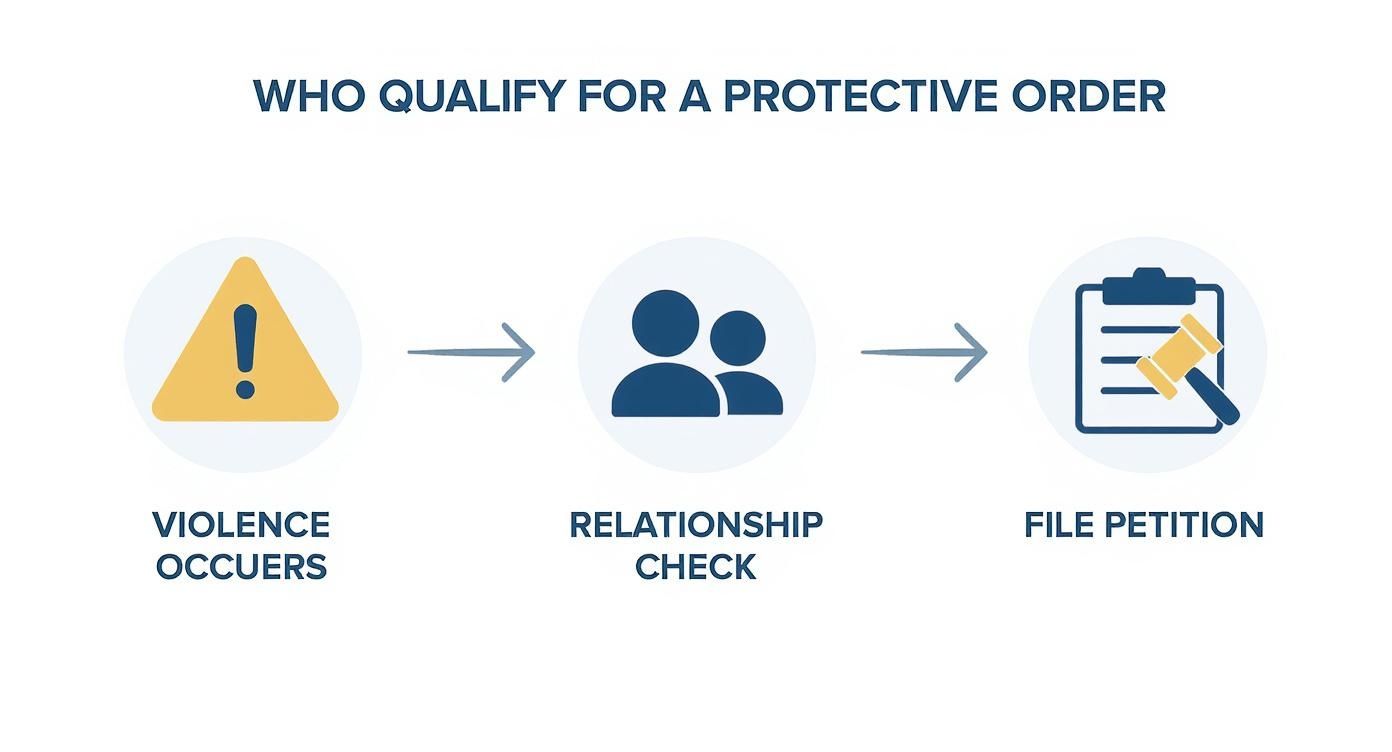
As you can see, the path starts with an act of violence or a credible threat. From there, you have to confirm a specific type of relationship exists. If you can check both those boxes, you can then file a petition with the court.
Starting with the Application
The first official step is to submit an Application for Protective Order. This is the legal document where you formally ask the court for protection and lay out exactly why you need it. You'll file this application in the county where either you or the other person lives.
Your application needs to be detailed and accurate. You’ll have to describe the acts of family violence, stalking, or sexual assault that happened. Get specific with dates, locations, and what was said or done—this information is the foundation of your entire case.
Securing Immediate Safety with a Temporary Ex Parte Order
In situations where you're in clear and present danger of more violence, you can ask the judge for a Temporary Ex Parte Order. This is an emergency order a judge can grant almost immediately, sometimes on the very same day you file your application.
The term "ex parte" means the judge makes this decision based only on your side of the story—your application and testimony. The other person isn't present or even notified yet. It’s a powerful tool that provides a crucial, temporary shield while you wait for the full court hearing.
A Temporary Ex Parte Order usually lasts for up to 20 days and gives you immediate protection. It’s designed to bridge the gap between filing your application and the final hearing, keeping you safe during an incredibly vulnerable time.
Preparing for Your Day in Court
After you file, the court will set a hearing date. This is when both you and the other party (the respondent) get a chance to present your sides of the story to the judge. This is the most critical part of the process, and being prepared is everything. Your goal is to give the judge clear and convincing evidence that family violence has occurred.
Strong evidence is what wins these cases. You should start gathering any proof you have, which might include things like:
- Photographs: Pictures of any injuries, damaged property, or other relevant scenes.
- Communications: Copies of threatening text messages, emails, voicemails, or social media posts.
- Police Reports: If you ever called the police, getting a copy of their report is powerful evidence.
- Witness Testimony: Statements from friends, family, or neighbors who saw the abuse or heard the threats.
Presenting your case to a judge is intimidating, no doubt about it. But with solid evidence and a clear account of what happened, you can effectively explain why a protective order is absolutely necessary for your safety. An experienced Houston criminal defense attorney can be a game-changer, helping you organize your evidence and tell your story in a compelling way.
What Happens After a Protective Order Is Granted
The moment a judge signs a final protective order, it’s no longer just a request—it’s a legally binding command with immediate and serious power. Think of this court order as your legal shield, creating an enforceable barrier between you and the person who has harmed you (the respondent).
From that point forward, the respondent must follow every single condition the judge laid out. They can no longer legally contact you or come near specific places, and any attempt to do so is a criminal act. This isn't a suggestion; it's a mandate backed by the full weight of Texas law.
Common Conditions and Restrictions
While every situation is unique and a judge can tailor an order accordingly, most protective orders in Texas come with a standard set of powerful restrictions. These are designed to sever contact and remove any opportunities for further harm.
Typically, the respondent is ordered not to:
- Commit any more acts of family violence, stalking, or harassment.
- Communicate with you or your family in any way—that includes texts, calls, emails, social media messages, or even sending messages through friends.
- Come within a certain distance of your home, your job, or your kids' school.
- Possess a firearm or ammunition.
That last point is a big one. Under Texas Penal Code Section 46.04, it becomes a state crime for anyone under a final protective order to have a gun. This is a crucial safety measure built into every single order.
A protective order is not just a piece of paper—it is an official court command. If the respondent violates any of its terms, even with what seems like a harmless text message, they can be arrested immediately.
Duration and Enforcement of the Order
In Texas, a final protective order is usually granted for a period of up to two years. As that expiration date gets closer, you may be able to petition the court to extend it if you still have a reasonable fear for your safety.
Enforcement is direct and immediate. If the respondent violates the order, call 911 right away. Police officers have access to a statewide protective order registry, allowing them to verify the order is active and make an arrest on the spot. Texas has been working hard to strengthen these protections, especially in domestic violence cases. In fact, new legislative efforts now require magistrates to use a statewide risk data system before even granting bail in certain violent felony cases. You can find more details about these victim protection updates in Texas on versustexas.com.
Your job is to keep a copy of the order with you at all times and report every single violation, no matter how minor it seems. This is how you ensure the order remains an effective tool for your protection and holds the respondent accountable.
The Serious Consequences of Violating a Protective Order
A protective order isn't just a piece of paper. Think of it as a direct command from a judge, backed by the full weight of the law. Violating any part of that order—no matter how small the action might feel—is a criminal offense in Texas. It's critical for everyone involved to understand just how severe the consequences are.
Ignoring the terms of a protective order can lead to an immediate arrest and serious criminal penalties. The law makes no exceptions for what someone might call a "minor" violation. A single text message, a quick phone call, or showing up at your child's school are all treated as criminal acts.
Escalating Criminal Penalties
The Texas Penal Code lays out a clear, escalating punishment structure for these violations. The consequences get worse with each offense, showing just how seriously the courts take enforcement.
-
First Offense: A first-time violation is usually charged as a Class A Misdemeanor. This is the most serious misdemeanor in Texas, carrying a potential penalty of up to one year in county jail and a fine of up to $4,000.
-
Second Offense: If you violate the order a second time, the charge gets elevated. The court sees a pattern of ignoring its commands, and the penalties reflect that.
-
Third or Subsequent Offenses: Committing two or more violations can result in a third-degree felony charge. A felony conviction is life-altering, carrying a punishment of two to ten years in a state prison.
These penalties are the teeth that give a protective order its power. It’s a tool designed to guarantee safety through strict, non-negotiable compliance.
What Constitutes a Violation
It’s surprisingly easy to misunderstand what actions can trigger an arrest. A violation isn't just about physical violence or direct threats. Any action that goes against the specific terms written in the court order is a breach.
This often includes things like:
- Any Communication: Sending a text, an email, or even a social media message.
- Third-Party Contact: Asking a friend or family member to pass a message along for you.
- Proximity: Knowingly coming within the forbidden distance of the protected person's home, workplace, or school.
Because these actions can lead to such serious charges, it is vital to understand every detail of your case. For a deeper dive, you can learn more about what happens after a violation of a protective order in Texas in our detailed guide. Knowing these rules is the only way to avoid severe legal trouble.
How to Defend Against a Protective Order
While protective orders are life-saving tools for many, they can sometimes be based on false or exaggerated allegations. If you've been served with an application for a protective order, it's easy to feel blindsided and overwhelmed. But you have a legal right to be heard and present your side of the story.
The first thing you must do is read every single word of the order and follow its conditions to the letter. Don't make the mistake of thinking you can "just explain things" to the other person. Even an accidental violation can lead to your immediate arrest and seriously damage your case. Treat it as a temporary rulebook while you prepare your defense.
Protecting Your Rights and Future
Don't wait. It's critical to get experienced legal help right away. A final protective order isn't just a piece of paper; it has long-term consequences that can ripple through every part of your life.
- Firearm Rights: A final order will make it illegal for you to own or even possess a firearm.
- Child Custody: It can weigh heavily on child custody decisions, often leading to supervised visitation or other restrictions.
- Professional Reputation: The stigma of a protective order can damage your reputation in your community and even affect your job.
You are not required to attend the protective order hearing, but failing to show up is a critical mistake. If you aren't there, the judge will only hear one side of the story, making it almost certain the order will be granted against you.
A skilled Texas assault defense attorney is your strongest asset in this fight. We can help you dig through the evidence—like text messages, emails, or witness statements—to challenge the claims made against you. By building a solid, fact-based defense, we make sure your side is presented fairly and persuasively in court.
If you need guidance, our team provides experienced protective order legal representation in Texas to help you navigate this difficult process.
Answering Your Questions About Texas Protective Orders
When you're dealing with the legal system, it's natural to have a lot of questions. We've pulled together some of the most common ones we hear to give you clear, straightforward answers about how protective orders work in Texas.
What's the Difference Between a Protective Order and a Restraining Order?
This is probably the most common point of confusion, and the difference is huge.
A Protective Order is a criminal court order. It's issued when a judge finds evidence of family violence, stalking, or sexual assault. Because it's a criminal matter, violating it is a crime in itself under the Texas Penal Code, and the police can make an immediate arrest.
A Restraining Order, on the other hand, is a civil court order. You'll typically see these in divorce cases to keep one spouse from draining a bank account or to manage behavior during the proceedings. Breaking a restraining order is a civil issue, handled as contempt of court—not an automatic trip to jail.
How Much Does It Cost to Get a Protective Order?
In Texas, there are no court fees to file a protective order for family violence, stalking, or sexual assault. The law was specifically designed this way to make sure that money is never a roadblock for someone who needs to get to safety. You can file for protection without having to worry about upfront costs.
Can a Protective Order Be Changed or Dropped?
Yes, but only a judge has the power to change or drop it. One of the parties has to file a formal motion with the court, and a judge has to agree that modifying or ending the order is the right thing to do.
This is critical: you can't just have a conversation with the other person and agree to ignore the order. Any informal "agreement" to drop it means nothing legally. The order is a command from the court, and it stays in full force until a judge says otherwise. Violating it is still a crime.
For a deeper dive into how courts have handled these issues in the past, understanding how to find relevant case law can give you valuable insight into the legal precedents that shape these decisions.
If you’ve been charged with a crime in Texas, call The Law Office of Bryan Fagan, PLLC for a free and confidential consultation. Our defense team is ready to protect your rights. Visit us at https://texascriminallawyer.net.