Being arrested for aggravated assault in Texas can be terrifying. It's one of the most serious violent crime charges you can face, and the label alone feels heavy. But you don’t have to face it alone. At its core, aggravated assault is a standard assault that gets "supercharged" into a felony because of two specific factors: either it caused serious bodily injury to someone, or a deadly weapon was used or shown during the incident.
Getting your head around that distinction is the first and most critical step in confronting the charge and protecting your future.
Understanding Your Aggravated Assault Charge

Facing any criminal accusation is overwhelming, but aggravated assault carries the weight of a severe felony conviction. You’re likely feeling anxious about what this means for your future, your family, and your freedom. The legal system can feel like an impossible maze, but you don’t have to find your way through it alone. Our goal is to explain the law in plain English and give you a clear, real-world understanding of the charge you’re up against.
Make no mistake, aggravated assault is a huge focus for law enforcement across the state. In fact, these cases make up roughly 21% of all felony cases handled by Texas courts, a statistic that shows just how aggressively they are prosecuted.
To really understand what makes an assault "aggravated," we have to start with the foundational principles of Criminal Law. At its heart, Texas law takes a simple assault and elevates it to an aggravated one based on very specific circumstances laid out in the Texas Penal Code.
Simple Assault vs. Aggravated Assault in Texas
So, what separates a misdemeanor scuffle from a life-altering felony? Think of simple assault as the base-level offense. It’s what happens when someone intentionally, knowingly, or recklessly causes bodily injury, threatens someone with imminent harm, or makes offensive physical contact. This is usually a misdemeanor.
Aggravated assault, on the other hand, adds a crucial element that dramatically raises the stakes—and the potential penalties. The table below breaks down the key differences.
| Factor | Simple Assault (Misdemeanor) | Aggravated Assault (Felony) |
|---|---|---|
| Type of Injury | Bodily Injury: Physical pain, illness, or any impairment. | Serious Bodily Injury: Creates a substantial risk of death, causes serious permanent disfigurement, or long-term loss/impairment of a body part or organ. |
| Weapon Use | No deadly weapon involved. | Deadly Weapon: A deadly weapon was used or even just shown during the assault. |
| Penalties | Fines (up to $4,000), jail time (up to 1 year), probation. | Prison sentence (2-20 years or more), fines (up to $10,000), long-term consequences. |
| Legal Classification | Typically a Class A Misdemeanor. | Usually a Second-Degree Felony, but can be enhanced to a First-Degree Felony in certain situations. |
As you can see, the line between these two charges is stark, and crossing it has massive implications for your life.
To get a conviction for aggravated assault, the prosecutor has to prove one of two things beyond a reasonable doubt:
- Serious Bodily Injury: The altercation resulted in an injury that created a substantial risk of death, caused serious permanent disfigurement, or led to the long-term loss or impairment of a body part or organ.
- Use or Exhibition of a Deadly Weapon: A deadly weapon was used—or even just displayed—during the assault. The legal definition of a "deadly weapon" is much broader than you might think and can include everyday objects if they’re used to threaten serious harm.
An arrest is not a conviction. The burden is on the State of Texas to prove every single element of the charge against you beyond a reasonable doubt. A strong defense strategy begins with understanding exactly what they need to prove.
The distinction between these charges is everything. A simple assault might end with fines or a short county jail sentence. An aggravated assault conviction can lead to decades in a state prison. This is why it is absolutely essential to get experienced legal help immediately after an arrest. Your rights and your future are on the line, and the moves you make right at the beginning can shape the entire outcome of your case.
How an Assault Becomes 'Aggravated'

The line between a simple assault and an aggravated assault in Texas can feel incredibly thin, but crossing it means jumping from a misdemeanor to a serious felony. The difference in penalties is massive, and it all comes down to what the prosecutor can prove about the incident.
Under the Texas Penal Code, a simple assault gets "aggravated"—or bumped up to a felony—if the state can show one of two things happened: you caused "serious bodily injury" or you "used or exhibited a deadly weapon."
Understanding what these two legal terms really mean is the first step to figuring out the case against you. They aren’t just vague concepts; they have very specific definitions that a skilled Texas assault defense attorney can challenge in court.
Defining Serious Bodily Injury
First, let's clear up a common misconception. The law draws a big, bright line between a standard "bodily injury," which can be as minor as causing someone physical pain, and a "serious bodily injury." A scrape or a simple bruise almost never counts.
According to Texas Penal Code Section 1.07(a)(46), an injury is only "serious" if it:
- Creates a substantial risk of death.
- Causes serious permanent disfigurement.
- Leads to the protracted (long-term) loss or impairment of any bodily member or organ.
Think of it this way: a punch that leaves a bruise is likely a simple assault. But if that exact same punch breaks a person’s jaw, requiring surgery and wiring it shut for weeks? A prosecutor will argue that caused a "protracted impairment" and file aggravated assault charges. The specific nature and duration of the injury are everything.
The prosecution doesn’t just get to say an injury was bad. They have to prove, beyond a reasonable doubt, that it was severe enough to meet that strict legal standard.
What Qualifies as a Deadly Weapon
When most people hear the term "deadly weapon," their minds jump straight to guns and knives. And while those are definitely included, the legal definition in Texas is much, much broader. This is where a lot of people get caught off guard.
The law says a deadly weapon is anything that, in the way it's used or intended to be used, is capable of causing death or serious bodily injury. This means almost any object can become a "deadly weapon" depending on the situation.
Common Examples of Deadly Weapons:
- Obvious Weapons: Firearms, knives, and brass knuckles are classic examples.
- Blunt Objects: A baseball bat, a tire iron, or even a heavy bar stool swung during a fight.
- Vehicles: A car or truck can easily be classified as a deadly weapon if it’s used to intentionally hit or threaten someone.
- Everyday Items: A broken beer bottle, a steel-toed boot, or even a heavy wrench can be considered a deadly weapon if used to inflict or threaten serious harm.
It’s also critical to know that you don't even have to actually hit someone with the object. Simply exhibiting it during an assault—like pulling a knife out of your pocket to intimidate someone—is enough for the state to elevate the charge. This is a subtle but crucial point, as the prosecutor has to prove your intent when you displayed the object. To learn more about how these components fit together, you can read our guide on the elements of assault charges in Texas.
Challenging the state’s story is the core of a strong defense. An experienced lawyer will scrutinize medical records to question the injury’s severity or argue that an ordinary object doesn't meet the legal definition of a deadly weapon in the context of your case.
The Penalties and Lifelong Consequences You Face

An aggravated assault conviction in Texas isn't just about fines or jail time. It's a life-altering event. The penalties are among the most severe in the entire criminal justice system, and the consequences don’t just end when a sentence is served—they follow you forever.
To build a strong defense, you first have to understand exactly what you're up against.
Texas prosecutors are known for their aggressive approach, especially with violent crimes. In 2020, our state's courts achieved a 114% criminal case clearance rate—the highest since 2001. This statistic isn't just a number; it shows how hard the system works to secure convictions. You can review the full report on Texas court statistics for a closer look at these trends.
Felony Charges and Prison Time
The majority of aggravated assault cases are charged as a second-degree felony. If you're convicted, a judge can sentence you to anywhere from 2 to 20 years in a state prison. On top of that, you could be hit with a fine of up to $10,000.
But it can get much, much worse.
Certain circumstances can "enhance" the charge, bumping it up to a first-degree felony. This is the same level as murder. The potential sentence skyrockets to 5 to 99 years—or even life—in prison.
These enhancements typically come into play if the alleged assault involves:
- A public servant on duty, like a police officer, judge, or firefighter.
- Retaliation against a witness, informant, or someone who reported a crime.
- A family or household member, particularly if it involves choking or is a repeat offense.
- A drive-by shooting or is related to gang activity.
A felony conviction is more than just a punishment; it's a permanent label that can fundamentally change the course of your life. The state takes these charges seriously, and so should you.
To give you a clearer picture, here’s a breakdown of the penalty tiers you could be facing.
Texas Aggravated Assault Penalty Tiers
| Felony Degree | Common Circumstances | Prison Sentence | Maximum Fine |
|---|---|---|---|
| Second-Degree Felony | Causing serious bodily injury or using a deadly weapon. | 2 to 20 years | $10,000 |
| First-Degree Felony | Assault against a public servant, family member (with prior conviction), or in a drive-by shooting. | 5 to 99 years (or Life) | $10,000 |
This table shows the stark reality of a conviction. Now, let’s look at the penalties that follow you long after any prison sentence is complete.
The Hidden Penalties Beyond the Courtroom
The judge's sentence is just the beginning. A felony conviction for aggravated assault triggers a cascade of "collateral consequences"—lifelong penalties that impact every corner of your future. These are the punishments nobody talks about in the courtroom, but they can be just as devastating as prison.
A conviction can permanently strip you of fundamental rights and slam doors shut on future opportunities. It creates a barrier that can feel impossible to overcome. For a deeper dive into sentencing, you might be interested in our guide on the penalties for aggravated assault in Texas.
Lifelong Restrictions and Lost Opportunities
After a conviction, you enter a new reality. These collateral consequences are far-reaching and can haunt you and your family for decades to come.
Permanent consequences often include:
- Loss of Firearm Rights: Under both Texas and federal law, a felony conviction means you can never legally own or possess a firearm again. This right is gone for life.
- Employment Barriers: Most employers run background checks. A violent felony on your record makes finding a good, stable job incredibly difficult.
- Housing Difficulties: Landlords and apartment complexes routinely deny applications from people with felony records, making it hard to find a safe place to live.
- Loss of Professional Licenses: If you're a nurse, teacher, pilot, or hold any other professional license, a conviction will almost certainly lead to its suspension or permanent revocation.
- Ineligibility for Federal Aid: Forget about getting federal student loans for college. A conviction often closes the door on opportunities for higher education.
These aren't just possibilities; they are the harsh realities that follow a conviction. This is why fighting an aggravated assault charge with an experienced Texas criminal defense attorney isn't just an option—it’s an absolute necessity to protect your future.
How to Build a Defense Against Your Charges
Getting arrested for aggravated assault feels like the end of the world, but it’s not the end of the story. An accusation is just that—an accusation. The State of Texas has the massive burden of proving every single part of its case against you beyond a reasonable doubt. That’s a very high bar to clear, and there are powerful, effective legal strategies we can use to challenge their claims and fight for your future.
This is where you pivot from just understanding the charges to actively defending against them. Building a rock-solid defense starts the second you hire an experienced Houston criminal lawyer who knows how to get ahead of the prosecution, scrutinize their evidence, and build a compelling narrative of your own.
Challenging the Prosecution's Core Arguments
Every aggravated assault case rests on a few key pillars: your intent, how severe the injury actually was, and whether a "deadly weapon" was truly involved. A smart defense strategy takes a sledgehammer to these pillars, piece by piece.
- Did You Really Intend to Do It? The prosecutor has to prove you acted intentionally, knowingly, or recklessly. Was it a genuine accident? A misunderstanding? We can argue that your state of mind simply doesn't meet the high legal standard required for a conviction.
- Was It Really a "Serious Bodily Injury?" The state has a specific definition for this, but prosecutors often stretch it. We’ll comb through medical records, consult our own experts if needed, and argue that the injury doesn't rise to the level of "serious" under Texas law. A broken finger, for instance, is painful, but it's a long way from causing a long-term impairment of an organ.
- Was That Really a "Deadly Weapon?" Just because an object was present doesn't automatically make it a deadly weapon. Was a tool simply in your hand, or was it actually used in a way that was capable of causing death or serious injury? We can push back hard on the prosecution's dramatic characterization of everyday items.
The prosecution’s case is often not as solid as it first appears. A thorough investigation can reveal inconsistencies, exaggerations, and weaknesses that can be used to build a powerful defense in your favor.
Asserting Your Right to Self-Defense
One of the most powerful shields against an assault charge is arguing your actions were justified. In Texas, you have a fundamental right to protect yourself and others from harm. If you had a reasonable belief that you were in immediate danger, you may have been legally entitled to use force.
The concept of self-defense is a cornerstone of Texas law. To win with this strategy, we have to show the jury that you had a reasonable fear of imminent harm and that the force you used was both necessary and proportional to the threat you were facing. For a deeper dive into this crucial strategy, check out our guide on using self-defense against assault charges in Texas.
Similarly, the defense of others allows you to use force to protect someone else—like a friend or family member—if you believe they are in danger. In both scenarios, the key is demonstrating that your actions were a reasonable response to a real threat, not an act of unprovoked aggression.
Other Powerful Defense Strategies
Beyond self-defense and picking apart the state's main arguments, several other strategies can be incredibly effective, depending on the unique facts of your case. An experienced Houston criminal defense attorney will explore every possible avenue to protect you.
Common defenses include:
- Mistaken Identity: Eyewitness testimony is notoriously unreliable, especially in chaotic situations like a bar fight or a poorly lit parking lot. We can challenge the police identification procedures and present evidence—like an alibi or conflicting witness statements—to prove you weren't the person who committed the act.
- False Accusation: Sadly, false allegations happen. They're often motivated by jealousy, anger, or a desire for revenge in a messy breakup. In these cases, our job is to uncover the accuser’s motive and expose every inconsistency in their story until their claims lose all credibility.
- Lack of Evidence: Sometimes, the state’s case is just plain weak. It might be full of holes and assumptions that don't meet the "beyond a reasonable doubt" standard. Your attorney can file motions to get illegally obtained evidence thrown out and will be ready to highlight every gap in the prosecution's case at trial.
An arrest is a terrifying experience, but remember: it is not a conviction. You have rights, and you have options. By working with a dedicated legal team, you can build a defense designed to protect your freedom and secure the best possible outcome for your future.
Navigating the Criminal Justice Process Step by Step
The legal system can feel like a foreign country with its own language and rules. When you’re staring down a charge as serious as aggravated assault, that complexity is downright terrifying. But knowing what’s coming—and what to expect at each stage—can cut through the anxiety and help you make smarter decisions.
Think of this as your roadmap through the Texas criminal justice system. We’ll walk through every critical phase, from the moment of arrest to a potential trial, so you understand exactly what’s happening and why.
The Initial Arrest and Your Rights
It all starts with an arrest. This is a confusing and often frightening experience, but it's also the first moment your constitutional rights truly matter. Police officers are required to inform you of your Miranda rights, which include the right to remain silent and the right to an attorney.
You need to use these rights immediately. Anything and everything you say can be twisted and used against you by the prosecution. Just politely state that you are invoking your right to remain silent and that you want to speak with a lawyer.
After the arrest, you'll be taken to a police station for booking. The process is pretty standard:
- They’ll record your personal information.
- They’ll take your fingerprints and a photograph (your mugshot).
- They’ll search you and confiscate your personal property, which will be held until you're released.
Try to remember that this is just procedure. The single most important thing you can do during this time is stay calm and wait for your attorney to arrive.
Arraignment and Bail Hearing
Your first court appearance is called an arraignment, and it usually happens within 48 hours of your arrest. During this brief hearing, the judge will formally read the charges against you, and you'll be asked to enter a plea—which is almost always "not guilty" at this stage.
This is also when the judge sets bail. Bail is a financial promise that you will show up for your future court dates. As you get your bearings in the criminal justice system, a major factor will be understanding bail costs for assault charges. A good lawyer will immediately argue for a reasonable bail amount or even for your release on a personal recognizance (PR) bond, which requires no money upfront.
The arraignment and bail hearing are the first real battlegrounds in your case. Having a skilled defense lawyer standing next to you is essential to protect your freedom right from the start.
Grand Jury, Plea Bargaining, and Trial
After the arraignment, your case moves into the pre-trial phase. For a felony like aggravated assault, the prosecutor has to present the case to a grand jury. This is a group of citizens who decide if there’s enough probable cause to formally indict you and move the case forward. Your lawyer can’t be in the room for this secret proceeding, but they can influence it by presenting favorable evidence to the prosecutor beforehand.
If you are indicted, the next stage is discovery, where your attorney finally gets to see all the evidence the state has against you. This is also when plea bargain negotiations usually get serious. A plea bargain is an agreement where you might plead guilty to a lesser charge for a more lenient sentence. Your lawyer will be your guide here, advising you if a plea offer is actually in your best interest or if you have a strong case for trial.
The infographic below breaks down the core principles of a strong legal defense, which all boils down to challenging the prosecution's case at every possible turn.
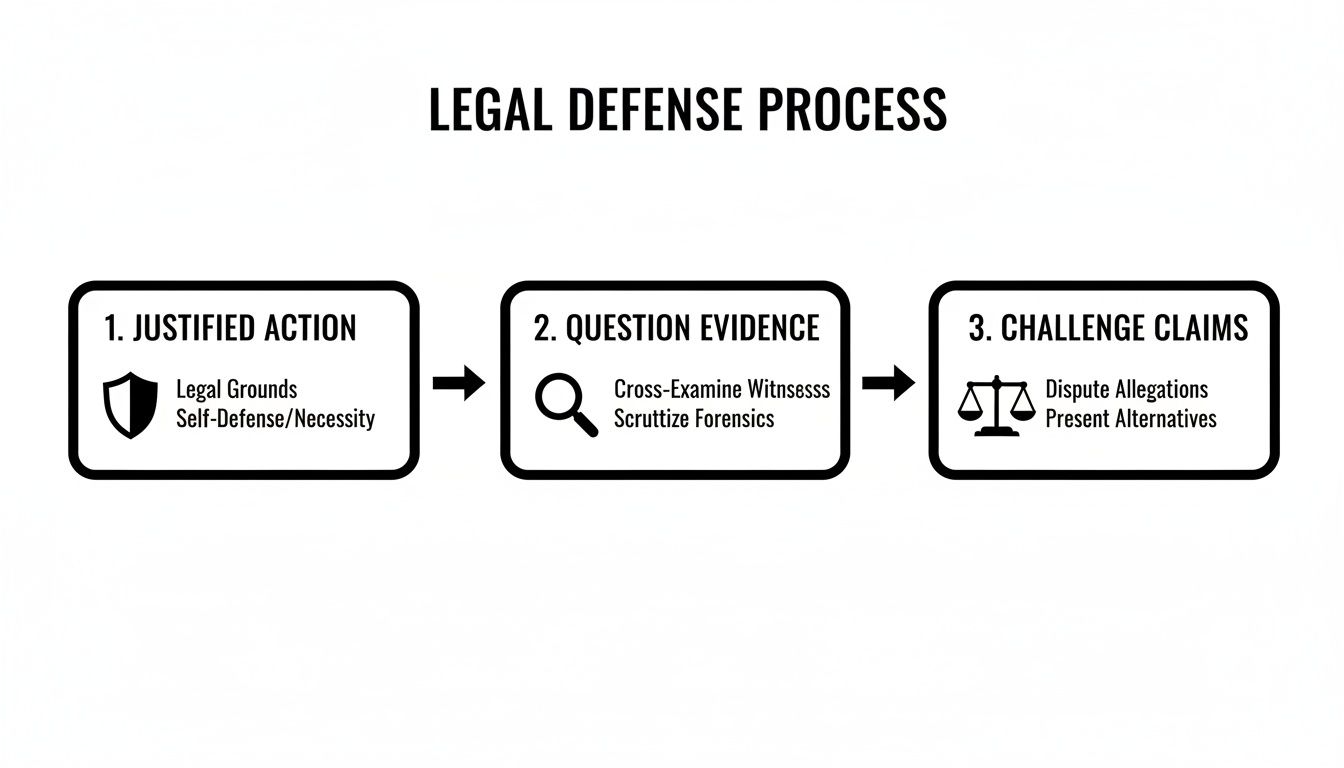
This process shows that a winning defense often involves justifying your actions, poking holes in the evidence, and challenging the state's claims. If a fair plea deal can't be reached, your case will be set for trial, where a jury of your peers will decide your guilt or innocence based on the evidence presented by both sides.
Frequently Asked Questions About Aggravated Assault in Texas
When you're hit with a charge as heavy as aggravated assault, your mind starts racing. The questions and the "what-ifs" can feel endless. Getting clear, straight-to-the-point answers isn't just helpful—it's the first step toward taking back some control over your situation.
We’ve pulled together some of the most common and urgent questions we hear from everyday Texans facing these charges. Our goal is to cut through the legal jargon and give you the practical information you need to make smart decisions.
Can the Alleged Victim Drop My Aggravated Assault Charges?
This is one of the biggest myths in criminal law. Many people assume that if the person who made the accusation changes their mind and wants to "drop the charges," the whole case just goes away. In Texas, that is absolutely false.
Once the police are involved and a report is filed, the fight is no longer between you and the accuser. It becomes a case between the State of Texas and you. The prosecutor at the District Attorney's office has the final say on whether to move forward, not the alleged victim.
Now, that doesn't mean the alleged victim's wishes are irrelevant. A good defense lawyer can use their reluctance to testify as powerful leverage, presenting it to the prosecutor along with other evidence to argue for a dismissal. But they can't force the DA's hand on their own.
Is "Assault With a Deadly Weapon" the Same Thing?
Yes, it is. While you might hear the term "assault with a deadly weapon" on TV or in casual conversation, that’s not the official legal language you'll see on court documents in Texas.
The formal charge is Aggravated Assault, as laid out in Texas Penal Code Section 22.02. Using a deadly weapon is one of the key "aggravating" factors that turns a simple misdemeanor assault into a very serious felony. So, if the state’s case is built on the claim that you used a weapon, you are officially facing an aggravated assault charge.
What if I Was Provoked?
Provocation is a tricky area. It can play a role in your case, but it is not a full-blown legal defense that excuses the act entirely. Think of it more as a mitigating factor.
Your attorney can argue that the alleged victim's actions provoked you, pushing the situation to a boiling point. This context might persuade a prosecutor to offer a more reasonable plea deal or convince a judge to impose a lighter sentence if you are convicted.
For this argument to work, the provocation generally needs to be something that would cause an ordinary person to react in the heat of passion. It’s important not to confuse this with self-defense, which is a complete justification for your actions.
Provocation might explain why you did what you did, but it doesn't legally justify it like self-defense does. A skilled lawyer, however, knows how to use the entire story to fight for a better outcome.
Can I Ever Get an Aggravated Assault Felony Off My Record?
This is a tough reality to face: getting an aggravated assault conviction off your record in Texas is next to impossible. This type of felony conviction is generally not eligible for an expunction (which destroys the record) or an order of nondisclosure (which seals it from public view).
That’s why the fight starts on day one. The single best way to keep your record clean is to prevent a conviction from ever happening in the first place.
This is where an aggressive, proactive defense becomes absolutely critical. The best results almost always come from:
- Getting the charges dismissed by the prosecutor before trial.
- Securing a "not guilty" verdict in court.
- Negotiating a plea bargain down to a lesser charge that is eligible for record sealing.
Your best—and often your only—shot at protecting your future from the permanent stain of a felony conviction is to fight the charge with everything you've got from the very beginning.
If you’ve been charged with a crime in Texas, call The Law Office of Bryan Fagan, PLLC for a free and confidential consultation. Our defense team is ready to protect your rights. https://texascriminallawyer.net