Being arrested in Texas can be terrifying—but you don’t have to face it alone. When you're hit with a serious criminal charge, the world can feel like it's spinning out of control. Understanding exactly what you're accused of is the first, most critical step toward getting your feet back on the ground and building a strong defense.
In Texas, "deadly conduct" is a serious charge because it doesn't require anyone to actually get hurt. Instead, it targets actions that recklessly put someone else in immediate danger of serious harm. It’s a charge that can pop up in all sorts of situations, from a heated argument that goes too far to the mishandling of a firearm, and the consequences can follow you for years. This guide will explain your rights and options in plain English.
What It Means to Face a Deadly Conduct Charge in Texas

Facing a deadly conduct charge can be a terrifying experience. These charges often arise from situations that escalated in the blink of an eye, leaving you feeling like things have spiraled beyond your control. The heart of this charge, laid out in Texas Penal Code § 22.05, isn't about causing an injury—it's about creating a significant and immediate risk of one.
Think of it this way: if you were to speed recklessly through a crowded parking lot without hitting a single person, your actions still created a clear and present danger. The law holds you accountable for that dangerous behavior itself. That's the core principle behind a deadly conduct charge.
To make this even clearer, let's break down the key ingredients a prosecutor must prove.
Deadly Conduct at a Glance
This table simplifies the legal jargon into what it really means for you.
| Key Element | What It Really Means | A Quick Example |
|---|---|---|
| The Action | The physical act you committed. | Firing a gun into the air at a party. |
| The Danger | Your action had to create a genuine risk of serious bodily injury. | A falling bullet could strike and kill someone. |
| The State of Mind | You acted recklessly or knowingly. | You were aware of the risk but did it anyway. |
Understanding how these pieces fit together is the first step in figuring out the strength of the case against you.
Two Paths to a Deadly Conduct Charge
The State of Texas can charge you with deadly conduct in one of two main ways. Figuring out which category your case falls into is absolutely critical for building a defense strategy with your Houston criminal lawyer.
- Reckless Endangerment: This is the broader and more common version. It covers any action where you are aware of a major, unjustifiable risk but consciously decide to ignore it, placing someone in imminent danger of serious bodily injury.
- Discharging a Firearm: This is a more specific—and often more serious—form of the offense. It involves knowingly firing a gun at or in the direction of a person, an occupied building, a home, or a vehicle.
The key takeaway here is that the prosecutor doesn't need to prove you intended to hurt anyone. They only need to show your actions were reckless and created a situation where serious harm was a real and immediate possibility.
What Does "Reckless" Really Mean?
In the legal world, "reckless" means more than just being careless. It implies you saw a significant risk and chose to ignore it. For instance, waving a loaded gun around during an argument would almost certainly be seen as reckless, because any reasonable person knows that creates a dangerously unpredictable situation.
Even pointing an unloaded gun at someone can land you a deadly conduct charge. Why? Because the law focuses on the fear and the perception of danger you created in that moment for the other person.
These cases often boil down to interpreting your state of mind and actions. Because of that, having a skilled Texas assault defense attorney is non-negotiable. They are the only ones who can effectively challenge the prosecution’s story and protect your rights.
Breaking Down the Law: Texas Penal Code § 22.05

To build a solid defense, you first have to understand the law you’re up against. An accusation of deadly conduct comes directly from Texas Penal Code § 22.05. Let's translate its dense language into plain English so you know exactly what a prosecutor has to prove to get a conviction.
The law splits deadly conduct into two very different types of actions. Figuring out which category your case falls into is the first step toward finding weaknesses in the state's argument. A sharp Houston criminal defense attorney will zero in on these specific legal elements to start dismantling the charges against you.
What the Prosecution Must Prove
The Texas Penal Code defines deadly conduct in two main ways. The first, and more common version, is when a person recklessly engages in conduct that places another in imminent danger of serious bodily injury. The second is when someone knowingly discharges a firearm at or in the direction of a person, an occupied home, a building, or a vehicle. That second one is treated far more severely.
At its core, a prosecutor's job is to prove beyond a reasonable doubt that your actions fit perfectly into one of those definitions. Every single word in that law—"recklessly," "imminent danger," "serious bodily injury," and "knowingly"—has a precise legal meaning that can be challenged. This is where your defense begins.
Defining Key Legal Terms
Legal jargon is confusing, but these terms are the building blocks of the state’s entire case against you. Let’s look at what they actually mean in the real world.
- Recklessly: This isn't just carelessness or a simple mistake. To act recklessly, you had to be aware of a major and unjustifiable risk but decided to ignore it anyway. Think of a driver aggressively weaving through rush hour traffic at 90 mph—they know it’s dangerous but do it anyway.
- Imminent Danger: This means the risk of harm was right there, right then—not a possibility for sometime in the future. The danger had to be immediate.
- Serious Bodily Injury: This is not a minor scrape or bruise. The law defines it as an injury that creates a substantial risk of death, causes serious permanent disfigurement, or leads to the long-term loss or impairment of a body part or organ.
- Knowingly: This mental state applies specifically to firearm-related cases. It means you were aware of what you were doing (firing a gun) and were reasonably certain your actions were aimed toward a person, building, or vehicle.
The heart of many deadly conduct cases, especially those without firearms, comes down to that one word: "recklessly." Proving someone was aware of a risk and consciously ignored it is a high bar for any prosecutor to clear, and it's often the first place a defense attorney will attack.
Two Types of Deadly Conduct Charges
The law draws a bright line based on whether a firearm was actually fired. This distinction is critical because it's the difference between facing a misdemeanor and a much more serious felony charge.
1. Reckless Action (Class A Misdemeanor)
This charge covers any behavior that recklessly puts someone in immediate danger. Brandishing a weapon during a heated argument is a classic example. Even if the gun is unloaded, just pointing it at someone is often considered reckless because it creates instant fear and the potential for a violent response. Road rage incidents, like trying to run someone off the road, can also fall into this category. You can learn more about how offenses are classified by reading our guide on understanding the Texas Penal Code structure.
2. Discharging a Firearm (Third-Degree Felony)
This is a much more serious charge. It applies when you knowingly fire a gun at or in the direction of a person, an occupied building, a home, or a car. The law is incredibly strict here. Firing a "warning shot" into the air in a neighborhood or shooting toward a house during a fight can easily land you a felony charge, even if nobody gets hurt.
Understanding these elements is your first line of defense against a charge that can turn your life upside down.
Understanding Misdemeanor vs Felony Deadly Conduct
Not all deadly conduct charges are created equal. In Texas, the single most important factor that determines the severity of your case is whether the state accuses you of a misdemeanor or a felony. That one distinction can change your life, impacting everything from your freedom to your fundamental rights.
Grasping this difference is the first step toward understanding what you're up against and building a defense that works. An experienced Texas criminal defense lawyer can dig into the specifics of your case, figure out why you were charged one way or the other, and map out the best strategy to protect your future.
What Elevates the Charge to a Felony?
The line between a misdemeanor and a felony deadly conduct charge is usually drawn by a single action: knowingly firing a gun.
- Class A Misdemeanor: This is the most common version of deadly conduct. It typically involves reckless actions that put someone in imminent danger without a firearm being discharged. Think brandishing a weapon during a heated argument or aggressively weaving a car through traffic just to intimidate another driver.
- Third-Degree Felony: The charge jumps to a much more serious third-degree felony if you knowingly discharge a firearm at or in the direction of a person, an occupied home, a building, or a vehicle. Firing a "warning shot" in a neighborhood is a classic example that can land you in handcuffs with a felony arrest.
The law is incredibly strict here. The prosecutor doesn't have to prove you meant to hit anyone or anything. They only need to show you knew you were firing a weapon toward one of those targets. That simple act transforms the entire case and sends the stakes through the roof.
Comparing Misdemeanor and Felony Penalties
The potential consequences for a conviction diverge sharply depending on the level of the charge. It’s not just about more time behind bars; a felony conviction comes with a lifetime of baggage that can slam the door on jobs, housing, and your civil liberties.
Here's a side-by-side look at how the penalties stack up.
Comparing Misdemeanor and Felony Penalties
| Potential Consequence | Class A Misdemeanor | Third-Degree Felony |
|---|---|---|
| Jail/Prison Time | Up to 1 year in county jail | 2 to 10 years in state prison |
| Maximum Fine | Up to $4,000 | Up to $10,000 |
| Right to Own a Firearm | Potentially retained | Permanently lost after conviction |
| Criminal Record | Permanent misdemeanor record | Permanent felony record |
As you can see, a felony conviction is a life-altering event. It creates a permanent barrier to certain jobs, professional licenses, and even housing opportunities. For many Texans, the permanent loss of the right to own a firearm is one of the most devastating consequences. You can learn more about the long-term impact by exploring the differences between a misdemeanor vs. felony in Texas in our detailed guide.
The Role of Your Criminal History
While firing a gun is the main factor, your past can also play a part in how your case is handled. A prosecutor is likely to be more aggressive in pushing for a felony charge—or less willing to negotiate a plea deal—if you have a history of violent offenses.
On the other hand, a clean record can be a powerful tool for a skilled defense attorney. It can be used to argue for reduced charges, alternative sentencing like probation, or even a dismissal, especially when the evidence is weak or the circumstances are unclear.
Facing a felony isn't just about the risk of prison; it's about protecting your entire future. A felony conviction can strip you of your right to vote, serve on a jury, and hold public office. This is why you cannot afford to face these charges without a strong legal advocate fighting for you.
Because the line between a misdemeanor and a felony can sometimes be blurry, having an experienced attorney is essential. We can challenge the prosecutor's story, question their evidence, and fight to get a felony charge reduced to a misdemeanor—a move that can make all the difference in the final outcome.
How Everyday Situations Can Turn Into These Charges

It’s easy to think criminal charges are only for "criminals." The reality is that a deadly conduct charge often starts with a normal situation that spirals out of control in a matter of seconds. One bad decision made in a moment of anger, fear, or even ill-advised celebration can land you in handcuffs.
Understanding just how easily these charges can come up is critical. It shows how an action—even one you never meant to be harmful—can be seen by police and prosecutors as reckless endangerment. These common scenarios make the abstract legal definition of "what is deadly conduct" feel very real, very fast.
Road Rage and Heated Disputes
Arguments on the road are a daily occurrence, but they can cross the line into criminal territory in a heartbeat. Picture this: another driver cuts you off, and in a flash of anger, you swerve your car toward them to scare them. You don't hit them, but they're forced to slam on the brakes to avoid a crash.
Even without contact, that move could be charged as deadly conduct. A prosecutor would argue you recklessly used a multi-ton vehicle in a way that put the other driver in imminent danger of serious bodily injury.
The same logic applies to arguments with neighbors or strangers on the street.
- Brandishing a Weapon: Simply pulling out a firearm during a heated argument can be enough for a charge, even if you never point it at the person. Displaying it in a threatening way is often all it takes.
- Pointing an Unloaded Gun: This one shocks a lot of people. Pointing an unloaded gun at someone can still lead to a deadly conduct charge. The law isn't focused on whether the gun could actually fire at that moment; it’s about the fear and immediate danger the victim felt.
Celebratory Gunfire and Reckless Handling
Discharging a firearm doesn’t have to be malicious to be illegal. Firing a gun up into the air is a classic example of an act that can bring a felony deadly conduct charge.
A bullet fired into the air has to come down somewhere, and it returns to the ground with enough velocity to kill. Firing a gun to celebrate New Year's Eve or the Fourth of July in a residential area is a textbook example of a reckless act that endangers everyone around, even if nobody gets hurt.
This type of charge doesn't even need a specific target. The act itself—knowingly firing a gun where people are likely to be—is the crime.
How a Split-Second Decision Is Judged
In all of these scenarios, prosecutors aren't primarily focused on what you intended to do. They’re looking at what you did. They will ask whether a reasonable person would have recognized the risk involved. Waving a gun during a fight or firing a warning shot are actions a jury will almost always see as creating an unjustifiable danger.
These examples show how a single moment of poor judgment can lead to severe legal consequences. If you're facing these charges, it's vital to have a Houston criminal lawyer who can challenge the state’s story and fight for your side.
How a Strong Defense Can Protect Your Future
Being accused of deadly conduct can feel like the ground has dropped out from under you. But an accusation is just that—an accusation, not a conviction. This is the moment to start building your defense. A smart, strategic defense is your best shield, and there are proven ways an experienced attorney can pick apart the evidence, challenge the prosecutor's story, and protect your rights.
Remember, the state has the burden of proving every single element of the charge beyond a reasonable doubt. A skilled defense lawyer knows exactly where to find the cracks in their case.
Challenging the State's Allegations
Every deadly conduct case stands on a few key legal pillars: that your actions were "reckless," that they created "imminent danger," and that the person was truly at risk of "serious bodily injury." A powerful defense strategy works by systematically knocking down one or more of these pillars.
Common and effective defense strategies include:
- Arguing a Lack of Recklessness: The prosecutor has to prove you knew there was a major, unjustifiable risk and simply ignored it. We can show that what happened was an accident, your actions were misinterpreted, or that you had no idea any risk even existed.
- Contesting "Imminent Danger": Was the danger really immediate? If the supposed threat was something that might happen later, it doesn't meet the legal bar for "imminent." We can challenge the timeline and the actual proximity of the alleged danger.
- Asserting Self-Defense: If you acted to protect yourself or someone else from a credible threat, your actions may have been completely justified under Texas law. This is a potent defense, especially in cases that spiral out of heated arguments or confrontations.
- Questioning the Evidence: Building a strong defense means putting every piece of evidence under a microscope. The reliability of eyewitness testimony, for example, can be a game-changer in a criminal case. We scrutinize police reports, witness statements, and physical evidence for inconsistencies, procedural errors, or violations of your rights.
Real-World Defense Scenarios
Let's see how these defenses actually play out.
Imagine you’re accused of deadly conduct for showing a handgun during a heated argument with a neighbor on your property line. The prosecution will paint this as a reckless act that put your neighbor in immediate danger.
A sharp defense attorney, however, could argue that your neighbor was the aggressor, had made threats against you, and was trespassing. In that context, displaying the weapon wasn't reckless at all—it was a justified act of self-defense meant to de-escalate a dangerous situation and protect your home.
The goal is to reframe the entire narrative. Your attorney's job is to tell your side of the story in a way that creates reasonable doubt, showing that your actions weren't criminal but were justified, misunderstood, or simply didn't meet the high legal standard for deadly conduct.
The Power of an Experienced Defense Team
Successfully fighting a deadly conduct charge requires more than just knowing the law; it demands a deep understanding of how Texas prosecutors think and operate. It’s about knowing how to attack the "reckless" state of mind, or mens rea, that the state absolutely must prove.
A skilled attorney will stand with you every step of the way, making sure your voice is heard and your rights are protected. Remember, an arrest is just the beginning of the story, not the end.
Navigating the Legal System After an Arrest
Getting arrested for deadly conduct can feel like being dropped into a foreign country without a map. Suddenly, you're tangled up in a world of police procedures, court dates, and legal jargon you’ve never heard before. Knowing what to expect can make a huge difference, helping you regain a sense of control when you need it most.
The legal system is a long road with many turns, but an experienced attorney can be your guide and shield every step of the way. Here is a step-by-step guide on what happens after an arrest.
The Initial Steps: From Arrest to Arraignment
After an arrest, you'll be taken to a local jail for booking. This is an administrative process where officers record your personal information, take your fingerprints, and snap a mugshot. Remember your right to remain silent—this is not the time to explain your side of the story. Do not answer any questions about the incident until your lawyer is present.
Soon after, you’ll have your first court appearance, known as an arraignment. This is a brief but important hearing where the judge will:
- Formally read the deadly conduct charge against you.
- Remind you of your constitutional rights.
- Ask for an initial plea (your lawyer will almost always advise "not guilty" at this stage).
- Set your bail amount.
Bail is money you pay to get out of jail while your case moves forward, acting as a guarantee that you'll show up for future court dates. A good lawyer can make a powerful argument for a lower, more affordable bail or even a personal recognizance bond, which lets you go free without paying upfront. For a closer look at these early stages, check out our detailed guide on the steps in the criminal justice process.
From Plea Bargaining to Trial
Once the arraignment is over, your case moves into a phase of investigation and negotiation. Your defense attorney will get all the evidence the prosecutor has gathered against you through a process called discovery. This includes everything from police reports and witness statements to photos or videos.
This is where your defense truly takes shape. Your attorney will comb through every piece of evidence, searching for weaknesses, contradictions, or any sign that your rights were violated. With that knowledge, they’ll often open plea negotiations with the prosecutor, aiming to get the charges reduced or dismissed entirely so you can avoid a trial.
The infographic below breaks down the fundamental approach to building a defense: challenging the evidence, arguing the law, and proving your side of the story.
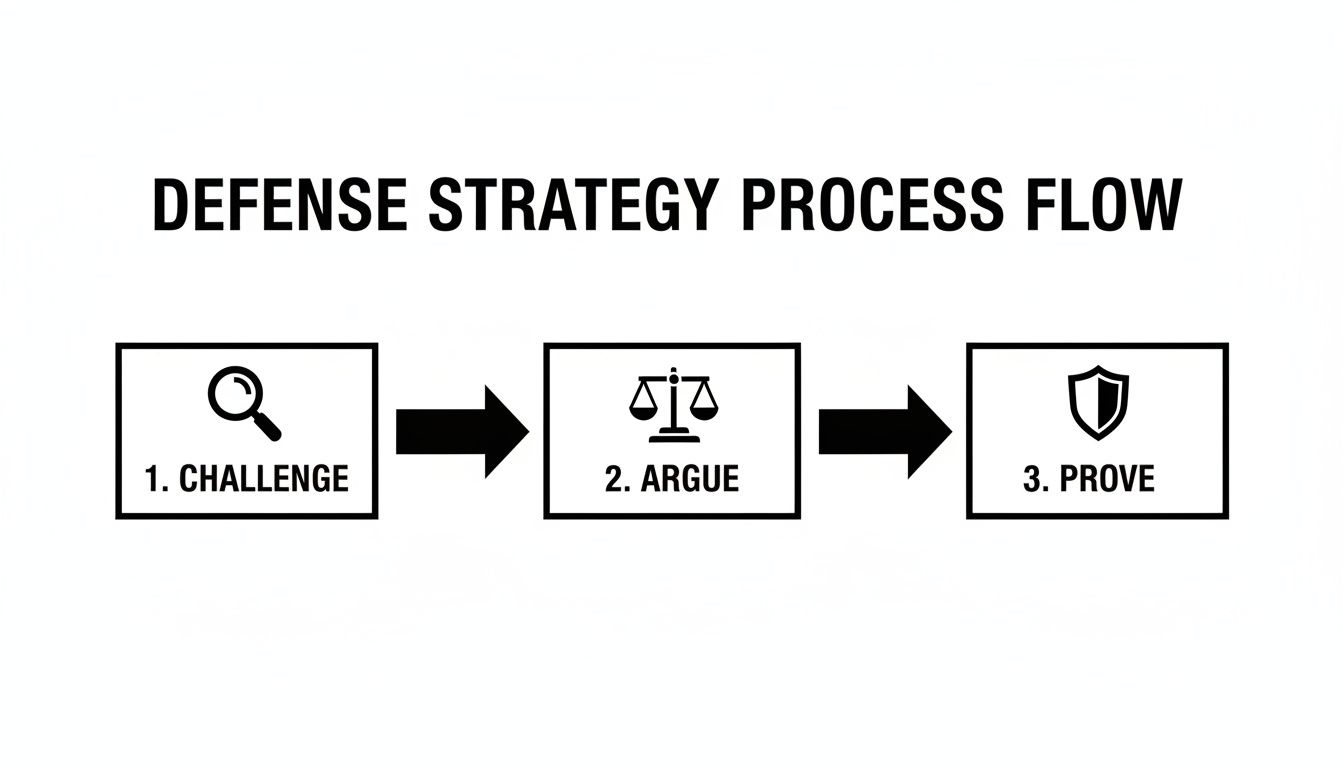
This strategic process is how a skilled lawyer systematically takes apart the prosecution's case to protect you at every turn.
The overwhelming majority of criminal cases are resolved with a plea bargain instead of going to trial. This is often the most practical route, but your attorney must always be ready to fight for you in court if a fair deal isn't on the table.
If plea negotiations fail, your case is set for trial. Here, both sides will present their arguments and evidence to a judge or jury, who will ultimately decide whether you are guilty or not guilty. At this point, having a battle-tested trial lawyer in your corner isn't just an advantage—it's an absolute necessity.
Common Questions About Deadly Conduct Charges
When you’re staring down a serious charge like this, the questions hit you fast and hard. Let's cut through the confusion and get straight to the answers you need right now.
Can I Be Charged If My Gun Was Unloaded?
Yes, absolutely. This is one of the most common—and dangerous—misconceptions people have. Texas law isn't focused on whether the gun could actually fire. It’s all about the fear and imminent danger your actions created for the other person.
When you point a firearm at someone, loaded or not, the law presumes that your action was reckless and put them in fear of serious bodily injury. The prosecutor doesn't have to prove the gun was loaded to charge you with a Class A misdemeanor. Their entire case is built on the reasonable terror you caused.
What Should I Do If Police Want to Question Me?
You need to calmly but firmly exercise your constitutional rights. State clearly and politely, "I am exercising my right to remain silent, and I will not answer any questions without my lawyer present."
That's it. Do not try to explain yourself, offer a "quick clarification," or tell your side of the story. Police are trained to get you talking, and every word you say can be twisted and used to build a case against you. Your first and only move should be to call a criminal defense attorney who can step in and protect you from the very start.
Can a Deadly Conduct Charge Be Removed From My Record?
Yes, it is possible to get this charge off your record, but it depends entirely on the final outcome of your case. This is why putting up a strong defense from day one is so critical for your future.
Expunction: This is the best-case scenario. If your case is dismissed or you're found not guilty at trial, you may be eligible for an expunction. This powerful legal tool completely destroys all records of the arrest as if it never happened.
Nondisclosure (Record Sealing): This is a good alternative. If you successfully complete a deferred adjudication program for a misdemeanor, you can petition the court for an order of nondisclosure. This seals the record from the public, so it won’t show up on most background checks.
Conviction: This is what we fight to avoid. A conviction, especially for a felony, will likely stay on your record forever, creating a permanent barrier to jobs, housing, and other opportunities.
Every decision made early in your case—from how you interact with police to the strategy you build with your lawyer—directly impacts your ability to clear your name and move on with your life.
If you’ve been charged with a crime in Texas, call The Law Office of Bryan Fagan, PLLC for a free and confidential consultation. Our defense team is ready to protect your rights. https://texascriminallawyer.net