Being arrested in Texas can be terrifying—but you don’t have to face it alone. The legal system can feel overwhelming, and you're likely worried about your job, your family, and your future. The good news is that an arrest is not a conviction, and you have options. One of the most powerful is deferred adjudication—a special type of community supervision (probation) that can end with your case being dismissed.
This guide will explain what deferred adjudication is in plain English, who qualifies, and how it can help you protect your future.
What is Deferred Adjudication, Really?
Imagine making a deal with the court. Instead of finding you guilty of a crime, the judge agrees to defer, or postpone, a finding of guilt. In exchange, you are placed on community supervision for a set period. If you follow all the rules and successfully complete the program, the judge dismisses your case entirely. You are never formally convicted of the crime.

This dismissal is a huge victory. It protects you from the long-term damage a permanent criminal conviction can cause, such as making it difficult to find a job or rent an apartment. Understanding this option is the first step toward taking back control of your life.
Key Things to Know About This Option
Navigating the criminal justice system is tough, but understanding your options is the first step toward a better outcome. Here are the most important things you need to know about deferred adjudication in Texas:
- It Avoids a Final Conviction: This is the single greatest benefit. When you successfully finish the program, your case is dismissed. You can legally say you were not convicted.
- Eligibility Isn't Guaranteed: Deferred adjudication is often available for first-time offenders facing charges like a first DWI, misdemeanor theft, or simple drug possession. However, Texas law prohibits it for certain serious offenses.
- Negotiation is Everything: A prosecutor is never required to offer you deferred adjudication. This is where having a skilled Houston criminal lawyer to negotiate on your behalf becomes absolutely critical to securing this outcome.
- The Record Isn't Automatically Erased: Even after a dismissal, the record of your arrest remains public. To truly clear your name, you must later petition the court for an Order of Nondisclosure to seal the record from public view.
An arrest is scary, but you don't have to navigate this complex process alone. A knowledgeable defense attorney can be your trusted guide.
What Deferred Adjudication Actually Means
While the term "deferred adjudication" sounds like complex legal jargon, the concept is straightforward. It is one of the most powerful second chances the Texas justice system offers.
So, what is it? Deferred adjudication is a special form of community supervision where a judge intentionally defers—or puts off—finding you guilty.
Instead of convicting you, the court places you on probation with a clear set of rules you must follow. If you comply with all the court's orders for the entire supervision period, your case is dismissed. The key takeaway is that you are never formally convicted of the crime. That detail can make all the difference for your future.
The Legal Framework Behind a Second Chance
Deferred adjudication is a formal process established by the Texas Code of Criminal Procedure, specifically Article 42.12. This law gives judges the authority to accept a plea of "guilty" or "no contest" without entering a finding of guilt on your record.
This legal framework provides an opportunity to avoid a permanent criminal record, which is a game-changer for anyone facing charges, especially first-time offenders. Successfully completing deferred adjudication can prevent one mistake from closing doors to future job, housing, or educational opportunities. To learn more about the specifics, you can explore the Texas deferred adjudication guidelines.
At its core, the process is about rehabilitation, not just punishment. By fulfilling the terms of your supervision, you show the court you are ready to move forward responsibly. In return, the system gives you a path to keep your record clean.
How It Differs From Regular Probation
It’s very easy to confuse deferred adjudication with regular probation, but the difference between them is massive. Understanding this distinction is critical to making the right decision for your case.
The single most important difference is the outcome: Deferred adjudication ends in a dismissal with no final conviction, while regular probation follows a conviction.
A conviction is a permanent mark on your record. It shows up on background checks for jobs, apartments, and professional licenses. In contrast, a dismissal through deferred adjudication opens the door to having the entire incident sealed from public view through an Order of Nondisclosure.
To make the distinction crystal clear, let's break it down side-by-side.
Deferred Adjudication vs Regular Probation
The table below highlights how these two legal paths differ and why deferred adjudication is almost always the preferred outcome if it is available.
| Feature | Deferred Adjudication | Regular Probation (Conviction) |
|---|---|---|
| Initial Plea | You plead "guilty" or "no contest." | You are found guilty at trial or plead guilty. |
| Judge's Finding | The judge defers a finding of guilt. | The judge finds you guilty and enters a conviction. |
| Case Outcome | Your case is dismissed upon successful completion. | The conviction remains on your record after probation. |
| Record Clearing | Eligible for an Order of Nondisclosure to seal the record. | Not eligible for nondisclosure; the conviction is public. |
Ultimately, when you choose deferred adjudication, you’re not just accepting probation—you’re working toward a complete dismissal. This path lets you put a criminal charge behind you for good, giving you a real shot at a fresh start.
Is Deferred Adjudication an Option for You?
While deferred adjudication is an excellent opportunity, it is not available for every person or every charge in Texas. Determining your eligibility is a critical first step, and the answer depends on the specific offense you are charged with and your criminal history.
Eligibility is a combination of legal rules and negotiation. The Texas Penal Code sets the baseline, but prosecutors and judges make the final decision on whether to offer it.
Who Typically Qualifies for This Option
Generally, deferred adjudication is designed for individuals with a clean or minimal criminal record. It is most often offered in cases involving first-time offenders who are facing charges that do not involve serious violence.
This typically includes misdemeanors and some lower-level state jail felonies. Common charges where deferred adjudication may be an option include:
- First-Time DWI: For many people facing their first DWI charge, this is a very common and achievable outcome.
- Misdemeanor Theft: Shoplifting or other minor theft offenses are frequently resolved this way.
- Simple Assault: Cases of assault that did not result in serious bodily injury are often eligible.
- Drug Possession: Possession of a small amount of a controlled substance is a classic example of a charge eligible for deferred adjudication.
For many Texans, these are the kinds of situations where the system offers a chance at rehabilitation instead of just punishment. To see how this fits into a bigger picture, you can explore more about programs available for first-time offenders.
Offenses That Are Legally Barred
While many offenses are eligible, Texas law explicitly prohibits deferred adjudication for certain serious crimes. If your charge is on this list, a judge is legally forbidden from offering you deferred adjudication, regardless of the circumstances.
Some of the most common disqualifying offenses include:
- Driving While Intoxicated (DWI) if you hold a commercial driver's license (CDL).
- Intoxication Assault or Intoxication Manslaughter.
- Certain serious sex offenses, especially those involving children.
The Texas Legislature regularly updates the penal code. For example, recent legislative sessions have tightened eligibility for certain violent crimes to enhance public safety. Discover more insights about these legislative changes at versustexas.com.
The Crucial Role of Negotiation
It is critical to understand that even if you are legally eligible, a prosecutor is never forced to offer you deferred adjudication. It is a privilege, not a right.
This is where the skill of an experienced Texas criminal defense attorney becomes your most valuable asset. The prosecutor holds significant power, and their decision often depends on the strength of their case versus the persuasiveness of your lawyer.
Your attorney's job is to build a powerful argument on your behalf, focusing on why you are a good candidate for this second chance. They will highlight factors like your clean record, stable employment, family ties, and willingness to attend counseling. A strong, compassionate presentation can convince a prosecutor to make an offer they might not have otherwise considered.
Navigating the Deferred Adjudication Process
The legal system can be a maze of confusing steps, but knowing what to expect can make the journey less intimidating. Deferred adjudication is a process that requires your full commitment from start to finish.
It begins with your defense attorney negotiating a plea bargain with the prosecutor. Your lawyer will present the reasons why you deserve a second chance and are a good candidate for deferred adjudication. If the prosecutor agrees, the next step is a formal plea hearing in court. You will stand before a judge and enter a plea of "guilty" or "no contest." After accepting your plea, the judge will officially place you on deferred adjudication community supervision—the legal term for this type of probation.
Your Responsibilities During Supervision
Once you are on community supervision, your primary responsibility is to follow every court-ordered condition without fail. Think of it as a contract with the court; upholding your end is the only way to earn a dismissal.
The specific terms vary by case, but most people on deferred adjudication share a core set of responsibilities:
- Regular Check-ins: You must report to a probation officer as scheduled, typically once a month.
- Financial Obligations: You are responsible for paying all court costs, fines, and supervision fees on time.
- Community Service: You will likely be required to complete a set number of community service hours.
- Mandatory Classes: Depending on the offense, you may be ordered to complete specific classes, such as an anger management course for an assault case or a substance abuse program for a drug or DWI charge.
- Staying Clean: You must abstain from illegal drugs and alcohol and should expect to submit to random drug and alcohol testing.
These are not mere suggestions; they are court orders. Even a minor violation can jeopardize your agreement and lead to a conviction.
This visual flow chart breaks down the initial steps toward securing a deferred adjudication offer.
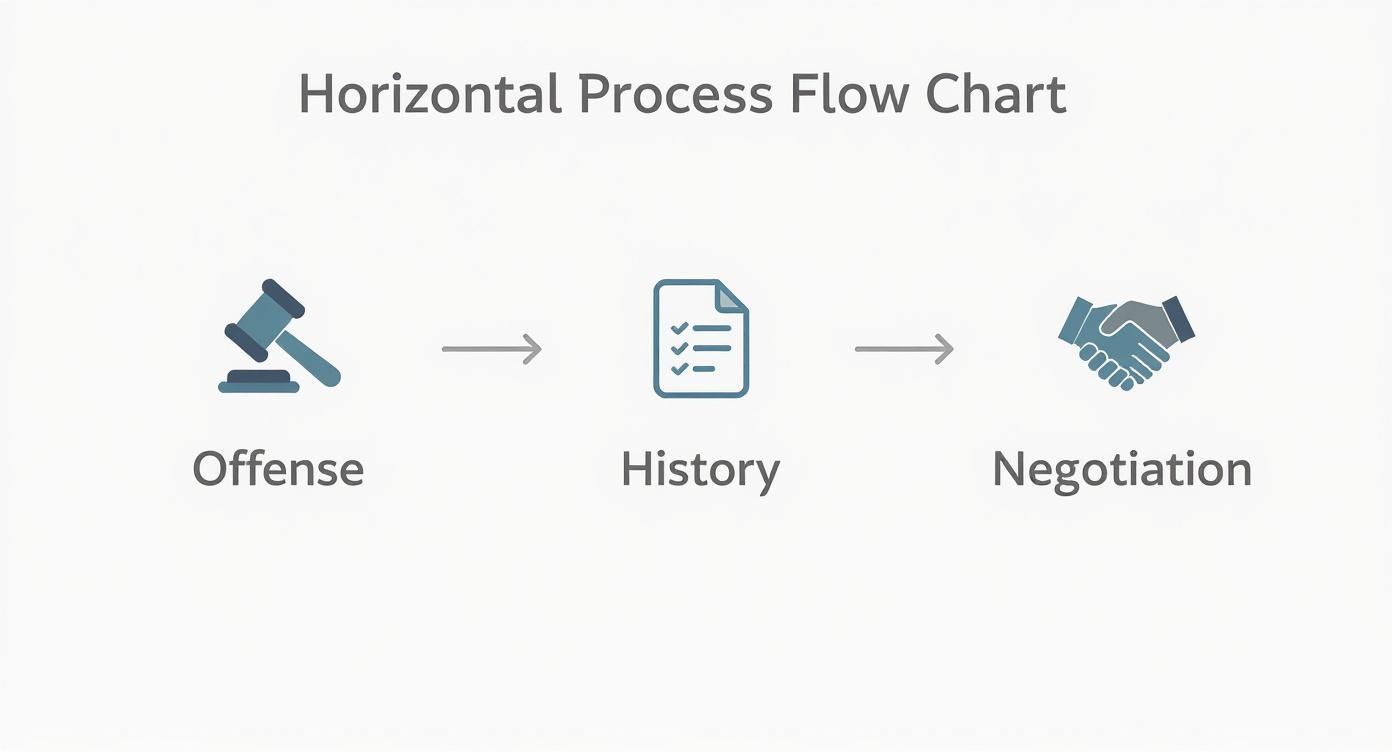
As you can see, getting a deferred adjudication offer involves a sequence of evaluations that look at the offense, your criminal history, and ultimately, a successful negotiation.
The Final Step: Dismissal
After you complete your supervision period—having paid every fee, attended every meeting, and finished every class—the judge will dismiss your case. This is the moment you have worked for. A dismissal means you were never formally convicted of the crime.
However, the journey isn't quite over. A dismissal does not automatically clear your record. The arrest and court case still exist as public information. To truly put this behind you, you must take one more critical step to have those records sealed.
Weighing the Pros and Cons of This Path
Deciding whether to accept a deferred adjudication offer is one of the most important choices you will make in your criminal case. It offers a genuine second chance, but it also comes with serious commitments and significant risks. It's essential to understand both sides before you agree to the terms.
The most compelling reason to consider deferred adjudication is the opportunity to avoid a final, permanent conviction. A criminal conviction can follow you for life, creating barriers to employment, housing, and professional licensing. Deferred adjudication provides a path to rehabilitation instead of punishment.
However, this opportunity has a trade-off. By accepting a deferred adjudication offer, you give up your constitutional right to a jury trial. You must also plead "guilty" or "no contest," which is an admission that the state has enough evidence to convict you.
The Advantages of Deferred Adjudication
For many people, the benefits of this arrangement far outweigh the negatives. Successfully completing the program can completely change the course of your future.
- No Final Conviction: This is the primary reason to choose this path. Once you finish supervision, the case is dismissed. You can legally and honestly state that you were not convicted of the crime.
- A Path to a Clearer Record: A dismissal makes you eligible to file for an Order of Nondisclosure. This powerful court order seals your record from the public, hiding it from most employers and landlords.
- Focus on Rehabilitation: Deferred adjudication often includes constructive requirements like counseling, treatment programs, or classes that can help you address the underlying issues that may have led to the charge.
The Disadvantages and Risks
On the other hand, deferred adjudication is not an easy way out. The supervision period can be long and demanding, sometimes lasting for years. The rules are strict, and the consequences for violating them are severe.
The biggest risk is a violation. If you fail to meet even one condition of your supervision, the prosecutor can file a Motion to Adjudicate Guilt. This can result in a conviction and a sentence—all without a new trial.
If the judge finds you violated the terms, they can sentence you to anything within the full range of punishment for the original offense. This could mean the maximum possible jail or prison time. Because you already waived your right to a trial, you do not get a second chance to argue your innocence. The only issue at the hearing is whether you broke the rules and what your punishment should be.
To help you see the full picture, here's a breakdown of the key factors to discuss with your attorney.
Key Considerations for Deferred Adjudication
This summary of the main advantages and disadvantages will help you weigh your legal options.
| Advantages (Pros) | Disadvantages (Cons) |
|---|---|
| No Conviction: Successfully completing the program results in a dismissal, not a conviction. | Gives Up Trial Rights: You waive your right to a jury trial and must enter a plea of guilty or no contest. |
| Record Sealing: A dismissal makes you eligible for an Order of Nondisclosure, sealing the record from public view. | Strict Conditions: Community supervision comes with demanding rules that can be difficult to follow for years. |
| Focus on Rehabilitation: The program often prioritizes treatment and counseling over simple punishment. | Severe Violation Consequences: A single violation can lead to a conviction and the maximum possible sentence. |
| Avoids Lifelong Stigma: Helps you avoid the social and professional damage of a permanent criminal record. | No Second Chance on Guilt: If you violate, the only hearing is on punishment—not whether you did the crime. |
The stakes are incredibly high. That's why it is absolutely critical to understand the potential consequences of a probation violationbefore you agree to any terms. Making an informed decision with a clear view of both the benefits and risks is the only way to protect your future.
Clearing Your Name After Deferred Adjudication
Successfully completing deferred adjudication and having a judge dismiss your case is a moment of profound relief. You followed every rule and fulfilled every obligation. However, a common misconception is that a dismissal automatically erases your record.
It does not.
The records of your arrest, the original charge, and the court proceedings still exist as public information. This means they can appear on background checks conducted by potential employers, landlords, or licensing boards. To truly move on and protect your future, you must take one final, crucial step: sealing your record.
Understanding the Order of Nondisclosure
To achieve a clean slate, you need an Order of Nondisclosure. This legal tool "seals" your criminal record from public view, effectively locking it away where most people cannot access it.
While law enforcement and certain government agencies can still see these records under specific circumstances, a nondisclosure order prohibits private entities from accessing them. This is the key to preventing a past mistake from affecting your ability to get a job, secure housing, or apply for a loan. To better understand what employers are looking for, understanding the scope of background checks can provide valuable context.
A dismissal is the victory; an Order of Nondisclosure is the final step that secures that victory and protects your privacy.
Remember, this process is not automatic. You, with your attorney's guidance, must actively petition the court and prove your eligibility.
The Waiting Period and Eligibility
Texas law requires a specific waiting period after your case is dismissed before you can file for an Order of Nondisclosure. The length of this period depends on the type of offense.

- For most misdemeanors: You can file for nondisclosure immediately after the dismissal.
- For certain serious misdemeanors: This includes offenses like assault or unlawful carrying of a weapon. You must wait two years after your case is dismissed.
- For eligible felonies: The wait is longer. There is a five-year waiting period from the date of dismissal.
It is also important to know that some offenses, particularly those involving family violence, are never eligible for nondisclosure, even after successfully completing deferred adjudication.
The system is designed to promote rehabilitation. Studies have shown that individuals who complete deferred adjudication are 75% less likely to have future convictions, and their employment rates increase by 50%.
It is easy to confuse nondisclosure with expunction, which completely destroys the record. An expunction is typically not available after deferred adjudication. To understand these crucial differences, please see our guide on expungement vs. nondisclosure in Texas. Securing an Order of Nondisclosure is the final, essential step to putting this chapter behind you for good.
Common Questions About Deferred Adjudication
Deferred adjudication is a powerful legal tool, but the process can be confusing. Here are clear, plain-English answers to some of the most common questions we hear.
https://www.youtube.com/embed/Clre_B728IE
Can You Get Deferred Adjudication for a Felony in Texas?
Yes, in many cases, you can. It is a common outcome for state jail felonies and some third-degree felonies, particularly for first-time offenders. This gives individuals a chance to keep a felony off their record.
However, Texas law prohibits deferred adjudication for the most serious felonies, such as murder, aggravated robbery, and certain sex offenses. For these charges, deferred adjudication is not an option.
Does Deferred Adjudication Show Up on Background Checks?
Yes, it does. This is a critical point that many people misunderstand. Even though your case is eventually dismissed, the initial arrest and the court case remain public record.
This means a standard background check run by an employer or landlord will show the charge. To prevent this, you must take the additional step of filing for an Order of Nondisclosure. This separate legal process seals the record, hiding it from public view and giving you a true fresh start.
What Happens If You Violate Your Deferred Adjudication?
Violating the terms of your community supervision is extremely serious. If you fail a drug test, miss an appointment with your probation officer, or get arrested for a new offense, the prosecutor can file a Motion to Adjudicate Guilt. This triggers a hearing where a judge will decide if you violated the rules.
If the judge finds that you did violate the terms, they can find you guilty of the original offense on the spot. At that point, the judge can sentence you to any punishment within the full range for that crime, including the maximum prison time. The stakes are incredibly high.
Can You Own a Gun After Deferred Adjudication for a Felony?
This is a complex issue where state and federal laws intersect. Under federal law, you are generally prohibited from owning or possessing a firearm if you have received deferred adjudication for any felony offense punishable by more than one year in prison.
Even if Texas law views deferred adjudication as a dismissal, federal law often takes precedence regarding firearms. The consequences for violating federal firearm laws are severe. Before you consider purchasing or possessing a firearm, it is absolutely essential to speak with a knowledgeable Texas assault defense attorney who can analyze the specifics of your case.
If you’ve been charged with a crime in Texas, call The Law Office of Bryan Fagan, PLLC for a free and confidential consultation. Our defense team is ready to protect your rights. Visit us at https://texascriminallawyer.net.