Skip to content
Being arrested in Texas can be terrifying—but you don’t have to face it alone. When you're facing a criminal charge, the language can be overwhelming. But few phrases hit as hard as "first-degree felony." Let's cut through the legal jargon. A first-degree felony is the most serious category of crime in Texas, just one step below capital murder. A conviction isn't just a setback; it carries consequences that can change the entire course of your life, including the real possibility of a life sentence.
What a First-Degree Felony Charge Means for You

Hearing that you or someone you love is facing a first-degree felony charge injects a new level of fear and uncertainty into an already stressful situation. This isn't just a label; it's a legal classification reserved for the most severe offenses. Understanding exactly what it means is the first critical step toward building a defense and protecting your future.
Think of the Texas criminal justice system as a ladder. Minor infractions are on the bottom rungs, while the most serious crimes sit at the very top. A first-degree felony is on the highest rung, right below capital murder. That placement isn't random—it reflects the extreme gravity of the alleged crime, which often involves significant harm, the use of a deadly weapon, or other aggravating factors.
Key Characteristics of a First-Degree Felony
The label itself sends a clear message: the state views this accusation with the utmost seriousness. Prosecutors will pour significant resources into securing a conviction, and the potential penalties are the most punitive available under Texas law.
Here are the fundamentals you need to understand right away:
- Severity: These are not minor mistakes. They are the most serious crimes on the books, including offenses like murder, aggravated robbery, and trafficking large quantities of drugs.
- Life-Altering Penalties: A conviction can lead to a prison sentence anywhere from five to 99 years, or even life. On top of that, fines can reach up to $10,000.
- Aggravating Factors: Often, what elevates a crime to this level is a specific circumstance. For example, causing serious bodily injury or using a weapon during another crime can turn a lesser offense into a first-degree felony.
- Long-Term Consequences: The punishment doesn't end with prison and fines. A conviction carries lifelong collateral consequences, impacting your right to vote, own a firearm, and find a job or a place to live.
It's absolutely essential to recognize the profound difference between a felony and a less serious offense. While any criminal charge is serious, a first-degree felony represents a moment in your life where the stakes simply couldn't be higher. You can learn more about the critical difference between a felony and a misdemeanor in our detailed guide, because understanding this distinction is key to grasping the fight ahead.
The Legal Definition Under the Texas Penal Code

To really understand what a first-degree felony is, you have to go straight to the source: the Texas Penal Code. This isn't just a list of crimes; it's the state's official rulebook that carefully lays out what makes one offense so much more serious than another.
The law isn't as concerned with the name of the crime as it is with the specific circumstances—the "how" and "why" behind what happened. These are the details prosecutors will dig into to decide if a charge is severe enough to hit that first-degree felony threshold.
How an Offense Becomes a First-Degree Felony
In Texas, think of crimes like a car with different trim packages. The base model might be a third or even second-degree felony. But the law allows for certain "aggravating factors" to be added, which can upgrade that same crime to the highest, most serious level.
These factors essentially act as enhancers. They can take an already serious situation and turn it into a critical one in the eyes of the court. It’s like throwing gasoline on a fire—the original offense is the flame, but these factors make it burn hotter and spread faster.
So, what are these game-changing elements? They usually fall into a few key categories that point to a higher level of danger or culpability.
The Role of Aggravating Factors
Aggravating factors are those specific, nitty-gritty details of an incident that make it worse. A prosecutor will hunt for these elements when they're trying to build a case for a first-degree felony charge.
Common aggravating factors under the Texas Penal Code include:
- Use of a Deadly Weapon: Just having a weapon during a crime can change everything. For instance, a robbery instantly becomes an aggravated robbery—a first-degree felony—if a firearm or another deadly weapon was used or even just displayed.
- Causing Serious Bodily Injury: If a victim suffers an injury that creates a real risk of death, permanent disfigurement, or the loss of a bodily function, the charge is often kicked up a notch. An assault that causes this level of harm becomes an aggravated assault, which can be charged as a first-degree felony.
- Specific Victim Status: The law gives extra protection to certain people. Committing an offense against a child, an elderly person, a public servant, or a witness can automatically enhance the felony level.
Understanding how these elements work is crucial. For a deeper dive into the different classifications, you can learn more about what a felony is in Texas and how the state categorizes these offenses. This context helps clarify why your specific charge is being treated so seriously.
The Texas Penal Code is precise. The difference between a second-degree and a first-degree felony can come down to a single element—like the type of injury sustained or the presence of a weapon. This is where a skilled defense attorney focuses their attention.
A sharp criminal defense lawyer will meticulously pick apart police reports and evidence to challenge whether these factors even existed. If the prosecution can't prove an aggravating factor was present beyond a reasonable doubt, it might be possible to get the charge reduced to a lesser felony, which can completely change the potential outcome of your case.
Real-World Examples of First Degree Felonies
Legal definitions are one thing, but seeing how they play out in real life is another. It's when you connect the Texas Penal Code to actual situations that the weight of a first-degree felony charge really sinks in.
Let's step away from the abstract legal jargon and look at some concrete examples. We'll examine a few of the most common offenses in this category and pinpoint the exact detail that elevates them to the most serious level of crime in Texas.
Murder vs. Capital Murder
In Texas, not all unlawful killings are treated the same. There's a critical line between murder, which is a first-degree felony, and capital murder, a separate and even more severe charge that can lead to life without parole or the death penalty.
Murder (First-Degree Felony): Under Texas Penal Code §19.02, this charge applies when someone intentionally or knowingly causes another person's death. It can also apply if someone intended to cause serious bodily harm and their actions resulted in death. Think of a physical fight that escalates tragically—that could be charged as murder.
Capital Murder: This isn't just murder; it's murder with specific, aggravating circumstances defined by law. For instance, killing a police officer or firefighter, murdering someone while committing another felony like robbery or kidnapping, or killing a child under 15 all fall under capital murder.
The distinction between these two can seem subtle, but the consequences for the accused are monumental.
Aggravated Robbery
Robbery is already a serious crime, but it becomes a first-degree felony when certain "aggravating" factors enter the picture. A standard robbery, which is a second-degree felony, involves using force or threats during a theft.
But under Texas Penal Code §29.03, it gets upgraded to aggravated robbery if the person committing the crime does one of two things:
- Causes serious bodily injury to someone.
- Uses or exhibits a deadly weapon.
Here’s the key: simply showing a gun during a theft, even if you never fire it, is enough to get you charged with a first-degree felony. The law sees the mere presence of a deadly weapon as a massive escalation of danger.
Aggravated Kidnapping
Kidnapping climbs to a first-degree felony when the offender's motive is especially malicious or dangerous. A basic kidnapping charge is a third-degree felony, but it’s bumped up to aggravated kidnapping under Texas Penal Code §20.04 if the person abducts someone with the intent to:
- Hold them for ransom.
- Use them as a shield or hostage.
- Inflict bodily injury or sexually abuse them.
- Terrorize them or someone else.
The crucial element here is the specific intent behind the abduction. It’s not enough for the prosecutor to prove you restrained someone; they have to prove you did it for one of these sinister reasons.
Common First Degree Felonies in Texas and Key Elements
To make this even clearer, let's break down some common charges and what elevates them to a first-degree felony. The table below highlights the specific element that prosecutors must prove to secure a conviction at this level.
| Offense | Texas Penal Code Section | Key Element for First Degree Classification |
|---|---|---|
| Murder | §19.02 | Intentionally or knowingly causing the death of an individual. |
| Aggravated Robbery | §29.03 | Committing robbery while using or exhibiting a deadly weapon OR causing serious bodily injury. |
| Aggravated Kidnapping | §20.04 | Abducting a person with specific intent, such as for ransom, to inflict injury, or to terrorize. |
| Aggravated Sexual Assault | §22.021 | Committing sexual assault with aggravating factors, such as causing serious injury or using a deadly weapon. |
| Trafficking of Persons | §20A.02 | Knowingly trafficking a person for forced labor or sexual conduct, especially involving a child victim. |
| Large-Scale Drug Trafficking | Health & Safety Code §481.112 | Manufacturing or delivering over 400 grams of a Penalty Group 1 controlled substance (e.g., cocaine, heroin). |
Understanding these key elements is the first step in building a defense. The entire case often hinges on whether the state can prove that one specific factor existed beyond a reasonable doubt.
A critical aspect of many serious charges is the "felony murder rule." First-degree felonies represent the most severe category of crimes in many U.S. states, often encompassing acts like first-degree murder, which can lead to life imprisonment. Under the felony murder rule, widely applied across states including Texas, a person can be charged with first-degree murder without intending to kill if a death occurs during the commission of another dangerous felony, such as armed robbery, burglary, or aggravated assault. Learn more about the legal reasoning behind the felony murder rule at RestoreJustice.org.
Large-Scale Drug Trafficking
In Texas, drug penalties are all about the type and weight of the substance. While having a small amount for personal use might be a misdemeanor or state jail felony, trafficking huge quantities is a completely different ballgame—it’s a first-degree felony.
Under the Texas Health and Safety Code, manufacturing or delivering over 400 grams of a Penalty Group 1 drug—think cocaine, heroin, or meth—triggers this charge. This isn't about targeting users. The law is written to go after individuals believed to be part of major drug distribution networks, reflecting the state's aggressive stance on high-level trafficking.
The Penalties for a First Degree Felony Conviction
A first-degree felony conviction in Texas carries some of the heaviest penalties in our justice system, second only to capital murder. When you're facing a charge this serious, you absolutely have to understand what's at stake. The numbers alone are sobering and don't leave much room for error.
Under the Texas Penal Code, the statutory punishment range for a first-degree felony is severe. A conviction means you are looking at:
- Prison Time: A sentence ranging from a minimum of five years up to 99 years, or even life.
- Fines: A potential fine of up to $10,000.
These aren't just abstract numbers on a page; they represent decades, or potentially an entire lifetime, behind bars. This stark reality is why mounting a powerful, strategic legal defense from the very beginning is not just an option—it's a necessity.
How Sentences Are Determined
That statutory range of 5-to-99 years or life is incredibly wide, giving a judge or jury significant power when handing down a sentence. They don't just pull a number out of thin air. Instead, they carefully weigh a variety of factors related to both the crime itself and your personal background.
Several key elements can swing the pendulum toward a harsher or more lenient sentence:
- Aggravating Circumstances: These are details that make the crime appear worse in the eyes of the court. Think extreme violence, the vulnerability of the victim (like a child or an elderly person), or a defendant who shows no remorse. Prosecutors will hammer these points to push for a longer sentence.
- Mitigating Circumstances: This is where your defense attorney comes in, presenting details that argue for a lesser sentence. This could include a lack of prior criminal history, evidence you acted under duress, or showing genuine remorse for your actions.
- Prior Criminal History: If you have previous felony convictions on your record, the state can seek to enhance your punishment, which almost always pushes the sentence toward the higher end of that 5-to-99 spectrum.
Ultimately, the court is trying to piece together the full story to decide on a punishment that fits the crime. Your defense lawyer's ability to present compelling mitigating evidence can make a massive difference in the final outcome.
Parole Eligibility and Probation
For many crimes, parole offers a chance at early release. But for first-degree felonies, the rules are much, much tougher—especially for those classified as "3g offenses" like murder or aggravated robbery. If you're convicted of a 3g offense, you must serve at least half of your sentence, up to a maximum of 30 years, before you are even eligible for parole.
The harshness of these penalties reflects just how seriously the justice system views these crimes. U.S. federal law considers any crime punishable by death or over one year in prison a felony. In Texas, this means we often build defenses for clients accused of offenses like aggravated assault or burglary that get escalated into first-degree charges. Data from the Bureau of Justice Statistics shows how these first-degree classifications can lock in long, unforgiving prison terms. You can learn more about felony classifications on Wikipedia.
So, what about probation? Don't count on it. For the vast majority of first-degree felonies, "straight probation" from a judge is simply not an option. A jury might have the power to recommend "community supervision" (the formal term for probation) in very limited situations, but it's incredibly rare for offenses of this magnitude. Prosecutors will almost always fight for significant prison time. Getting a grasp on the nuances of sentencing guidelines and rehabilitation strategies in Texas is critical for understanding what to expect.
Given these severe potential outcomes, your freedom and future truly hang in the balance. A conviction isn't just about losing years of your life to a prison cell; it carries lifelong consequences that will follow you long after your sentence is served.
Navigating the Texas Legal System After an Arrest
Being arrested for a first-degree felony is like being thrown into the deep end of the legal pool. It's disorienting, frightening, and the stakes couldn't be higher. In those first few moments and days, everything feels chaotic, but knowing what’s coming can give you a sense of control. Let's walk through the process step-by-step, clearing up the confusion and showing you the road ahead.
The path from the initial arrest to a potential trial follows a very specific roadmap in the Texas criminal justice system. Understanding that map is the first move in building a defense and protecting your rights.
The Critical First Steps After an Arrest
The entire legal journey kicks off the second those handcuffs click. What happens right after an arrest is crucial—it sets the tone for everything that follows.
Arrest and Booking: Once you're in custody, you'll be taken to a local police station or county jail for booking. This is really just an administrative process. They’ll take your mugshot, collect your fingerprints, and record all your personal information.
Initial Appearance (Arraignment): Texas law is clear: you must be brought before a magistrate within 48 hours of your arrest. This hearing, often called an arraignment, is usually brief. The judge will officially tell you what you're being charged with, go over your constitutional rights (like the right to an attorney), and set an initial bail amount.
Bail or Bond Hearing: This is a huge early hurdle. Here, the judge decides if you can be released from jail while your case is ongoing and what conditions will be attached. When making this call, the judge will weigh the seriousness of the first-degree felony charge, your past criminal history, and whether you're seen as a flight risk or a danger to the community.
This chart gives you a clear picture of what a felony conviction really means in Texas.
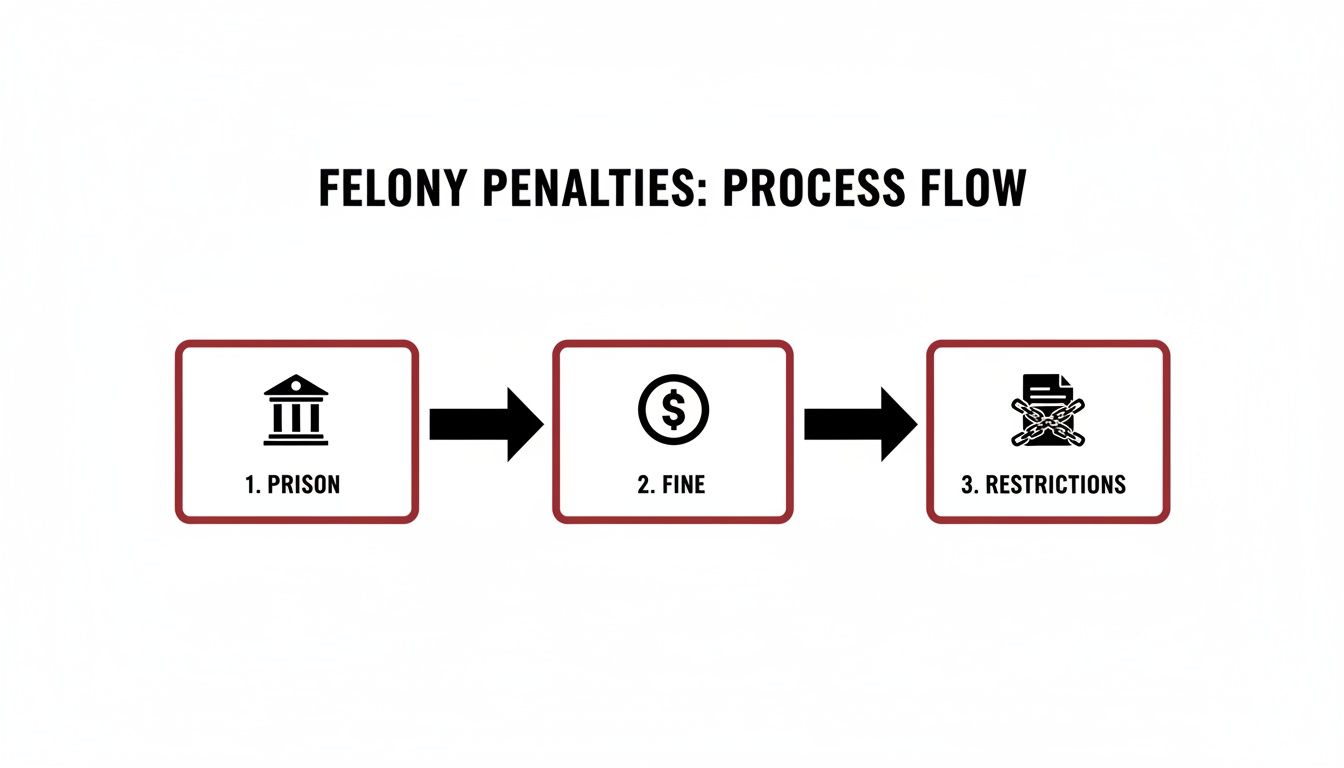
As you can see, it’s not just one thing. A conviction branches out into prison time, heavy fines, and a whole host of restrictions that follow you long after your sentence is served.
The Journey Through the Court System
Once the initial dust settles, your case moves into a much longer and more complicated phase. Having a seasoned Houston criminal lawyer in your corner during this time isn't just a good idea—it's absolutely essential.
From day one, your attorney should be digging into the facts of your case, collecting evidence, and looking for cracks in the prosecution's story.
Grand Jury Indictment
In Texas, every felony case has to go before a grand jury. Think of them as a group of everyday citizens who listen to the prosecutor's preliminary evidence. Their only job is to decide if there's enough probable cause to formally charge you with a crime.
- If the grand jury believes there's enough evidence, they issue an indictment (a "true bill"), and your case officially moves forward to trial court.
- If they don't see enough evidence to proceed, they'll "no-bill" the case, and the charges are usually dropped right then and there.
Pre-Trial Motions and Discovery
This is where a good defense attorney really starts to earn their keep. During the "discovery" phase, the prosecutor is legally required to hand over all the evidence they have against you. Your lawyer will comb through every single piece of it—police reports, witness statements, lab results, you name it.
Based on that review, your attorney can file pre-trial motions to attack the state's case. These motions might ask the judge to:
- Suppress evidence that was collected illegally, like from an unconstitutional search.
- Dismiss the charges altogether because of a lack of evidence or critical procedural mistakes.
- Challenge the admissibility of certain testimony, especially from expert witnesses.
For a first-degree felony, particularly one involving a death, the scientific evidence is often the whole ballgame. Understanding the crucial role of a forensic pathologist expert witness in Texas courts can show you just how much an expert's testimony can make or break a case.
A single successful pre-trial motion can completely dismantle the prosecution's case, often leading to a dismissal or a significantly better plea offer before you ever see the inside of a courtroom for trial.
Plea Bargaining and Trial
The overwhelming majority of criminal cases never go to a full-blown trial. They're resolved through plea bargaining instead. Your attorney will negotiate directly with the prosecutor to see if a deal can be struck. This might mean pleading guilty to a less serious charge or agreeing to a more favorable sentence.
If a fair plea agreement isn't on the table, your case will be set for trial. You have a constitutional right to have your case heard by a jury of your peers. At trial, both sides present their evidence and arguments. In the end, the jury has to decide if the state has proven your guilt beyond a reasonable doubt. This is the highest burden of proof in our legal system, and it's entirely up to the prosecutor to meet it.
What Happens After a Conviction? Life Isn't Over.
The gavel falls, the sentence is read, but the impact of a first-degree felony conviction is far from over. Even after prison time is served, the consequences linger, creating lifelong obstacles that can feel just as punishing as incarceration itself. These are what the legal world calls “collateral consequences,” and they can fundamentally change your place in society.
A conviction sends a ripple effect through nearly every corner of your life. It means losing fundamental rights most people never think twice about. In Texas, you lose your right to vote while you’re incarcerated and on parole. Far more permanently, you will lose your right to own a firearm for the rest of your life.
The Lasting Shadow on Your Future
Beyond losing specific rights, a felony on your record creates immense, practical hurdles. Finding a decent job becomes a massive challenge, as many employers hesitate to hire someone with a serious criminal history. The same goes for securing safe housing—landlords run background checks and often deny applicants with felony convictions outright.
On top of that, a first-degree felony can instantly disqualify you from getting the professional licenses needed for careers in healthcare, real estate, education, and many other fields. These barriers can make it feel impossible to get back on your feet and build a productive life.
How We Fight for Your Second Chance
But a conviction does not have to be the final word. While the road ahead is tough, there are legal pathways to soften these devastating impacts, and our firm is here to help you navigate them. We believe in second chances and fight to restore our clients’ futures.
A criminal record should not be a life sentence of closed doors and lost opportunities. Our legal system provides avenues for relief, and our job is to explore every one of them to help you move forward.
Our post-conviction legal support isn't just about paperwork; it's about strategy. We focus on several key areas:
- Appeals: If legal errors were made during your trial, we can file an appeal to challenge the conviction or the sentence. The goal is simple: get it overturned or sent back for a new, fair trial.
- Expunctions: For cases that were dismissed or ended in an acquittal, we can work to have the record of your arrest completely wiped clean. This process, called an expunction, makes it as if the charge never even happened.
- Orders of Nondisclosure: In some situations where a conviction can't be expunged, we can petition the court for an order of nondisclosure. This essentially seals your record from the public, preventing most private employers, landlords, and others from ever seeing it.
These legal tools are powerful, but they are also incredibly complex and come with strict deadlines. Having an experienced Texas assault defense attorney who lives and breathes post-conviction law is essential to clearing your name and truly getting a chance to rebuild your life.
Common Questions About First-Degree Felony Charges
When you're up against a charge this serious, your mind is probably racing with questions and what-ifs. It's a confusing, high-stress time, but getting straight answers can help you feel more grounded and ready for the road ahead. Here are a few of the most common questions we hear from people in your exact situation.
Can a First-Degree Felony Be Reduced to a Lesser Charge?
Yes, it's definitely possible, and it’s one of the primary goals for any sharp criminal defense attorney. The key is to meticulously pick apart the prosecution's case and challenge the specific "aggravating factors" that pushed the offense into first-degree territory in the first place.
For example, if your lawyer can prove that a deadly weapon wasn't actually used or show that the alleged injury doesn't legally qualify as "serious bodily injury," the whole foundation of the first-degree charge can crumble. A successful challenge could get the charge dropped to a second or third-degree felony, which carry far less severe penalties.
What's the Difference Between State and Federal First-Degree Felonies?
This distinction is absolutely crucial. State first-degree felonies are prosecuted right here in Texas, under the Texas Penal Code, for crimes that happened within our state's borders. Think of the local District Attorney's office handling the case.
Federal felonies are a completely different beast. They involve crimes that cross state lines, break a specific federal law, or take place on federal property. These cases are handled in federal courts by federal prosecutors, and they operate under a totally separate set of laws and sentencing guidelines—which are often much stricter than what you'd see at the state level.
Can I Get Probation for a First-Degree Felony in Texas?
It's extremely rare. For most first-degree felonies—especially the most serious ones classified as "3g offenses" like murder or aggravated robbery—a judge is legally blocked from granting straight probation.
While a jury technically has the power to recommend community supervision in some very limited scenarios, it is absolutely not a common outcome. The overwhelming expectation for a conviction on a first-degree felony should be a potential prison sentence.
If you’ve been charged with a crime in Texas, call The Law Office of Bryan Fagan, PLLC for a free and confidential consultation. Our defense team is ready to protect your rights. Learn more by visiting our Texas criminal defense website.