Skip to content
Being arrested in Texas can be terrifying — but you don’t have to face it alone. When you’re facing criminal charges, it can feel like the deck is stacked against you. The prosecution seems to have all the power, but that’s not the whole story. You have constitutional rights, and a motion to suppress evidence is one of the most powerful tools your defense attorney has to protect them.
What a Motion to Suppress Evidence Means for You
So, what is it exactly? A motion to suppress is a formal legal request filed by your attorney asking the judge to throw out certain evidence because it was obtained illegally. Think of it as calling a foul on law enforcement. If the police didn’t play by the rules when they gathered evidence against you, that evidence shouldn't be used to try and convict you.
This isn't some legal loophole; it's a cornerstone of American justice. Your rights under the Fourth, Fifth, and Sixth Amendments are a shield, and this motion is how your lawyer enforces them. You can read more about the legal basis for these motions on our blog.
The Core Purpose of This Motion
At its heart, this motion is all about accountability. Its goal is to make sure law enforcement respects your rights during every interaction—whether it’s a routine traffic stop for a suspected DWI or a full-blown investigation into assault, theft, or drug possession.
When police officers break the law to build a case against you, the evidence they find is considered "fruit of the poisonous tree." A successful motion to suppress ensures that this tainted evidence gets tossed out, keeping the entire justice system fair for everyone.
How It Strengthens Your Defense
Filing a motion to suppress can completely change the game. By challenging how the prosecution got its proof, your attorney can poke serious holes in their case.
A successful motion can lead to a few game-changing outcomes:
- Evidence Is Thrown Out: The judge agrees the police acted unlawfully and orders that the prosecutor cannot use the tainted evidence against you at trial.
- Charges Are Reduced: Without their key evidence, the prosecutor’s case gets a lot weaker. This often forces them to offer a much better plea deal, like dropping a felony drug charge down to a misdemeanor.
- Case Is Dismissed: Sometimes, the suppressed evidence was the only thing holding the prosecutor's case together. When it’s gone, they have nothing left, and the charges get dismissed entirely.
To help you visualize how this works, here’s a quick breakdown of the key components of a motion to suppress.
Key Aspects of a Motion to Suppress
This table summarizes the core components of a motion to suppress, helping you quickly understand its purpose and function in a criminal case.
| Component | Plain-English Explanation | Constitutional Right Protected |
|---|---|---|
| The Motion Itself | A written document your lawyer files with the court arguing why evidence should be excluded. | Due Process (Fifth & Fourteenth Amendments) |
| The "Exclusionary Rule" | The legal principle that says illegally obtained evidence can't be used in court. | Fourth Amendment (Protection from unreasonable searches and seizures) |
| The Hearing | A mini-trial where your lawyer presents arguments and evidence to a judge about the police misconduct. | Right to Counsel (Sixth Amendment) & Right to Confront Witnesses (Sixth Amendment) |
| The Judge's Ruling | The final decision by the judge on whether to grant or deny the motion to throw out the evidence. | Judicial Oversight & Due Process |
In short, a motion to suppress isn't just a piece of paper; it's a powerful legal action that holds the system accountable and protects your fundamental rights.
Your Constitutional Shield: The Power Behind a Motion to Suppress

The entire idea behind a motion to suppress isn't a legal technicality. It comes directly from the bedrock of American freedom: the U.S. Constitution and the Texas Constitution. These documents are a powerful shield that protects you from government overreach, especially when you're accused of a crime.
This legal tool is built on two of your most fundamental rights. Understanding them is the first step toward seeing why this motion is so critical for a fair defense.
The Fourth Amendment: Your Right to Privacy
The Fourth Amendment protects you from unreasonable searches and seizures. This means law enforcement can't just stop your car, search your home, or seize your property on a whim. They need a legally valid reason—what the courts call probable cause—or a properly issued search warrant.
Think about a common scenario in Texas: a DWI stop. An officer can’t pull you over just because they have a "hunch." They must see a specific traffic violation or have a reasonable suspicion that you're driving while intoxicated. If they stop you without that legal basis, any evidence they find could be suppressed. That includes everything from the smell of alcohol on your breath to the results of a field sobriety test.
The Fifth Amendment: Your Right to Remain Silent
The Fifth Amendment gives you the right to avoid self-incrimination. You’ve heard it on TV a million times: "You have the right to remain silent." This isn't just a line from a script; it’s a vital protection to prevent you from being pressured or forced into making statements that could be used against you.
If you are in police custody and they start asking you questions designed to get an incriminating answer, they are required to read you your Miranda rights. When they fail to do that, or if they use threats and intimidation to get a confession, your words may be thrown out of court. For a deeper dive, you can learn more about how Miranda Rights violations can impact a criminal case.
This leads to a powerful legal doctrine called the "fruit of the poisonous tree." In simple terms, if the police break the rules to get evidence (the "tree"), then any additional evidence they discover because of that illegal action (the "fruit") is also tainted and inadmissible in court.
For example, imagine an officer illegally searches your car and finds a key to a storage unit. If they then get a warrant and find drugs in that unit, both the key and the drugs can be suppressed. The initial illegal search poisoned everything that came after it. This doctrine is a crucial safeguard, ensuring that a violation of your rights at any stage can't be used to build a case against you.
Common Grounds for Suppressing Evidence in Texas
So, what gives your attorney the legal footing to file a motion to suppress evidence? Every case is unique, but certain scenarios pop up again and again in Texas criminal law—especially in DWI, drug possession, and assault cases. Understanding these common grounds can help you see how an officer's actions might get challenged in your own situation.
A Houston criminal lawyer will comb through every detail of your arrest, looking for procedural mistakes or constitutional violations. They'll draft a written motion explaining exactly why specific evidence should be thrown out. The trial court then has to decide if the police followed the law. To learn more about the technical side, you can explore how courts handle these motions on Justia Law.
Illegal Traffic Stops and Searches
This is one of the most common reasons to file a motion to suppress, particularly in DWI and drug cases. Your Fourth Amendment protection against unreasonable searches and seizures kicks in the second an officer flips on their lights to pull you over.
An officer can't just stop your car on a hunch. They must have reasonable suspicion that you've committed a traffic violation or are engaged in criminal activity.
- Example: An officer pulls you over for speeding. That's a valid stop. But if they pull you over just because it's late and you're leaving a bar district, that stop is likely illegal. Any evidence found because of that bad stop—like drugs in your console or the smell of alcohol—could be suppressed.
The same rules apply to searching your car. Unless they have a warrant, police generally need probable cause to believe your vehicle holds evidence of a crime. The only other way they can legally search is if you give them your voluntary consent.
Invalid Search Warrants
Sometimes, the police do get a search warrant before searching your home or car. But a warrant isn't a golden ticket. Under the Texas Code of Criminal Procedure, Article 18.01, a search warrant has to meet very strict requirements to be valid.
A warrant can be attacked if:
- It lacks probable cause: The affidavit the officer gave the judge didn't contain enough solid facts to justify a search.
- It’s too broad: The warrant doesn't specifically name the place to be searched or the things they're looking for. A warrant to "search John Doe's property for illegal items" is too vague.
- It contains false information: The officer knowingly or recklessly lied in the affidavit to trick the judge into signing it.
If your Texas assault defense attorney can prove the warrant was defective, any evidence found during that search becomes "fruit of the poisonous tree" and gets thrown out.
Coerced or Involuntary Consent
Police often try to sidestep the warrant process by asking for your permission to search. It’s critical to remember: you always have the right to say no.
For consent to be legally valid, it must be given voluntarily and without coercion. If an officer uses threats, intimidation, or tricks to get you to agree, that's not real consent.
Imagine an officer says, "Let us search your car, or we'll get a warrant and make this much harder for you." Any "yes" you give under that kind of pressure is coerced. Proving it can be tricky, but it’s a powerful basis for a motion to suppress.
Miranda Rights Violations
Your Fifth Amendment right against self-incrimination is protected by the Miranda warnings. But police only have to read you your rights if two things are true at the same time: you are in custody (meaning you're not free to leave) and they are interrogating you (asking questions designed to get you to confess).
If the police question you in custody without Mirandizing you, anything you say is generally inadmissible in court. This is huge in assault, theft, and other cases where a confession is the prosecution's main piece of evidence. A successful motion to suppress your statements can gut the state's case.
So, What Happens at a Suppression Hearing?
Filing a motion to suppress is the first step, but it’s far from the end of the fight. Knowing what to expect during the actual hearing process can take a lot of the mystery and anxiety out of the equation. This is where your attorney gets to put the government's case—and law enforcement's actions—under a microscope.
The whole thing kicks off when your attorney files a detailed written motion. This isn't just a simple form; it's a legal argument that tells the court and the prosecutor exactly what evidence they believe was gathered illegally and why it violates your constitutional rights. Once that's filed, the prosecutor gets their turn to fire back with a written response.
The Hearing: A Mini-Trial Focused on Police Conduct
After the paperwork is filed, the judge will schedule a suppression hearing. It’s best to think of this as a mini-trial, but with a crucial difference: it’s not about whether you’re guilty or innocent. The entire focus is on the actions of the police.
You’ll have to be there, but you almost never have to testify. Instead, your attorney takes center stage, cross-examining the arresting officers under oath. They will grill the officers on every detail of the traffic stop, the search, or the interrogation, looking for inconsistencies, mistakes, or constitutional violations. The prosecutor then gets a chance to question the officers, trying to paint a picture of by-the-book police work.
This is where the rubber meets the road. The whole process is designed to expose any missteps that could get the evidence thrown out.
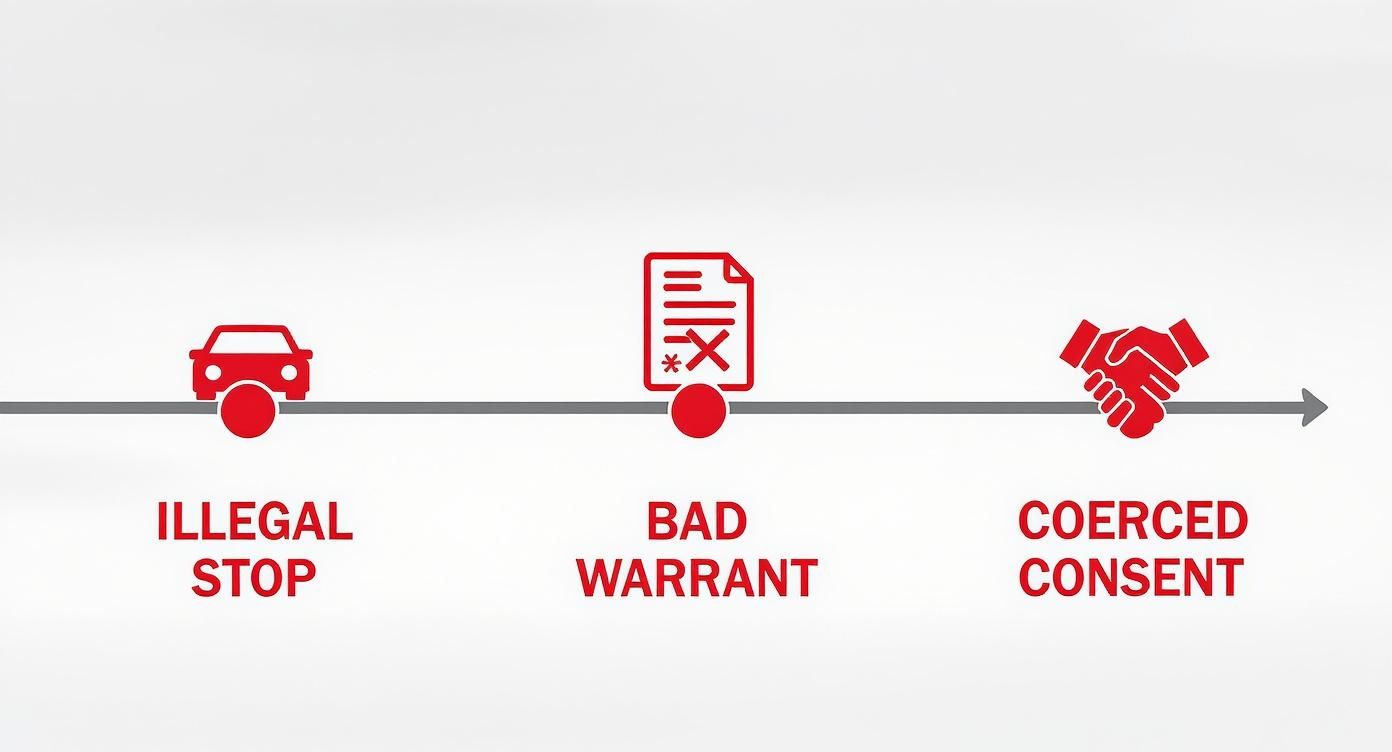
As you can see, something as simple as an officer not having a good reason to pull you over can kickstart this entire process and put the state’s case in serious jeopardy.
What Happens After the Judge Hears Everything?
Once the testimony is done and both sides have made their legal arguments, the judge steps in to make the final call. It really only goes one of two ways:
- Motion Granted: The judge agrees with your attorney. Your rights were violated, and the illegally obtained evidence gets tossed out. The prosecutor is now legally barred from using it against you at trial. This is a huge win.
- Motion Denied: The judge sides with the prosecutor, ruling that the police acted within the bounds of the law. The evidence is deemed admissible, and it can be used against you at trial.
The suppression hearing is a make-or-break moment. It usually happens after the early stages of a case, like your initial court appearance. To get a better sense of the overall timeline, it helps to understand what happens at an arraignment hearing and how all these pieces fit together. The judge's decision here will drastically change the entire dynamic of your case.
To give you a clearer picture, here’s a simplified breakdown of how a suppression hearing typically unfolds in Texas.
Timeline of a Suppression Hearing in Texas
| Step | Who is Involved? | What Happens? | Typical Timeframe |
|---|---|---|---|
| Filing the Motion | Defense Attorney, Court Clerk | Your attorney files a written motion with the court, detailing the legal grounds for suppression. | 2-4 weeks after arraignment |
| Prosecutor's Response | Prosecutor, Defense Attorney | The prosecutor files a written response arguing against the motion. | 1-2 weeks after motion is filed |
| The Hearing | Judge, Defense Attorney, Prosecutor, Police Officer(s), Defendant | Both sides present evidence and arguments. Officers are questioned on the stand. | A few hours on a scheduled court date |
| Judge's Ruling | Judge | The judge makes a decision, either orally from the bench or in a written order later. | Immediately or within 1-2 weeks |
This timeline isn't set in stone, as every case is different, but it gives you a solid idea of the rhythm of the process.
How a Successful Motion Can Reshape Your Case
Winning a motion to suppress evidence isn't just a small victory; it's a potential earthquake that can completely upend the prosecution's case against you. Think of the state’s case as a house of cards. If your attorney successfully gets a key piece of evidence thrown out, it’s like yanking a card from the bottom of the stack. The whole thing can come tumbling down.
This single legal maneuver can totally reshape your future, creating leverage you never thought you had.
Potential Outcomes After a Win
When a judge agrees that police violated your rights, the fallout for the prosecution can be huge. Here’s what often happens next:
- Full Dismissal of Charges: Sometimes, the suppressed evidence is the only thing tying you to the alleged crime. In a drug possession case, for instance, if the drugs found during an illegal search get tossed out, the prosecutor literally has no case left. This frequently leads to a complete dismissal.
- A Favorable Plea Bargain: Without their smoking gun, prosecutors lose a ton of confidence in their ability to win at trial. Suddenly, they're in a much weaker negotiating position. This can force them to offer a significantly better plea deal, like dropping a felony to a misdemeanor or recommending probation instead of jail.
- A Strengthened Trial Defense: Even if the case still moves forward, your defense just got a whole lot stronger. The jury will never see or hear the illegally obtained evidence. That makes it incredibly difficult for the prosecutor to prove guilt beyond a reasonable doubt.
A successful motion to suppress isn't just a legal theory; it has real-world power to dismantle a case. Winning a suppression motion can be a true game-changer, with countless examples where suppressing key evidence directly led to a dismissal or a "not guilty" verdict at trial.
Ultimately, getting a motion granted puts you back in the driver's seat. It holds law enforcement accountable and dramatically improves your chances of walking away free. Digging into how to get charges dropped in Texas can give you even more insight into these powerful legal strategies. A skilled Texas DWI attorney knows exactly how to use this tool to protect your rights.
Frequently Asked Questions About Suppressing Evidence
It’s completely normal to have questions when you’re navigating the Texas criminal justice system. A motion to suppress evidence is a powerful tool, but it can also be confusing. This section cuts through the legal jargon to give you clear, direct answers to the questions we hear most often from clients.
Our job is to demystify this process and make sure you understand your rights and options.
Can Any Type of Evidence Be Suppressed?
Yes, just about any kind of evidence can be thrown out if your attorney can prove it was obtained by violating your constitutional rights. This isn't just about physical objects the police find.
Here are some common types of evidence that get challenged:
- Physical Evidence: This includes drugs found in a car, a weapon from an assault case, or stolen items from a theft.
- Statements or Confessions: If the police questioned you in custody without reading you your Miranda rights, anything you said can be suppressed. The same goes for any confession they got out of you using threats or coercion.
- Digital Evidence: Information from your phone, computer, or other devices is fair game for a suppression motion if police accessed it with an illegal search or a bad warrant.
- Test Results: In a DWI case, breathalyzer or blood test results can be tossed if the traffic stop that started it all was illegal or if the officer administering the test didn't follow proper procedures.
The bottom line isn’t what the evidence is, but how the police got their hands on it.
Does Filing This Motion Mean I Look Guilty?
Absolutely not. Filing a motion to suppress is not an admission of guilt. In fact, it’s a standard, respected part of the legal process that has nothing to do with whether you actually committed the crime.
Think of it this way: the motion puts the spotlight squarely on the conduct of law enforcement, not on you. You're simply exercising your constitutional right to make sure the government plays fair. It’s your attorney’s duty to hold the police and the prosecution accountable, and this motion is one of the best tools for the job.
How Long Does the Suppression Process Take?
The timeline really depends on the complexity of your case and the court’s schedule. Typically, after your attorney files the written motion, the prosecutor gets a chance to file a response. After that, the court will set a date for the hearing.
The whole process—from filing the motion to getting the judge’s final decision—can take anywhere from a few weeks to a couple of months. It adds an extra step to your case, but it’s often a necessary one that can completely change the final outcome.
What Happens If the Judge Denies the Motion?
If the judge denies the motion, it means the evidence will be allowed in at trial. That can feel like a setback, but it is far from the end of your case. A skilled criminal defense attorney always has a Plan B.
Even if the evidence comes in, your lawyer can still attack its credibility and reliability in front of the jury. They can also keep negotiating with the prosecutor for a better plea deal or get ready to fight a hard-hitting trial. A denied motion just means that one battle is over, but the fight for your freedom is not.
Can my record be cleared if the case is dismissed?
Yes. If a successful motion to suppress leads to a dismissal of your case, you may be eligible to have the arrest record cleared through a process called expunction. An expunction legally destroys the records of your arrest, allowing you to deny that it ever happened. This is a critical step for moving on with your life after a criminal charge, helping with job applications, housing, and more.
If you’ve been charged with a crime in Texas, call The Law Office of Bryan Fagan, PLLC for a free and confidential consultation. Our defense team is ready to protect your rights.
This blog post is for informational purposes only and does not constitute legal advice. You should consult with an attorney for advice regarding your individual situation.