Being arrested in Texas can be terrifying—but you don’t have to face it alone. When you're facing a criminal charge, the whole situation feels overwhelming. But one of the most important factors in your case, and one that most people don't understand, is something called prosecutorial discretion. This is the incredible power prosecutors have to decide everything from whether to file charges against you at all to what those charges will be.
What Prosecutorial Discretion Means For You
Getting arrested is a frightening experience. The good news is, you don’t have to face what comes next alone. After the police arrest you, they don’t get the final say. Instead, they package up your case file and send it over to the district attorney's office. At that moment, a prosecutor becomes the gatekeeper of your case, and their choices will dictate everything that follows.
You can think of a prosecutor as a filter for the entire court system. Their job isn’t just to rack up convictions; they are legally and ethically required to seek justice. That means they must look at every single case on its own merits and decide the right path forward. They have the authority to look past the initial police report and weigh all the circumstances surrounding the alleged crime.
The Power to Choose
This authority is what we call prosecutorial discretion. It’s a fundamental part of our justice system that gives prosecutors the wiggle room to make critical judgment calls. They are not robots forced to pursue every single charge the police bring to their desk. Instead, they can use their experience to make decisions that truly serve the public and ensure a fair outcome.
This power allows them to take several different actions:
- File Charges: They can agree with the police and move forward with the recommended charges.
- Modify Charges: They might decide to file less serious charges (like dropping a felony assault down to a misdemeanor) or, if new evidence comes up, even more serious ones.
- Decline to Prosecute: They can dismiss the case entirely. This often happens if they feel the evidence is weak, the arrest was shaky, or that pursuing the case just wouldn't be in the interest of justice.
- Offer Diversion Programs: For some people, especially first-time offenders accused of something like minor drug possession, prosecutors can offer an alternative to a conviction, like a pretrial diversion program.
Understanding how this works is the first step in seeing how a skilled Houston criminal defense lawyer can start fighting for your future. The charge you were arrested for is not the final word. It's just the opening move in a negotiation where a strong advocate can make a world of difference.
How Prosecutors Decide the Fate of a Criminal Case
When police hand a case over to a prosecutor in Texas, it doesn’t just get a rubber stamp and move on to court. Instead, the prosecutor starts a careful evaluation, guided by two fundamental questions that will steer the entire direction of your case.
Understanding these two questions is the key to seeing exactly where a skilled defense lawyer can make a critical difference.
The First Question: "Can I Prove This Case?"
This first question is all about the evidence. It’s a purely legal and practical assessment. The prosecutor has to look at everything the police gathered—reports, witness statements, physical evidence—and decide if it’s strong enough to prove guilt "beyond a reasonable doubt" to a jury. This is the highest standard of proof in our justice system.
They're not just looking at the quantity of evidence, but the quality. They’ll scrutinize every detail for potential constitutional issues, like an illegal search or a coerced confession. If the evidence is weak, contradictory, or was gathered improperly, the answer to this question might be a flat "no."
The Second Question: "Should I Prove This Case?"
Here’s where things get more complex. This question is where prosecutorial discretion truly comes into play. Even with enough evidence for a conviction, the prosecutor has to decide if pursuing the charge actually serves the interests of justice and the community.
This decision is never made in a vacuum. It’s a judgment call, and it’s influenced by a whole host of factors that go beyond the black-and-white text of the law.
Factors Influencing a Prosecutor's Decision
Prosecutors have a lot to consider when they're deciding whether to push a case forward, reduce the charges, or drop it altogether. This is where a defense attorney has a real opportunity to step in and present arguments that can sway the outcome in your favor.
Below is a breakdown of the key factors a Texas prosecutor typically weighs.
| Factor | What the Prosecutor Considers | Potential Impact on Your Case |
|---|---|---|
| Severity of the Offense | Is this a serious felony like aggravated assault or a minor misdemeanor like petty theft? | More serious charges get more resources and attention. A low-level offense may be a candidate for dismissal. |
| Your Criminal History | Do you have a long record, or is this your first brush with the law? | A clean record is a powerful mitigating factor and can open the door to diversion programs or a reduced charge. |
| Strength of Evidence | How credible are the witnesses? Was the evidence collected properly? Are there holes in the police report? | Weak or unreliable evidence makes a conviction less likely, giving your attorney leverage to argue for a dismissal. |
| Victim's Input | What does the alleged victim want to see happen? | While not the final word, the victim's wishes can carry significant weight, especially in cases like family violence. |
| Community Values & Policies | Does the local District Attorney’s office have specific priorities, like cracking down on DUIs or decriminalizing low-level drug possession? | Office policies can heavily influence how certain types of cases are handled, regardless of the individual prosecutor. |
Each of these factors creates an opening for your lawyer to build a narrative that explains why justice would be better served by not pursuing the maximum charge—or any charge at all.
This entire decision-making process is really about the prosecutor acting as a gatekeeper for the justice system.
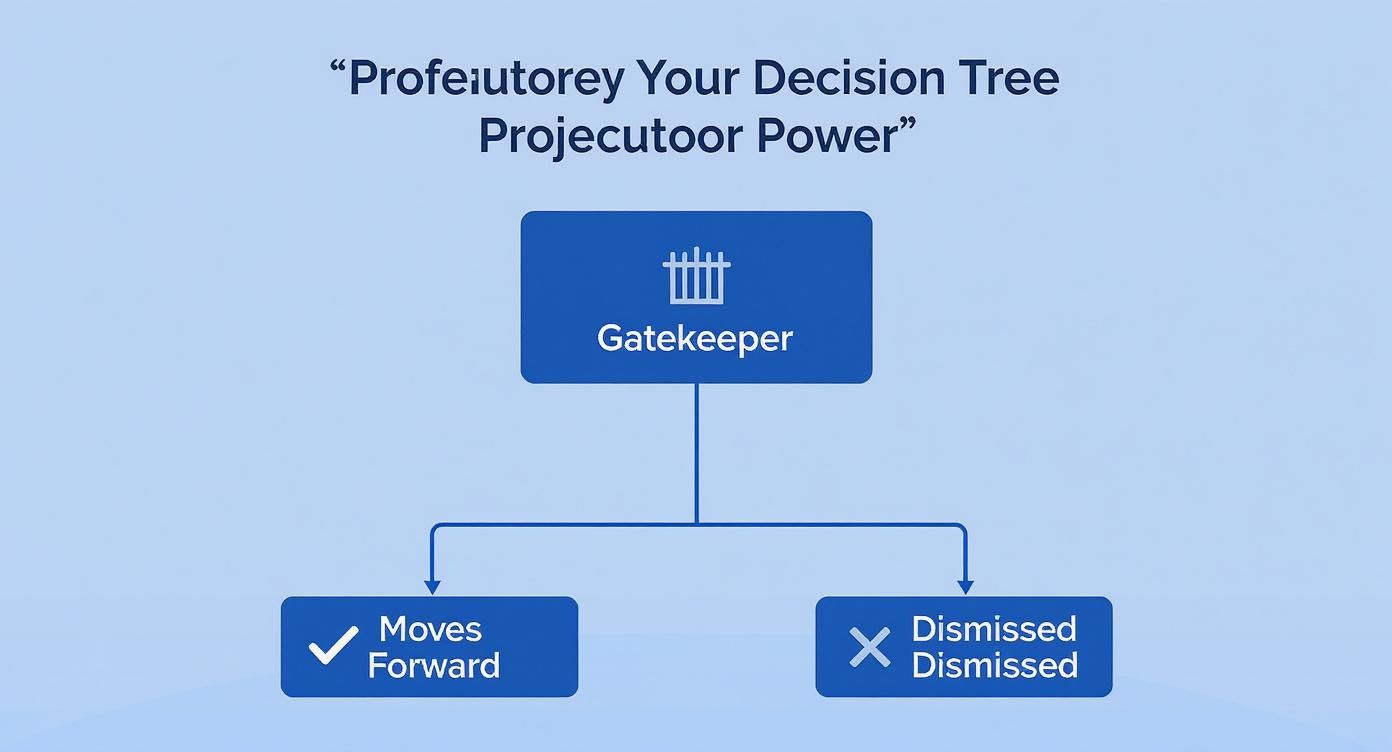
As the infographic shows, your case essentially hits a fork in the road on the prosecutor’s desk. Their evaluation determines whether it moves forward toward trial or gets filtered out of the system right then and there.
The Real-World Impact of Discretion
This two-question evaluation isn't just an informal process; it’s a core function of a prosecutor's job. A detailed report from the Office of Justice Programs confirms that prosecutors across the country consistently weigh the "Can I prove it?" versus "Should I prove it?" dilemma at every stage.
The bottom line is this: the initial charge from the police is just a starting point. The prosecutor's discretion creates a crucial window of opportunity where a persuasive defense attorney can introduce mitigating evidence and solid legal arguments to fight for a much better outcome.
This is exactly why having an experienced defense lawyer in your corner from the very beginning is so important. We can dig into the state's evidence, find the weak spots, and present a compelling case to the prosecutor explaining why a dismissal or a reduced charge is the right call.
For anyone wondering how to get criminal charges dropped in Texas, a proactive approach during this early phase is absolutely essential.
Real-World Examples of Prosecutorial Discretion
Theory is one thing, but seeing how prosecutorial discretion plays out in real life makes its importance hit home. The initial charge you face isn’t set in stone; it’s just the starting point. From there, the unique facts of your case matter immensely, and a prosecutor’s decision can completely change the direction of your case in Texas.
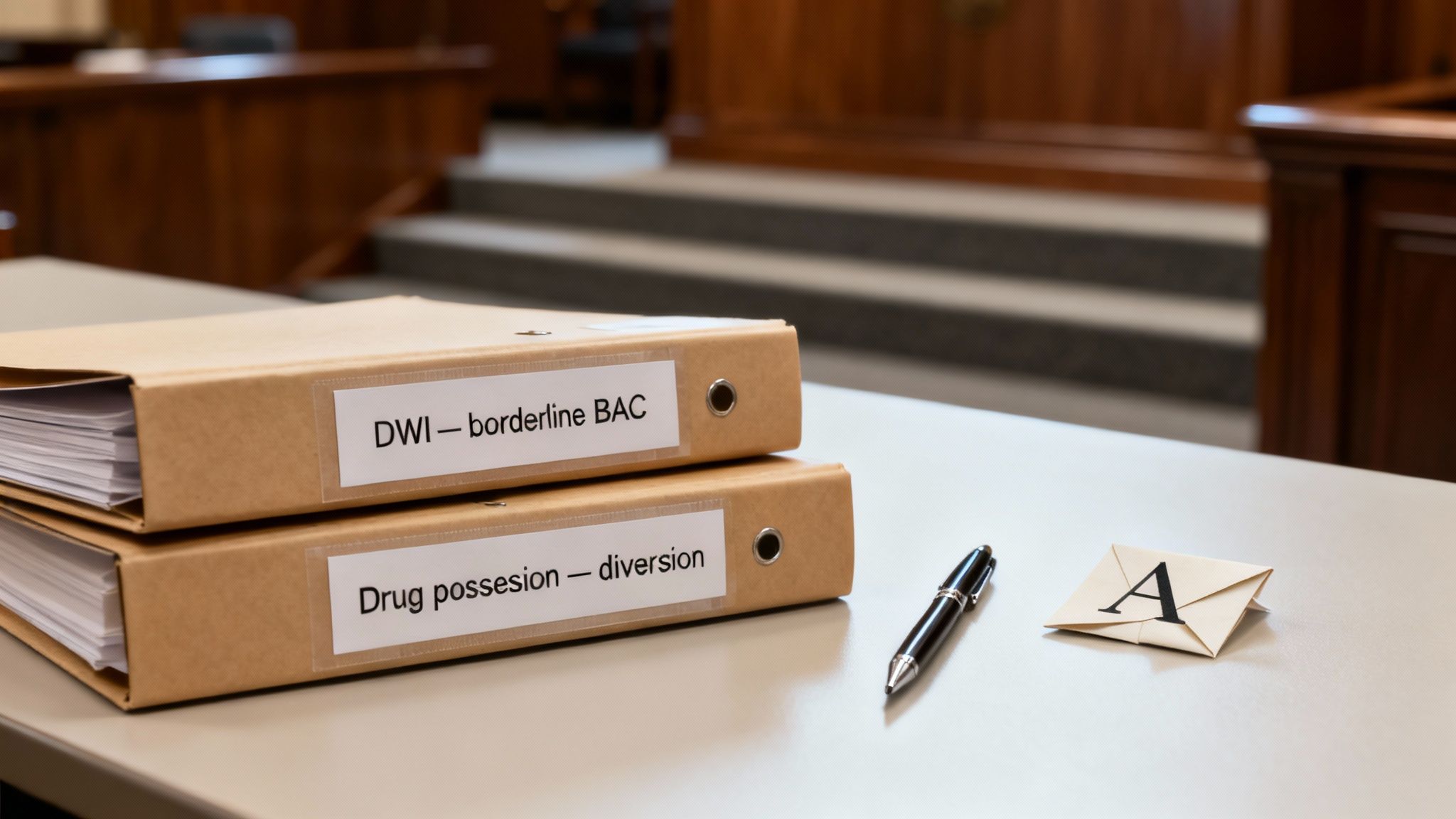
Let's walk through a couple of common situations where a prosecutor’s choice, especially when nudged by a strong Texas assault defense or DWI attorney, leads to a much better outcome for the accused.
The First-Time DWI Arrest
Imagine this: a young person gets pulled over for a suspected DWI in Houston. It's their first-ever brush with the law, and their blood alcohol concentration (BAC) is 0.08—right on the legal limit. To make things more complicated for the state, the arresting officer might have made some procedural mistakes, like botching the field sobriety tests or not having a solid reason for the traffic stop in the first place.
A prosecutor looking at this file has a few options. They could dig in their heels and push the DWI charge, which comes with serious penalties. But a skilled Texas DWI attorney would immediately start poking holes in the state’s case.
Your lawyer would highlight several key points for the prosecutor:
- The borderline BAC result, which is shaky and could be easily challenged in court.
- Any procedural errors the officer made during the arrest.
- Your clean criminal history and good standing in the community.
Faced with these weaknesses, the prosecutor might use their discretion to offer a deal. Instead of a DWI conviction that follows you for life, they could reduce the charge to something like Obstruction of a Highway. That's a non-alcohol-related offense that has a far less damaging impact on your record.
A Minor Drug Possession Case
Here’s another all-too-common scenario. Someone is arrested for possessing a small amount of a controlled substance, which is a state jail felony under the Texas Penal Code. While the charge itself sounds scary, the person has no prior convictions, holds down a steady job, and is a parent.
Their defense attorney can build a case that’s not just about the evidence but about the person themselves. By presenting this bigger picture to the prosecutor, the attorney can argue that a felony conviction would be an unnecessarily harsh punishment that doesn't actually serve the community's best interests.
This is a classic example of when a prosecutor has to ask themselves, "Just because I can prove this case, should I?" A conviction could cause the person to lose their job and destabilize their family, creating a worse outcome for everyone involved.
Recognizing this, the prosecutor might use their discretion to offer entry into a pretrial diversion program. If you successfully complete the program—which usually involves classes, community service, and staying out of trouble—the prosecutor agrees to dismiss the case entirely. This lets you avoid a criminal conviction and, down the road, seek an expunction to clear your record completely.
These examples show that an arrest is not the end of the story. A prosecutor’s power of discretion creates a critical opening for your defense attorney to step in, negotiate, and fight for a result that protects your freedom and your future.
The Legal Roots Of A Prosecutor’s Power
Every criminal case begins with a choice: whether to charge someone at all. That decision doesn’t come from thin air—it springs from the U.S. Constitution and our commitment to separation of powers. Think of it as a built-in check and balance: the executive branch, which includes state and federal prosecutors, holds the baton when it comes to enforcing laws.
By design, prosecutors aren’t wired to pursue every allegation like an assembly-line machine. Instead, they weigh each matter on its own merits. This approach keeps our courts from drowning in minor or groundless claims and frees up energy for the most pressing crimes.
A Long-Standing Legal Tradition
Prosecutorial discretion isn’t a modern workaround—it’s as old as the Republic itself. From the earliest days of the nation, elected and appointed prosecutors have held the power to:
- Decide if charges should be filed
- Select which offenses to pursue
- Tailor their strategy based on the evidence
An early test of this authority came after the Civil War. President Lincoln’s amnesty for former Confederates was challenged in court, but the Supreme Court affirmed it as a constitutional exercise of executive discretion. You can discover more insights about this historical context in legal scholarship.
This history shows us something crucial: a prosecutor’s power isn’t random or unchecked. It’s a deliberate part of our legal framework, ensuring that justice adapts to each situation rather than forcing every case into the same mold.
Grounded In Texas Law
In Texas, prosecutorial discretion takes on local color. District and county attorneys—elected by voters—carry the state’s banner in criminal court. Their decisions are shaped by statutes passed down in Austin and guided by the Texas Penal Code and the Code of Criminal Procedure.
A prosecutor’s discretion operates within the boundaries set by law. While they have the power to make judgment calls, those decisions must still align with the principles of justice and the rules laid out in the Texas Penal Code and Code of Criminal Procedure.
Whether you’re facing a DWI or an assault charge, it’s vital to know that a prosecutor’s reach is both broad and bounded. Their authority flows from centuries of legal tradition—but it stops at the edge of the rulebook. That’s precisely when a skilled defense attorney can step in: by mapping out that framework and advocating for a fair result. To explore the laws prosecutors rely on, you can learn more about the Texas Penal Code structure in our guide.
How a Defense Attorney Can Influence the Outcome
While a prosecutor holds a lot of cards, it’s crucial to remember they don’t make decisions in a vacuum. A sharp, proactive criminal defense attorney doesn’t just sit back and wait for the prosecutor to make a move. We get in there and actively work to shape that decision in your favor. This is where your power to fight back really begins.
At The Law Office of Bryan Fagan, PLLC, our approach is both strategic and personal. We know that prosecutors respond to two things: solid legal arguments and a full picture of the person they’re charging. Our job is to give them both, loud and clear.
Building a Persuasive Defense Narrative
From the moment you hire us, we launch our own investigation. We never, ever take the police report at face value. Instead, we put every piece of evidence under a microscope, hunting for weaknesses, inconsistencies, and constitutional violations.
Our investigative work includes:
- Challenging the Evidence: We dig into police procedures to find any missteps, like an illegal search or a failure to read you your Miranda rights. Uncovering these errors can get evidence thrown out, which can cripple the prosecutor's case.
- Interviewing Witnesses: We track down and talk to every relevant witness. Often, we find facts and perspectives that law enforcement either overlooked or flat-out ignored.
- Uncovering Mitigating Factors: We work hard to present you as a whole person, not just another case file. By highlighting your clean record, family responsibilities, job, and positive community ties, we give the prosecutor compelling reasons to use their discretion in a more lenient way.
Opening a Dialogue with the Prosecutor
Armed with all this information, we do more than just get ready for trial. We open a professional and respectful line of communication with the prosecutor. This early intervention is often the most critical part of your entire defense. In these conversations, we can lay out our findings and make a strong case for a better outcome before the legal machine really gets rolling.
A prosecutor's decision is often shaped by the strength and professionalism of the defense. When we present a well-researched, credible argument for a dismissal or reduction, we give them a sound legal reason to use their discretion in a way that helps you.
This isn't about begging for mercy; it's about leveling the playing field with facts and solid legal reasoning. For many people, the choice of representation can be overwhelming, but understanding the difference between a public defender vs a private attorney can highlight how a dedicated legal team has the resources for this kind of deep-dive investigation.
Ultimately, our goal is to convince the prosecutor that a harsh conviction isn't the most just outcome. We aim to show them that a dismissal, a reduction in charges, or an offer for a diversion program is the right and fair decision. By methodically taking apart the state's case while building up your personal story, we create the leverage needed to turn the tide in your favor.
Common Questions About Prosecutorial Discretion
https://www.youtube.com/embed/WfnPzgxHfPY
When you're navigating the Texas criminal justice system, it's natural to have a lot of questions. A concept like prosecutorial discretion can feel confusing and unfair, but you deserve clear, straightforward answers. Below, we’ve broken down some of the most common concerns people have when they learn just how much power a prosecutor holds over their case.
Our goal is simple: to give you the information you need to feel more in control. Knowledge is a powerful tool, and understanding how the system really works is the first step toward building a strong defense.
Can a Judge Overrule a Prosecutor?
This is a common point of confusion, and the answer is generally no. A judge can't force a prosecutor to file charges against someone, and they typically can't force them to dismiss a case, either. This goes right back to the separation of powers in our legal system.
The prosecutor is part of the executive branch, tasked with enforcing laws. The judge, on the other hand, is part of the judicial branch, responsible for making sure court proceedings are fair. A judge’s role is to act as a neutral referee, not to make the charging decisions for the prosecution. This reality highlights just how much authority the prosecutor wields in your case.
Is Discretion the Same as a Plea Bargain?
They're closely related, but they are not the same thing. Think of prosecutorial discretion as the broad, overarching power a prosecutor has to make all kinds of decisions in a case. A plea bargain is just one specific outcome of them using that power.
Here’s a better way to look at it: a prosecutor uses their discretion to decide if they'll even offer a plea deal. Then, they use it again to decide what the terms of that deal will be—for example, agreeing to reduce a felony drug charge to a misdemeanor. The final plea agreement is simply the end result of their discretion in action.
Does This Mean My Case Is Guaranteed to Be Dismissed?
Absolutely not, and it’s critical to understand this. Discretion is a choice, not an obligation. A prosecutor can just as easily use their power to pursue the most serious charges and seek the maximum penalties allowed by law. There is never a guarantee of a dismissal or any other favorable outcome.
The ability to influence a prosecutor's decision rests entirely on the strength of the defense. A compelling, well-argued case from your attorney is what gives the prosecutor a legitimate reason to use their discretion in your favor.
Without a strong advocate poking holes in the state's evidence and presenting mitigating factors, a prosecutor often sees no reason to offer leniency. Your attorney’s job is to create that reason.
If you’ve been charged with a crime in Texas, call The Law Office of Bryan Fagan, PLLC for a free and confidential consultation. Our defense team is ready to protect your rights. Get in touch with us today.