Skip to content
Being arrested for DWI in Texas can be terrifying—but you don’t have to face it alone. The flashing lights, the handcuffs, the booking process—it’s a frightening experience that can leave anyone feeling overwhelmed, scared, and completely unsure of what comes next.
But right now, the actions you take in the next 24 to 48 hours are absolutely critical. This is the time to shift from a state of crisis to a state of control by taking clear, deliberate steps to protect your rights and start building your defense. Your first priorities are simple but urgent: preserve evidence and meet a non-negotiable legal deadline that could save your driver's license.
Your First Steps After a DWI Arrest
The most important things you can do right after a DWI arrest are to document everything you remember about the stop, figure out where your car is, make sense of the paperwork they gave you, and call an experienced DWI defense attorney. You absolutely cannot wait.
You have only 15 days from the date of your arrest to request a special hearing to fight an automatic driver's license suspension. If you miss this window, your license will be suspended regardless of what happens in your criminal case.
Document Every Detail
Your memory is one of the most powerful pieces of evidence you have, but it fades fast—especially after a stressful event like an arrest. As soon as you can, sit down and write out every single detail you can remember about the traffic stop and your arrest. Don't filter anything; just get it all down on paper.
This information is invaluable for your attorney. It helps them spot weaknesses in the prosecutor’s case right from the start.
Think through these questions:
- The Stop: Why did the officer pull you over? Were you speeding, weaving, or was it something simple like a broken taillight? Under Texas law, an officer must have "reasonable suspicion" to initiate a traffic stop.
- The Conversation: What did the officer ask you? What did you say back? Try to recall the exact words if you can. Did they tell you that you were being recorded?
- The Tests: What field sobriety tests did they make you do? Do you have any injuries or medical conditions that might have made it hard to perform those tests?
- The Arrest: When and where did they officially arrest you? What reason did the officer give for putting you in cuffs?
This infographic gives you a quick visual breakdown of the top three things you need to do as soon as you're released.
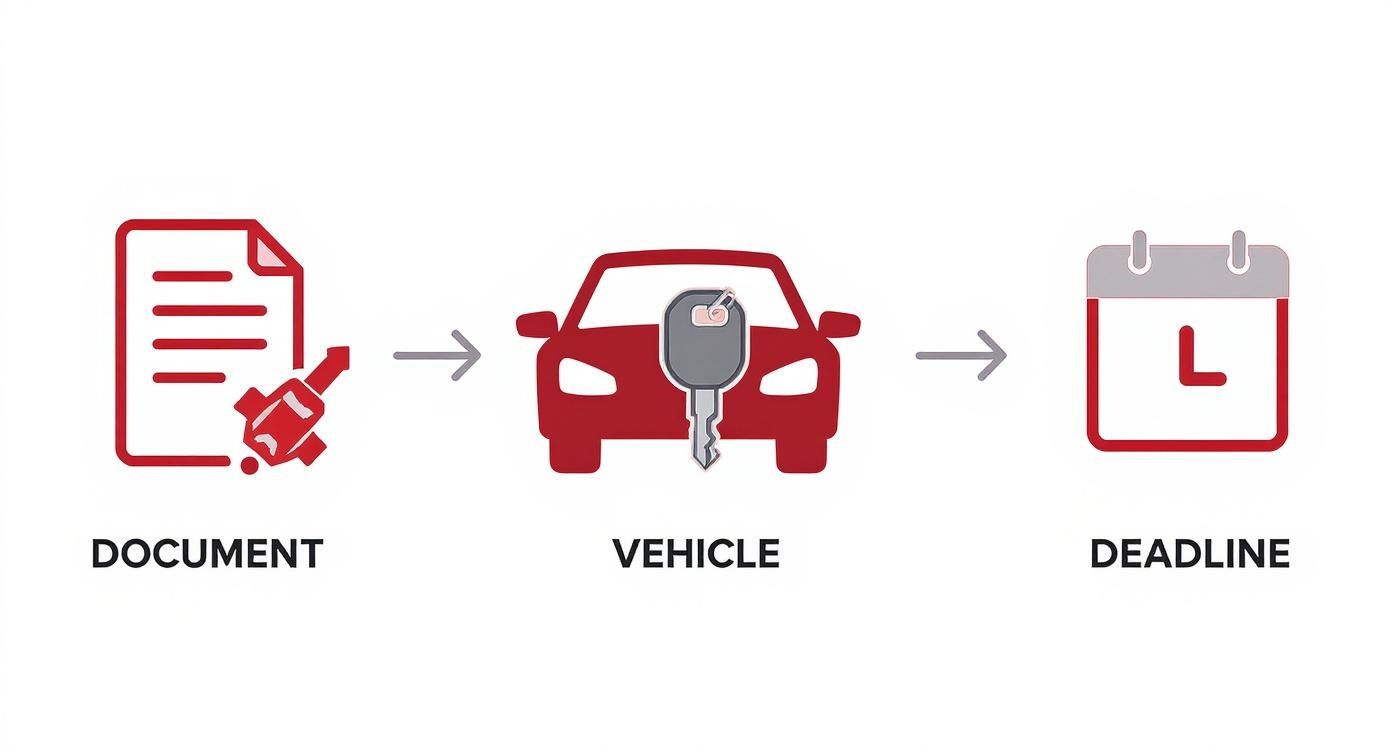
As the graphic shows, the clock is ticking. You need to document the facts, get your car back, and—most importantly—deal with that strict 15-day deadline for the ALR hearing.
Understand Your Paperwork
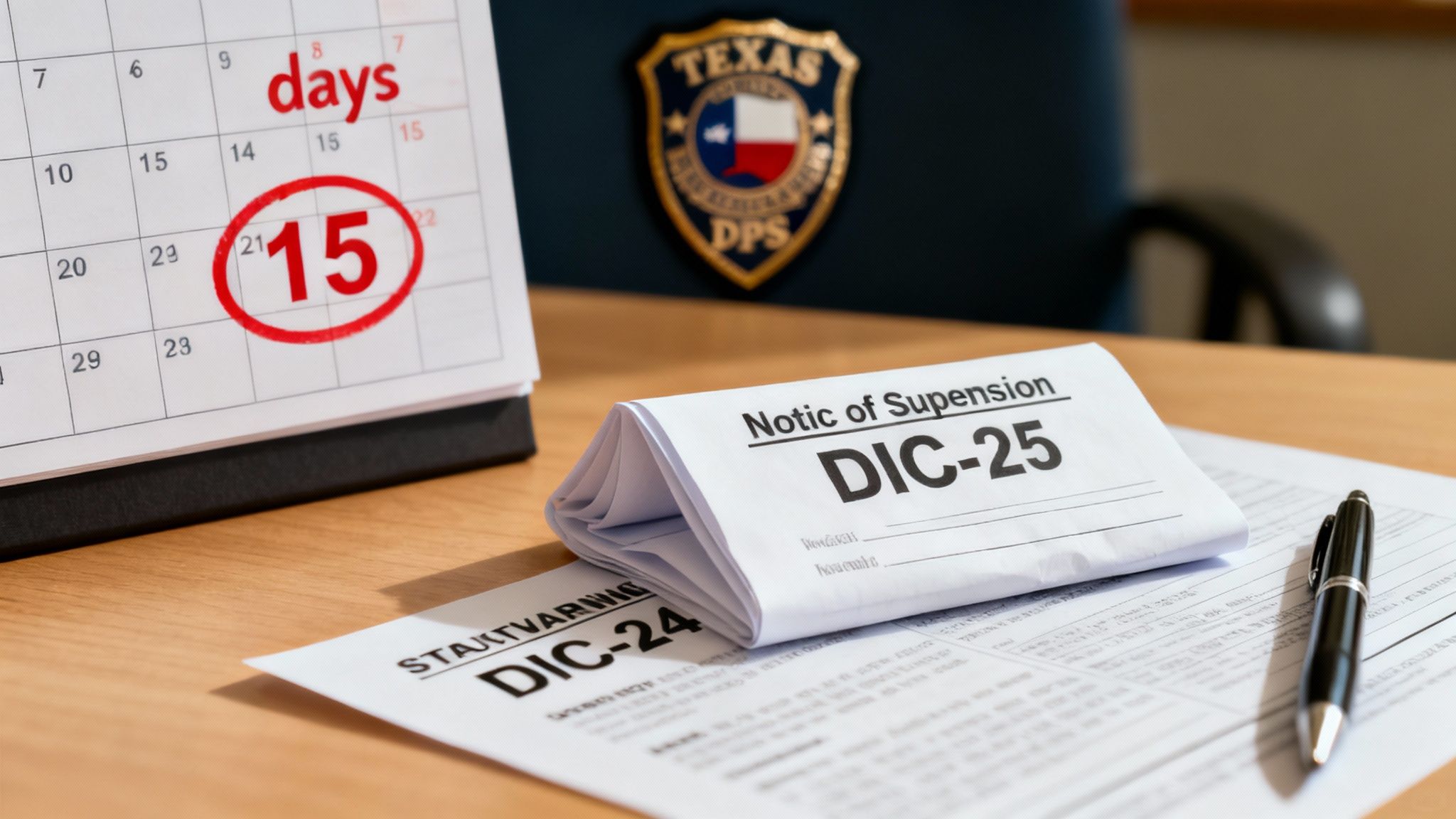
When you were released, you were likely handed a stack of documents. Buried in that stack are two forms that are extremely important: the DIC-24 (Statutory Warning) and the DIC-25 (Notice of Suspension/Temporary Driving Permit).
The DIC-24 is the form the officer should have read to you, explaining what happens if you refuse or fail a breath or blood test. The DIC-25 is the real kicker—it acts as your temporary license, but it's also official notice that your real license is set to be suspended in 40 days.
Crucial Deadline: You have only 15 calendar days from the date of your arrest to request an Administrative License Revocation (ALR) hearing. If you miss this deadline, your license gets suspended automatically, no matter what happens with your criminal case.
Taking these initial steps to take if you've been charged with a DUI arrest can completely change the direction of your case. After you’ve written everything down and looked at your paperwork, you need to find your vehicle—it was almost certainly towed and is racking up storage fees by the day.
Then, make the most important call: get an experienced Texas DWI attorney on the phone. They can file the ALR request for you and start fighting for your rights immediately.
Saving Your License with the ALR Hearing

When you’re arrested for a DWI in Texas, you aren't just facing a criminal charge. You’re immediately thrown into a second, separate civil battle against the Texas Department of Public Safety (DPS). This second fight is all about keeping your driver’s license.
This administrative process is called an Administrative License Revocation (ALR) hearing. Here’s what you need to understand right away: the outcome of your criminal DWI case has zero direct impact on this ALR proceeding, and vice versa. You could be found not guilty in criminal court and still lose your license if you ignore this separate process.
And here's the most critical part: you only have 15 days from the date of your arrest to formally request an ALR hearing. Miss that deadline, and your license gets automatically suspended. No exceptions.
Why the ALR Hearing Is Your First Line of Defense
Requesting an ALR hearing is a powerful first move for two reasons. First, it puts a stop to the automatic suspension, allowing you to keep driving while your case is pending. Second—and this is a huge strategic advantage—it gives your DWI attorney a golden opportunity to challenge the state's case against you from the very beginning.
Think of the ALR hearing as a mini-trial. The DPS has to prove that the officer had a legitimate reason to pull you over and probable cause to arrest you for DWI. This is where your lawyer gets to cross-examine the arresting officer under oath, locking them into their story months before a criminal trial would even begin.
This process can expose shaky justifications for the traffic stop, procedural mistakes, and other weaknesses in the state’s evidence. Everything said under oath can be used later to build your criminal defense. It's an advantage many people don't even know they have. You can find out more by reading up on common misconceptions about the DWI hearing process.
What Happens During the ALR Process
Once your lawyer requests the hearing, it gets scheduled with the State Office of Administrative Hearings (SOAH). An Administrative Law Judge—not a criminal court judge—will preside over the proceeding.
The DPS will have its own lawyer there to present its case, which almost always relies on the arresting officer's testimony. Your attorney’s job is to poke holes in that testimony.
We often focus on key questions like:
- Reasonable Suspicion: Was the initial traffic stop even legal? Did you actually run a stop sign, or was the officer just fishing?
- Probable Cause: Did the officer truly have enough evidence to believe you were intoxicated? Were the field sobriety tests administered and graded correctly?
- Statutory Warnings: Did the officer correctly read you the DIC-24 warnings before asking for a breath or blood sample? Any deviation can be grounds for a challenge.
Your attorney will use this hearing as a critical discovery tool. By questioning the officer, we can uncover details about the stop that may not be in the police report, giving us a significant head start in building your criminal defense strategy.
If we win the ALR hearing, your license is safe from suspension. If the judge sides with the DPS, a suspension will be ordered. But even then, all is not lost. Your attorney can often help you get an occupational driver's license, which allows you to drive to work, school, and other essential places. Taking this first step is a crucial part of what to do after a DWI arrest.
DWI Criminal Case vs. ALR Hearing: A Quick Comparison
It's easy to get these two processes confused, but they are completely separate legal battles with different rules, goals, and consequences. Understanding the distinction is the first step toward building a strong, comprehensive defense.
| Aspect | Criminal Court Case | Administrative License Revocation (ALR) Hearing |
|---|---|---|
| Goal | To determine guilt or innocence for the DWI charge. | To determine if your driver's license should be suspended. |
| Who's Involved | Prosecutor, Defense Attorney, Judge, and potentially a Jury. | DPS Attorney, Defense Attorney, Administrative Law Judge. |
| Potential Outcome | Jail time, fines, probation, permanent criminal record. | License suspension (from 90 days to 2 years). No jail time. |
| Standard of Proof | "Beyond a reasonable doubt" (very high standard). | "Preponderance of the evidence" (much lower standard). |
| Deadline | Statute of limitations is typically two years. | You must request the hearing within 15 days of arrest. |
Treating these as two distinct fronts in your fight is key. A victory in one doesn't guarantee a win in the other, which is why a strategic approach to both is absolutely essential from day one.
Finding the Right Texas DWI Defense Lawyer
After a DWI arrest, the single most important decision you will make is who you hire to represent you. The right Houston criminal lawyer can mean the difference between a conviction that haunts you for life and a dismissal that lets you get back on your feet.
But with billboards and online ads everywhere, how do you find someone you can actually trust with your future?
This isn’t the time for a quick Google search and calling the first number you see. You need an advocate with specific, proven experience in Texas DWI defense. The laws are incredibly complex, and the science behind breath and blood tests is highly technical. A general criminal defense lawyer, even a good one, often lacks the specialized knowledge to effectively dismantle the state’s evidence.
You are not just another case number. Your situation is unique, and the stakes are intensely personal. The legal moves you make right now are critical, and that process starts with finding a qualified Texas DWI attorney who knows how to navigate the fines, license suspension, and potential jail time.
Key Qualifications to Look For
When you start researching attorneys, your focus should be narrow: find someone who lives and breathes DWI law. A true DWI specialist has a deep grasp of the science and legal nuances that most general practitioners simply don't possess.
Here are the critical qualifications you should be looking for:
- Board Certification: Is the attorney Board Certified in Criminal Law by the Texas Board of Legal Specialization? This is a mark of a genuine expert in the field.
- Scientific Knowledge: Do they have advanced training on how breathalyzer machines (like the Intoxilyzer 9000) actually work? Do they understand the science of blood testing and gas chromatography?
- Trial Experience: How many DWI cases have they taken to a jury trial? A lawyer who isn’t afraid to go to court is a lawyer that prosecutors take seriously.
- Local Reputation: Do they regularly practice in the specific court and county where your case is filed? Knowing the local judges and prosecutors is a massive advantage.
A great DWI lawyer doesn't just know the law; they know the science. They understand how to challenge the reliability of a breath test, question the administration of field sobriety tests, and find errors in police procedure that can get evidence thrown out completely.
Questions to Ask During Your Consultation
Think of your initial consultation as a two-way interview. It's your chance to assess their expertise and decide if they’re the right fit for your case. To help you make a confident choice, we've put together a detailed guide on how to find a good criminal defense lawyer that goes into even more detail.
Don't be afraid to ask direct, tough questions. A confident and experienced attorney will welcome them.
Consider asking things like:
- "What is your strategy for reviewing the traffic stop video?"
- "How do you challenge the results of a field sobriety test?"
- "Based on what I've told you, what potential weaknesses do you already see in my case?"
- "Who exactly will be handling my case—you, or will it be passed off to a junior associate?"
Listen carefully to their answers. You're looking for someone who gives you clear, strategic responses, not vague promises. The right attorney will be both a compassionate guide through this process and a fierce defender in the courtroom, ready to protect your rights at every single turn.
Navigating the Texas Criminal Court System

Once you’ve hired an experienced DWI attorney, the focus shifts from the immediate fallout of the arrest to the long game: the court process. The Texas criminal court system can feel like a completely different world with its own language and rules. It's designed to be intimidating.
But knowing what's coming can take away a lot of that fear. Your attorney is your guide and your shield through this entire ordeal. They'll handle the deadlines, file every motion, and stand next to you at every appearance, making sure your rights are protected from start to finish.
The First Court Appearance: Arraignment
Your first official trip to court is for a hearing called the arraignment. It's usually short and straightforward. The judge will formally read the charges against you and ask how you plead. This is where your lawyer steps in. They will almost always enter a plea of "not guilty" on your behalf. Don't let that phrase scare you; it doesn't mean your case is destined for a jury trial. Pleading "not guilty" is the standard legal move that keeps all your options open and gives your attorney the time they need to dig into the state’s evidence.
Gathering Evidence: The Discovery Phase
After the arraignment, your case moves into what’s known as discovery. This is where the real work begins. During discovery, the prosecutor is legally required to hand over everything they have against you. Your attorney will get a file packed with documents and media, and they will go through it with a fine-tooth comb. This evidence package usually includes:
- The official police report, which is the officer's side of the story.
- Dashcam and body camera videos of the traffic stop and your arrest.
- The results of any breathalyzer or blood tests.
- The officer’s handwritten notes and any statements from witnesses.
This is where a seasoned DWI lawyer truly earns their keep. They aren't just reading reports; they're hunting for weaknesses. Was the initial traffic stop even legal? Was the breathalyzer machine calibrated correctly? Was the blood draw done by the book? Finding the answers to these questions can completely change the direction of a case.
A strong defense is built by taking the prosecutor's case apart, piece by piece. Your attorney's job during discovery is to find the weak links in the chain of evidence that can be challenged in court.
Challenging the State’s Case with Motions
If your lawyer finds problems with the evidence—like a faulty breathalyzer test or an illegal stop—they will file legal arguments called motions. One of the most powerful tools is a "Motion to Suppress Evidence." This is a formal request asking the judge to throw out any evidence that was obtained illegally. If the judge agrees, that evidence is gone. It cannot be used against you at trial.
For example, if the dashcam video shows the officer pulled you over without a valid reason, everything that happened after that moment—the field sobriety tests, the breath test, your arrest—could get thrown out. Winning a key motion like this can cripple the prosecutor's case, sometimes leading to a full dismissal.
While a DWI arrest can happen to anyone, statistics from the NHTSA website show that certain groups are disproportionately affected. For instance, in 2022, young adults between 21 and 34 accounted for 27% of drivers involved in fatal alcohol-related crashes. These numbers underscore the need for a strong legal defense and a focus on preventing future incidents.
Protecting Your Future After a DWI Charge
A DWI charge in Texas doesn't just disappear when the court case is over. A conviction can throw up roadblocks for years, making it harder to get a job, keep a professional license, find a place to live, and even get reasonable car insurance. It’s a heavy weight to carry, but it absolutely does not have to define your future.
The good news is that the Texas legal system has powerful tools to help you move on. The goal is to make sure one mistake doesn't permanently slam the door on future opportunities. By understanding your options right now, you and your attorney can build a strategy that looks beyond the immediate legal fight.
Clearing Your Name with an Expunction
The best-case scenario in any DWI case is getting it dismissed or being found not guilty at trial. If your case ends in your favor, Texas law allows you to go after an expunction. Think of an expunction as a legal order telling every government agency to destroy all records of your arrest.
It's as if the arrest never happened. Once an expunction is granted, you can legally deny you were ever arrested for that charge. This is the gold standard for clearing your record and gives you a true fresh start.
Sealing Your Record with Non-Disclosure
But what if your case isn't dismissed? For certain first-time DWI offenses that lead to a conviction and probation, you might be eligible for an Order of Non-Disclosure. This legal tool doesn’t destroy the records, but it does seal them from public view.
This means that when a potential employer or landlord runs a background check, the conviction won't show up. While law enforcement and some state agencies can still see it, a non-disclosure effectively removes the charge from your public record, drastically reducing its impact on your life. Dealing with these complex legal steps requires a clear head, so it's important to cultivate mental clarity to empower you through this process.
Navigating Different Legal Landscapes
Where you were arrested matters. The specific consequences and the best strategies to use can change depending on the county or city. Local enforcement policies and public resources play a huge role in how these cases turn out.
For example, some U.S. cities, like Richmond, Virginia, have high rates of drunk driving arrests and alcohol-related fatalities, signaling a much stricter enforcement environment. On the other hand, cities with strong preventive programs and plenty of alternative transportation, like Chandler, Arizona, report some of the lowest DUI risks.
These regional differences are exactly why a localized defense strategy is so critical. You can see more details on how drunk driving statistics vary from city to city. A skilled Texas DWI lawyer knows how to navigate the specific legal environment you’re up against and build a defense that works.
Common Questions After a DWI Arrest
After the shock of a DWI arrest wears off, the questions start flooding in. It’s completely normal to feel overwhelmed and anxious about what’s next. Let’s cut through the noise and give you clear, straightforward answers to the most urgent questions we hear every day.
What Happens if I Refused the Breath or Blood Test?
This is one of the most common situations we see. If you refused to give a breath or blood sample, you need to understand Texas’s “implied consent” law. Under the Texas Transportation Code, just by having a Texas driver's license and driving on our roads, you’ve legally agreed to submit to a chemical test if an officer has probable cause to arrest you for DWI.
Refusing that test triggers an immediate, automatic driver's license suspension through the ALR process. While your refusal does deny the prosecutor a key piece of evidence—your blood alcohol concentration (BAC)—it does not mean your case will be dismissed. The State can still build a case against you using the officer’s testimony, dashcam video, and your performance on the field sobriety tests.
Bottom line: whether you took the test or refused it, your next move is the same. You need to contact an experienced DWI lawyer who can defend you in both the criminal court and the separate license suspension hearing.
Will I Go to Jail for a First-Time DWI in Texas?
The fear of jail time is almost always the biggest worry after a DWI arrest. A first-offense DWI in Texas is a Class B Misdemeanor under the Texas Penal Code, and it technically carries a potential jail sentence of up to 180 days. However, jail time is not a guaranteed outcome, especially for a first offense with no other aggravating factors.
Judges and prosecutors look at a lot of different factors when deciding on a sentence, including:
- Your BAC level (the higher it is, the more seriously they take it).
- Whether there was an accident involved.
- Your criminal history, if you have one.
- The specific facts surrounding your arrest.
A skilled defense attorney can often negotiate for much better outcomes, like probation, community service, and DWI education classes instead of jail. The goal is to show the court that you’re a person who made a one-time mistake, not a danger to the public.
How Much Does a Good DWI Lawyer Cost?
It’s a fair question. The cost of hiring a strong DWI defense lawyer varies, depending on their experience and the complexity of your specific case. It's completely understandable to worry about the expense, but it’s critical to see this as an investment in protecting your future.
A DWI conviction can cost you far more in the long run. Think about the lasting financial damage from court fines, years of drastically increased car insurance premiums, lost job opportunities, and even potential harm to a professional license.
Many people are surprised to find out that a top-tier defense can be more affordable than they assumed. Most reputable firms, including ours, offer a free and confidential consultation to go over the details of your case. This lets you get a clear picture of the legal fees involved and make an informed decision without any upfront financial pressure. The right attorney provides value that far exceeds the initial cost.
If you’ve been charged with a crime in Texas, call The Law Office of Bryan Fagan, PLLC for a free and confidential consultation. Our defense team is ready to protect your rights.