Skip to content
Realizing you’ve missed a court date can be terrifying. That sinking feeling in your stomach is a mix of panic and dread, and your mind is likely racing with worst-case scenarios. If you're in this position right now, the most important thing to know is this: do not ignore it. Hiding from the problem is the single worst mistake you can make, because a judge has almost certainly issued a warrant for your arrest.
Being arrested in Texas can be terrifying—but you don’t have to face it alone. Taking immediate, proactive steps is the key. You can often stop the situation from spiraling out of control and show the court you are taking this seriously.
Why Your First Move Matters After Missing Court
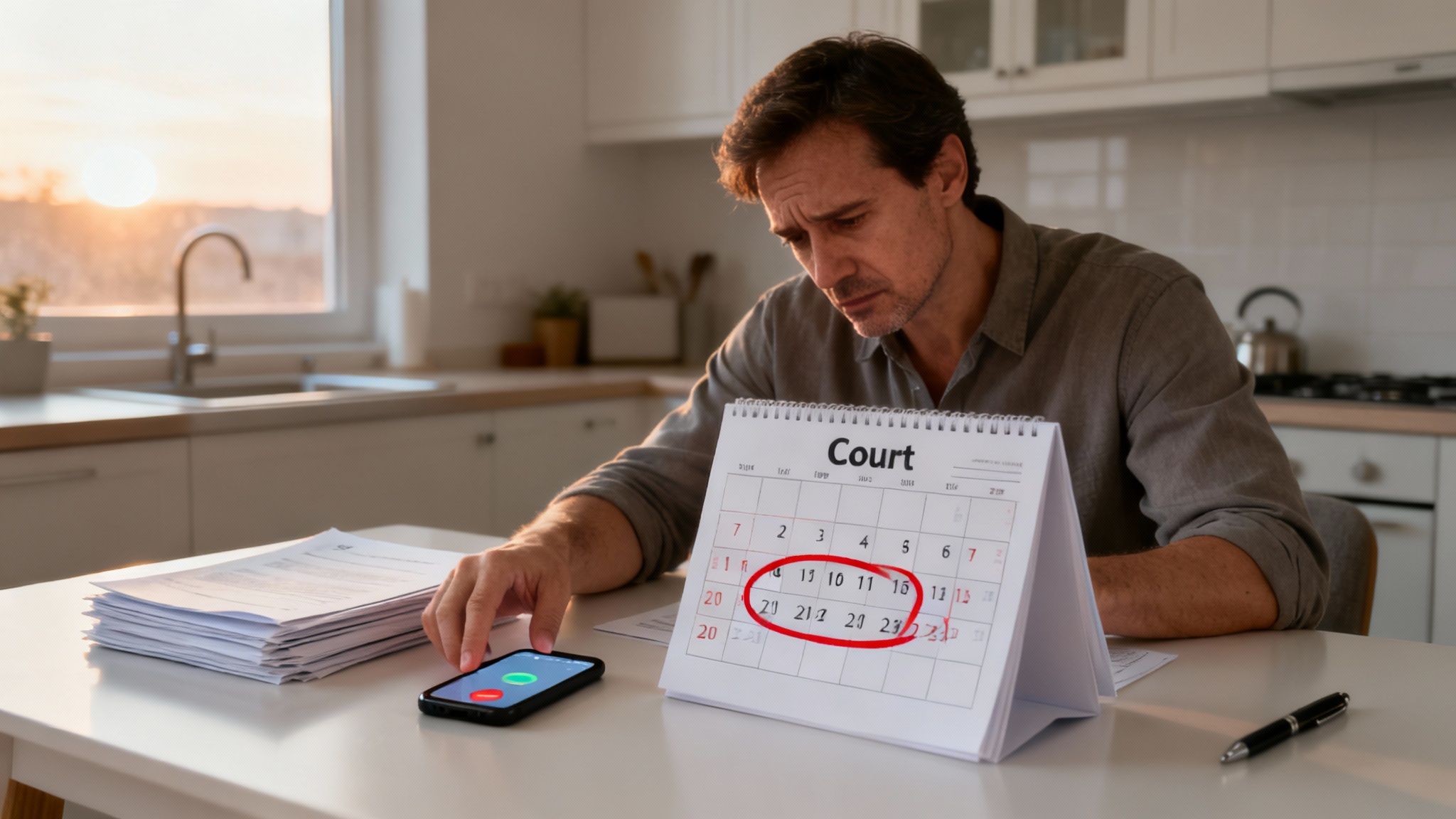
Let's be clear: missing a court date is a fixable problem, but you have to handle it correctly. Will you be arrested at work? How much trouble are you really in? It’s a frightening situation, but you are not the first person this has happened to, and you have options.
People miss court for all sorts of legitimate reasons. We’ve seen it all:
- Simple scheduling mix-ups with work or family.
- The court notice was mailed to an old address.
- A true medical emergency or a family crisis that couldn't be ignored.
- Car trouble on the way to the courthouse.
But here’s the reality: the court system doesn't wait for an explanation. When the bailiff calls your name and you’re not there, the judge’s next move is almost always to issue a bench warrant, also known as a capias. This is a direct order for any law enforcement officer to arrest you on sight.
Understanding Failure to Appear in Texas
In legal terms, missing court is called a "Failure to Appear," or FTA. Under Texas law, this isn't just a simple mistake—it’s a separate criminal offense. That means on top of the original charge (whether it was a DWI, theft, or assault), you could now face an entirely new charge just for the missed court date.
This new charge can add more fines and even jail time. It also makes your original case much more difficult. A prosecutor will see an FTA and assume you're not taking the process seriously, making it harder to negotiate a fair plea deal. This is exactly why what you do next is so critical.
Your Immediate Action Plan
The panic is understandable, but now it's time to shift into action. Your goal is to get ahead of this before a warrant catches up with you during a routine traffic stop. First, pull together any information you have about your case—the case number, the county, and the specific court you were supposed to be in.
Your very next step should be calling an experienced Texas criminal defense attorney. A lawyer can immediately start working to protect you. They can:
- Find out if a warrant exists without alerting the police.
- Contact the court and the prosecutor’s office to understand the situation fully.
- Start building a strategy to get the warrant recalled or set aside.
- Advise you on the best way forward, which can often help you avoid being arrested altogether.
Acting fast shows the judge that your absence wasn't intentional disrespect. It was a mistake you are actively trying to fix. This can make all the difference, especially when it comes to setting a new bond. If you're concerned about bail, getting familiar with how to get bond reduced can give you some valuable insight.
A missed court date feels like a complete disaster, but it's a legal problem with a solution. How you respond right now sets the tone for everything that follows. By getting an attorney involved immediately, you're not just doing damage control—you're taking back control of your situation.
What Happens When You Miss a Court Date?
If you miss a court date in Texas, the legal system doesn't just hit pause. It keeps moving, and that forward motion triggers a cascade of serious consequences designed to force your appearance. It's a harsh reality, but understanding what's happening behind the scenes is the first step toward fixing the problem.
The two most immediate things you can expect are a "Failure to Appear" (FTA) charge and the issuance of a bench warrant. These aren't just minor administrative issues; they're major legal events that add a whole new layer of trouble to your original case.
A New Criminal Charge: The Failure to Appear
In Texas, an FTA isn't just a note in your file. It’s a completely separate criminal offense under Texas Penal Code § 38.10. That means on top of whatever you were originally facing—be it a misdemeanor DWI, assault, or a felony drug charge—you're now facing a brand new crime.
The seriousness of the FTA charge usually matches the original offense:
- Missed court for a Class C misdemeanor? The FTA is also a Class C.
- Missed court for a Class A or B misdemeanor? The FTA becomes a Class A misdemeanor.
- Original charge was a felony? The FTA is now a third-degree felony.
This new charge comes with its own set of penalties, including steep fines and potential jail time, all completely separate from your first case. It also gives the prosecutor more leverage, making it tougher to negotiate a good outcome later. One simple mistake can suddenly feel like it has doubled your legal problems overnight.
A Direct Order for Your Arrest: The Bench Warrant
At the same time you're charged with FTA, the judge will almost certainly issue a bench warrant, also known as a capias. This is a direct order from the court to any law enforcement officer in Texas to arrest you on sight. An active warrant means any routine interaction with the police can instantly land you in jail.
Imagine getting pulled over for something as minor as a broken taillight. The officer runs your license, the warrant pops up, and your day immediately ends in handcuffs. You could be arrested at work, at home, or while picking up your kids from school. The warrant hangs over your head, disrupting every part of your life. It can also trigger a hold on your driver's license renewal, making it impossible to legally drive.
The fallout from an FTA is immediate and widespread. It’s not just the risk of arrest; it complicates every stage of your original case, including what happens at a pretrial hearing and any negotiations that follow.
Missing a court date is a surprisingly common issue with devastating effects. In fact, failure to appear charges account for a shocking 13% of all jail bookings in the U.S., which translates to over 1 million arrests every single year. This statistic, highlighted in research from the Prison Policy Initiative, shows just how easily a missed appointment can spiral into incarceration, taking a heavy toll on individuals and their families.
Whether your original charge was minor or serious, the consequences of an FTA escalate the situation dramatically. The good news? With a strategic and immediate response, you can start to undo the damage and get back in control. The key is to act now, before that warrant catches up with you.
How to Proactively Handle an Active Warrant
Knowing a warrant for your arrest is out there is a heavy burden. Every unexpected knock on the door or police car in your rearview mirror can send a jolt of anxiety through you. But this isn't the time to panic; it's the time to be strategic. Taking proactive steps right now is the best way to get control of the situation and protect your freedom.
Your first question is probably, "How do I know for sure if there's a warrant?" While some Texas county websites have public databases, searching for your own name can be risky. A much safer and more effective approach is to have an experienced attorney investigate for you. We can quietly confirm the warrant's existence without raising any red flags, giving you the information you need to make a smart decision.
Once we confirm the warrant, you have a critical choice to make. You can either turn yourself in, or you can have an attorney fight to get the warrant lifted before you ever see the inside of a jail cell.
Your Two Main Options Weighed
Choosing your next move is crucial, and it’s important to understand the very different outcomes each path can lead to.
- Turning Yourself In: This might seem like the most responsible thing to do, but it almost always leads to an immediate arrest. You will be photographed, fingerprinted, and booked into jail. From there, you'll have to navigate the stressful and confusing bail process from behind bars, which can take hours or even days.
- Hiring an Attorney to Recall the Warrant: A skilled criminal defense lawyer can file a legal document called a "Motion to Set Aside Capias" or a "Motion to Withdraw Warrant." This is a formal request to the judge, asking them to cancel the arrest warrant and simply schedule a new court date for you to appear.
This flowchart shows the direct path from a missed court date to a bench warrant, highlighting the critical juncture you are at now.
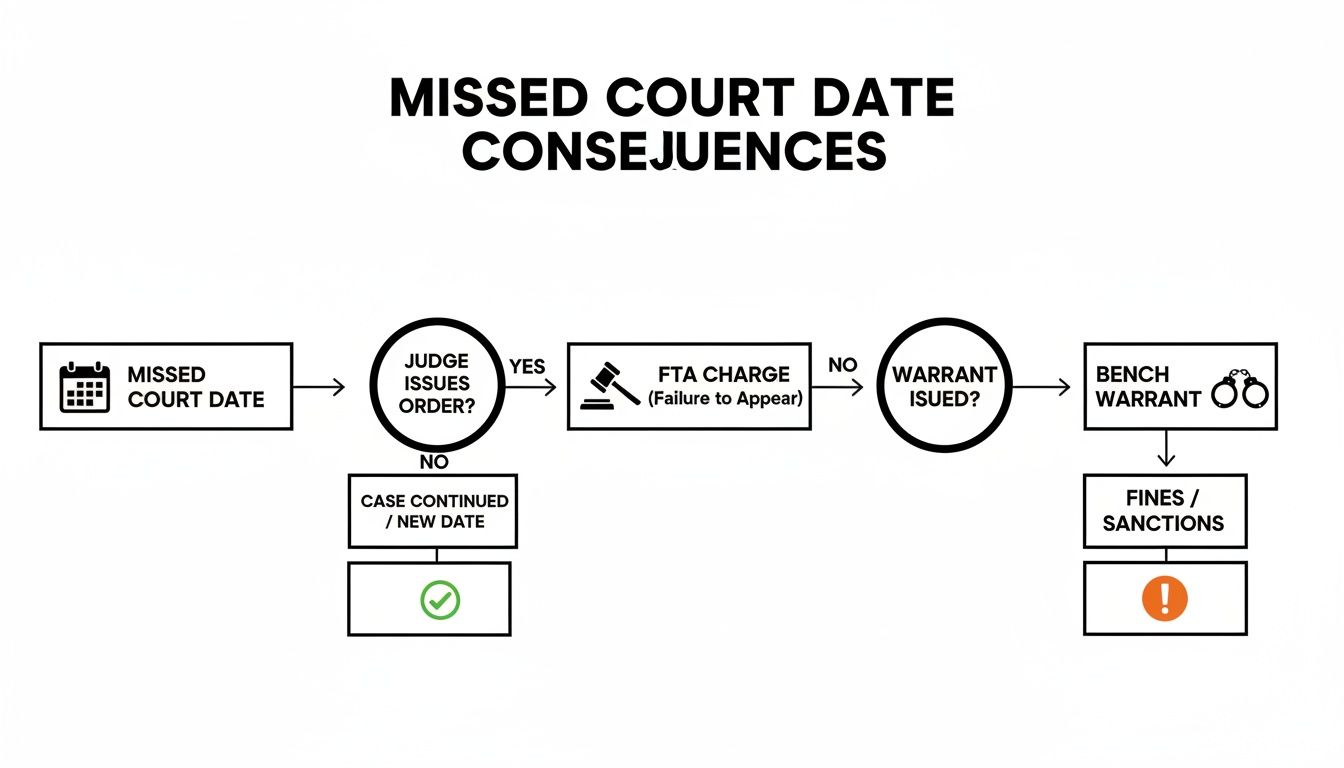
As you can see, the warrant is a direct consequence of the Failure to Appear. But what happens next is up to you.
Why a Motion to Withdraw the Warrant Is a Smarter Strategy
Filing a motion is about resolving the issue without sacrificing your freedom. When an attorney presents this motion, we are telling the judge that you are not a flight risk and that your failure to appear was a mistake, not a deliberate act of defiance. We can present legitimate reasons for your absence and show the court you are ready and willing to handle your case.
This approach offers several huge advantages:
- You may avoid arrest entirely. The goal is for the judge to grant the motion, recall the warrant, and set a new date, allowing you to remain free.
- It demonstrates responsibility. It shows the judge you've hired counsel and are taking the matter seriously.
- It saves you from the trauma of being jailed. You can keep working and living your life while we handle the legal process.
By having an attorney file a motion on your behalf, you are not just hoping for the best—you are actively creating a better outcome. It transforms you from a fugitive into a defendant who is responsibly addressing a legal problem.
To help you see the difference clearly, let's compare these two options side-by-side.
Comparing Your Options After a Warrant Is Issued
| Action | What It Involves | Potential Outcome | Recommended For |
|---|---|---|---|
| Turning Yourself In | Voluntarily going to the police station or county jail. You will be processed, booked, and held until you can post bond. | Immediate arrest and incarceration. You'll have to arrange bail from jail, which can be slow and stressful. | Very few situations. It guarantees you will be arrested and jailed, losing control over the process. |
| Hiring an Attorney to File a Motion | Your lawyer files a motion to withdraw the warrant, appears in court on your behalf, and argues for a new court date. | The warrant is recalled without arrest. You are given a new court date and can remain free while the case proceeds. | Almost all misdemeanor and many felony cases. This is the safest, most strategic way to resolve a warrant and avoid jail. |
As the table shows, hiring an attorney gives you a strategic advantage and a much higher chance of avoiding jail time altogether.
Choosing the right legal partner is essential. If you are searching for an experienced criminal defense lawyer near you, it's important to find a firm that understands the local court procedures for recalling warrants.
This isn’t a situation you should face alone. The legal system is complex, and the stakes are incredibly high. An active warrant puts your job, your family, and your liberty on the line. By acting quickly and strategically with professional legal help, you can often turn a terrifying situation into a manageable one.
Building Your Case: Explaining Why You Missed Court

The reason you missed your court date is everything. In a judge's eyes, there’s a massive difference between simply forgetting and being caught in an unavoidable crisis. That "why" isn't just an excuse; it's the foundation for a legal strategy to get the Failure to Appear (FTA) charge thrown out and get your original case back on track.
A compassionate defense attorney knows how to frame your circumstances in a way the court will listen to. Our job is to explain that your absence wasn't an act of defiance, but the result of a legitimate, documented problem that was out of your hands.
Legitimate Reasons vs. Simple Mistakes
Judges have heard every excuse in the book, so honesty and proof are non-negotiable. While oversleeping or mixing up the date on your calendar is a common human error, it's a much harder sell to a judge than a true emergency.
Courts are far more willing to show leniency if your absence was caused by something you can prove. Some of the reasons that can anchor a strong defense include:
- A Documented Medical Emergency: This could be a sudden illness, a car accident, or an injury that required a hospital visit for you or a dependent.
- A Death in the Immediate Family: A sudden loss is a universally understood reason for being unable to handle other obligations.
- Being Jailed in Another Jurisdiction: If you were locked up in another county or state, you obviously couldn't be in two places at once.
- You Never Received the Court Notice: If the summons was sent to an old address, you can't be held responsible for missing a date you never even knew about.
Just saying one of these things happened isn't enough. You have to back it up with solid evidence.
The strength of your defense lies in the proof you can provide. A compelling story is good, but a compelling story supported by official documents is what convinces a judge to give you a second chance.
The Power of Evidence in Your Defense
Evidence is what turns your reason from an excuse into a verifiable fact. Your lawyer will help you track down the right documentation to build the strongest possible case for getting the warrant recalled and the FTA charge dismissed.
This is the kind of proof that makes a difference:
- Hospital admission or discharge papers to prove a medical crisis.
- A tow truck receipt or a mechanic's repair bill showing your car broke down on the way to the courthouse.
- A death certificate or obituary to verify a family tragedy.
- Proof of your correct address (like a utility bill) paired with court records showing the notice was mailed somewhere else.
When building your defense, it’s also important to understand the rules of evidence. For example, you may need to know about the admissibility of text messages in court if you were texting with a family member about an emergency that kept you away.
Missing court happens more often than you'd think, and it's frequently due to simple mistakes or flaws in the system. A Pew poll found that 37% of people who miss court simply forget, while another 8% never received notice. These stats show just how easily an oversight can spiral into a warrant.
An experienced attorney knows how to package this evidence and present it effectively to both the prosecutor and the judge. We can argue that your failure to appear was not willful, which is the key element the state has to prove to convict you. By showing your absence was an honest mistake backed by a real reason, we can often persuade the court to forgive the FTA and let you focus on what really matters—your original case.
What Happens to Your Case After a Failure to Appear?
Getting a bench warrant handled is a massive relief, but it's the first step, not the finish line. Your original criminal case still needs to be resolved, and now it has an extra layer of complexity. The Failure to Appear (FTA) doesn't just vanish—it becomes a permanent part of your case history, and you need a smart plan to deal with the fallout.
Your next day in court is going to feel different. The judge and the prosecutor now know you skipped a date. This single fact can change everything, from your bond conditions to how plea bargain talks go down.
Facing the Court After a Missed Date
When you walk back into that courtroom, the FTA is often the first thing on the agenda. A prosecutor might see your absence as a sign that you’re unreliable or don't respect the court, making them much less willing to offer a good plea deal. They could even argue for tougher bond conditions, like weekly check-ins, an ankle monitor, or a higher bail amount.
This is exactly where an experienced defense attorney becomes your most valuable asset. Our job is to get out in front of the problem and start rebuilding your credibility. We'll present the reasons for your absence and argue that it was a one-time, understandable mistake, not a sign of who you are. The goal is to show the judge and prosecutor you’re taking this seriously.
As you prepare for your next steps, reviewing strategies for managing and mitigating litigation risk can provide some valuable perspective on handling the legal challenges ahead.
How an FTA Complicates Different Types of Charges
A missed court date makes any case harder, but how it gets harder often depends on the original charge. A good Houston criminal lawyer knows these nuances and can build a defense designed to undo the specific damage an FTA causes.
Here’s a look at how it might play out for common charges in Texas:
- DWI Cases: With a DWI, prosecutors are already looking for signs of poor judgment. They'll try to paint an FTA as just one more example of irresponsibility, making it tougher to negotiate for a reduction or get into a diversion program. We have to work to separate the two issues, arguing that one mistake shouldn't unfairly poison the facts of the other.
- Assault Cases: In Texas assault defense situations, an FTA can be used to argue you're a flight risk or a danger to the community. This could convince a judge to set a much higher bond or add stricter conditions to a protective order. Our job is to prove you aren't a threat and that missing court had nothing to do with the original allegations.
- Drug Possession Cases: Miss court on a drug charge, and the prosecutor might assume you were dodging a drug test. We fight back by showing you took proactive steps to clear the warrant, proving your commitment to seeing the case through.
- Theft or Fraud Cases: When the charge already involves dishonesty, an FTA can be spun as another example of untrustworthiness. Rebuilding that trust is everything. We focus on presenting you as a responsible person who made an error and is now ready to face the legal process head-on.
A missed court date hands the prosecution a new weapon to use against you. A strategic defense is about disarming them by providing context, evidence, and a compelling story that shows the FTA was an anomaly, not a pattern.
The Long-Term Damage to Your Criminal Record
Beyond the immediate courtroom fight, an FTA can haunt you for years. If you are convicted of the Failure to Appear charge itself, it becomes a brand-new, separate offense on your criminal record. This is a crucial point that catches so many people by surprise.
That new conviction can become a major roadblock later on, especially when you’re trying to clear your record and move on with your life.
An FTA conviction can make it difficult or impossible to:
- Get an Expunction: This is the legal process that completely destroys arrest records. An FTA conviction could make you ineligible to expunge your original charge, even if that charge was ultimately dismissed.
- Obtain an Order of Nondisclosure: This is often called record sealing. It stops the general public from seeing your record. Certain convictions, including some FTAs, can disqualify you from sealing other offenses.
The stakes are incredibly high. One missed court date can create a permanent blemish on your record that follows you for years, impacting your ability to get a job, rent an apartment, or get a professional license. This is why fighting the FTA charge is just as critical as defending against the original accusation. Our goal is always to resolve the FTA in a way that protects your future, ensuring one mistake doesn't define the rest of your life.
Common Questions After Missing a Court Date
When you realize you've missed a court date, your mind probably starts racing. It’s a scary and confusing spot to be in, and getting clear answers is the first step toward getting things back on track. We’ve pulled together some of the most common questions our clients ask to give you the straightforward information you need right now.
Our goal here is to skip the dense legal jargon and give you practical advice that helps you understand what you're up against and what your options are.
How Quickly Do I Need to Act After Missing Court?
You need to act immediately. The clock starts ticking the second the judge calls your name and you’re not in the courtroom. A bench warrant can be issued that very same day, which puts you at instant risk of being arrested.
Waiting around—even for just a day or two—only makes things worse. It dramatically increases the chances you’ll be picked up during a routine traffic stop or some other random, inconvenient moment. The absolute best thing you can do is call a Texas criminal defense attorney the moment you realize your mistake. They can get to work right away to protect you.
Does a Bench Warrant Mean I’m Definitely Going to Jail?
Not necessarily, but you can't just ignore it and hope for the best. An active warrant gives any police officer the authority to arrest you on sight, but going to jail isn't a foregone conclusion if you're smart about it. Trying to handle this on your own often ends with handcuffs.
The most effective way to stay out of jail is to hire an experienced lawyer to file a motion to recall or withdraw the warrant. In many cases, your attorney can convince the judge to lift the warrant and simply set a new court date, letting you stay free while your case moves forward.
A warrant is a serious problem, but it doesn't have to end with you behind bars. A proactive legal strategy is your best defense against an unnecessary arrest.
Can I Really Be Arrested for Missing Court for a Traffic Ticket?
Yes, absolutely. This is a huge misconception that gets a lot of people in Texas into much bigger trouble than they ever anticipated. Failing to show up for a traffic ticket hearing—even for something minor—can and often does result in a warrant for your arrest.
On top of that, it can also trigger a hold on your driver's license, which means you won't be able to renew it until the whole mess is sorted out. Never underestimate the consequences of a missed court date, no matter how small the original offense seems. It's always best to treat any court appearance with the seriousness it deserves.
How Does a Missed Court Date Affect My Immigration Status?
For non-citizens, a Failure to Appear (FTA) can have devastating, life-altering consequences. The stakes are incredibly high. An FTA isn't just a simple procedural hiccup; immigration authorities can view it as a separate crime, sometimes one involving "moral turpitude."
This creates major problems for your legal status in the United States. A missed court date could torpedo your chances for:
- Visa applications or renewals
- Your green card (lawful permanent resident) application
- Your ability to apply for U.S. citizenship down the road
In the worst-case scenario, it could even trigger removal or deportation proceedings. If you have any concerns about your immigration status, it is absolutely critical that you consult with a criminal defense attorney immediately to fix the FTA and protect your future in this country.
If you’ve been charged with a crime in Texas, call The Law Office of Bryan Fagan, PLLC for a free and confidential consultation. Our defense team is ready to protect your rights.