Your Rights Are Your Shield: Navigating a Texas Police Interrogation
Being questioned by police in Texas can be terrifying and confusing. Your mind races, and the pressure to just explain can feel overwhelming. But what you say, and what you don't say, in these moments can shape the entire case against you.
Texas law gives you important protections, but they only help if you use them clearly. Miranda protections apply when two things happen together: custody and interrogation. A Texas defense explanation notes that police questioning alone isn't enough. You must be both in custody and subjected to interrogation, and spontaneous statements can still be used even if no direct questions were asked, as explained in this Texas interrogation rights overview.
That means the safest move is simple. Stop talking. Use a short script. Ask for a lawyer. This guide on what to say and not say during a police interrogation in texas gives you direct language you can use right now to protect yourself.
1. Invoke Your Right to Remain Silent Immediately
If police are questioning you while you're in custody, your first job is to stop giving them information. Don't explain. Don't defend yourself. Don't try to sound helpful.
Say this instead: "I am exercising my right to remain silent."
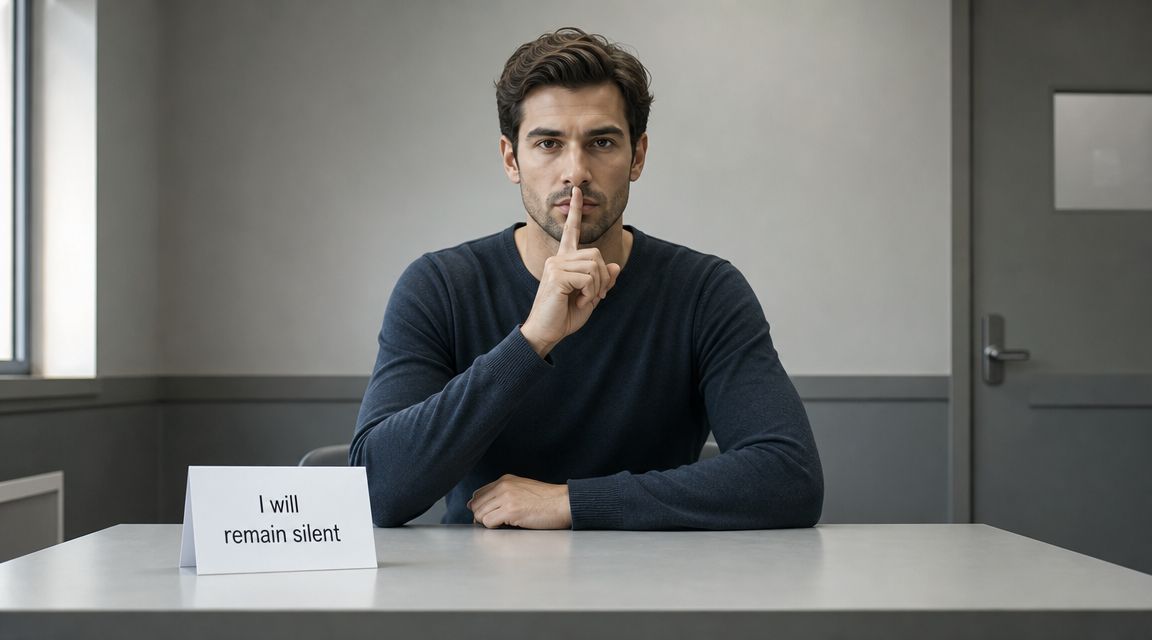
Texas law treats statements made during custodial interrogation as serious evidence. Under Texas Code of Criminal Procedure Article 38.22, an oral statement made during custodial interrogation is generally not admissible unless it is electronically recorded. Texas also added a separate recording rule in Code of Criminal Procedure section 2.32 for certain serious offenses, as described by the National Association of Criminal Defense Lawyers on Texas recording of interrogations.
Use a short script and then stop
The script matters because vague language creates problems. "Maybe I shouldn't say anything" is weak. "I don't know if I need a lawyer" is weak. Clear words protect you.
Use one of these:
- Best option: "I am exercising my right to remain silent."
- Also strong: "I want to remain silent."
- If they keep pushing: "I already invoked my right to remain silent."
A Houston DWI stop can turn into a prosecution because of one small admission such as discussing drinking. A Dallas drug case can get much harder when you start explaining why something was in your car. An assault allegation can get worse fast when you try to justify what happened before you've spoken with counsel.
Practical rule: Once you invoke silence, stay silent about everything. Don't answer some questions and skip others.
If officers continue talking, repeat your script calmly. Don't argue with them. Don't raise your voice. Later, your lawyer can review whether police respected your rights, including issues involving Miranda rights violations in Texas.
2. Request an Attorney Immediately and Refuse to Answer Questions
Invoking silence is good. Asking for a lawyer is even stronger.
Say this: "I want a lawyer."
Not "Do you think I need one?" Not "Maybe I should talk to an attorney." Not "Can I get one later?" Keep it direct and short. Under Texas defense guidance, once you clearly request counsel during custodial interrogation, questioning should stop.

What to say and what not to say
Here is the cleanest script:
- Say this: "I want a lawyer."
- Then add: "I will not answer questions without my attorney present."
- If they continue: "I have requested an attorney."
Avoid these phrases:
- Don't say: "Maybe I need a lawyer."
- Don't say: "Should I have an attorney?"
- Don't say: "I'll answer a few questions first."
Texas defense guidance emphasizes that the most technically defensible script is a short, unambiguous invocation such as "I am exercising my right to remain silent" and "I want a lawyer," as explained in this Texas police interrogation rights article. Ambiguous statements can be treated as continued engagement.
A person arrested in San Antonio on a drug charge may feel pressure to explain who owned the drugs. A white-collar suspect in Austin may want to clarify a transaction. A Dallas DWI defendant may want to talk about driving, fatigue, or medication. Don't do it. Once you ask for a lawyer, stop participating.
"I want a lawyer" is not rude. It's protection.
After that, don't chat with officers in the hall, in the patrol car, or while waiting in a holding cell. Small talk can become evidence too.
3. Never Agree to Consent Searches or Waive Your Rights
Police may ask in a calm, casual tone: "You don't mind if we take a look, right?" That is not a harmless question. It is a request for permission to gather evidence.
Your script is simple: "I do not consent to any searches."

You don't need to physically resist. You shouldn't physically resist. Just state your refusal clearly and stay calm.
Use these exact words
If police ask to search your car, home, phone, bag, or pockets, say:
- For any property: "I do not consent to a search."
- If they ask again: "I am not giving permission for any search."
- If they present paperwork: "I will not sign anything without my lawyer."
This matters in all kinds of Texas criminal cases. In a Houston drug case, consent to search a car can expose evidence the state later uses against you. In an Austin burglary investigation, consent to search a home can hand police exactly what they were hoping to find. In a DWI investigation, your words about what's in the car can become just as damaging as what officers recover.
If officers search anyway, don't fight them. Say you don't consent, remember what happened, and tell your lawyer.
A defense attorney can later challenge whether the search was lawful. If you want to understand how these challenges work, review this explanation of illegal search and seizure in Texas.
Also, don't sign waivers because you're tired, scared, or eager to go home. Many people hurt their defense by agreeing to things they didn't understand under pressure.
4. Do Not Lie or Fabricate Information to Police
Silence protects you. Lying doesn't.
A lot of people panic and start building a story. They change times, deny being somewhere, blame someone else, or invent an innocent reason for suspicious facts. That usually makes things worse because police compare your words to body camera footage, witness statements, phone data, and physical evidence.
Silence is safer than a bad explanation
If you must identify yourself or provide basic booking information, keep it factual and brief. Beyond that, stop. Don't fill the silence because you're uncomfortable.
Bad examples:
- Don't say: "Those drugs aren't mine. My friend must've left them there," if you don't know that to be true.
- Don't say: "I was never there," if location data could prove otherwise.
- Don't say: "We only argued. Nothing physical happened," if there may be witnesses or injuries.
Better script:
- Say this: "I am remaining silent and I want a lawyer."
A Dallas drug possession case can become harder when a suspect invents a story about ownership. A San Antonio assault allegation can tighten when a person lies about where they were. An Austin financial case can expand when someone starts explaining transfers or records without counsel.
Police don't need your made-up explanation to charge you. But prosecutors can use false statements to attack your credibility later.
This is especially important if you're facing charges like theft, assault, drug possession, or DWI. Prosecutors often focus on inconsistencies. Even a small lie can make a jury doubt everything else you say later in court.
5. Understand Police Interrogation Tactics and Manipulation Techniques
Police are allowed to use pressure in an interrogation. They may act friendly. They may sound disappointed. They may suggest they already know everything.
They may also tell you things that are designed to make you talk. That's why you should never assume the officer is being fully honest with you during questioning.
Take a moment to watch this discussion on interrogation pressure in Texas cases.
Common tactics you may hear
An officer might say your friend already blamed you. They might say a judge will go easier on you if you cooperate. They might minimize the accusation by saying, "We know you're not a bad person. We just need your side."
Do not take the bait.
Use this response:
- When they claim they have evidence: "I want a lawyer."
- When they say cooperation will help: "I am exercising my right to remain silent."
- When they appeal to your conscience: "I won't answer questions without my attorney."
A Houston DWI suspect might hear that test results already prove intoxication. A drug suspect might be told another person confessed. An assault suspect may be told the case will look better if they just explain. None of that changes your rights.
For a closer look at how questioning works in violent-crime investigations, this Texas assault police interrogation guide explains common risks.
The officer's goal is to gather evidence. Your goal is to avoid giving it to them.
Stay calm. Don't argue about whether they're lying. Don't try to outsmart them. Ask for your lawyer and stop talking.
6. Document Everything Officer Names, Badge Numbers, Times, and Witnesses
If police questioned you, details matter later. Your lawyer may need to know who was in the room, when questioning started, what was said before and after Miranda warnings, and whether you asked for a lawyer more than once.
You may not be able to take notes during the interrogation. That's fine. Memorize what you can, then write it down as soon as you can.
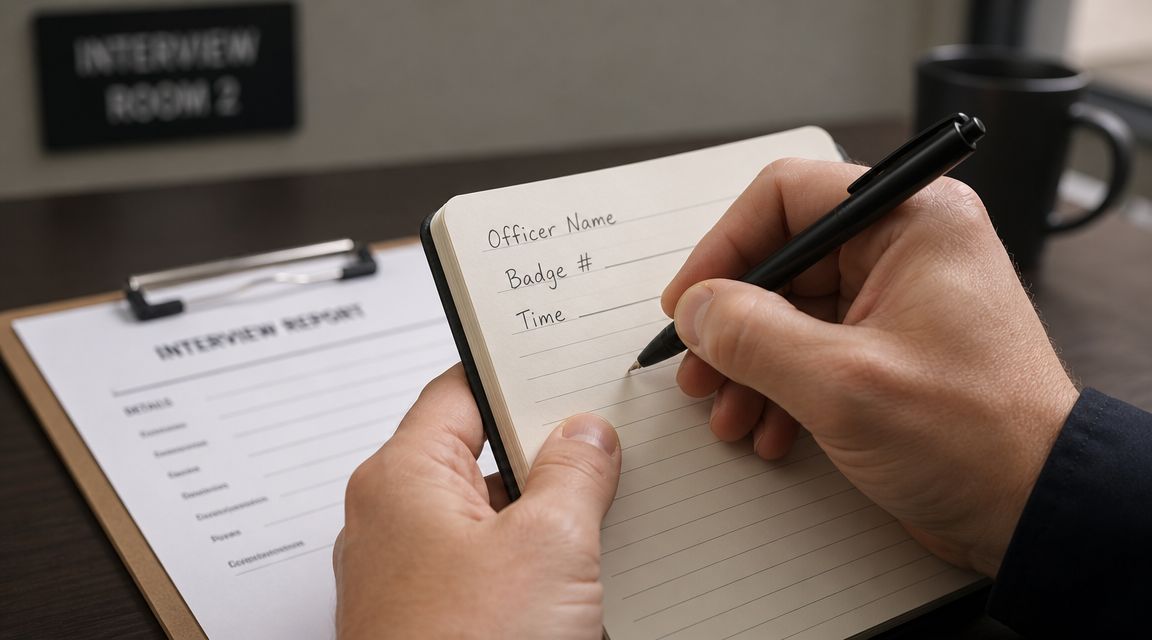
What to record after questioning
Write down:
- Officer details: Names, badge numbers, and agencies if you know them
- Timing: When you were stopped, arrested, moved, questioned, and released
- Location: Patrol car, station interview room, hospital, roadside, or jail
- Your statements: The exact words you used to invoke silence or ask for a lawyer
- Conditions: Whether you were tired, hurt, threatened, denied food, denied water, or kept waiting for a long time
- Witnesses: Anyone who saw or heard part of the interaction
This can matter in a DWI case, a drug case, an assault case, or a theft case. If officers kept questioning after you invoked your rights, your lawyer may challenge what happened. If recording rules applied in your case, the existence or absence of a recording may become important.
Texas law draws a sharp line once custodial interrogation begins. Your words may become evidence, while a clear invocation of silence can cut off questioning and help preserve defenses. That legal line is one reason accurate notes can help your attorney reconstruct what happened.
Write everything down the same day if you can. Memory fades fast under stress.
Bring those notes to your defense lawyer. They may help with suppression motions, plea negotiations, or trial strategy.
7. Know What Not to Discuss and Avoid Specific Admissions
A confession rarely comes in one dramatic sentence. It usually comes in pieces.
They say they were there. They admit they knew the person. They explain why they were angry. They confirm the bag was theirs. They say they only had a couple of drinks. Those details can give prosecutors exactly what they need.
Topics you should never discuss
If police are questioning you, don't talk about:
- Your location: Whether you were at the scene
- Your actions: What you touched, carried, drove, sent, or took
- Your mental state: Whether you were angry, scared, jealous, drunk, or high
- Your intent: Why you did something or what you meant to do
- Your knowledge: Whether you knew about drugs, money, weapons, or stolen property
- Your relationships: Connections to alleged victims, witnesses, or co-defendants
A Houston DWI investigation becomes easier for the state if you admit you were drinking. A possession case becomes easier if you admit the bag was in your car and you knew it was there. An assault charge becomes easier to prove if you admit you hit someone, even if you think you were justified.
Use this script instead:
- If asked where you were: "I am remaining silent."
- If asked what happened: "I want a lawyer."
- If asked to explain: "I won't answer questions without my attorney present."
You are not required to talk your way out of an arrest. In fact, trying to do that often hands the state admissions about identity, intent, knowledge, or possession. Those are key parts of many criminal charges under the Texas Penal Code, including assault, theft, drug offenses, and intoxication-related cases.
7-Point Guide: Say vs. Dont Say in Texas Police Interrogations
| Action | 🔄 Implementation | ⚡ Resources | ⭐ Effectiveness | 📊 Expected outcome | 💡 Ideal use cases / Key advantage |
|---|---|---|---|---|---|
| Invoke Your Right to Remain Silent Immediately | Low, simple, clear verbal invocation required | Minimal, no attorney required to state it | ⭐⭐⭐, reliably prevents self‑incrimination but may need repetition | Limits admissible statements; reduces risk of contradictory testimony | Immediate custodial encounters; quick protection of Fifth Amendment rights |
| Request an Attorney Immediately and Refuse to Answer Questions | Low, clear, unambiguous request stops questioning | Medium, requires access to counsel (phone/attorney) | ⭐⭐⭐⭐⭐, legally bars further interrogation once requested | Stops police questioning; strengthens suppression and defense strategy | Complex or high‑stakes cases (DWI, fraud, serious felonies); best legal protection |
| Never Agree to Consent Searches or Waive Your Rights | Low–Medium, must clearly and repeatedly refuse consent | Low, verbal refusal; attorney helpful later | ⭐⭐⭐⭐, protects Fourth Amendment but police may seek warrant | Reduces chance evidence obtained without warrant; may enable suppression motions | Vehicle, home, or personal searches in drug, weapon, or DWI investigations |
| Do Not Lie or Fabricate Information to Police | Low, discipline to remain truthful or silent | Minimal, no resources required; attorney advice recommended | ⭐⭐⭐⭐, prevents separate charges and preserves credibility | Avoids obstruction/false‑statement charges; maintains credibility at trial | All interactions with law enforcement; critical to avoid compounding charges |
| Understand Police Interrogation Tactics and Manipulation Techniques | Medium, requires prior knowledge or briefing | Medium, training materials, counsel, or education needed | ⭐⭐⭐, improves resistance but does not guarantee immunity | Better recognition of deception; reduces risk of false confession | Young/vulnerable individuals and anyone likely to face prolonged interrogation |
| Document Everything: Officer Names, Badge Numbers, Times, and Witnesses | Medium, note‑taking or memorization under stress | Low, pen/paper or phone; attorney review later | ⭐⭐⭐⭐, strong support for suppression motions and accountability | Creates timeline and evidence of procedural violations; aids defense | Cases alleging coercion, Miranda violations, or procedural errors |
| Know What Not to Discuss: Avoid Specific Admissions on Key Details | Medium, requires legal judgment and restraint | Low, no special resources, legal guidance advised | ⭐⭐⭐⭐, prevents prosecutor's strongest evidence (admissions) | Limits prosecutorial evidence; preserves defense theories and bargaining power | DWI, drug possession, assault, white‑collar matters where admissions are decisive |
You've Been Questioned. What Happens Next?
If police have already questioned you, the case is not over. In many situations, it is only beginning. Whether you were released, booked into jail, or formally arrested, what you do next matters.
First, contact a criminal defense lawyer as quickly as possible. Your attorney can review whether the stop, arrest, search, and interrogation were lawful. If police ignored your request for counsel, failed to respect your right to remain silent, or obtained statements improperly, your lawyer may file a motion to suppress those statements.
Then the Texas criminal process starts moving. After an arrest, you may face booking, bail, and an initial court appearance. From there, your case may move into charging decisions, arraignment, plea negotiations, pretrial hearings, trial preparation, and sentencing if there is a conviction. If you're dealing with a DWI, assault, theft, or drug possession charge, every early statement you made can affect those later stages.
You should also think beyond the immediate charge. Some Texans may later qualify for expunction, nondisclosure, record sealing, or other post-conviction relief, depending on the outcome of the case. Those options can matter if you're trying to protect your job, housing, professional license, or future opportunities.
If your case touches family issues, protective orders, or related allegations, coordinated legal advice matters even more. Criminal cases often overlap with family law disputes, especially in domestic violence accusations or cases involving children.
The Law Office of Bryan Fagan, PLLC is a Texas-based criminal defense firm that represents clients in Houston, Dallas, Austin, San Antonio, and surrounding counties. If you've been questioned by police and you're worried about what happens next, speaking with defense counsel quickly can help you understand your options and start building a strategy.
The most important thing to remember is this. You do not need to explain yourself to the police. Your safest words are still the same: "I am exercising my right to remain silent" and "I want a lawyer."
If you've been charged with a crime in Texas, call Law Office of Bryan Fagan PLLC for a free and confidential consultation. Our defense team is ready to protect your rights.