When a friend or family member is facing criminal charges in Texas, it’s natural to feel powerless. Someone you care about is caught in the legal system, and you’re on the outside looking in. You might be asked to write a character letter for the court, and your first thought could be, "What difference can my words possibly make?"
The truth is, a genuine, well-written character letter can be a surprisingly powerful tool in a Texas courtroom. It has the potential to significantly influence a judge’s perspective, especially when it comes time for sentencing. Your story helps paint a fuller picture of the person, humanizing them beyond the cold, hard facts of the case file and explaining why they deserve a second chance.
Your Letter Can Make a Difference in a Texas Courtroom
Being arrested in Texas can be terrifying and isolating—but you don’t have to face it alone. The legal system, by its very nature, tends to reduce people to a case number and a list of charges, whether it's for a DWI, assault, or drug possession. A character reference letter is your chance to push back on that reduction. It reminds the court that the person at the center of this case is more than their worst mistake.
These letters are not the place to argue legal points or challenge the facts of the case. Leave that to your loved one’s criminal defense attorney. Instead, their purpose is to provide context and insight into the defendant’s character. Under the Texas Penal Code, a judge has considerable discretion during sentencing, and they often look for compelling reasons to consider leniency. Your letter can provide those reasons.
Why Your Perspective Is So Valuable
Your unique relationship with the defendant gives your words genuine weight. As a friend, family member, employer, or mentor, you can speak to positive traits that the court would otherwise never hear about.
A strong character letter accomplishes a few key things:
- It Humanizes the Defendant: Your personal stories show the judge a real person with positive qualities, family connections, and community ties.
- It Demonstrates a Support System: Your letter proves the defendant isn’t alone. It shows they have a network of people ready to help them stay on the right path.
- It Highlights Positive Character Traits: You can provide specific, real-world examples of their honesty, work ethic, generosity, or commitment to rehabilitation.
A common misconception is that you need to be a lawyer or a professional writer to have an impact. That’s just not true. The most effective letters are simple, honest, and heartfelt. It's not about complex legal jargon; it's about sharing the truth of your experience with this person.
This letter becomes part of a much larger defense strategy. An experienced Texas criminal lawyer will often collect several letters to present a united front, showing the judge a broad base of community and family support. This is just one piece of the puzzle, which is why learning how to choose a criminal defense attorney who understands this strategy is such a critical first step.
Your contribution directly supports their efforts to secure a more favorable outcome, like probation instead of jail time. It truly can make all the difference.
The Essential Structure of a Persuasive Character Letter
When you're writing a letter to a judge, remember they are incredibly busy. A powerful letter is one that's easy to read, gets straight to the point, and looks professional from the moment it’s picked up. Think of the structure as the foundation—a clean, organized format ensures your words carry the weight they deserve.
This isn't just about being polite; it’s about being effective. Much like the principles behind writing clear and concise professional notes, your goal is to make your point respectfully and efficiently. This blueprint will help you build a letter that is credible, organized, and persuasive.
The Formal Heading and Salutation
Every letter to the court must start with a formal heading. This isn't just a stuffy tradition; it provides critical information that immediately tells the judge who the letter is for and which specific case it concerns. Without it, your letter could easily get lost in the shuffle.
Your heading needs to include:
- The Date: The full date you are writing the letter.
- The Judge’s Full Name and Title: Always use their formal title, like "The Honorable Jane Doe."
- The Court's Name and Address: For example, "123rd District Court, Harris County, Texas," followed by the full courthouse address.
- The Case Information: This is non-negotiable. You must include the case name (e.g., "State of Texas v. John Smith") and the case or cause number. The defendant's attorney will give you this exact information.
After the heading, use a formal salutation. Something like, “Dear Judge Doe,” or “To the Honorable Judge Doe:” sets a respectful and serious tone right from the start.
The Introduction: Your Identity and Purpose
Your first paragraph should cut right to the chase. This is where you introduce yourself and state exactly why you're writing. Don't make the judge hunt for this information.
In this opening, be sure to include:
- Your Full Name: State clearly who you are.
- Your Relationship to the Defendant: Explain how you know them. Be specific. "I am John Smith's direct supervisor at ABC Company," is much stronger than "I'm his friend."
- The Length of Your Relationship: Specify how many years you've known the person. Knowing someone for 15 years carries more weight than knowing them for six months, and this detail adds a ton of credibility to your perspective.
Wrap up this first paragraph by explicitly stating that you are writing in support of the defendant's character. For instance, you could say, "I am writing this letter to offer my personal perspective on John Smith's character as you consider his sentencing."
The Body: Crafting Your Narrative with Substance
This is the heart of your letter. The body is where you share the specific stories and observations that paint a picture of the defendant's positive traits. This section should be broken into two or three short, focused paragraphs.
Forget generic statements like, "He is a kind person." Instead, show it. Describe a specific time you saw him help a neighbor without being asked or volunteer on a weekend when he could have been doing anything else. Concrete examples are what make a letter memorable and impactful.
The Conclusion: A Respectful Summary
Your final paragraph should tie everything together. Briefly summarize your main points and respectfully state your hope for a particular outcome, whether it's leniency or consideration of probation. Reiterate your belief in the defendant’s good character and their ability to be a positive force in the community.
It's absolutely crucial to maintain a respectful tone here. You are not telling the judge what to do. You're simply offering your perspective to help them make a difficult decision. A simple closing like, "Thank you for your time and for considering my perspective," works perfectly.
Finally, end the letter with a formal closing, such as “Sincerely,” or “Respectfully,” followed by your handwritten signature. Below your signature, type your full name, address, and phone number. Providing your contact information shows you stand by your words and are willing to be contacted. This one small step massively boosts your letter's credibility and ensures it is taken seriously.
Bring Your Letter to Life with Specific Personal Stories
Saying someone is "a good person" is nice, but in a courtroom, it's just noise. A busy judge has heard it a thousand times, and it's easy to dismiss because it lacks any real substance. The true power of your letter isn’t in compliments; it’s in the stories you tell.
A heartfelt, specific story that shows the person’s character in action is far more persuasive than a generic label. Your goal is to paint a picture for the judge, giving them a genuine glimpse into who this person is outside of the courtroom. That’s what makes your words—and the person you're writing for—credible and real.
Brainstorming Memorable Anecdotes
Start by thinking about the positive qualities you want to highlight. What is this person really like? Are they known for their honesty, their kindness, their rock-solid work ethic, or their deep commitment to family? Pick a few key traits, then dig into your memory for specific moments where you saw those qualities shine through.
Don't worry about perfect writing just yet. Just get the memories down on paper. To get you started, ask yourself a few questions:
- Work Ethic: Can you remember a time they stayed late to help a coworker finish a tough project, even when they didn't have to?
- Kindness: Did they ever organize a fundraiser for a neighbor in need or make a point to regularly check in on an elderly relative?
- Honesty: Is there a time they owned up to a mistake and took full responsibility, even when it was difficult?
- Family Commitment: Have you seen them consistently put their family first, sacrificing their own time or resources for their kids or partner?
These specific examples are the foundation of a powerful letter. They give the judge concrete evidence to back up your claims about their character.
Anchoring Your Stories with Concrete Details
Once you have a few good stories, it's time to add the details that make them believable. This is where you ground your narrative in reality and boost your own credibility as a witness to their character. Vague stories can sound made-up, but specifics make them stick.
When you write, include details that can be verified. For instance, legal defense experts always stress that letters should include measurable, time-bound facts. It makes them far more persuasive. This means adding things like the number of years you've known the person, specific dates of employment, or even quantified community involvement, like the number of hours they volunteered.
Key Takeaway: The difference between a weak letter and a powerful one often comes down to the details. A judge is far more likely to be swayed by a story about how the defendant spent 150 hours volunteering at the local food bank last year than by a simple claim that they are "generous."
Adding these kinds of numbers gives the court something tangible to work with. It shows that your knowledge of the person is deep and based on real-world observation, not just a casual friendship. This kind of information also helps support other court documents, like a presentence report, creating a consistent and credible picture of the defendant. This is a crucial piece of the puzzle for arguing for mitigation under Texas sentencing and rehabilitation guidelines.
To give you a quick visual summary, this graphic breaks down the best practices for writing an effective character letter.
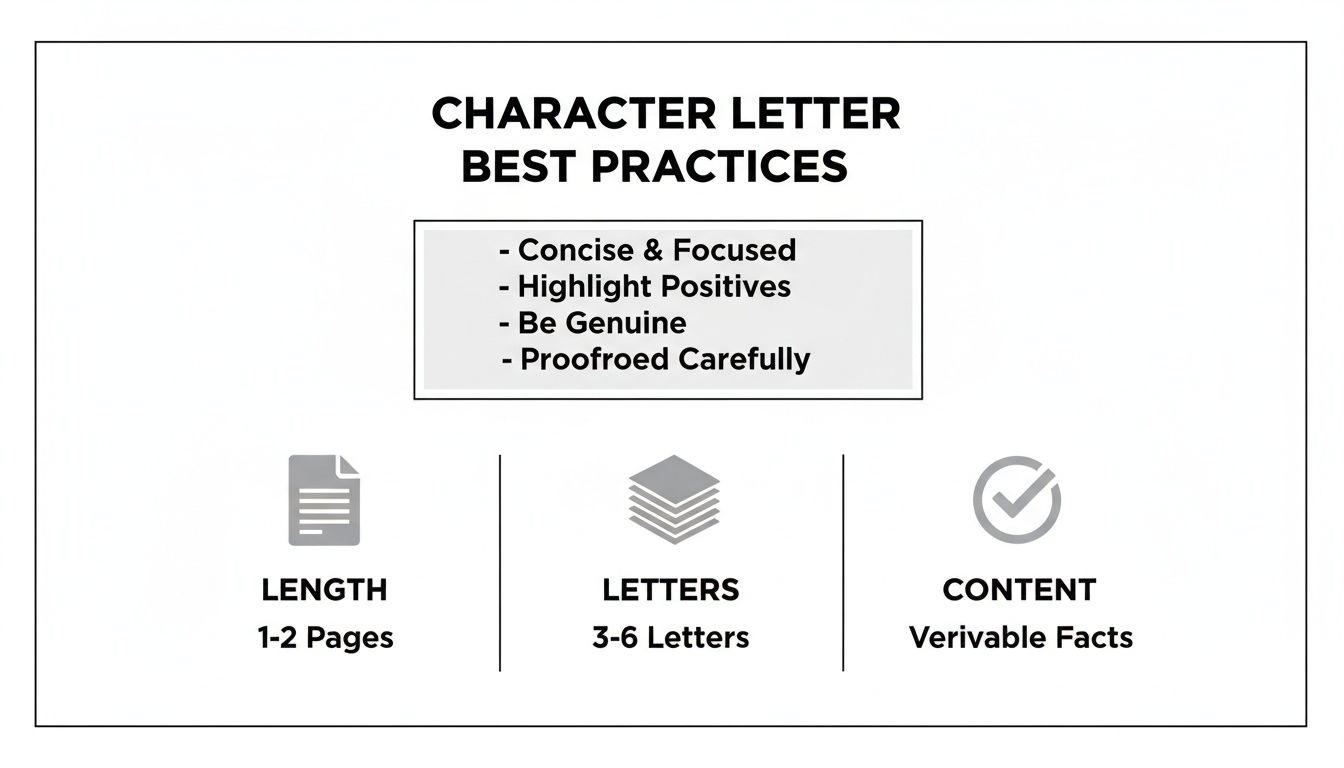
As the infographic shows, keeping your letter focused and concise (1-2 pages), being part of a small group of high-quality letters (3-6 total), and filling it with verifiable details are key to making a real impact.
Transforming General Praise into Powerful Testimony
So, how do you put this all into practice? The trick is to show, don't tell. Instead of just listing positive adjectives, you need to describe a scene that brings those qualities to life for the reader.
The table below shows how to elevate a generic compliment into a story that truly resonates.
| Transforming General Praise into Powerful Testimony | |
|---|---|
| Weak General Statement | Strong Specific Example |
| "Jane is a very dedicated employee." | "I have supervised Jane for the past five years at our firm. Last year, when our team was facing a critical deadline on the Miller account, she voluntarily stayed late every night for a week to ensure the project was completed flawlessly. Her dedication directly contributed to our success and is why she is so respected among her 18 colleagues." |
| "He is a great father." | "I’ve seen him coach his son’s Little League team for the last three seasons. He never misses a practice, and last month, when a player’s family couldn’t afford the tournament fee, he quietly paid it himself so the boy wouldn’t be left out." |
| "She is a kind and generous person." | "For the past two years, she has spent every Saturday morning volunteering at the Austin Animal Center. She's logged over 200 hours there, and I know for a fact she adopted two of the oldest dogs that no one else wanted." |
See the difference? The strong examples provide context (how long you've known them, your relationship), a specific scenario, and a measurable action. This kind of detailed, personal account is exactly what a judge needs to see the real person behind the charges. It’s what can make all the difference.
Critical Mistakes to Avoid in Your Character Letter

You’re writing this letter because you want to help, and that good intention is what matters most. But in the world of criminal law, even the smallest misstep can accidentally do more harm than good. What you choose to leave out of your letter is just as critical as the personal stories you decide to put in.
A well-meaning mistake can quickly undermine your credibility or, even worse, damage the very case you're trying to support. Learning what not to do is the first step toward writing a letter that is genuinely helpful, persuasive, and taken seriously by the court.
Never Minimize or Make Excuses for the Offense
This is probably the most damaging mistake you can make. Resist the urge to downplay the seriousness of the charges with phrases like "it was just a misunderstanding," "it wasn't that big of a deal," or "everyone makes mistakes." To a judge, this language can sound like a lack of respect for the law and the entire judicial process.
Your letter is about the person's character, not the facts of the case. When you try to justify or excuse the alleged behavior, you risk sounding like you believe the defendant is above the law. That kind of tone can instantly alienate the judge and cancel out all the good you’re trying to do.
Instead of making excuses, it’s far more powerful to acknowledge the gravity of the situation while focusing on the defendant’s positive qualities. You can show your support for their potential for rehabilitation without ever questioning the court's role.
Avoid Questioning the Court or Legal System
Your letter is a request for consideration, not a platform to air your grievances with the justice system. Any language that seems to criticize the police, the prosecutor, or the court's proceedings is a major red flag.
Writing things like, "He never should have been arrested," or "The charges are completely unfair," positions you as an adversary to the court. A judge is likely to see that and immediately discount your entire perspective.
Crucial Reminder: The courtroom is not the place to debate guilt or innocence. That is the defense attorney's job. Your role is simply to provide a personal perspective that helps the judge see the defendant as a whole person, especially during sentencing. Maintain a respectful tone at all times.
Your goal is to build a bridge, not burn one. A respectful, humble tone shows that you understand your limited role in the process and that you value the court's time and attention.
Do Not Include Dishonest or Exaggerated Claims
It might be tempting to stretch the truth a little to make the person you’re writing for sound better. Don't do it. This is an incredibly risky strategy that almost always backfires. Every single statement you make in your letter must be 100% true.
Judges and prosecutors read these letters right alongside official documents, like pre-sentence reports. If you claim the defendant has worked at a company for five years, but payroll records show it was only two, your entire letter—and your credibility—is destroyed in an instant.
- Stick to what you know firsthand. Don't speculate or repeat second-hand stories you've heard from others.
- Avoid over-the-top praise. Using extreme language like "he is the most honest person I've ever met" can sound insincere and hollow. Let your specific, real-life stories speak for themselves.
- Be completely honest. Even a small embellishment can be discovered and used to discredit your entire testimony.
Authenticity is your greatest asset. An honest letter detailing real examples of good character is far more powerful than a perfectly polished but exaggerated one. Remember, your own integrity is on the line, and any dishonesty reflects poorly on both you and the person you are trying to help. Sticking to the truth is the only way to ensure your letter serves as a positive and reliable piece of the defense.
How Character Letters Are Used in the Texas Justice System
To write a letter that actually makes a difference, you first have to understand where it fits into the legal puzzle. A common mistake people make is thinking these letters are meant to argue guilt or innocence during a trial. That’s not how they work in the Texas justice system.
The real power of a character letter comes into play during what’s called mitigation. These letters are most influential after a person has been convicted or has pleaded guilty, right when the judge is deciding on the punishment. This is the sentencing phase, and your words can give the judge a compelling reason to show leniency.
The Role of Your Letter in Sentencing
During sentencing, a judge isn't just looking at the crime; they're trying to craft a punishment that fits the individual. They'll review the case facts, the person's criminal history, and an official pre-sentence report. Your letter injects a much-needed human element into that stack of paperwork.
It offers a personal glimpse into the defendant's character, their value to the community, and their true potential for rehabilitation. A smart Houston criminal lawyer will gather a collection of these letters from different people to present to both the judge and the prosecutor.
This collection does two things: it shows a strong support system and paints a picture of someone who is more than just the worst mistake they ever made. This gives the attorney leverage in a couple of key areas:
- Plea Bargaining: Even before a formal sentencing, these letters can be shared with the prosecutor. They might help persuade the prosecutor to offer a better plea deal, like reduced charges or a recommendation for probation instead of jail.
- Sentencing Hearings: In court, the attorney will use your stories to argue for a lighter sentence. They can reference specific examples from your letter to advocate for outcomes like probation over prison time.
Knowing this context is everything. You aren't writing to a jury to change their verdict. You're writing to a judge to influence their decision on punishment.
Are Character Letters Formal Evidence?
In Texas, character letters aren't considered formal evidence like DNA or sworn testimony. Think of them as persuasive documents used for mitigation. This distinction is important because it means the rules for submitting them are different from the strict rules of evidence used during a trial.
It’s interesting to see how different legal systems handle this. For instance, courts in the UK sometimes treat character references as a more direct part of the sentencing evidence. Here in the U.S., the focus is squarely on using them to support arguments for a lesser sentence.
Because they aren't formal evidence, your attorney's role is critical. They know how to get your letter in front of the right people at the right time. Understanding the entire legal journey, including the different steps in the criminal justice process, can give you better context for where your letter fits. The need for proper procedure is also why legal teams must understand how to distribute information to regulatory authorities securely and efficiently.
Your Personal Story, A Key Part of Legal Strategy
Don’t underestimate the power of your letter. It’s a vital piece of a coordinated defense strategy. By sharing your honest and specific experiences, you give the defense attorney the personal ammunition they need to build the strongest possible case for a fair and merciful outcome.
Common Questions About Writing a Character Letter for Court
When you sit down to write something this important, questions are bound to come up. You want to get every detail right so your letter has the best possible chance of helping someone you care about. We’ve been through this process countless times with clients and their families, so we’ve put together clear, direct answers to the questions we hear most often.
Our goal is to clear up any confusion and give you the confidence to write a powerful, effective letter.
Who Should I Send the Letter To?
This is probably the most critical practical question, and the answer is simple: Never send your letter directly to the judge or the courthouse. This might seem like the most direct route, but it’s a procedural mistake that could get your letter thrown out before anyone even reads it.
The proper channel is always through the defendant's defense attorney. Give your letter to them. They will review it to make sure it aligns with the overall legal strategy and doesn’t accidentally include anything that could hurt the case. The attorney knows the right time and the right way to formally submit it to the court, ensuring it has the maximum possible impact.
Should I Mention the Specific Crime?
As a general rule, it’s best to avoid discussing the details of the crime itself. Your job isn’t to be a legal analyst or offer an opinion on what happened. You’re there to talk about one thing and one thing only: the defendant’s character. You’re painting a picture of the person you know, separate from this one incident.
Getting into the specifics of the crime can easily lead you down a path of making excuses or minimizing the offense, which judges do not appreciate.
There is, however, one small exception. You can briefly acknowledge that you know why you’re writing the letter. This shows the court you understand the gravity of the situation.
For example, you could say something like: "I am aware that he is facing serious charges for assault, and I am writing to provide my perspective on the man I have known for over a decade."
This approach shows respect for the court process while keeping the focus exactly where it needs to be: on character.
How Many Character Letters Are Ideal?
There’s no magic number here. When it comes to character letters, quality always, always beats quantity. A good Texas assault defense attorney will usually aim to collect between three and six strong, well-written letters from a diverse group of people. Think about it from the judge's perspective. They would rather read a few compelling letters from people who truly know the defendant than a dozen generic ones.
A strong collection might include letters from:
- A long-time boss or supervisor.
- A respected community figure, like a pastor or a coach.
- A close family member who can speak to their home life.
- A friend who has known them for years.
A handful of powerful letters from credible sources is far more effective than a huge stack of lukewarm praise. Trust the defense attorney to guide this process. Your single, well-crafted letter is a vital piece of that strategy.
If you’ve been charged with a crime in Texas, call The Law Office of Bryan Fagan, PLLC for a free and confidential consultation. Our defense team is ready to protect your rights.