Skip to content
Being arrested for a 1st DWI offense in Texas can be terrifying — but you don’t have to face it alone. This isn't just a traffic ticket; it's a serious criminal charge that can lead to jail time, thousands of dollars in fines, and a permanent mark on your record. After an arrest, the clock starts ticking immediately. The single most critical deadline you face is the 15-day window to request a hearing to save your driver's license from automatic suspension.
What Happens Immediately After a DWI Arrest in Texas

Getting arrested for a DWI in Texas is a blur. One minute you're driving, and the next you're in handcuffs, facing a legal system that feels overwhelming. We understand. The fear and confusion are real, but it’s critical to know you don’t have to go through this by yourself.
The first 24 to 48 hours are chaotic but incredibly important. You’ll be taken to a police station or county jail for booking—which involves taking your fingerprints, a mugshot, and filling out paperwork. This is the moment your official criminal record begins.
Your Rights and First Steps
In the middle of all this, you have to remember your constitutional rights. You have the right to remain silent, and you absolutely should use it. Don't try to explain your side of the story or talk your way out of it. Simply and politely tell the officers that you wish to speak with an attorney and will not answer any questions.
Your next priority is getting out of jail, which usually means posting bail. A judge sets the bail amount to ensure you show up for future court dates. A friend, family member, or a bail bondsman can help you post bond and secure your release.
The Most Urgent Deadline You Face
Here's a critical detail that many people miss: your driver's license. From the day of your arrest, you have just 15 days to request what’s called an Administrative License Revocation (ALR) hearing with the Texas Department of Public Safety (DPS).
This isn't part of your criminal case; it's a completely separate civil process. If you miss that 15-day deadline, the state automatically suspends your license—it doesn't matter if you're eventually found not guilty of the DWI.
Navigating the immediate aftermath of an arrest requires quick, smart decisions. This initial period is overwhelming, but knowing the process can make all the difference. Protecting your rights, getting released, and, most importantly, meeting that 15-day ALR deadline are the first building blocks of a strong defense. An experienced DWI lawyer can handle all of this for you, ensuring your rights are protected from day one while you focus on putting your life back together.
Understanding What a DWI Really Means in Texas
To build a strong defense, you first have to understand what you’re up against. A 1st DWI offense in Texas isn't as simple as blowing over a certain number on a machine. The state has a very specific definition of "intoxicated," and prosecutors have two different ways to try and prove it in court.
Most people think a DWI charge only happens if your Blood Alcohol Concentration (BAC) is 0.08% or higher. While that’s one path to a conviction, it’s not the only one. Understanding both is the first step in finding the weaknesses in the state’s case against you.
It's Not Just About the Numbers
Under Texas Penal Code § 49.01, the law defines "intoxicated" as not having the "normal use of mental or physical faculties" because of alcohol, a drug, or any other substance.
This is a huge deal. It means an officer can arrest you based on their observations alone—things like the smell of alcohol, seeing you stumble, or how you performed on field sobriety tests. Your BAC could be under the 0.08% legal limit, and you could still be charged and even convicted based on an officer’s opinion.
Think of it this way: the prosecutor can take one of two routes to get a conviction.
- The "Per Se" Route: This is the straightforward, numbers-based approach. The prosecutor uses scientific evidence—a breath or blood test showing a BAC of 0.08% or higher—to argue you were legally intoxicated.
- The "Impairment" Route: This path is more subjective. The state relies on the arresting officer’s testimony about what they saw, heard, and documented during the stop. This includes your driving patterns, speech, appearance, and performance on those roadside tests.
Because the state has two ways to prove its case, a skilled DWI lawyer knows how to fight back on both fronts. We scrutinize the so-called "scientific" evidence for errors and challenge the officer's subjective, and often flawed, interpretation of your actions.
Not All First-Time DWIs Are Created Equal
It's a shock to many, but a first-time DWI in Texas is a serious crime, not just a traffic infraction. The penalties you face depend on the specific circumstances of your arrest, particularly your alleged BAC.
A standard first-offense DWI is typically a Class B Misdemeanor. However, if your BAC is measured at 0.15% or higher, the charge is enhanced to a Class A Misdemeanor. That enhancement is a game-changer, bringing much steeper penalties.
A conviction for a Class B Misdemeanor can result in up to 180 days in jail and a fine of up to $2,000. But that’s just the beginning. When you add state surcharges, court costs, and probation fees, the total financial impact can easily climb to between $4,000 and $6,000. You can find more details on these costs by reviewing legal analyses of Texas DWI laws.
Let’s break down how these two charges compare side-by-side.
First-Time DWI Charges And Potential Penalties In Texas
The table below gives you a clear snapshot of what’s at stake for a standard first offense versus one with a high BAC.
| Charge Type (First Offense) | Texas Penal Code Classification | Potential Jail Time | Maximum Fine |
|---|---|---|---|
| Standard DWI (BAC < 0.15%) | Class B Misdemeanor | Up to 180 Days | $2,000 |
| Enhanced DWI (BAC ≥ 0.15%) | Class A Misdemeanor | Up to 1 Year | $4,000 |
As you can see, the difference between a 0.14% BAC and a 0.15% BAC can mean double the potential jail time and double the fines. It highlights why every detail in a DWI case is so important.
Understanding these legal definitions is where your defense begins. It tells us exactly what the prosecutor must prove and shines a light on where their case is most vulnerable. Whether they're relying on a machine's reading or an officer's opinion, every piece of their evidence can—and should—be challenged.
Fighting Your Case on Two Fronts
When you’re arrested for a 1st DWI offense in Texas, it feels like your world stops. But the legal system doesn't wait—it immediately starts two separate legal battles, each with its own rules, timeline, and consequences. This is a crucial point that many people don't realize: you’re not just fighting one case, but two at the same time.
One fight is the criminal case. This is what most people think of—the courtroom process that decides your guilt or innocence. It’s where prosecutors try to prove you were intoxicated, and it’s where a judge can sentence you to jail time, order significant fines, and leave you with a permanent criminal record.
The other fight is the administrative case. This one is entirely separate from the criminal court. It’s a civil process handled by the Texas Department of Public Safety (DPS), and it’s focused on only one thing: your driver’s license. These two cases run on parallel tracks, and winning one doesn’t automatically mean you’ll win the other.
The Administrative Battle for Your License
The moment you either refuse a chemical test (breath or blood) or provide a sample that’s over the legal limit, the clock starts ticking on your license. This is because of Texas's "implied consent" law. By having a Texas driver's license, you have legally agreed to provide a breath or blood sample if an officer lawfully arrests you for DWI.
If you refuse that test or if your Blood Alcohol Concentration (BAC) is 0.08% or higher, the DPS will automatically move to suspend your license through a process known as an Administrative License Revocation, or ALR.
You only have 15 days from the date of your arrest to request an ALR hearing and challenge this suspension. If you miss that deadline, you lose your right to fight, and your license will be suspended. There are no excuses or extensions.
This hearing is your first and often best chance to challenge the evidence against you. To get a better sense of what happens, check out our detailed Harris County ALR hearing guide. A skilled lawyer can use the ALR hearing to cross-examine the arresting officer and find weaknesses in the state’s case—weaknesses that can become powerful advantages in your criminal case later on.
The Criminal Case for Your Freedom
While the ALR case is about your ability to drive, the criminal case is about your future. This is the main event, where a prosecutor in a courtroom will do everything they can to secure a conviction. The stakes here are much higher. A conviction for a first-time DWI, a Class B Misdemeanor, includes:
- Jail Time: You could face up to 180 days in county jail.
- Significant Fines: Expect thousands of dollars in fines, court costs, and state-mandated fees.
- A Permanent Record: A DWI conviction stays on your record forever. It can haunt you for years, affecting your ability to get a job, rent an apartment, or hold a professional license.
The infographic below breaks down the two main ways the state tries to prove you were "intoxicated" in a criminal case.
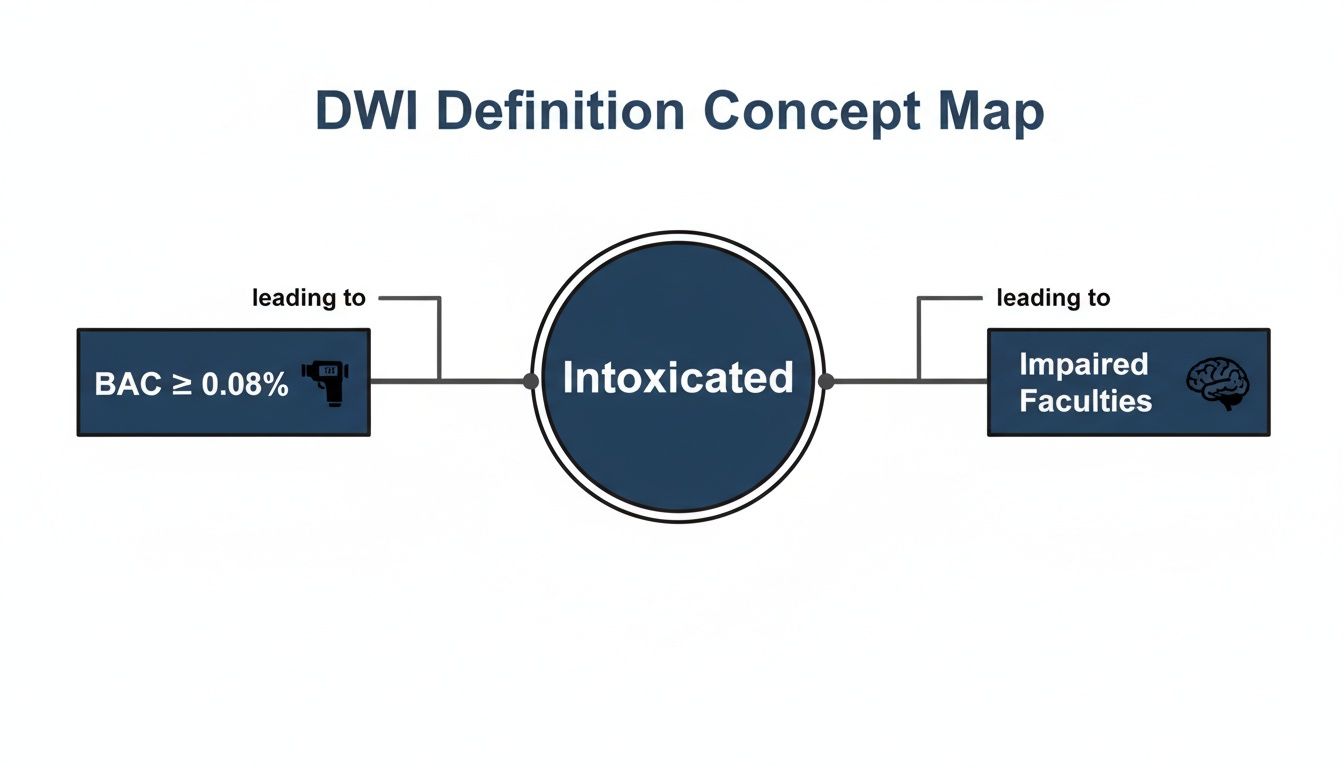
As you can see, prosecutors don't need a BAC number to convict you; they can also rely on the officer’s subjective opinion that your faculties were impaired. This is why you need a defense strategy that addresses both the science and the officer’s observations.
Because you’re fighting on two fronts at the same time, you need a comprehensive game plan for both. Saving your license is the immediate emergency, but protecting your freedom and your future is the ultimate goal.
Navigating the Texas DWI Court Process Step by Step
Walking into a criminal courtroom for the first time can be intimidating. The legal system has its own language, strict rules, and a formal atmosphere that can make anyone anxious. If you're facing a 1st DWI offense in Texas, this journey can feel particularly overwhelming.
But it doesn't have to be. Understanding the road ahead—from your first appearance to the final outcome—can replace anxiety with a sense of control. Your case isn't just one big court date; it's a series of steps where your attorney acts as your guide and your advocate.
Step 1: Your First Court Date (The Arraignment)
Your first official court appearance is called an arraignment. This hearing is usually very brief. The judge will formally read the charge against you and ask how you plead. This is where your lawyer will step in and, in almost every case, enter a plea of "not guilty" on your behalf.
Pleading "not guilty" is not about denying what happened. It is a critical legal move that preserves all of your constitutional rights. It gives your attorney the time needed to investigate your case, review the state's evidence, and start building a powerful defense.
Step 2: The Discovery Phase
After the arraignment, your case moves into the discovery phase. During this stage, your attorney formally requests that the prosecutor turn over every single piece of evidence they have against you. This goes far beyond just the police report.
A typical discovery package includes:
- Dashcam and bodycam video footage from all officers involved.
- Maintenance and calibration logs for the breathalyzer or blood testing equipment.
- The officer's sworn affidavits and any witness statements.
- Your full arrest record, booking photos, and intake forms.
Your lawyer will meticulously review this information, searching for inconsistencies, procedural mistakes, or violations of your rights. This is often where the cracks in the prosecution's case begin to appear.
Step 3: Plea Bargaining and Diversion Programs
The truth is that most DWI cases in Texas are resolved before ever going to trial. They are often settled through plea bargaining, a negotiation process where your attorney and the prosecutor work to reach a more favorable outcome for you.
It's important to understand the landscape. A “first DWI offense in Texas” isn't a rare event. Data shows that major counties like Harris, Dallas, and Tarrant handle thousands of these cases every year. This high volume means prosecutors have established policies and options that a seasoned DWI attorney knows how to use to your advantage. You can explore more about these DWI statistics in Texas to see just how common these cases are.
In some counties, first-time offenders might even qualify for special programs that offer a path to getting the case dismissed.
Pre-Trial Diversion Programs: These are programs run by the District Attorney's office that serve as an alternative to a conviction. If you successfully complete all the requirements—which might include classes, community service, and staying out of trouble—the prosecutor agrees to dismiss your DWI charge completely.
These programs are a fantastic opportunity, but they are not offered to everyone. Eligibility rules can be strict and vary by county. A local lawyer who knows the DAs and the court system can tell you if you qualify and help you get into one. The goal is always to find the best path forward, whether that means fighting for a full dismissal, negotiating a lesser charge, or building an aggressive case for trial.
Common Defense Strategies for a First DWI Charge
The single most important thing to remember is this: being arrested for a 1st DWI offense in Texas is not the same as being convicted. The prosecutor has the entire burden of proving their case beyond a reasonable doubt, and a skilled defense attorney knows exactly where to find the weak spots in their argument.
Every DWI case is unique, but many share common flaws. A thorough defense involves scrutinizing every detail—from the moment the police lights appeared in your rearview mirror to the final chemical test result.
Challenging the Initial Traffic Stop
The state’s entire case against you rests on the legality of the initial traffic stop. If the officer did not have a valid, legal reason to pull you over, any evidence they gathered afterward could be thrown out of court. This includes the field sobriety tests, your statements, and your breath or blood sample.
An officer needs "reasonable suspicion" that you violated a traffic law or were driving erratically. This could be:
- Swerving or weaving across lane lines
- Speeding or driving significantly below the speed limit
- Running a stop sign or red light
- Driving at night without your headlights on
If the officer’s dashcam video shows you were driving perfectly fine, we can file a "motion to suppress evidence." If the judge agrees, the evidence can be excluded, and the case may be dismissed.
Attacking the Field Sobriety Tests
Standardized Field Sobriety Tests (SFSTs) are notoriously unreliable. They are essentially coordination exercises that many sober people would fail under ideal conditions—let alone on the side of a dark road with police lights flashing in their eyes.
Your lawyer can challenge the results by showing:
- Improper Administration: The officer did not give the instructions exactly as required by national standards.
- Medical or Physical Conditions: Pre-existing injuries, balance issues, or even your age and weight can negatively affect your performance.
- Environmental Factors: Was the ground uneven? Was it poorly lit? Bad weather can make these tests nearly impossible to perform correctly.
These tests are designed to be subjective, and a good attorney knows how to expose that subjectivity to a judge or jury.
Scrutinizing the Breath or Blood Test
Prosecutors often present breath or blood test results as if they are undeniable scientific fact. They are not. The machines used for these tests are complex and require strict, regular maintenance and calibration to function properly.
A breathalyzer is just a machine, and machines can make mistakes. An experienced DWI attorney knows to demand the device's full service history, looking for any sign of malfunction or operator error that could make the results invalid.
For example, we might find the breathalyzer wasn't calibrated correctly, the officer who ran the test wasn't certified, or there were gaps in the chain of custody for a blood sample. We can also argue a "rising BAC," where your blood alcohol level was still increasing after you stopped drinking and was actually lower when you were driving. This can be a very powerful defense.
Outcomes for a first DWI in Texas can vary widely depending on the county, the BAC level, and the local court's culture. For example, in Harris County, it's not uncommon for 40-50% of first-time cases to end in non-convictions (like dismissals or reductions). In Dallas County, those rates can climb as high as 45-55%. These numbers show just how much a strong defense can change the outcome. You can learn more about how Texas DWI statistics impact case outcomes.
When you're thinking about defense strategies, finding the right legal help is non-negotiable. For those searching for a local DWI attorney, it's helpful to understand how lawyers use tools like effective local SEO strategies for lawyers to connect with clients who need them most.
Protecting Your Future After a DWI Case

The stress of a 1st DWI offense in Texas doesn’t end when your court case is over. A conviction leaves a permanent mark—a criminal record that can follow you for years, casting a long shadow over your personal and professional life.
This record shows up on background checks, making it harder to get a good job, rent an apartment, or even qualify for a loan. It will almost certainly cause your car insurance rates to skyrocket and could put professional licenses for careers in nursing, teaching, or real estate at risk.
But a conviction does not have to be the final word. Texas law provides powerful legal tools to help you move forward and reclaim your good name. The key is understanding your options for clearing your record.
Erasing the Arrest: Expunctions
An expunction is the most complete way to clear your name, like a legal eraser for your record. When a judge grants an expunction, it orders all government agencies—from the local police to the court clerk—to physically destroy every record related to your arrest.
After an expunction, it's as if the arrest never happened. You can legally deny it ever occurred on job applications or any other form. However, eligibility rules are very strict. You generally only qualify if:
- Your case was dismissed by the prosecutor.
- A jury found you "not guilty" at trial.
- You successfully completed a pre-trial diversion program.
Sealing the Record: Orders of Nondisclosure
What if you don't qualify for an expunction? You might still be able to seal your record with an order of nondisclosure. This option doesn't destroy the records, but it does something equally important: it hides them from public view.
An order of nondisclosure makes your record invisible to private background check companies, potential landlords, and most employers. Law enforcement and certain state licensing agencies can still access it, but for most everyday purposes, it is sealed.
You may be eligible for an order of nondisclosure if you successfully completed a special type of probation known as deferred adjudication. However, there are specific waiting periods and other requirements you must meet before you can apply.
The process for clearing your record is complex and full of legal hurdles. Understanding the difference between these two options is the first step. To learn more, you can explore our guide on expunging a DWI in Texas, which breaks down the eligibility rules and the entire process in greater detail.
Protecting your future is our primary goal. We don't just fight to win your case in court; we work to ensure that one mistake doesn't define the rest of your life. A clean slate opens doors to better opportunities and gives you the fresh start you deserve.
Common Questions About a First-Time DWI in Texas
If you’re facing a 1st DWI offense in Texas, your mind is probably racing with questions. The uncertainty can be overwhelming, but getting clear, direct answers is the first step toward taking back control. Here are some of the most common questions we hear from people in your situation.
Can I Get My First DWI Dismissed in Texas?
Yes, it is absolutely possible to get a first-time DWI charge dismissed in Texas. While no lawyer can ever guarantee a specific result, a dismissal is often achievable when we can find significant weaknesses in the prosecution's case.
An experienced attorney will investigate every detail of your arrest to find those opportunities. Common reasons a case might be dismissed include:
- Lack of Evidence: The state simply might not have enough solid proof to convince a jury you were guilty.
- Procedural Errors: Police must follow a strict rulebook during a stop and arrest. If they violate your rights at any point, the evidence they gathered can often be suppressed.
- Successful Pre-Trial Motions: Your lawyer can file formal challenges to the legality of the traffic stop or the scientific validity of a breath or blood test.
Uncovering these issues is the foundation of a strong defense and the best path to a dismissal.
Will I Need an Ignition Interlock Device on My Car?
It's very likely. An ignition interlock device (IID) is a small breathalyzer wired into your car's ignition. It prevents the car from starting if it detects alcohol on your breath. In Texas, judges often require you to install one as a condition of your bond just to remain out of jail while your case is ongoing.
It's almost always mandatory if your BAC was 0.15% or higher. It is also a standard requirement if you need an occupational driver’s license to get to work or school during any license suspension period.
What Is the Real Cost of a First DWI in Texas?
The fine ordered by the judge is just the tip of the iceberg. The true financial cost of a first DWI is staggering and can easily exceed $10,000 over the next few years.
You have to consider all the other expenses that add up:
- Bail to get out of jail
- Attorney fees for your defense
- Court costs and administrative fees
- Monthly probation supervision fees
- Tuition for mandatory DWI education classes
- Driver’s license reinstatement fees
- A dramatic and long-lasting increase in your car insurance premiums
This financial burden is one of the biggest long-term consequences of a conviction, which is why fighting the charge from day one is so critical to protecting your financial future.
If you’ve been charged with a crime in Texas, call The Law Office of Bryan Fagan, PLLC for a free and confidential consultation. Our defense team is ready to protect your rights.