Being arrested in Texas can be terrifying. You may be sitting in jail waiting for bond, trying to understand a no-contact order, or wondering whether one argument at home is about to change your future.
If you're facing assault family violence in Texas, you need clear answers fast. These cases move quickly, and the stakes reach far beyond a single court date. A criminal charge can overlap with a protective order, housing problems, child custody concerns, and even permanent firearm restrictions.
An Introduction to Family Violence Charges in Texas
Texas treats family violence cases as a serious public safety issue, not a private dispute. One reason is repeat conduct. A Texas Council on Family Violence report found that 70% of offenders abuse the same victim again, even after warnings or protective orders, which helps explain why prosecutors often push these cases hard and courts impose strict conditions early in the process, according to Understanding Houston's domestic violence report.
That doesn't mean you should assume you're already convicted. It means you should understand what you're dealing with and act carefully from the start.
Why these cases feel overwhelming so quickly
A family violence case often creates problems on several tracks at once:
- Criminal case: You may face a misdemeanor or felony under Texas Penal Code §22.01.
- Protective order issues: A judge may restrict where you go, who you contact, and whether you can return home.
- Life consequences: Your job, professional license, immigration status, and firearm rights may all be affected.
Many people are shocked by how fast this happens. You may be released on bond but barred from your home. You may think the case will disappear if the other person changes their mind, but the prosecutor controls the case once it's filed.
Practical rule: The first hours and days after an arrest matter. What you say, who you contact, and whether you follow court orders can help or hurt your defense.
What you need to understand right now
You need plain-English answers to a few core questions:
- What conduct counts as assault family violence under Texas law?
- What charge level are you facing?
- What happens after arrest, arraignment, and bond?
- Can the case be defended or reduced?
- What happens to your record and your rights if you're convicted?
This same court process can also feel familiar if you've dealt with other criminal charges such as DWI, theft, or drug possession. The steps of arrest, bond, plea negotiations, trial, sentencing, and possible post-conviction relief are similar. The difference here is that family violence allegations often bring extra restrictions and long-term consequences.
What Counts as Assault Family Violence Under Texas Law
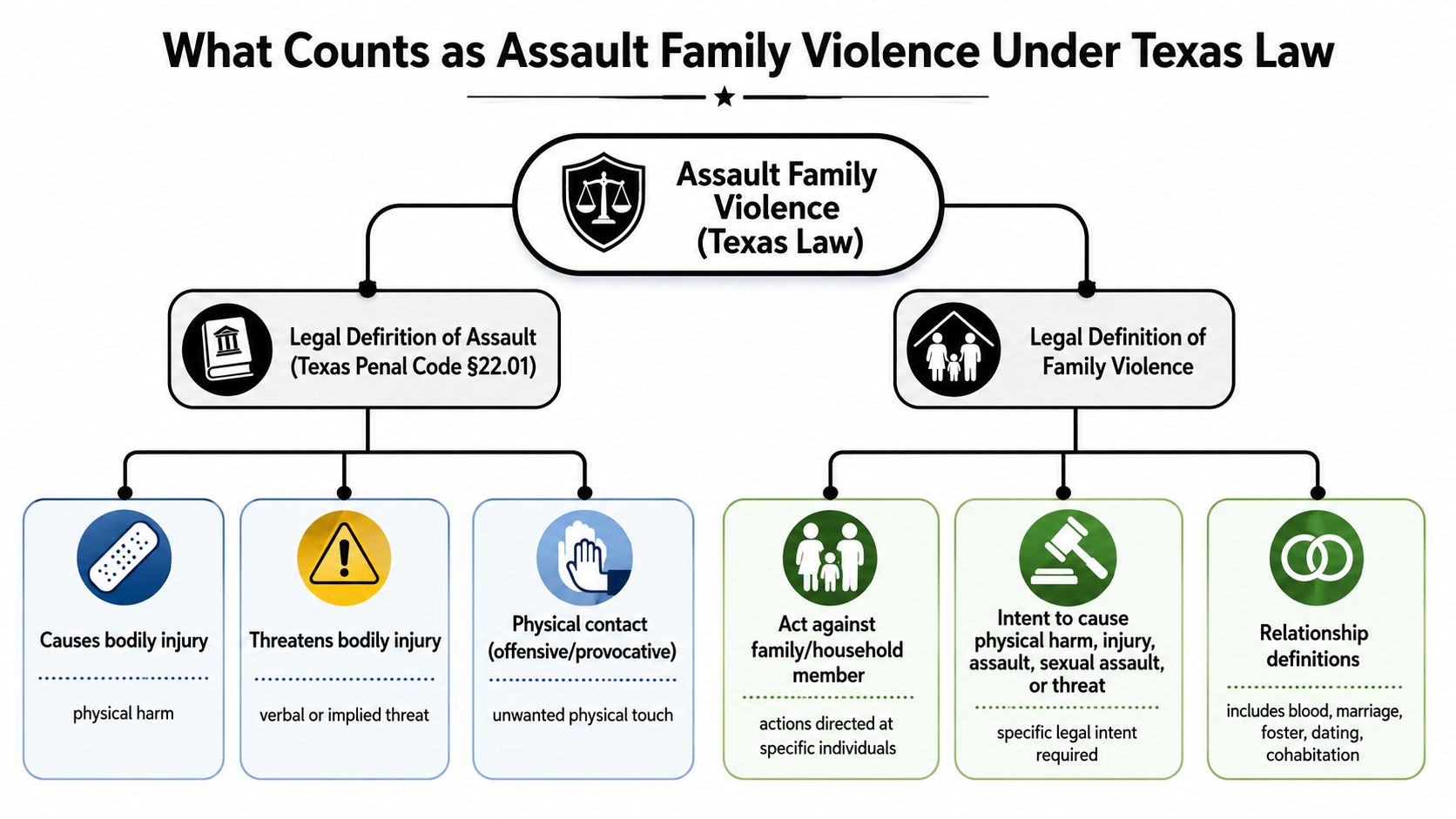
Under Texas law, this charge has two parts. First, the State must claim an assault under Texas Penal Code §22.01. Second, the alleged victim must fit a qualifying relationship under the family violence laws, including relationships recognized in Texas Family Code Chapter 71.
The legal definition is broader than commonly expected. Texas law covers not only bodily injury, but also threats that place a family member in fear of imminent harm, even without physical contact. That broad definition can support both prosecution and protective orders based on non-physical intimidation, as explained in this overview of Texas family violence law.
The three ways assault is usually alleged
In plain language, prosecutors commonly build these cases in one of three ways:
- Bodily injury: The State says you caused physical pain, illness, or impairment.
- Threat of imminent harm: The State says you made the other person reasonably fear that harm was about to happen.
- Offensive or provocative contact: The State says the physical contact itself was unwanted and offensive.
That means a case doesn't always involve a black eye, broken bone, or hospital visit. A shove, grab, or threat can still trigger a charge if the relationship qualifies.
Who counts as family or household
This is another place where people get tripped up. "Family violence" doesn't only mean married spouses. It can include people connected by blood, marriage, dating relationships, household living arrangements, and certain other close domestic relationships.
A helpful way to think about it is this. If Texas law sees the relationship as part of a family or home setting, the case may be treated differently than a bar fight or argument with a stranger.
Common examples that surprise people
| Relationship | Can it fall under family violence law |
|---|---|
| Current spouse | Yes |
| Former spouse | Yes |
| Dating partner | Yes |
| Former dating partner | Yes |
| Roommate or household member | Yes |
| Parent of your child | Often yes |
This broad definition is one reason people facing Texas assault defense issues often need immediate legal advice. A case that sounds minor in everyday conversation can carry much heavier consequences when the alleged victim is a partner, roommate, or former partner.
A family violence allegation isn't defined only by what happened. It's also defined by who the State says was involved.
Understanding the Charges and Potential Penalties
The charge level in an assault family violence case depends on the alleged conduct, the injury, and your history. Texas uses an escalation system. What starts as a misdemeanor can become a felony quickly.
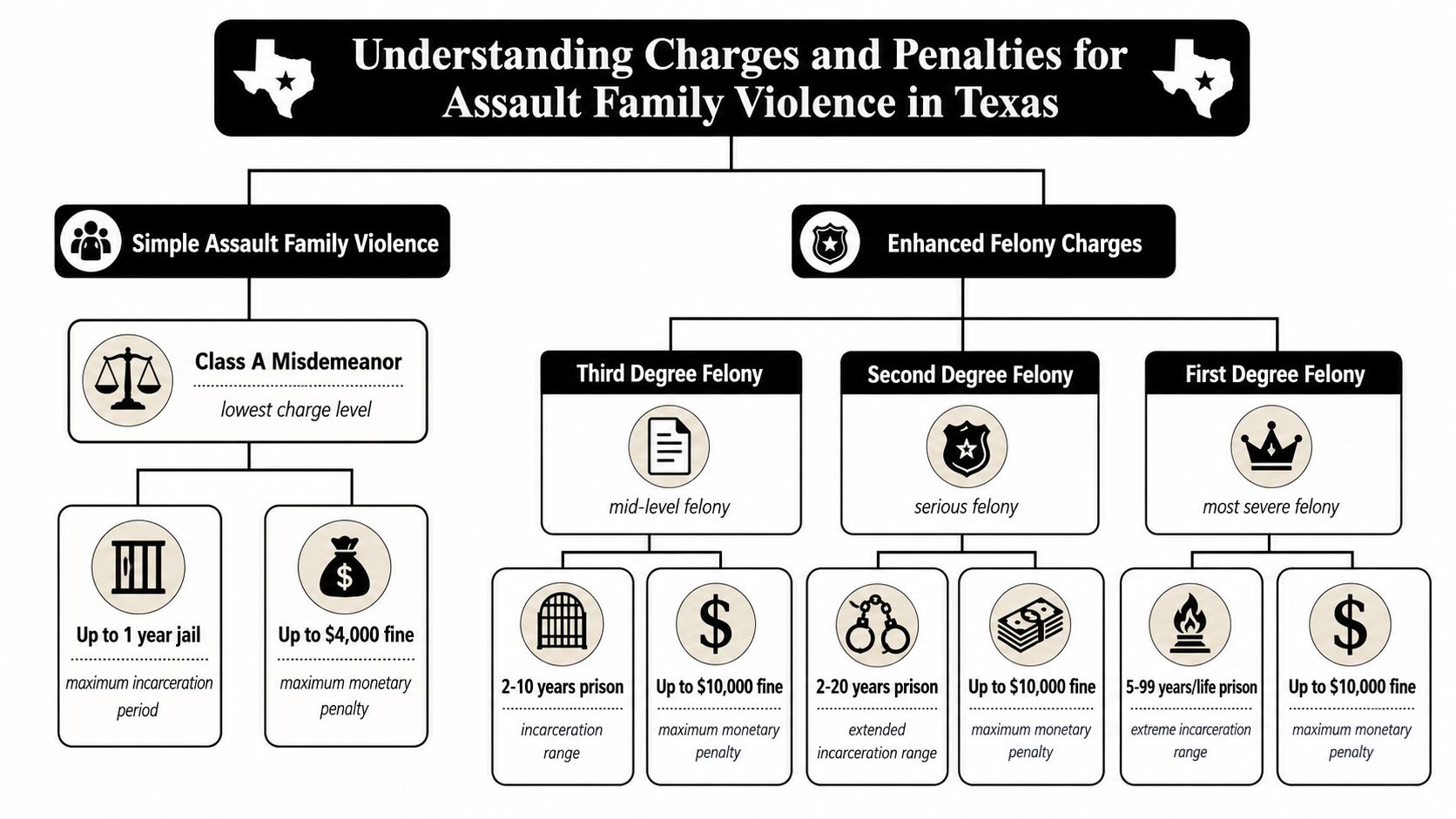
For many first accusations, assault family violence is charged as a Class A misdemeanor. Under Texas law, that can mean up to 1 year in jail and a fine of up to $4,000, as discussed in this summary of family violence under Texas Penal Code.
When the charge moves from misdemeanor to felony
Texas law enhances these cases based on aggravating facts.
A first-time assault family violence charge is typically a Class A misdemeanor, but it automatically escalates to a third-degree felony if you have any prior domestic assault conviction, increasing the possible prison time from 1 year to 2 to 10 years, according to Neal Davis on Texas domestic violence charge levels.
The same source also explains that aggravated assault involving serious bodily injury or use of a deadly weapon against a family member can be charged as a second-degree felony, punishable by 2 to 20 years, and in some circumstances can rise to a first-degree felony with 5 to 99 years or life.
A simple penalty ladder
Here is the basic structure:
- Class A misdemeanor: Up to 1 year in jail and up to a $4,000 fine
- Third-degree felony: 2 to 10 years in prison and up to a $10,000 fine
- Second-degree felony: 2 to 20 years in prison and up to a $10,000 fine
- First-degree felony: 5 to 99 years or life, plus up to a $10,000 fine
Texas also has a separate offense for continuous violence against the family when the State alleges repeated assaults within a set period. In practical terms, prosecutors use enhancement rules to show the court that a case is more serious than a one-time misdemeanor.
If you want a side-by-side comparison from another state system, this practical guide to Colorado DV charges is useful because it shows how domestic cases often carry extra conditions beyond the base assault charge.
For readers trying to compare legal help categories, Domestic Violence Defense in Texas addresses defense for family-violence charges and their family-law consequences.
Navigating the Texas Criminal Court Process
After an arrest, individuals don't need more legal theory. They need to know what happens next. The process is usually a chain of deadlines, hearings, restrictions, and decisions.
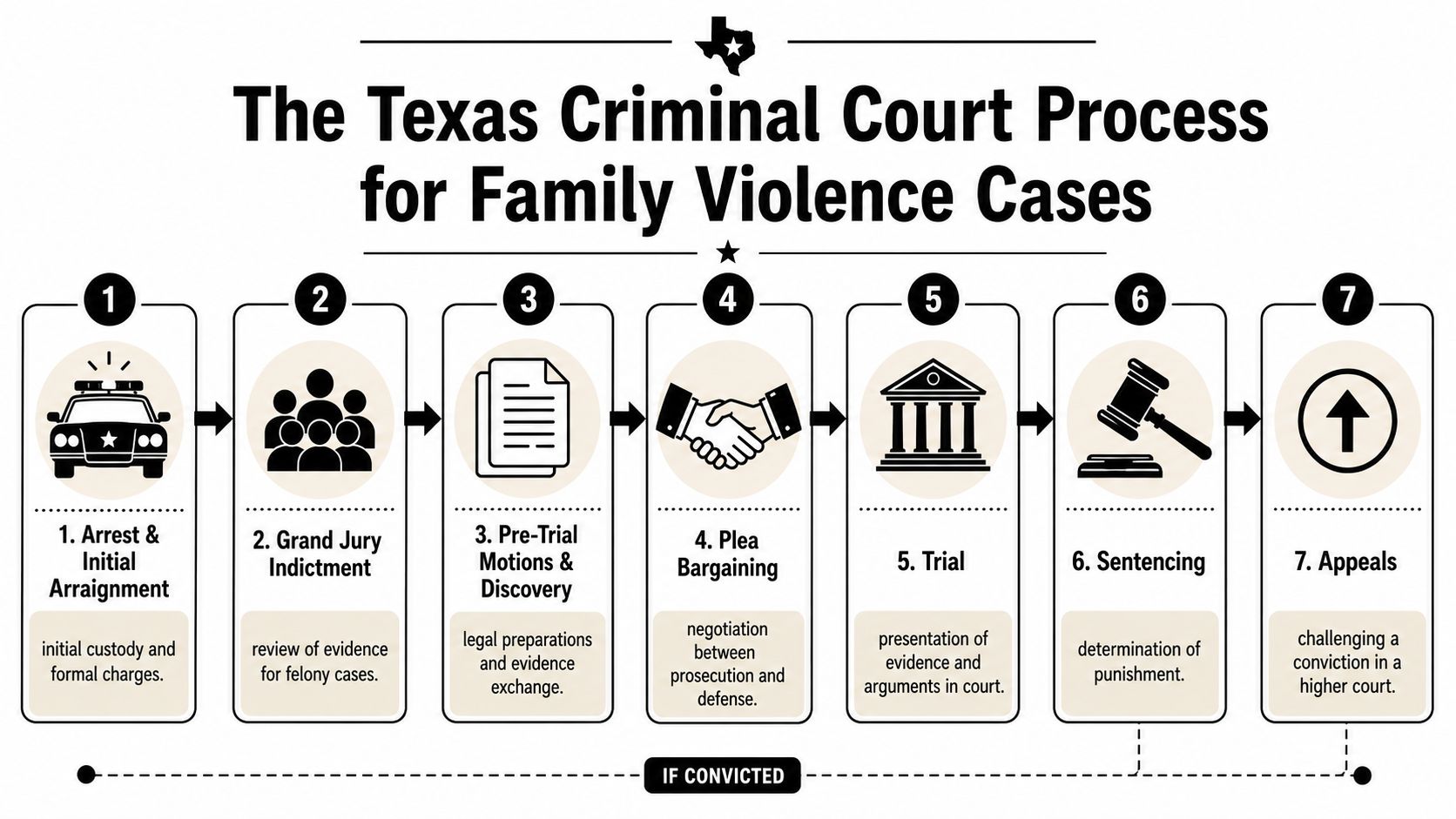
A visual timeline helps first.
Arrest, booking, and the first hearing
Police may arrest you, take you to jail, and book the case into the system. Soon after, you'll appear before a magistrate or judge for an initial hearing. That's where bond is often set and release conditions are imposed.
One of the biggest surprises is the emergency protective order. In many cases, the court enters restrictions immediately, even before you've had a full chance to tell your side.
A close look at an emergency protective order in Texas can help you understand what these no-contact terms may include.
If the court orders no contact, treat that order literally. Don't call, don't text, don't send messages through friends, and don't assume the other person's consent makes it okay.
Courts may also bar you from returning home, possessing certain items, or going near the alleged protected person. If you violate the order, you may face a separate criminal problem on top of the original case.
Pretrial preparation and discovery
Once the case is pending, your lawyer begins evaluating evidence. That often includes police reports, recordings, witness statements, photos, and medical records if any exist.
This stage is called discovery, which is the process where the defense reviews what the State plans to use. If you want a non-technical overview of that concept, this founder's guide to litigation discovery gives a readable explanation of how evidence exchange works.
Early legal help matters here. When to Hire a Criminal Defense Lawyer in Texas discusses why representation soon after arrest or investigation can affect the direction of a case.
Later, if the charge is a felony, the case may go through a grand jury process. Your lawyer may also file motions to challenge evidence, suppress statements, or clarify bond conditions.
This video offers a general look at legal issues that often arise in Texas criminal cases:
Plea bargaining, trial, and sentencing
Many Texas criminal cases, including DWI, theft, drug possession, and assault cases, are resolved through plea negotiations. A plea bargain may involve reduced charges, adjusted sentencing recommendations, or agreed conditions. But you should never accept an offer just because you're scared or tired.
Ask these questions before any plea decision:
- What exactly am I pleading to
- Will there be a family violence finding
- What happens to my firearm rights
- Can this affect custody, housing, or licensing
- Will this outcome block sealing or expunction later
If you don't accept a plea, the case can go to trial. At trial, the prosecutor must prove the charge beyond a reasonable doubt. If you're convicted, the court moves to sentencing, where punishment may include jail, prison, probation, fines, classes, counseling, and other conditions.
Building a Strong Defense Against Family Violence Allegations
An accusation is not a conviction. In many cases, the defense work starts by slowing things down, checking the facts, and testing the State's evidence instead of reacting emotionally.
One common mistake is assuming the case is weak if there are no visible injuries. That's not how Texas law works. A charge can be based on threats or offensive physical contact under Texas Penal Code §22.01, and prosecution often relies on testimony rather than medical proof, as explained in this article on whether family violence charges can be filed without injuries.
Defenses that may apply
A real defense depends on the facts, but common issues include:
- Self-defense: You used force because you believed it was immediately necessary to protect yourself.
- Defense of others: You acted to protect a child or another person.
- Accident: The contact happened, but it wasn't intentional, knowing, or reckless in the way the State claims.
- False or exaggerated allegation: The story is inconsistent, incomplete, or contradicted by other evidence.
- Lack of proof: The prosecutor can't prove each legal element beyond a reasonable doubt.
Some defenses are factual. Others are strategic. For example, a lawyer may challenge statements made during a chaotic scene, question whether a witness saw what happened, or point out missing context in photos or recordings.
Why proactive defense matters
Waiting usually makes these cases harder. Evidence gets harder to find, witnesses become less clear, and temporary court orders can shape the case before your defense is organized.
If you're evaluating options, how to get domestic assault charges dropped explains common paths to dismissal or reduction in Texas. For broader assault allegations, Assault and Violent Crime Defense in Texas covers defense for assault charges ranging from misdemeanor to felony.
Your defense isn't about finding a loophole. It's about making the State prove what it alleges and protecting you from consequences that can outlast the case itself.
Long-Term Consequences Record Sealing and Firearm Rights
The courtroom punishment is only part of the risk. In assault family violence cases, the long-term fallout is often what hurts the most.
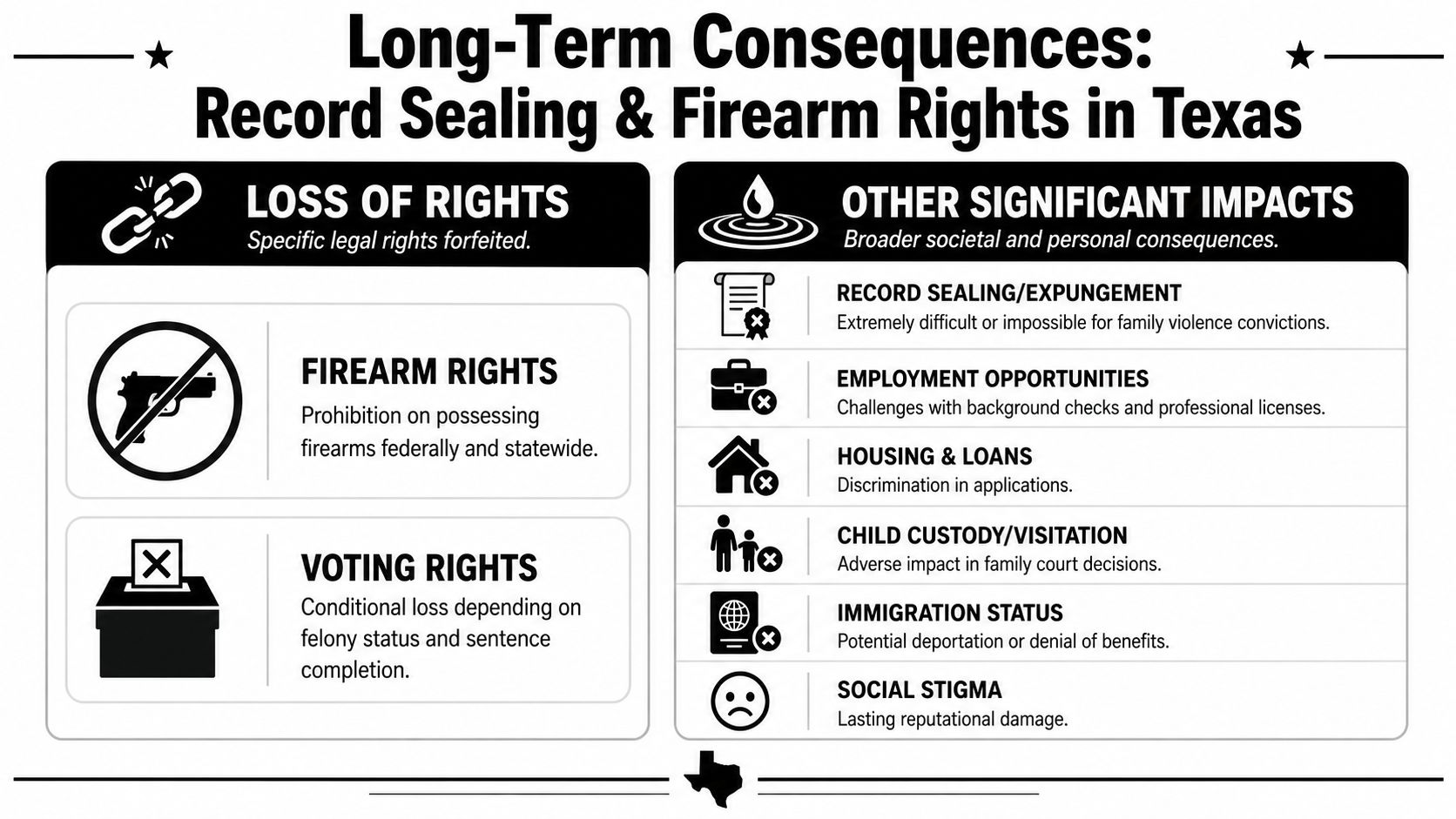
A conviction can affect employment, housing, professional licensing, family court disputes, and your reputation. That's why plea decisions in these cases need more care than people expect.
Firearm rights can be lost for life
Even a Class A misdemeanor conviction for Assault Causing Bodily Injury Family Violence triggers a permanent lifetime federal firearm ban under 18 U.S.C. §922(g)(9), according to this explanation of firearm consequences after a Texas family violence conviction.
If the case is a felony, federal law also prohibits firearm possession after release from prison under 18 U.S.C. §922(g)(1), as discussed in this felony family assault FAQ.
That means a plea that sounds manageable because it avoids prison can still carry a lifetime restriction.
Record sealing and expunction issues
People often ask whether they can clean up the record later. Sometimes they can, but the outcome matters.
In general terms:
- Dismissal or acquittal: You may be able to pursue expunction.
- Conviction: Family violence findings can create major limits on record-clearing options.
- Deferred outcomes: You need careful legal review before assuming a case can be sealed.
If you're looking at this issue from a rehabilitation standpoint, family violence expungement in Texas is a useful starting point.
A practical way to think about plea consequences
| Outcome concern | Why it matters |
|---|---|
| Firearm ban | Can apply even after a misdemeanor family violence conviction |
| Record impact | May limit sealing or expunction options |
| Employment | Background checks often flag violence-related cases |
| Housing | Landlords may deny applications |
| Child custody | Family courts may weigh the allegation or conviction |
A family violence plea is never "just a misdemeanor" if it changes your rights long after probation or jail ends.
What to Do Now If You Are Accused
You don't need to solve the whole case tonight. You do need to avoid mistakes.
Start with these steps:
- Stay silent with police: Don't try to explain, justify, or smooth things over without legal advice.
- Follow every court order: If there's a no-contact order, obey it exactly.
- Save evidence: Keep texts, call logs, photos, videos, and names of witnesses.
- Avoid indirect contact: Don't ask friends or relatives to pass messages.
- Get legal advice early: Early decisions affect bond conditions, defense strategy, plea options, and future record issues.
Also think beyond this charge. The same principles apply in other criminal matters like DWI, theft, and drug possession. Arraignment, plea bargaining, trial, sentencing, and post-conviction relief all require careful choices. If your case ends favorably, you may want to ask about expunction or record sealing right away instead of waiting.
A family violence accusation is serious, but it isn't the end of your story. The right response is calm, disciplined, and informed.
If you've been charged with a crime in Texas, call The Law Office of Bryan Fagan, PLLC for a free and confidential consultation. Our defense team is ready to protect your rights.