Being accused of hurting a child in Texas can turn your life upside down in a single day. You may have been reported by a teacher, a doctor, a neighbor, a former partner, or Child Protective Services. You may be terrified because what happened was an accident, a misunderstanding, or a parenting moment that someone else is now calling abuse.
Answers about injury to a child in Texas require straight information, not panic. Texas treats these cases with extreme seriousness, but an accusation is still not proof. The law requires prosecutors to prove specific facts, a specific mental state, and a direct connection between your conduct and the injury.
This is also where many people get confused. They assume that if a child was hurt, a criminal conviction must follow. That isn't how Texas law works. A tragic injury and a criminal act are not automatically the same thing.
An Accusation Is Not a Conviction but It Is Terrifying
Being arrested in Texas can be terrifying, but you don't have to face it alone.
When the accusation involves a child, the fear is even worse. Many parents and caregivers tell me the same thing. They aren't just afraid of jail. They're afraid of losing their children, their job, their reputation, and the ability to explain what really happened.

Texas authorities investigate these cases aggressively for a reason. Since 2000, injuries have been the leading cause of death for Texans ages 1 through 44, and about 60 Texans die daily from injuries and violence, according to Safe Austin's child abuse overview.
The state's child abuse numbers are also sobering. In 2023, Texas recorded 58,000 confirmed child victims of abuse and neglect, and 164 children died in Texas in 2023 due to abuse and neglect. In Central Texas, 98% of child victims were abused by someone they loved and trusted, as discussed in this Texas injury to a child penalties overview.
Why the system reacts so fast
Police, hospitals, schools, and CPS often move quickly when they think a child may have been harmed. That can mean:
- Fast interviews: Investigators may want statements from you right away.
- Quick removal concerns: CPS may ask questions about who can be around the child.
- Immediate criminal exposure: Police may treat the case as a felony before hearing the full story.
Practical rule: The faster the state moves, the more careful you need to be with every word you say.
Why you still have options
A serious accusation doesn't erase your rights. The prosecutor still has to prove the charge beyond a reasonable doubt. Your lawyer can challenge how the injury happened, what witnesses assumed, what medical records show, and whether your words were taken out of context.
That matters in all criminal cases, whether the issue is a child injury allegation, a theft case, a drug possession allegation, a DWI arrest, or a Texas assault defense matter. The process is scary, but it isn't automatic. You still have room to defend yourself.
What Legally Constitutes Injury to a Child in Texas
Texas Penal Code §22.04 is the law behind an injury to a child charge. In plain English, the state must prove three things. It must prove who the alleged victim is under the statute, what kind of injury occurred, and what your mental state was at the time.
The victim must meet the statute
Under §22.04, a child is a person 14 years old or younger, as explained in this discussion of the age cutoff under Texas law. If the alleged victim is older than that, this specific charge may not fit.
That age line matters more than many people realize. It can change what charge the state files and how the defense approaches the case.
The injury must fit a legal category
Texas doesn't treat every injury the same. The prosecution must prove a direct causal link between the actor's conduct and one of three injury tiers: bodily injury, serious bodily injury, or serious mental impairment, while also proving a mental state such as intent, recklessness, or criminal negligence, according to this breakdown of Texas Penal Code §22.04.
Here is the basic idea:
| Legal term | Plain-English meaning |
|---|---|
| Bodily injury | Physical pain, illness, or impairment |
| Serious bodily injury | Injury involving substantial risk of death, permanent disfigurement, or long-term loss of function |
| Serious mental impairment | Major mental deficiency, impairment, or injury that the state can tie to the conduct |
A defense lawyer often focuses on whether the injury fits the category the prosecutor picked. A bruise, a fracture, a delay in seeking care, and a severe head injury do not all raise the same legal issues.
The mental state often decides the case
At this stage, many wrongful accusations can be challenged. Texas generally looks at whether the conduct was:
- Intentional: You meant to cause the result.
- Knowing: You knew what you were doing would cause the result.
- Reckless: You ignored a substantial risk.
- Criminally negligent: You should have recognized a serious risk but failed to do so.
Think about the difference between dropping a heavy object on a child on purpose and dropping it because your grip slipped during normal caretaking. The injury may be real in both situations, but the legal meaning is not the same.
An injury alone doesn't answer the criminal question. The state must still prove how it happened and what you were thinking or failing to perceive at the time.
If you want a broader comparison of how Texas breaks down violent offenses and what the state has to prove, this overview of the elements of assault charges in Texas can help. For a wider look at offense grading, Felony vs. Misdemeanor Charges in Texas explains how Texas classifies offenses and the penalty range for each level.
Understanding the Felony Levels and Potential Penalties
A parent leaves a toddler with a relative for one afternoon. Hours later, the child is hurt, the hospital asks hard questions, and police start using words like intentional, knowing, reckless, and criminally negligent. Those words are not just labels. In a Texas injury to a child case, they often determine whether the allegation carries years in prison or a lower felony range.
How the punishment ladder works
Texas Penal Code §22.04 grades these cases by combining two questions. How serious was the injury? What mental state does the State claim it can prove?
That structure works like a two-part chart. One part measures harm. The other measures blame. If the prosecutor raises either one, the punishment range can rise sharply.
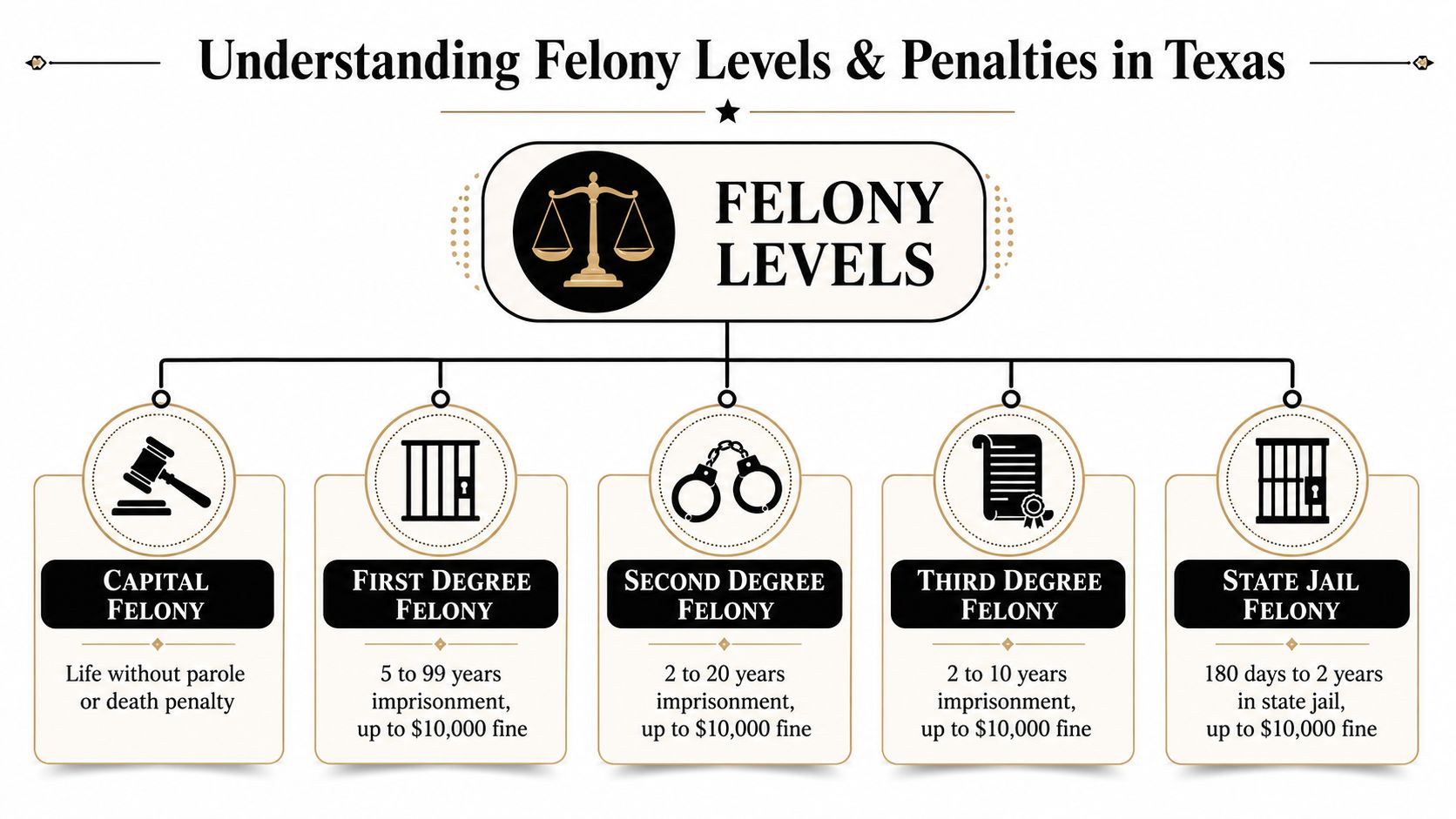
A general breakdown looks like this:
| Charge level | Conduct alleged | Punishment range |
|---|---|---|
| First-degree felony | Intentional or knowing serious bodily injury | 5 to 99 years or life, up to $10,000 fine |
| Second-degree felony | Reckless serious bodily injury | 2 to 20 years, up to $10,000 fine |
| Third-degree felony | Intentional or knowing bodily injury | 2 to 10 years, up to $10,000 fine |
| State jail felony | Reckless bodily injury or criminal negligence causing injury | 180 days to 2 years, up to $10,000 fine |
Texas courts also treat injuries to very young children with intense scrutiny, which is one reason these investigations can move fast and feel overwhelming. For a practical overview of how a felony case proceeds after an accusation, this guide to the steps in the Texas criminal justice process can help place the penalty issue in context.
Why wording changes the stakes
Small wording differences can change a case in a major way.
“Bodily injury” is broader and can include pain, illness, or physical impairment. “Serious bodily injury” means the alleged harm created a substantial risk of death, caused death, or led to serious permanent disfigurement or long-term loss or impairment. If the State upgrades the injury description, it can upgrade the felony level too.
The same is true for mental state. A prosecutor may describe an incident as intentional because that theory supports a harsher punishment range. A defense attorney's job is to test whether the evidence supports that claim. In many cases, it does not.
For wrongly accused parents and caregivers, this is often the most overlooked part of the case. The injury may be real. The fear is real too. But a real injury does not automatically prove a criminal act. Children fall. Medical conditions can mimic abuse. Accounts from stressed witnesses can be incomplete or wrong. A rushed conclusion can turn a tragic accident into a felony accusation on paper.
How the defense challenges the prosecution's version
The charging decision is not the end of the story. It is the prosecution's first draft of what happened.
A defense lawyer may challenge whether the child's condition meets the legal definition the State selected. Medical records matter here. So do timing, prior injuries, alternative explanations, and whether experts are overstating certainty. If the allegation says serious bodily injury, the defense examines whether the medical evidence reaches that level under Texas law.
The defense also looks closely at intent. That is often where the case can be won or significantly reduced. An exhausted parent who makes a mistake, a caregiver dealing with an unexpected emergency, or a person blamed for an injury caused by an accident may have no criminal intent at all. In some cases, the evidence shows poor judgment. In others, it shows no crime happened.
That distinction matters because prosecutors often build a story from the outcome backward. The child was hurt, so someone must have acted criminally. Texas law requires more than that. The State must prove the act and the required mental state, not just the injury.
Penalties reach beyond a sentence
The punishment range gets attention first, but the true pressure starts long before any verdict. A felony accusation can affect bond conditions, custody, employment, and your ability to see your child. It can also shape how doctors, investigators, and even relatives interpret what happened.
Families also face practical fallout at home after a serious incident. In some situations, there may even be a need for understanding post-trauma cleaning process issues while the legal case is still unfolding. That kind of disruption shows why early defense work matters. The goal is not only to fight the charge in court, but to push back against a narrative that may be treating an accident as a crime before all the facts are in.
The Legal Process from Accusation to Courtroom
Many individuals have never been through a criminal case before. They don't know what happens first, who is investigating them, or why one interview can create problems in two separate systems.
The criminal case track
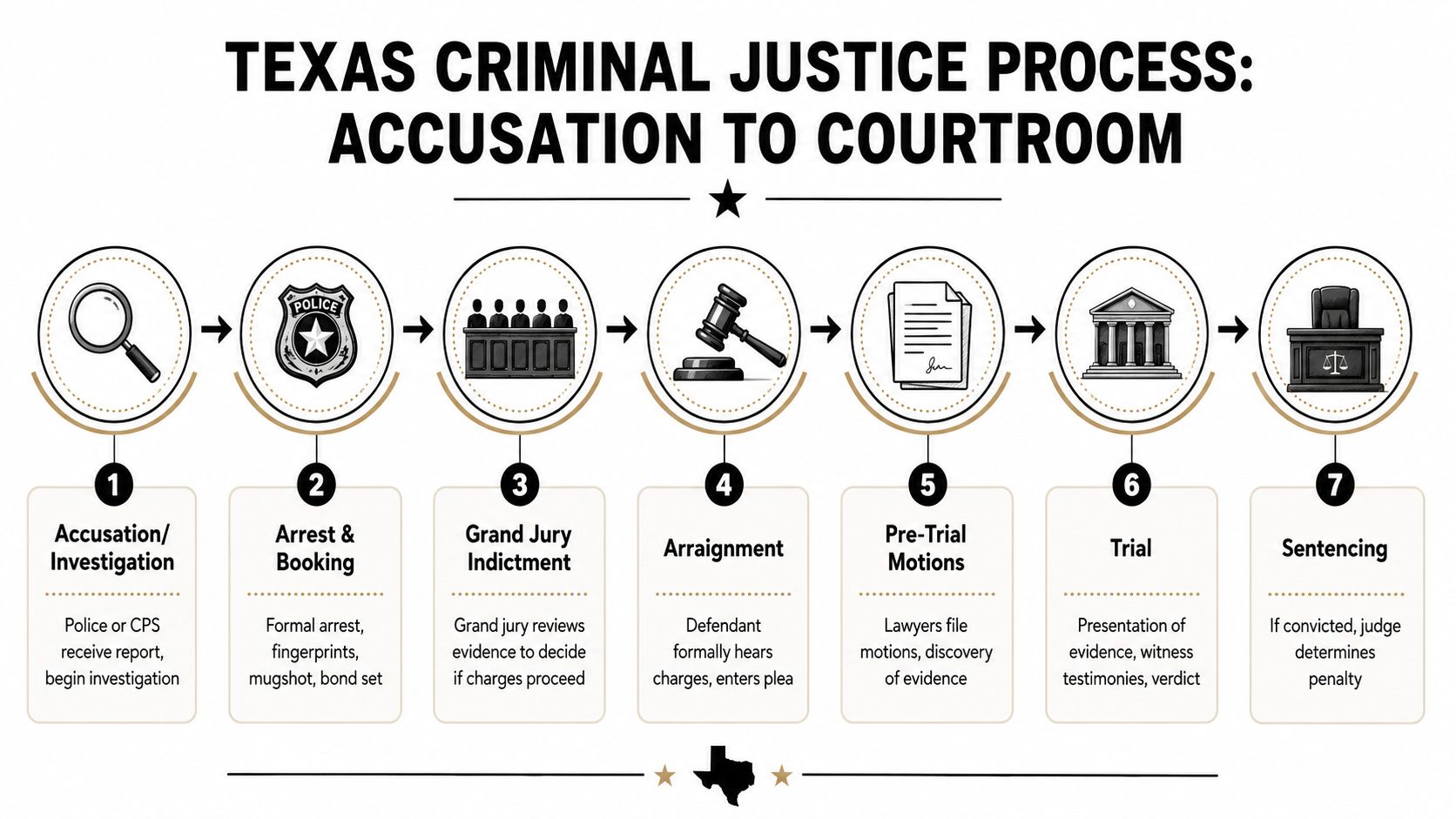
A typical path looks like this:
Report and investigation
Police, medical staff, school officials, or CPS receive a report and begin gathering information.Arrest and booking
You may be arrested, photographed, fingerprinted, and held until bond is set.Formal charging stage
In felony cases, a grand jury may review the evidence before the case moves forward.Arraignment and early court settings
You hear the charge and enter a plea, usually not guilty at the start.Pretrial phase
Lawyers review records, file motions, challenge evidence, and discuss possible plea bargaining.Trial and sentencing if necessary
If there's no acceptable resolution, the case can go to trial.
For a broader overview of the timeline, this guide on the steps in the criminal justice process gives helpful context.
The CPS track is separate
CPS may investigate at the same time as police, but the two systems don't serve the same purpose. CPS focuses on child safety and placement. Prosecutors focus on criminal charges.
That separation creates a common trap. You may think talking openly to CPS will “clear things up,” but your statements can still affect the criminal case. Even well-meaning explanations can sound damaging when taken out of context.
Talk to a lawyer before giving detailed statements to police or CPS. A rushed explanation can become the center of the prosecution's case.
Practical problems families face right away
Families also face immediate household disruption. A home may be treated like a scene that needs documentation, restricted access, or specialized cleaning after a traumatic event. If that issue comes up, a resource on understanding post-trauma cleaning process can help you understand what that work involves in practical terms.
At this stage, your defense lawyer may also coordinate with family-law issues, bond conditions, and no-contact orders. If your case intersects with custody or protective-order concerns, the legal strategy has to be consistent across every forum.
Building a Strong Defense Your Future Depends On
A child gets hurt. Panic follows. By the time police reports, medical notes, and witness statements start stacking up, a tragic accident can begin to look like a crime on paper.
That is why the defense in these cases often turns on one question: what happened, and what can the state prove under the Texas Penal Code?
Under Texas law, an injury alone does not end the analysis. The prosecution still has to prove your mental state and your conduct. In many cases, the central dispute is whether the injury was caused intentionally, knowingly, recklessly, or by criminal negligence, or whether it resulted from an accident, a misunderstanding, or facts investigators interpreted too quickly.
Accident versus criminal act
This distinction gets missed all the time.
Young children fall, climb, choke, slip, and get into danger fast. A parent may make a poor judgment call under stress. A caregiver may misread symptoms or respond imperfectly in an emergency. Those facts can be heartbreaking without being criminal.
A defense lawyer looks closely at whether the accusation matches the evidence, not just the outcome. The state may point to a serious injury and ask a jury to work backward from the result. A good defense does the opposite. It starts with the timeline, the medical details, the surroundings, and the witness accounts to test whether the prosecution's story holds together.
Questions often include:
- Was the injury accidental? A severe injury can still come from a noncriminal event.
- What mental state is the state trying to prove? Under the Penal Code, that matters.
- Does the medical evidence clearly support abuse, or only suggest possibilities?
- Did investigators assume intent before all facts were known?
- Is there a gap between what happened and what the state claims happened?
Defense themes that may matter
Every case depends on its facts, but several defenses appear often in injury to a child cases.
Lack of intent or knowledge
The prosecution may claim a parent meant to cause harm when the evidence shows a rushed mistake, panic, or poor handling without a criminal purpose. That difference can decide the case.Accident
An accident is not a legal excuse invented after the fact. Sometimes it is the truth. If the physical evidence, medical records, and timeline fit an accidental event better than an intentional assault, the defense should show that clearly.False or distorted allegation
In family conflict, especially custody disputes, one person's accusation can shape the whole investigation. Texts, prior statements, and timing may reveal motive, exaggeration, or inconsistency.Weak causation
The state must connect your conduct to the child's injury. If the medical proof is uncertain, if several caregivers were present, or if the timing does not line up, that weakness matters.Reasonable discipline issues
Some cases involve discipline that prosecutors characterize as abuse. Texas law requires a careful legal and factual review of what happened, how it happened, and whether the force used was reasonable under the circumstances.
One hard truth is that bad facts are not always criminal facts.
What a defense lawyer actually builds
A strong defense usually starts long before trial. It may involve reviewing hospital records line by line, comparing witness statements for contradictions, preserving photos and messages, consulting medical experts, and challenging interviews taken when a parent was exhausted, grieving, or frightened.
That work is similar to rebuilding a scene after a storm. One piece alone may not tell the story. Put the timing, records, injury pattern, and witness accounts together, and a very different picture can emerge.
Sometimes the defense goal is dismissal. Sometimes it is reducing the charge by showing the alleged mental state cannot be proved. Sometimes it is preparing the case for trial because the state's theory does not hold up under close examination. If the case ends in a dismissal or acquittal, you may also want to learn how record expunction works in Texas.
If the prosecution says the case is obvious, your lawyer's job is to test every assumption, every label, and every jump from injury to intent.
Life After the Verdict Can You Clear Your Record
Even after the courtroom process ends, the case may keep affecting your life. A conviction for injury to a child can lead to the permanent loss of custody rights, severe employment restrictions, and professional license forfeiture, according to this Texas injury to a child consequences overview.

If charges were dismissed or you were found not guilty
People should ask about expunction right away. In some situations, Texas law allows a person to remove records of an arrest or case from public view after a dismissal, acquittal, or other qualifying outcome.
If you're trying to understand that process, this page on how to get a record expunged is a practical place to start.
If there was a conviction
Clearing a conviction is much harder, especially for a serious felony. But that doesn't mean there are never options. Depending on the outcome and the procedural history, a lawyer may evaluate:
- Post-conviction relief: Looking for legal errors or grounds to challenge the result.
- Record sealing questions: In some cases, nondisclosure may be discussed, though it is not available for every offense.
- Long-term planning: Addressing licensing, employment, and family-court consequences.
Why this matters early
Post-case relief is often easier to preserve when the trial lawyer is thinking ahead from the beginning. Plea terms, findings, deferred outcomes, and dismissal language can matter later.
A criminal case doesn't only ask whether you can avoid jail. It also asks whether you can still build a stable life afterward.
Your First Steps When Accused of Injuring a Child
If you were accused today, your next few decisions matter more than is commonly understood. Trying to “clear things up” on your own can make the case harder to defend.
Start with this checklist.
What to do immediately
Stay silent about the facts
You have the right to remain silent. Use it. Don't give a long explanation to police, CPS, school officials, or hospital staff without legal advice.Ask for a lawyer clearly
Say you want an attorney before any questioning. Be polite, but firm.Preserve evidence
Save texts, call logs, photos, videos, medical paperwork, and names of witnesses. Don't edit or delete anything.Keep off social media
Don't post your side of the story. Don't argue with the accuser online. Don't assume privacy settings will protect you.
What not to do
People often hurt their own case by acting from panic.
- Don't guess about timelines or medical details.
- Don't pressure witnesses to help you.
- Don't contact the child or reporting party if a no-contact issue may exist.
- Don't assume CPS is “separate enough” that your statements won't matter.
The safest first move is simple. Say less, preserve more, and get legal advice fast.
Why fast action changes the case
Early legal help can affect bond conditions, interviews, evidence collection, contact with CPS, plea discussions, trial preparation, and later relief options. That's true in injury to a child cases and in other serious charges such as DWI, assault, theft, or drug possession.
If you've been charged with a crime in Texas, call The Law Office of Bryan Fagan, PLLC for a free and confidential consultation. Our defense team is ready to protect your rights.
If you're facing an injury to a child allegation or any other criminal charge in Texas, Law Office of Bryan Fagan PLLC can help you understand your rights, the court process, and your defense options. A free and confidential consultation can help you take control of the situation before the state defines the story for you.