Being arrested in Texas can be terrifying, especially when your phone rings and a loved one says they’re in jail in Brazoria County. Most families don’t know what happens next, what bail means, or who they should call first. That fear is normal.
Bail is often the first problem you need to solve, but it isn’t just about getting someone out of jail. It also affects how quickly you can start building a defense, protect a job, care for children, and keep life from spinning further out of control. If you understand the process, you can make calm decisions instead of rushed ones.
An Arrest in Brazoria County What You Need to Do Now
If you just got that call, focus on three things. Get accurate information, avoid panic decisions, and bring a lawyer into the process as early as possible.

Start by confirming the person’s full name, where they’re being held, and what charge they were told about. Charges can change after review, so treat early information as a starting point, not the final word. If you need a basic overview of the arrest timeline, this guide on what happens when you get arrested can help you understand the first stage.
Your first moves matter
When families panic, they often call the first bondsman they see online and agree to terms they don’t understand. That can create new problems. Slow down enough to gather facts.
Use this simple checklist:
- Write down the charge if you know it.
- Ask where the person is being held and whether booking is complete.
- Find out whether bail has already been set.
- Do not discuss the facts of the case over jail calls. Those calls may be recorded.
- Contact a criminal defense attorney quickly so bail strategy starts early, not after mistakes have been made.
Practical rule: The goal in the first hours isn’t to explain the whole case. It’s to protect the person in custody, secure release if possible, and stop avoidable damage.
Why the first hours are so important
In Texas, bail decisions happen early. That means the record a judge sees at the beginning can shape what happens next. A person’s ties to the community, work history, and ability to follow court conditions can matter.
This is also the stage where common charges often begin to split into different paths. A DWI under Texas Penal Code and related transportation laws, an assault allegation under Texas Penal Code Section 22.01, a theft case under Texas Penal Code Section 31.03, or a drug possession case under the Texas Health and Safety Code may all raise different concerns for the court. The facts may be very different, but the first practical question is usually the same. How do we get you released while protecting the case?
The Different Types of Bail Bonds in Texas
Texas uses a few main types of release. Families get confused because people use the word “bond” to mean several different things at once. It helps to separate them.
Cash bond
A cash bond means the full bail amount is paid directly to the court. This involves putting down the whole deposit yourself.
If the person appears in court and follows the rules, that money may be returned at the end of the case, subject to court rules and any lawful deductions. The upside is control. The downside is obvious. Many families don’t have that amount available on short notice.
Surety bond
A surety bond is commonly what is meant when discussing a bail bond. A licensed bail bondsman posts the bond, and you pay the bondsman a fee for that service.
A simple way to think about it is this:
| Type | Who pays the full amount up front | Is there a fee | Is the fee usually refundable |
|---|---|---|---|
| Cash bond | You or your family | No separate premium | The bond itself may be returned under court rules |
| Surety bond | The bondsman guarantees it | Yes | The fee is generally not refunded |
| PR bond | No cash deposit to a bondsman | No premium | Not applicable |
With a surety bond, the family usually pays far less up front than the full bail amount. But that convenience has a tradeoff. The premium is the cost of the service, and collateral may also be required in some cases.
Personal recognizance bond
A personal recognizance bond, often called a PR bond, means the person is released based on a promise to appear and comply with conditions. No premium is paid to a bondsman.
For families, this is usually the best financial result. But it’s not automatic. Courts look at things like the charge, criminal history, community ties, and whether the person appears likely to return to court.
A PR bond is not a dismissal. It’s simply a different form of release while the case is pending.
Why people mix these up
People often ask, “How much is the bond?” when they really mean one of two things. They may mean the total bail amount set by the court, or they may mean the amount they must pay a bondsman. Those are not the same number.
That confusion can get expensive. Before anyone signs paperwork, make sure you know:
- The court-set bail amount
- The type of bond available
- Whether collateral is required
- What conditions of release apply
The kind of charge also matters. In an assault case, the court may impose a no-contact order. In a DWI case, the court may impose conditions tied to driving, alcohol use, or supervision. Violating those conditions can create a new crisis even after release.
The Bail Process in Brazoria County Step by Step
The bail process feels chaotic when you’re living it. It’s easier to manage when you break it into stages.
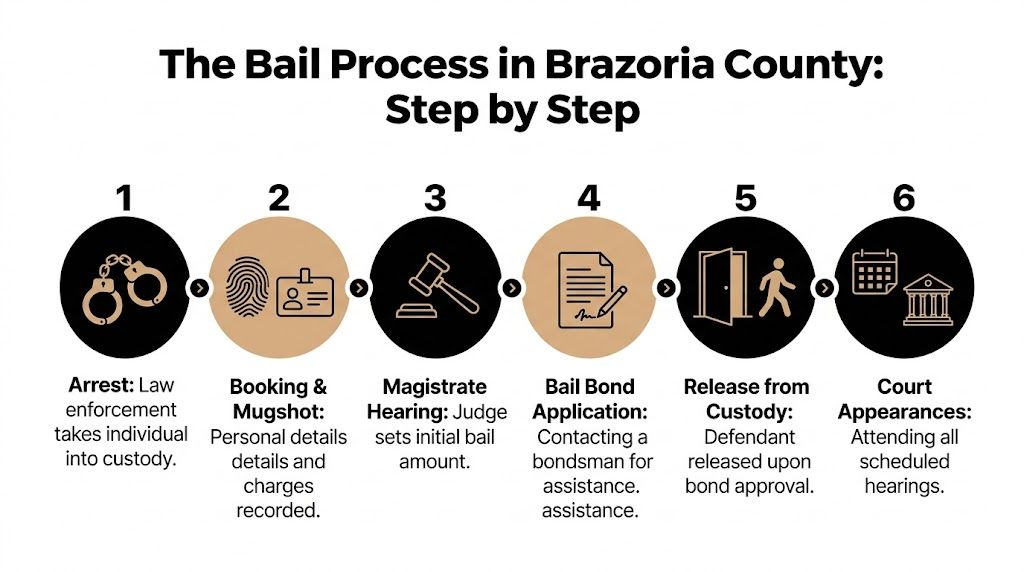
Booking
After arrest, law enforcement takes the person into custody for booking. That usually includes fingerprints, photographs, basic identification, and entry of the alleged charge into the jail system.
This stage can feel slow because families are waiting for information while the jail is processing the person. During booking, you may not get complete answers right away. That delay is frustrating, but it’s common.
Magistration
After booking comes magistration. This is when a magistrate advises the accused person of the charge, explains certain rights, and addresses bail.
In Texas, this early appearance can shape the entire release process. If you want a plain-English explanation of what the court considers, this article on what happens at a bond hearing is useful.
Posting the bond
Once bail is set, there are usually three possible paths. You may be able to post cash, use a licensed surety bondsman, or ask for release on personal recognizance if the facts support it.
Families often move fastest with a surety bond because they don’t need the entire bail amount in hand. But speed still depends on correct paperwork, jail workload, and whether the bondsman has verified everything needed for release.
Release from custody
After the bond is posted and accepted, the jail still has to complete the release process. This is another place where people get discouraged because they assume payment means instant release.
It usually doesn’t. The jail must confirm the bond, process internal paperwork, and clear the person for release. Delays can happen even when everything is going correctly.
Don’t assume something has gone wrong just because release takes time after the bond is posted. A lot of waiting in criminal procedure is administrative.
What families should do during the wait
This is the part where clear planning helps. Use the waiting time well.
- Prepare basic documents: Have identification, contact information, and any employment or family details ready for the lawyer.
- Plan transportation: Make sure someone can pick the person up after release.
- Review conditions carefully: If the court orders no contact, travel restrictions, or testing requirements, take them seriously.
- Stop discussing facts by phone: Save case details for private attorney conversations.
After release
Getting out of jail is only the beginning. The case moves forward through court settings, negotiation, and sometimes trial. In many cases, a lawyer may review police reports, challenge the stop or arrest, file motions, negotiate with prosecutors, and work toward dismissal, reduction, or a strong trial defense.
That applies whether the allegation is DWI, assault, theft, or drug possession. It also applies later if you qualify for relief such as expunction or nondisclosure after the case ends. Bail gets you home. Defense strategy determines what happens to your record and your future.
What Do Bail Bonds in Brazoria County Cost?
Your first call may sound like this: “They set bail at $10,000. Do we need ten thousand dollars today?” In many cases, no. The court sets the full bail amount, but a bail bondsman usually charges a percentage of that amount as the fee for posting a surety bond. That distinction matters because families often make decisions in a panic before they understand what they are being asked to pay.
In Texas, the premium on a surety bond is commonly a percentage of the full bail amount, and that fee is usually not refunded. If you want a clearer breakdown of how the math usually works, this guide on how much bail costs in Texas cases explains the difference between bail, bond premiums, and related expenses.
What local bail amounts look like
County-level bond data gives a useful starting point, especially for families trying to budget quickly. According to bond amount data collected for Brazoria County criminal cases, the average bail amount is $25,451, the median is $5,000, and many bonds fall between $2,500 and $15,000.
That same source shows how sharply bail can change based on the accusation:
| Charge or level | Average bail | Median bail if listed |
|---|---|---|
| DWI under 49.04 | $3,131 | $2,500 |
| Assault causing bodily injury to a family member | $5,389 | $2,500 |
| Driving with license invalid | $2,149 | $1,500 |
| Class B misdemeanor | $3,208 | Not listed |
| Class A misdemeanor | $5,893 | Not listed |
| State jail felony | $15,374 | Not listed |
| Third degree felony | $29,980 | Not listed |
The same Brazoria County dataset also reports that personal recognizance bonds are rare, with 0.5% overall and less than 1% of cases in the summary figures above.
What families usually pay out of pocket
A percentage fee sounds manageable until you apply it to the actual bond amount. A $2,500 bond is one thing. A $30,000 felony bond is another.
For example, if bail is set at $10,000, the upfront cost for a surety bond is often far lower than $10,000, but it can still be a serious strain on a family budget. On top of that, a bondsman may ask for collateral depending on the charge, prior record, or missed court history.
That is where many families get blindsided. They prepare for the premium and forget the rest.
You may also be dealing with:
- Collateral requirements, such as a vehicle title or other property interest
- Transportation costs to and from the jail and court
- Missed work
- The cost of defending the criminal case itself
Why the cheapest option is not always the smartest one
Bail cost is not just a money question. It is also a legal strategy question.
If a family rushes to pay a bond without involving a defense lawyer early, they may miss a chance to ask for a lower amount, better terms, or in the right case a personal bond. Bondsmen help with release. A defense attorney looks at the bigger problem, including whether the bond amount is higher than it should be and what facts can be presented to the court to bring it down.
That difference can save far more than shopping for a slightly lower premium.
Collateral and contract terms
Collateral works like security for the bondsman’s risk. If the defendant misses court, the financial consequences can reach beyond the fee you already paid.
Before signing anything, ask direct questions and get the answers in writing:
- Is the premium refundable under any circumstance?
- What collateral is required?
- When will collateral be returned?
- What events count as a violation of the bond agreement?
- Are there payment plans, and what happens if a payment is late?
A worried family often feels pressure to sign fast. Slow down just enough to read the contract. One careful review now can prevent a second crisis later.
How a Criminal Defense Attorney Can Change Your Bail Outcome
At 2 a.m., a family member gets the call. Someone you love is in the Brazoria County jail, the bond amount sounds impossible, and every minute feels expensive. In that moment, many families focus on one question, how do we pay this. A defense lawyer asks a different question first. Is this bond higher or stricter than it needs to be?

That difference matters.
A bondsman helps secure release after a bond is set. A criminal defense attorney can work on the front end, asking the court to reduce the amount, ease unnecessary conditions, or approve a personal bond when the facts support it. That is why early lawyer involvement can affect both the immediate release decision and the direction of the case itself.
What a lawyer can show the judge early
Judges usually make fast decisions with limited information. If the court hears only the arrest allegation, the picture is incomplete. A defense attorney adds the missing pieces and ties them to the legal questions the judge cares about, public safety, court appearance, and reasonable conditions of release.
That often includes facts like:
- Steady employment or a recent job offer
- Family members who live nearby and can help with court compliance
- A stable address
- A record of appearing in court when required
- Medical, childcare, or work responsibilities that show strong community ties
- Details that correct exaggerations or fill gaps in the arrest narrative
To a worried family, those facts may sound ordinary. To a judge, they are the building blocks of a lower bond argument. Bail works a lot like a risk calculation. The more clearly counsel can show stability and reliability, the stronger the request for release on workable terms.
Lower bail can protect the defense, not just the budget
The first financial benefit is obvious. If bond goes down, the cost of getting out usually goes down too. In some cases, the court may allow release without a surety bond at all.
But the legal benefit is just as important.
A person who gets out sooner can meet with counsel, gather records, keep a job, arrange childcare, and avoid making stressed, unplanned decisions from jail. According to the Texas Code of Criminal Procedure rules on bail, bail should be high enough to secure appearance in court, but not used as an instrument of oppression. That gives a defense attorney a legal framework to argue that the amount and conditions should match the actual risk, not the fear of the moment.
Bail hearings are often the first defense hearing
Families sometimes treat bail as a payment problem. In practice, it is often the first chance to shape how the court sees the case.
For example, in a DWI case, counsel may start reviewing the stop, testing, license issues, and release conditions right away. In an assault case under Texas Penal Code Section 22.01, a no-contact order may need quick clarification so the client does not violate it by accident. In a theft case under Texas Penal Code Section 31.03, early release can help preserve employment records, receipts, or surveillance requests before evidence disappears. In a drug possession case, quick legal advice can reduce the risk of harmful statements or consent to searches that create new problems.
That is the perspective bail guides written only from the bondsman side often miss. Release is one goal. Positioning the case for a stronger defense is the other.
One practical note. Firms that explain this process clearly online often build trust faster, which is one reason legal teams study law firm marketing strategies. Clear information helps families act calmly and choose the right help.
A good lawyer does more than get someone out of jail. A good lawyer uses the bail stage to protect money, protect options, and protect the case from avoidable mistakes in the first days after arrest.
Finding a Reputable Bail Bondsman in Brazoria County
If you need a bondsman, treat that choice like a safety decision, not a convenience decision. The wrong person can make a bad night worse.
The first rule is simple. Verify the license before you pay anything. The Brazoria County Bail Bond Board issues licenses and handles complaints against bondsmen, and the county explains that process on the Brazoria County Bail Bond Board page.
A quick screening checklist
Aggressive advertising can make every service look the same. They’re not the same.
Before signing, ask:
- Are you currently licensed in Brazoria County
- What is the premium and what part is non-refundable
- Do you require collateral
- What events could put my collateral at risk
- Who do I contact after hours if release is delayed
- Will I get a full written contract before paying
The county notes that using an unlicensed agent can risk bond forfeiture and loss of collateral, especially in fast-growing areas like Pearland and Angleton.
What to watch for
Some red flags show up quickly:
| Red flag | Why it matters |
|---|---|
| Refuses to show proof of license | You may be dealing with an unlicensed operator |
| Pushes payment before explaining terms | You may not understand your legal and financial risk |
| Gives vague answers about collateral | Disputes often start here |
| Avoids putting promises in writing | Verbal assurances are hard to enforce |
If a bondsman seems annoyed that you’re asking careful questions, keep looking. A legitimate company should expect those questions.
Consumers often trust polished websites and constant ads. That’s true in legal services too. If you’re curious how firms create visibility online, this overview of law firm marketing strategies gives useful context for why strong advertising should never replace basic verification.
Common Questions About the Bail Process
Families usually have a few questions left after the bond is posted. These are the ones that create the most trouble when people guess instead of asking.
What happens if you miss court
Missing court can trigger a bond forfeiture process and lead to a warrant. If a surety bond is involved, the bondsman may also take steps under the contract to recover losses or secure the defendant’s return to court.
This is why court dates must be tracked carefully. If there’s a conflict, tell your lawyer immediately. Don’t wait until after the missed hearing.
What happens to the money or collateral when the case ends
The answer depends on the type of bond.
With a cash bond, the posted amount may be returned under court rules after the case ends, assuming the person complied with requirements and there are no lawful deductions. With a surety bond, the premium paid to the bondsman is generally the fee for the service and is usually not returned. Collateral should be returned according to the contract once the bond obligation is fully resolved.
Read the paperwork closely. Families often remember the payment but forget the return conditions for collateral.
Can a bond be revoked
Yes. A bond can be revoked if the defendant breaks conditions of release, misses court, commits a new offense, or violates specific court orders.
That issue comes up often in family violence and assault-related cases. A no-contact order is not a suggestion. If the court orders no contact, even well-meaning communication can cause major damage.
What comes after bail in the criminal case
Release from jail doesn’t end the case. The next stages may include arraignment, pretrial settings, plea negotiations, motions, trial, and sentencing if there’s a conviction.
If the case ends favorably, some people may later qualify for expunction or record sealing through nondisclosure, depending on the result and the offense. Others may need post-conviction relief options. Those remedies can be life-changing because they affect jobs, housing, and professional licenses, but they depend on the details of the outcome.
The smart approach is to treat bail as step one, not the finish line.
Your Case Does Not End with Bail Call Us Today
Getting out of jail matters, but it’s only the first move. The important work is protecting your rights, challenging weak evidence, managing court conditions, and preparing the case for negotiation or trial. If you want a broader look at litigation readiness, this guide on how to prepare for trial and win your case gives a helpful general overview.
A strong defense can also shape what happens after the case, including sentencing issues, probation concerns, expunctions, nondisclosures, and other paths that help you move forward.
If you’ve been charged with a crime in Texas, call Law Office of Bryan Fagan PLLC for a free and confidential consultation. Our defense team is ready to protect your rights.