A boat stop in Texas often starts as a routine safety check. Then the questions get sharper. Have you been drinking? Do you have your life jackets? Who was operating? If there’s been a collision, the day can unravel fast.
For many people, this is their first contact with the criminal system. They’re worried about jail, a suspended driver’s license, court dates, insurance trouble, and what happens if a child was onboard. Those fears are real. Texas takes boating safety seriously, and the law can hit hard when officers believe alcohol, missing equipment, or reckless operation played a role.
Texas also has a lot at stake on the water. The state reported 169 boating incidents and 24 fatalities in 2024, and 22 victims, or 92%, were not wearing life jackets, according to Texas boating regulations summarized here. When you understand boating laws in texas before an incident, you lower your risk of a citation. When you understand them after an arrest, you make better decisions about your defense.
A Day on the Water Can Turn into a Legal Nightmare
A normal lake day usually doesn’t feel like the start of a criminal case. You load the cooler, launch the boat, and head out thinking about the weather and the water, not Penal Code sections or court appearances. Then a game warden signals you over, or another vessel cuts too close, or someone falls and gets hurt.
That’s when boating laws in texas stop feeling like background rules and start controlling what happens next.
A boating incident can create more than one legal problem at the same time. A stop that begins with a safety inspection can turn into a BWI investigation. A collision can lead to questions about speed, lookout, registration, life jackets, reporting duties, and whether you rendered aid. If alcohol is involved, officers may start building a criminal case under Texas Penal Code §49.06, which covers Boating While Intoxicated.
Most people I speak with after a boating arrest say the same thing. They didn’t realize a day on the lake could threaten their license, freedom, and record all at once.
Texas officers and prosecutors don’t treat BWI like a minor boating ticket. They usually treat it much closer to a road DWI case, especially where there’s an accident, a child passenger, or signs of unsafe operation. That means the choices you make in the first hours matter.
The first mistakes people make
Some mistakes happen before the stop. Others happen after.
- Talking too much: Many boaters try to explain everything on the spot. That often gives the state extra statements to use later.
- Assuming it’s just a citation: A BWI arrest can carry jail exposure and license consequences.
- Ignoring paperwork deadlines: A criminal charge and a license suspension issue can move on separate tracks.
- Waiting too long for legal help: Early review of the stop, the tests, and the officer’s report can make a real difference.
If you’re reading this after a stop, arrest, or accident, you’re not overreacting. You’re doing what you should do. Get clear on the rules, protect your rights, and take the process seriously from the start.
Texas Boating Basics Before You Launch
A lot of cases start before the engine does. I have seen stops that began with something simple, like expired registration, a missing life jacket for a child, or safety gear shoved under a seat where nobody could reach it. Once an officer finds one problem at the ramp or during a boarding, the rest of the trip gets examined more closely.
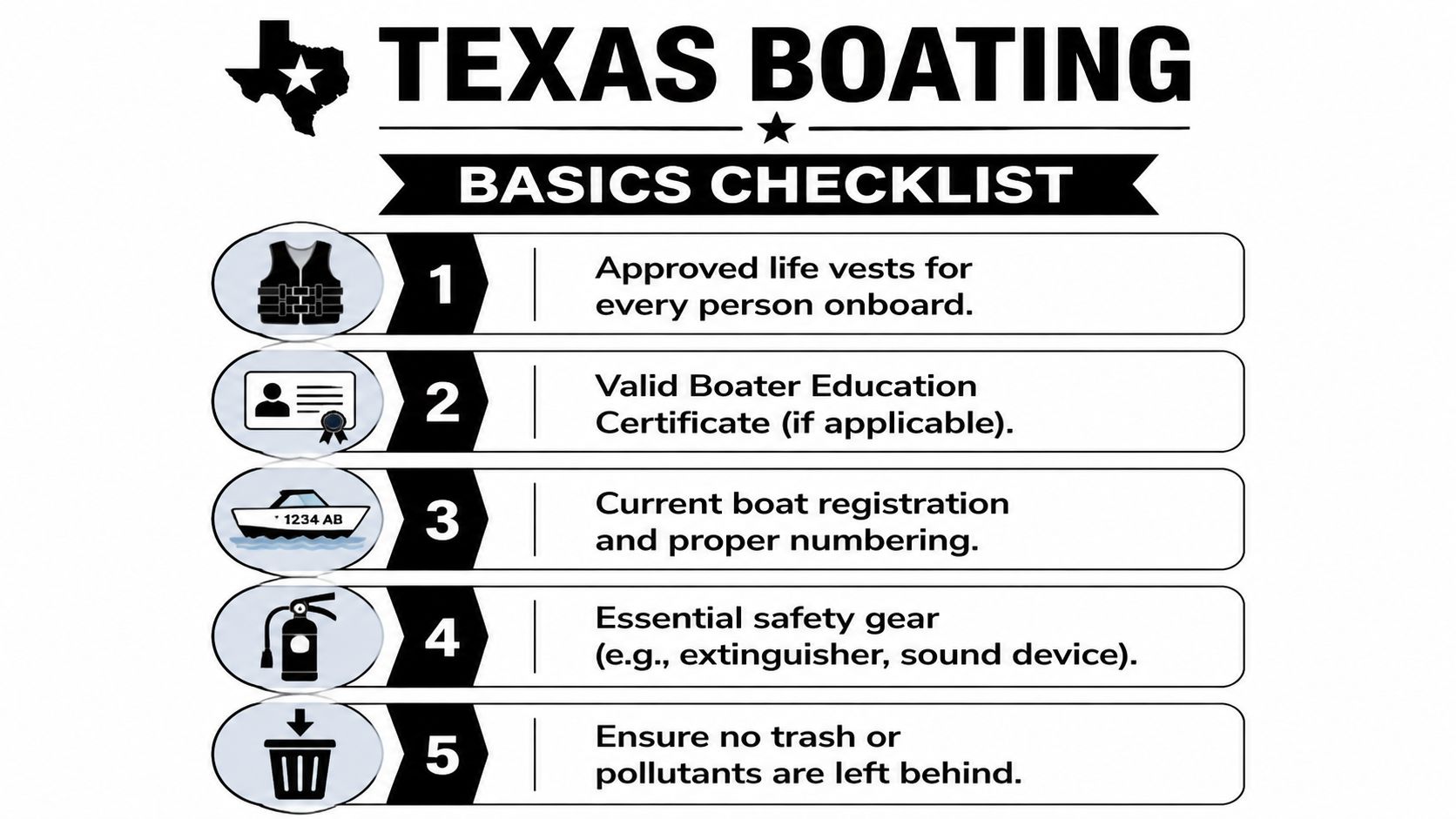
Your pre-launch legal checklist
Before you launch, make sure the boat is legal on paper and safe in practice.
- Life jackets: Under Texas Parks & Wildlife Code §31.123, the boat must have one U.S. Coast Guard approved wearable PFD for each person on board. Texas Parks and Wildlife also states that children under 13 must wear a Coast Guard approved life jacket while underway on a vessel less than 26 feet long, unless they are in an enclosed cabin. See the Texas Parks and Wildlife life jacket requirements.
- Registration and numbers: Texas generally requires a Certificate of Number and current validation decals for motorized vessels, with limited exceptions for some non-motorized craft. The state sets out those rules through Texas Parks and Wildlife vessel registration requirements.
- Boater education: If you were born on or after September 1, 1993, Texas requires an approved boater education course before operating certain vessels, including many motorboats, personal watercraft, and some sailboats. The course requirement is explained on the Texas Parks and Wildlife boater education page.
- Required safety gear: Depending on the vessel, you may need a throwable flotation device, fire extinguisher, navigation lights, sound-producing device, or ventilation equipment. For a practical owner-focused review of extinguisher issues, Boat Juice's marine fire safety guide is worth reading before the season starts.
- Basic housekeeping: Unsecured fuel containers, loose gear, and obvious spill risks can turn a routine contact into a longer inspection. They also make it easier for the state to argue careless operation later.
What officers notice first
Officers usually start with the things they can verify fast. Registration. Decals. Life jackets. Fire extinguisher. Education card if one is required.
That matters because small violations tend to stack.
A missing document may lead to more questions. Poorly fitted child PFDs can become part of a negligence narrative if there is an accident. Safety gear packed so deep that nobody can reach it is not much help on the water, and it does not look good in court either.
What helps your case before any case exists
Keep the registration current and accessible. Store the education certificate where you can produce it without digging through bags. Check that child life jackets fit the actual children riding that day, not the children from last summer. Confirm that required gear works, not just that it is technically on board.
Those steps do more than avoid tickets. They cut off easy arguments a prosecutor would otherwise use to paint the operator as careless or indifferent to safety.
Practical rule: If a game warden or marine officer steps aboard, your paperwork and equipment should answer the first round of questions for you.
Why defense lawyers care about launch-day details
These facts often show up again after an arrest or accident. Prosecutors use them to build a theme. Poor preparation. Poor judgment. Poor regard for passengers.
My job in a BWI or boating case is to challenge weak assumptions, bad stops, flawed testing, and overcharged facts. But prevention still matters. If the boat is properly equipped, properly registered, and operated by someone who met the education rules, the state has fewer pieces to work with from the start.
Navigating the Rules of the Water
Once you’re underway, the legal focus shifts from what’s onboard to how you operate. Many preventable citations stem from operational issues. Boating laws in texas expect you to use judgment, maintain control, and avoid creating danger for other people on the water.
Safe operation matters more than excuses
Texas boating enforcement often centers on common-sense conduct. Can you keep a proper lookout? Are you moving at a safe speed for traffic and conditions? Are you creating a hazardous wake near docks, swimmers, or smaller vessels? Those questions matter long before any officer asks about alcohol.
A lot of people think boating rules are looser than road rules. They aren’t. The environment is less structured, but that often means your judgment gets scrutinized more closely, not less.
Common trouble spots on Texas lakes
These are the places where operators often run into legal trouble:
- Speed and wake control: Excessive speed or a dangerous wake can support allegations of negligent or reckless operation.
- Lookout failures: If you’re distracted by passengers, music, or your phone, the state may argue you failed to keep a proper lookout.
- PWC use: Personal watercraft draw attention because they’re fast, maneuverable, and often used close to swimmers or tow sports.
- Towing activities: Pulling a skier, tube, or wakeboarder creates extra safety duties. The operator has to manage both the vessel and the person being towed.
- Youth operation issues: Age and education rules matter quickly when a younger operator is involved.
Recent updates families should know
Texas lawmakers have tightened some safety requirements in recent years. Recent Texas legislation, such as H.B. 308, has expanded safety rules, now mandating wearable life jackets for all occupants on most motorboats, including kayaks and canoes, and requiring PFDs for anyone being towed by a PWC, according to iLearnToBoat’s summary of Texas life jacket law updates.
That matters for families because the old habit of storing life jackets nearby may not be enough in situations where the law now requires them to be worn.
On the water, “I had the gear somewhere in the boat” is often a weak defense. Wear requirements are different from onboard possession requirements.
The real trade-off
The trade-off is simple. Some boaters want flexibility and speed. Texas law rewards caution instead. If you slow down near congestion, keep your distance, and treat tow sports and PWCs as higher-risk activities, you reduce your chance of both accidents and enforcement contact.
That approach may feel conservative in the moment. It also keeps a recreation day from becoming an evidence file.
Understanding Texas BWI Laws and Penalties
You can leave the marina thinking you are fine to drive home later, then end the night in handcuffs because an officer says you were operating a boat while intoxicated. I have seen that happen after a day that started with nothing more serious than a cooler, friends, and a few hours on the lake.
A Boating While Intoxicated charge is a criminal accusation under Texas Penal Code §49.06. The state must prove you operated a watercraft in a public place while intoxicated.
Plain English definition: The state must prove you were operating a watercraft in a public place while intoxicated.
What intoxicated means under Texas law
Texas does not limit intoxication to someone who looks obviously drunk. Prosecutors can try to prove intoxication by claiming you lost the normal use of your mental or physical faculties because of alcohol, drugs, a controlled substance, or some combination of them. They may also use a chemical test result, including an alcohol concentration of 0.08 or higher.
That matters on the water because ordinary boating conditions can look bad on paper. Sun, wind, dehydration, rough water, fatigue, and poor footing can all affect speech, balance, and coordination. Officers still write those observations into reports, and prosecutors still use them.
Alcohol also remains a recurring factor in fatal boating crashes. The U.S. Coast Guard discusses that pattern in its recreational boating statistics reports, including its annual data summaries at uscgboating.org.
Why BWI is treated like a road DWI
Texas treats BWI much more seriously than many boaters expect. A first case is commonly charged as a Class B misdemeanor, and it can bring jail exposure, fines, and a driver’s license suspension. If there is an open container on the boat, the minimum jail term can increase. Prior convictions, serious injuries, or a death can raise the charge level fast.
From a defense standpoint, the practical effect is familiar. A boating arrest can trigger many of the same concerns people have after a car stop, which is why this explanation of what a DWI is in Texas helps put the overlap in context.
The mistake I see often is assuming a lake arrest gets treated as a lesser version of DWI. It usually does not.
What the state tries to prove
In a BWI prosecution, the state usually builds its case around a few specific issues:
- Operation of the vessel: Were you controlling the boat, even if someone else owned it?
- Public place: Was the waterway one covered by the statute?
- Intoxication evidence: This can include officer observations, statements, field sobriety testing, breath results, or blood results.
- Context evidence: Prosecutors often point to speed, wake violations, near-collisions, poor docking, or an accident to support the intoxication claim.
Early case review matters. On water, the facts are often less clean than the arrest report suggests. A good defense looks closely at who was operating, where the stop happened, how sobriety tests were administered, whether the officer understood marine conditions, and whether the chemical testing process followed the rules.
For another plain-language overview of intoxicated driving concepts that often overlap with BWI defense, Nares Law Group's intoxicated driving guide is a useful companion read.
A short video can also help if you’re trying to understand how intoxication cases are built and challenged in practice.
The stakes are bigger than the arrest
A BWI case can reach well beyond one weekend on the lake. It can affect your job, professional licensing, insurance costs, custody disputes, and any civil claim tied to an accident. If someone was injured, the criminal case may become only one part of a much larger legal problem.
That is why I tell clients to treat the first days after a BWI arrest seriously. Early decisions about statements, testing issues, witnesses, and records can shape the defense long before the first court date.
What Happens After a BWI Arrest in Texas
After a BWI arrest, individuals often recall pieces of the night, not the sequence. They remember the lights, the boarding, the balancing tests, the handcuffs, or the tow back to shore. The legal process feels scattered, but it usually follows a pattern.
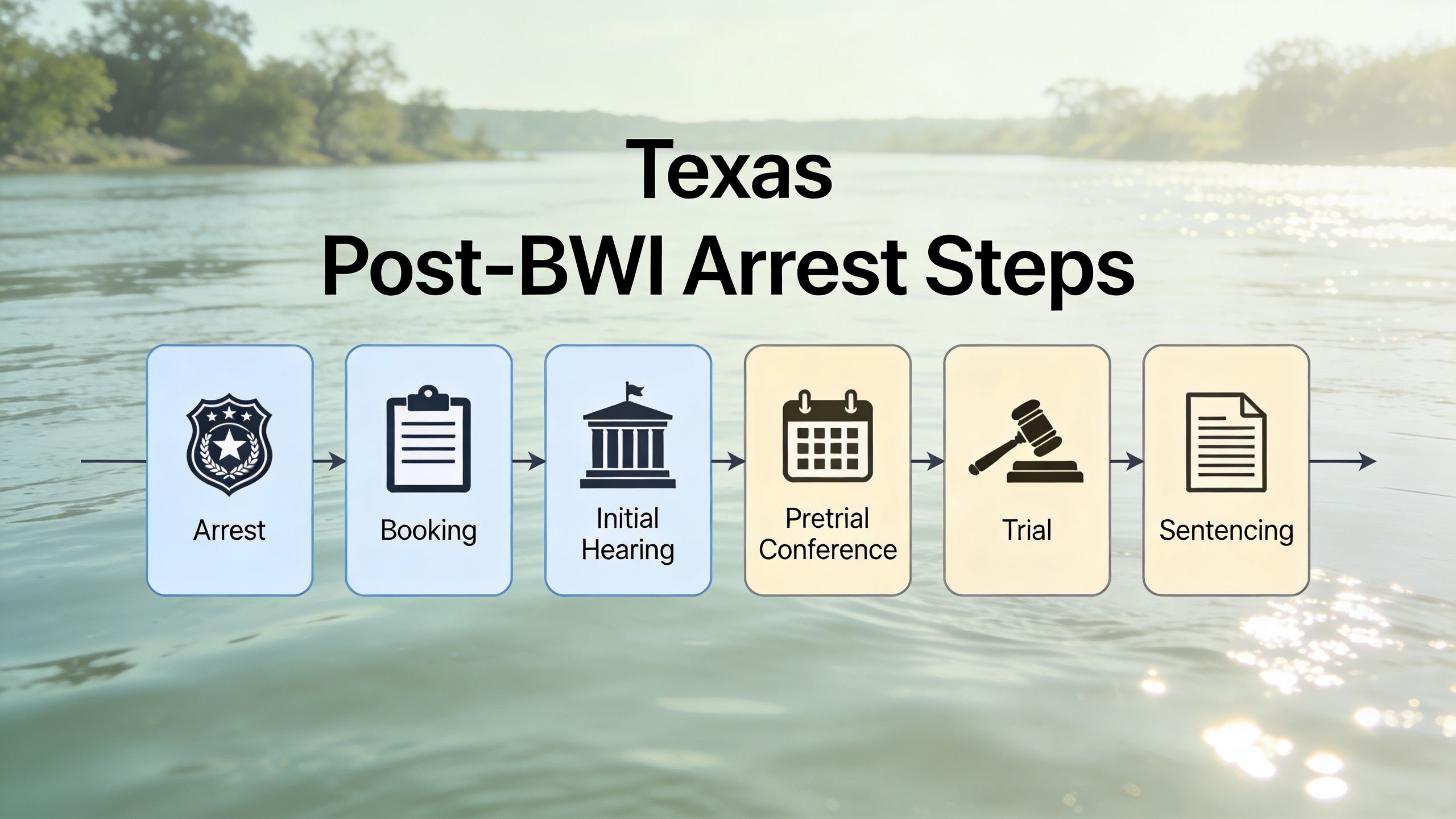
The stop and investigation
Texas officers may begin with a safety inspection or a response to reported unsafe operation. During that contact, they look at your speech, balance, odor of alcohol, eyes, coordination, and answers to basic questions. On water, that can be messy. Boats move. Docks sway. People are wet, sunburned, tired, or dehydrated.
That doesn’t stop officers from using those observations as evidence.
If they suspect intoxication, they may ask you to perform field sobriety tests. Those tests are often hard enough on dry land. On or around a vessel, they can be even more open to challenge later.
Booking and charges
If the officer decides there is probable cause, you may be taken into custody, transported, and booked. At booking, officers document the charge, gather identifying information, and may seek a breath or blood specimen depending on the circumstances and their procedures.
Many people often start asking the wrong people for legal advice. Friends and family mean well, but the better move is to understand your rights and get case-specific guidance quickly. Questions about refusal also come up often. If that issue applies to your case, this article on whether you can refuse a breathalyzer test is a helpful starting point.
Your criminal case and your driver’s license problem may move on separate tracks. Do not assume handling one solves the other.
Arraignment and early court settings
At an early court appearance, the court addresses the charge and release conditions, and the case starts moving through the criminal docket. People often call this arraignment, though local practice can vary by county. Bail conditions may restrict alcohol use, travel, or contact with certain people. If there was an accident, those conditions can become stricter.
This is also where defense strategy starts taking shape. Early questions include:
- Was the stop lawful
- Did the officer have enough to escalate from inspection to investigation
- Were the tests administered and documented properly
- Were your statements voluntary and accurately reported
Plea bargaining, trial, and sentencing
Most criminal cases don’t jump straight to trial. First, the defense reviews reports, videos, testing records, witness accounts, and any weak points in the state’s evidence. Then plea discussions may happen. A strong defense file gives your lawyer more advantage in those talks.
If negotiation doesn’t produce an acceptable result, the case may go to trial. At trial, the state must prove the charge beyond a reasonable doubt. If there’s a conviction, sentencing follows under the applicable law and the court’s findings.
License consequences and fast deadlines
Separate from the criminal case, you may also face a process affecting your driver’s license. People miss this because they focus only on the court date listed on their paperwork. That’s a mistake. License consequences can arrive on a different timeline.
Fast action matters after release. Save every document. Write down what happened while it’s still fresh. Don’t contact witnesses to “straighten things out” on your own. And don’t post your version online. Those steps rarely help and often create new problems.
Building Your Texas BWI Defense Strategy
A BWI case is often won or lost in the details. By the time a client calls me, the officer has already written the report, chosen the language, and framed the events in a way that supports an arrest. Defense work starts by pulling that version apart and comparing it to the video, the witness accounts, the testing records, and the actual conditions on the water.

Where good defenses often begin
No two BWI cases should be defended the same way. The right strategy depends on the lake or bay, the time of day, the weather, the reason for the contact, the officers involved, and whether the state has reliable proof of intoxication or is relying on impressions dressed up as certainty.
I usually start with a few practical questions:
- Why did the contact begin? A lawful safety check does not give officers unlimited authority to turn every encounter into a criminal investigation.
- What did the officer observe? Bloodshot eyes, poor balance, and confusion can have innocent explanations after hours in the heat, sun, chop, and wind.
- Were the field sobriety tests meaningful in that setting? Tests developed for roadside use can become less reliable on docks, ramps, or uneven surfaces near moving water.
- Can the state prove operation? In some cases, that point is weaker than the report suggests, especially if several adults were on board.
- Does the evidence match across sources? If the video, body language, witness statements, and paperwork conflict, that gap matters.
Environmental factors are not excuses. They are part of the facts. Fatigue, dehydration, glare, motion, medical conditions, and unstable footing can make a sober person look impaired, especially to an officer who has already decided what he is looking for.
Mitigation still matters
A defense strategy is not limited to attacking the state’s proof. It also includes reducing damage where the facts are difficult. That can mean gathering medical records, documenting safe boating history, showing employment consequences, or completing a safety course before court if counsel believes it will help.
Boater education can support mitigation in the right case. The U.S. Coast Guard’s Recreational Boating Statistics has long reported higher accident involvement among operators with no formal boating safety instruction, which is why judges and prosecutors often view post-arrest course completion as a sign that the person is taking safety seriously. If you want a broader look at how defense lawyers challenge impairment allegations, this guide on how to fight a DWI in Texas covers several strategies that also carry over into BWI cases.
Good defense asks two questions at the same time. What can be excluded, and what can be explained?
After the case ends
The case file can continue to matter long after court is over. Depending on the result, you may have options such as expunction, nondisclosure, or other post-conviction relief that limit who can see the arrest or charge. Eligibility depends on the outcome, your record, and how the case was resolved.
That timing matters for more than the criminal case. If the incident also led to injuries, civil deadlines can start running while you are still dealing with the prosecution. DFox Law on injury claim timeframes gives a useful overview of that side of the problem. A careful defense plan looks at the whole life of the case, from the first stop through record cleanup after it ends.
Boating Accidents and Your Legal Duties
After a boating accident, people often focus on the physical emergency and forget the legal one. Texas law expects you to stop, help, and report when the facts trigger a reporting duty. Failing to do that can create criminal exposure separate from whatever caused the accident.
What you must do right away
If there’s a collision or serious incident, your first job is safety. Stop the vessel. Check for injuries. Call for emergency help if needed. Exchange identifying information with the other people involved, and don’t leave the scene until it’s lawful to do so.
Then think about reporting. Texas law requires boat operators to report any accident involving death, injury, a missing person, or property damage exceeding $2,000. A written report must be submitted to TPWD within 48 hours for a fatality and within 30 days for other incidents, according to the Texas Parks and Wildlife Department news release.
A practical accident checklist
Use this order if you can:
- Secure people first: Prevent further injury and get everyone into the safest position possible.
- Call for help: Medical response and law enforcement may both be needed.
- Identify witnesses: Don’t coach them. Just make sure names and contact information are preserved.
- Document conditions: Weather, wake activity, location, vessel damage, and visible injuries may matter later.
- Report on time: Missing the reporting deadline can become its own problem.
- Get legal advice early: Especially if alcohol, serious injury, or a death may be alleged.
If the accident also creates civil exposure, timing rules matter there too. For a plain-language overview of those deadlines, DFox Law on injury claim timeframes is a useful companion resource.
A final point matters. Don’t guess on the report, and don’t minimize facts to make the situation sound better. An incomplete or careless statement can damage both your criminal defense and any related civil case.
If you’ve been charged with a crime in Texas, call Law Office of Bryan Fagan PLLC for a free and confidential consultation. Our defense team is ready to protect your rights.