Skip to content
A DWI in Texas means the state says you were operating a motor vehicle in a public place while intoxicated. Under Texas law, that can mean your blood alcohol concentration was 0.08% or higher, or that you had lost the normal use of your mental or physical faculties because of alcohol, drugs, or a combination of substances.
Seeing flashing lights in your rearview mirror can turn an ordinary night into a very frightening one. If you've been arrested, you're probably worried about your license, your job, your record, and what happens next.
That fear is real. So is the fact that there is a path forward.
Facing a DWI in Texas? You Are Not Alone
A traffic stop late at night can change the tone of your week in a matter of minutes. One conversation with an officer can leave you wondering whether you are about to lose your license, face court, or carry a criminal record that follows you into work, family life, and future opportunities.
That reaction is normal.
A DWI charge feels intensely personal, but these cases move through Texas courts every day. Prosecutors and judges take them seriously, which means your first job is to understand where you are in the process. A DWI case works like a chain of stages. The stop, the arrest, the license issue, the criminal case, and the outcome each raise different rights and different choices.
If you searched for what is a dwi in texas, you are probably trying to answer two questions at once. First, what is the state accusing me of? Second, what happens now? Those are the right questions to ask at the start.
Why DWI cases confuse people
A common misconception is that a DWI charge requires a breath test result over the legal limit. In Texas, the accusation often begins earlier, with the officer's observations during the stop and roadside investigation.
It is also a mistake to believe that politeness obligates you to answer every question from an officer. You can be respectful and still protect your rights. That distinction matters from the first contact on the roadside.
Another point causes confusion. A person may be dealing with alcohol, prescription medication, or another depressant, and the signs can overlap in ways that are not obvious to the driver. If substance use is part of the bigger picture, getting help for depressant addiction may matter both for your health and for what comes after the case.
Practical rule: An arrest starts a DWI case. It does not decide it.
What you need right now
You do not need panic. You need a roadmap.
Start with these questions:
- What stage am I in right now? The answer changes what deadlines apply and what decisions make sense.
- What evidence is the state likely relying on? The stop, the officer's observations, body camera video, field sobriety testing, and chemical testing can all matter.
- Is my driver's license at risk already? In many cases, the license issue runs on a separate track from the criminal case.
- What parts of the case can be challenged? A legal problem at the stop, arrest, testing, or paperwork stage can affect the entire case.
- What options exist if the case does not end in a dismissal? Sometimes the best strategy involves reducing the charge, limiting the damage, or planning for post-conviction relief.
That is the frame I want a new client to have. One stage at a time. One decision at a time. Texas DWI law is strict, but the result is never based on one label alone. The facts, the timeline, the evidence, and the choices you make after the arrest all shape what comes next.
What Legally Constitutes a DWI in Texas
Texas defines DWI under Texas Penal Code § 49.04. The word that matters most is intoxicated, and Texas law gives prosecutors two different ways to try to prove it.

The two legal paths prosecutors use
Think of DWI proof as having two lanes.
The first lane is the BAC lane. Under Texas Penal Code § 49.01(2), intoxication can be shown by a BAC of 0.08 or more, as explained in this overview of the legal definition of DWI in Texas.
The second lane is the impairment lane. The state can also claim you didn't have the normal use of your mental or physical faculties because of alcohol, a controlled substance, a drug, a dangerous drug, or some combination of those substances.
That second lane is where people get surprised. You can face a DWI charge even if your BAC is below 0.08, or even if there is no breath result at all.
What officers use as evidence
In impairment-based cases, officers often rely on Field Sobriety Tests. The three most familiar are the Horizontal Gaze Nystagmus test, the Walk-and-Turn, and the One-Leg Stand.
The state often treats those tests as proof of impairment. The same legal overview notes that certain field sobriety testing has a validated 77% accuracy rate for some uses, which is one reason prosecutors present those tests even without a BAC reading.
Still, these tests are not perfect. Roadside conditions matter. So do footwear, fatigue, anxiety, injuries, age, and medical conditions.
You can be arrested because an officer believes you seemed impaired. That doesn't mean the officer's conclusion is beyond challenge.
Alcohol isn't the only issue
Texas DWI law isn't limited to beer, wine, or liquor. Prescription medication, illegal drugs, and mixed-substance cases can also lead to arrest if the officer claims you lost normal use of your faculties.
That matters for people taking sleep aids, anti-anxiety medication, pain medication, or other depressants. If substance use is part of your life, practical support can matter alongside legal defense. A plain-language resource on help for depressant addiction may be useful if you're trying to understand how these substances affect behavior, safety, and treatment options.
The plain-English version
A Texas DWI case usually comes down to one of two claims:
| Legal theory | What the state argues |
|---|---|
| Per se BAC | Your alcohol concentration was 0.08% or higher |
| Loss of faculties | You couldn't use your mind or body normally because of a substance |
If you understand that distinction, you're already in a better position than many people at the start of a DWI case.
Understanding the Consequences of a DWI Conviction
A conviction is the point where many people first realize how wide this problem can spread.
You may be focused on the fine or the jail risk. Those matter. But a Texas DWI conviction can also affect your license, your job, your insurance costs, and any professional credential that depends on a clean record. That is why I tell clients to view the case in stages. First, understand the punishment range. Then look at the separate consequences that follow you outside the courtroom.
First offense consequences
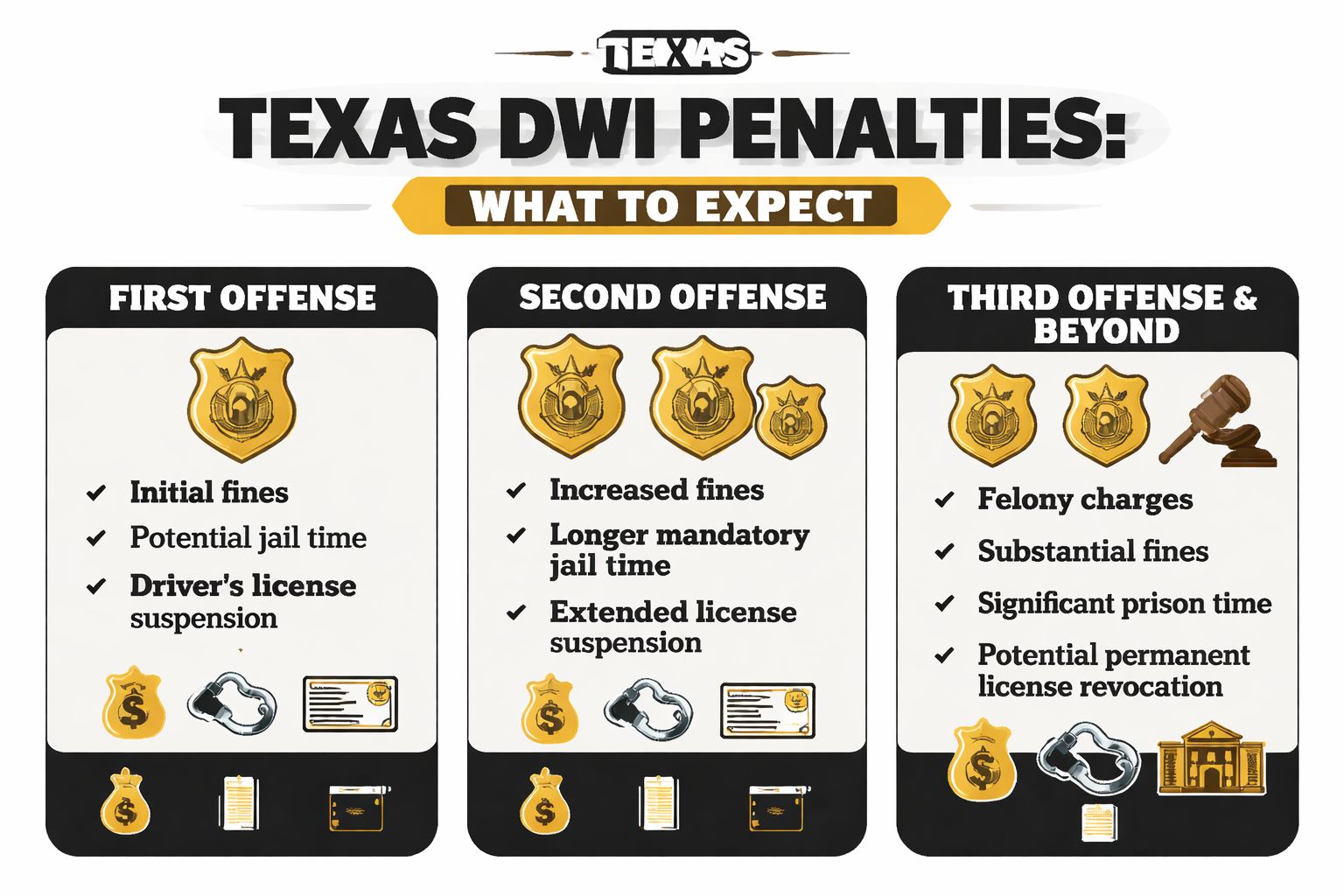
A first DWI is usually charged as a Class B misdemeanor. In plain English, that means it is the lowest rung on the DWI ladder, but it is still a criminal offense with real punishment. A conviction can bring a fine, jail time, and a driver's license suspension under Texas law.
If the allegation includes a BAC of 0.15 or higher, the charge can be filed more seriously. That changes the risk analysis right away. A case that started as "my first arrest" can carry heavier exposure than people expect.
Repeat offenses get more serious fast
Texas increases penalties sharply when there is a prior DWI conviction.
A second DWI is generally a Class A misdemeanor, which raises both the possible fine and the jail exposure. A third DWI is usually a third-degree felony. Once a case reaches felony territory, the stakes are different in every practical sense. Prison exposure becomes real, firearm rights can be affected, and background checks become harder to explain away.
If you have priors from another state, do not assume they are irrelevant. Part of a defense lawyer's job is to examine whether an old case can legally be used to enhance the new one.
A simple way to view the ladder
The easiest way to understand the penalty structure is to picture three doors.
- First offense: misdemeanor punishment, possible jail, fines, and license consequences
- Second offense: a higher misdemeanor level with greater jail risk
- Third offense: felony punishment with much more serious long-term fallout
The legal label matters because it affects far more than the sentence itself.
Beyond the courtroom
A DWI conviction does not stop with the judge's sentence. Beyond criminal court penalties, a DWI can also affect driving privileges, insurance, employment, and professional licensing.
For some clients, that collateral damage is the hardest part. A nurse may worry about a licensing board. A commercial driver may worry about earning a living. A parent may worry about school pickup, probation rules, or higher insurance premiums that strain the family budget. Those concerns are legitimate, and they need to be part of the strategy from the start.
If you have read a comprehensive guide to Georgia DUI, the broad pattern will feel familiar even though Texas uses its own charging rules and procedures.
The license problem is separate
One of the most confusing parts of a Texas DWI case is that the driver's license issue can run on a separate track from the criminal charge.
That separate track is often called the ALR process, short for Administrative License Revocation. It is an administrative case about your driving privileges. It is not the same as the criminal prosecution. A person can have progress in one case and still face trouble in the other. Clients are often surprised by that, but it helps to picture it as two cases growing out of the same arrest.
Court, plea bargaining, trial, and sentencing
After the arrest, the case usually moves through several stages before it ends.
Early court appearances
The first settings are usually about getting the case on the court's calendar, addressing conditions you must follow, and setting deadlines. Making good decisions early at this stage can prevent avoidable mistakes later.
Plea negotiations
Many DWI cases are resolved through negotiation, but that does not mean a mere concession. Negotiation works best after the defense has reviewed the stop, the arrest decision, the testing, the video, and the officer's report. If the evidence is weak in one of those areas, that weakness can affect settlement discussions.
Trial
Some cases should be tried. At trial, the state has to prove its case with admissible evidence, and the defense can challenge the stop, the investigation, the breath or blood evidence, and the officer's interpretation of what happened.
Sentencing and beyond
If there is a conviction, the court can impose fines, confinement, supervision terms, classes, ignition interlock requirements, and other conditions. After that, there may still be important questions about compliance, future eligibility for record-related relief, and how to protect your license and livelihood as you work through the consequences.
The key point is simple. A DWI conviction is serious, but it is not a dead end. It is a legal process with distinct stages, and each stage creates choices that can affect what happens next.
DUI vs DWI and Other Special DWI Cases
A lot of Texans use DUI and DWI as if they mean the same thing. In Texas, they don't.
Adult DWI versus underage DUI
For adults, the common charge is DWI. For drivers under 21, Texas has a zero-tolerance rule. A DUI charge under Alcoholic Beverage Code § 106.041 can apply if there is any detectable amount of alcohol in the minor's system, as explained in this discussion of the difference between a DUI and a DWI in Texas.
That is a much lower threshold than the adult DWI standard.
Side-by-side comparison
| Issue | Adult DWI | Underage DUI |
|---|---|---|
| Who it applies to | Drivers 21 and older | Drivers under 21 |
| Alcohol threshold | 0.08% BAC or loss of normal faculties | Any detectable amount of alcohol |
| Core idea | Intoxication | Zero tolerance |
This is one of the biggest points of confusion for families. Parents often call after a teenager is cited and assume the state must prove the same thing it would need in an adult case. It doesn't.
Other situations that can change the case
Some DWI arrests involve extra facts that make the situation more serious, such as a child passenger, a commercial driver's license, or prior offenses. Those details can affect charging decisions, negotiations, and long-term consequences.
If you're comparing how different states use these terms, a comprehensive guide to Georgia DUI can be helpful for seeing how the language changes outside Texas. Just be careful not to assume another state's rules apply here.
What Happens After a Texas DWI Arrest
Once the handcuffs go on, the process usually moves fast. Knowing the order of events can help you avoid mistakes.

Step one after the stop
The case often starts with a traffic stop. The officer may ask where you've been, whether you've been drinking, and whether you'll perform field sobriety tests.
After that, the officer may arrest you and take you to jail or a processing center for booking. That usually includes fingerprints, photographs, paperwork, and a bond process before release.
The license deadline many people miss
After a DWI arrest, your driver's license issue can move on a separate track. There is often a short deadline to act if you want to fight the suspension.
A key issue in many cases is whether you agreed to testing or refused it. If you're trying to understand that choice and its consequences, this guide on refusing a breathalyzer test in Texas explains how refusal can affect the case and your license situation.
The first paperwork you receive after arrest may matter as much as the court date. Read it carefully and act quickly.
The ALR hearing
The ALR hearing is not your criminal trial. It focuses on whether the state can suspend your license based on the arrest and the testing issues.
That means you can have two separate problems at once:
- The criminal case, where the prosecutor tries to prove DWI
- The license case, where the state tries to suspend your driving privileges
Those two tracks can involve some of the same facts, but they are not the same proceeding.
What court usually looks like next
The next stage is usually your first court appearance, often called an arraignment or initial setting. At this stage, the court formally handles the charge and begins setting deadlines and future dates.
After that, the case may move through several phases:
Evidence gathering
Your attorney requests reports, videos, test records, and other documents.Review of the stop and arrest
The defense examines why you were pulled over, what the officer observed, and whether procedures were followed.Negotiation with the prosecutor
Some cases move toward dismissal issues, reduction discussions, or other negotiated outcomes.Motions and hearings
The court may hear disputes about evidence, testing, or the legality of police conduct.
Here is a short video that helps explain the process in a simple way:
What you should do in the first days
Write down everything you remember while it's fresh. Include where you were, what you drank or took, when you ate, what the officer said, how the tests were given, and whether there were witnesses.
Save any receipts, text messages, rideshare records, or medication information that might matter. Small details often become important later.
How an Experienced Attorney Can Defend Your Case
A DWI case is rarely just about one number. Many cases turn on judgment calls, procedure, and whether the state can prove its version of events.

The stop can be challenged
Police need a lawful reason to stop your vehicle. If the stop wasn't legally justified, that can affect what evidence the state gets to use later.
A defense lawyer starts by asking basic but powerful questions. What traffic violation was observed? Is it on video? Does the report match the bodycam or dashcam?
Field tests are not automatic proof
A significant number of DWI cases rely on subjective officer observations rather than BAC evidence, and defenses often challenge the 20-30% error rate in Field Sobriety Tests, as noted in this review of Texas DWI laws and penalties.
That matters because roadside tests are affected by many things unrelated to intoxication. Uneven pavement, poor lighting, nerves, physical limitations, and prescription medication can all change performance.
Breath and blood evidence can also be questioned
Even when the state has chemical testing, the defense still examines the details. Problems can arise with machine maintenance, timing, handling of the sample, or the chain of custody.
If your case involves a low BAC or an impairment theory instead of a straightforward alcohol reading, the defense may focus on whether the officer confused fatigue, illness, or lawful medication use with intoxication.
A strong defense doesn't rely on one argument. It checks every stage of the case for weakness, from the stop to the testing to the courtroom paperwork.
Building a defense strategy
An attorney may challenge the case by focusing on different pressure points:
- The initial stop if the officer lacked legal cause
- The arrest decision if the observed facts didn't support probable cause
- The field sobriety tests if they were poorly administered or unfairly interpreted
- The chemical evidence if there are reliability or handling issues
- The overall narrative if video and witness accounts don't match the report
For readers looking for a deeper breakdown of defense approaches, this article on how to fight a DWI in Texas gives a practical overview. Firms that handle these cases, including the Law Office of Bryan Fagan, PLLC, typically review the police reports, video, testing records, and court history to look for pressure points in the prosecution's case.
Your Next Steps to Protect Your Rights and Future
If you've been charged, don't panic. But don't drift either. The early choices you make can affect both your license and your criminal case.
Start with the basics:
- Stay quiet about the facts unless you're speaking privately with your lawyer. Statements to police, friends, or social media can come back later.
- Keep every document you received at release, including bond papers, notice forms, and court dates.
- Write down your memory of the stop and arrest as soon as possible.
- Show up to court and follow bond conditions carefully.
- Ask about record relief later if your case is dismissed or resolved in a way that may allow cleanup of your record.
For many people, the long-term question is whether the arrest can be removed from public view. This guide to DWI expungement in Texas explains when expunction or related record relief may be possible.
The main point is simple. A DWI charge is serious, but it isn't hopeless. You have rights at the roadside, rights in court, and options after the case ends. The sooner you get informed and organized, the better position you'll be in to protect your future.
If you've been charged with a crime in Texas, call Law Office of Bryan Fagan PLLC for a free and confidential consultation. Our defense team is ready to protect your rights.