Being arrested in Texas can be terrifying. You may be asking one question over and over. Can a case be dismissed before court in Texas?
Yes, it can.
An arrest starts a case. It does not decide the outcome. In many situations, a criminal case can end before trial because the prosecutor drops it, a judge excludes key evidence, a grand jury refuses to indict, or the case is resolved through a program that leads to dismissal. The path depends on the facts, the charge, the county, and how quickly your defense moves.
If you were arrested for DWI, assault, theft, or drug possession, the worst thing you can do is assume the system will sort itself out. The better approach is to treat dismissal as a goal that requires strategy. That means preserving evidence, identifying police mistakes, reviewing probable cause, challenging searches, and putting pressure on weak parts of the State's case early.
An Arrest Is Not a Conviction Your Path to a Dismissal
A lot of people call a lawyer from the same place. They've just bonded out, their phone is full of worried messages, and they think their case is already halfway to a conviction.
It isn't.
A Texas criminal case usually has several decision points before trial. After an arrest, police reports are reviewed. Charges may be filed or screened. Evidence gets tested. Witnesses may cooperate, or they may not. Video can help the State, or it can help you. What looked strong at the arrest scene can weaken fast once the legal issues come into focus.
Practical rule: The earlier your defense starts, the more chances you have to shape the outcome before trial ever happens.
That matters in everyday cases. A Texas DWI attorney may challenge whether the officer had a lawful reason to stop your car. A Houston criminal lawyer handling a theft case may focus on identification problems, missing store video, or weak proof of intent. In a Texas assault defense case, the key issue might be self-defense, inconsistent witness statements, or whether the allegation matches the injuries.
What your case usually looks like after arrest
Most cases move through a sequence like this:
- Arrest and booking
- Bail or bond conditions
- Filing decision by the prosecutor
- First court appearances and settings
- Evidence review and negotiations
- Pretrial motions
- Possible dismissal, plea, or trial
In Texas, criminal procedure gives the defense chances to test whether the State can legally use its evidence. Texas Penal Code charges define the offense itself, but the State still has to prove that offense with admissible evidence. If it can't, dismissal becomes a real possibility.
The mindset that helps
Don't think of dismissal as luck. Think of it as a result that sometimes comes from pressure, preparation, and timing.
You can help by staying off social media, following bond conditions, saving texts and videos, and giving your lawyer names of witnesses right away. Those small steps can make a large difference when your attorney starts building a dismissal strategy.
How Prosecutors Decide to Dismiss a Case
The prosecutor is the first major gatekeeper in a criminal case. An arrest by police does not force the District Attorney's office to keep moving forward if the proof doesn't hold up.

A prosecutor reviews what the police gathered and asks a practical question. Can this case be proven in court with admissible evidence? If the answer is no, dismissal can happen before trial.
What prosecutors are looking at
Think of the prosecutor's review as a filter. Some cases move through. Others don't.
Common pressure points include:
- Weak evidence: The report may sound confident, but the proof may be thin once body cam, lab work, or witness statements are reviewed.
- Witness problems: A complaining witness may change their story, stop responding, or create credibility concerns.
- Police procedure issues: If officers made mistakes during a stop, arrest, or search, important evidence may be vulnerable.
- Proof problems on elements: Under the Texas Penal Code, each charge has elements the State must prove. In theft, intent matters. In assault, the facts must fit the legal definition. In drug possession, the State must tie the substance to you, not just the place where it was found.
Why this differs by case type
A misdemeanor theft case and a felony drug case are not evaluated the same way.
In a shoplifting allegation, the prosecutor may decide the evidence is too shaky if identification is poor or store footage doesn't clearly show concealment and intent. In a felony case, the State may push harder at first, but serious charges also create serious litigation over searches, statements, and forensic evidence. That can open the door to dismissal if the legal foundation cracks.
A useful way to understand charging decisions is to review how prosecutors decide whether to file charges in Texas. The filing stage often decides whether your case gains momentum or starts to weaken.
A strong defense presentation can change how the prosecutor sees the case before trial settings pile up.
What actually helps and what doesn't
What helps:
- Early defense contact with the prosecutor
- Organized evidence from the defense side
- A clear explanation of legal weaknesses
- Proof of mitigation when appropriate
What doesn't help:
- Calling the prosecutor yourself and talking too much
- Posting your side of the story online
- Assuming the complaining witness can “drop charges”
- Ignoring court dates while hoping the case disappears
Later in the process, legal motions can create even more pressure on the State. This overview gives a practical look at that stage.
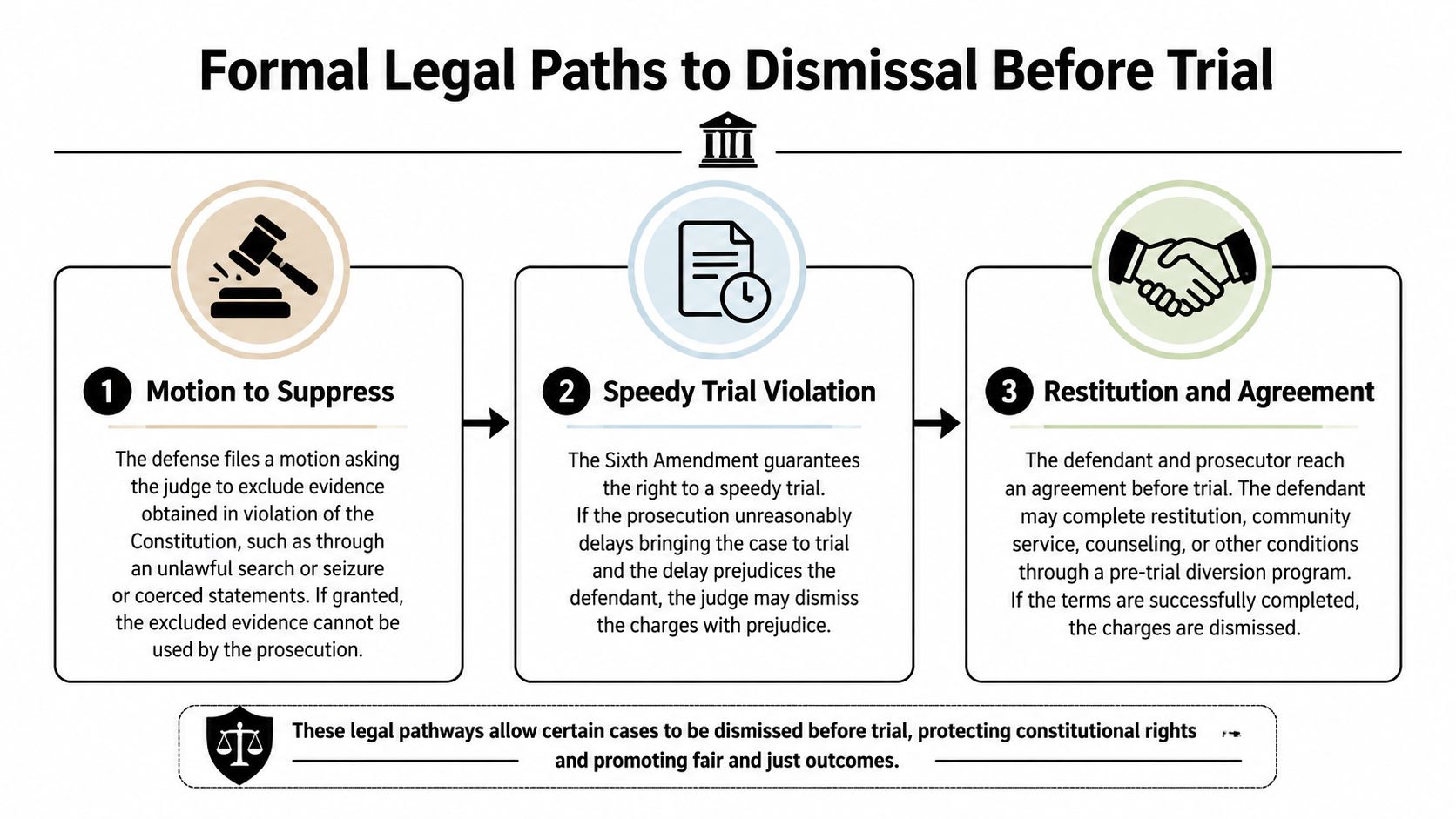
Formal Legal Paths to Dismissal Before Trial
Some dismissals happen because a prosecutor chooses to drop the case. Others happen because the law creates a formal path that blocks the case or resolves it without trial.
Grand jury no-bill in felony cases
If you're facing a felony, the case may go to a grand jury. That group reviews whether there is enough basis to issue an indictment. If the grand jury returns a no-bill, the case does not move forward as a felony prosecution in that form.
This is one reason early defense work matters. In some cases, your lawyer may present favorable information before indictment. That can include documents, witness information, or context that changes how the case is viewed.
A no-bill is not available in every case, and the defense does not control the process. But for the right felony case, it can stop momentum before trial ever begins.
Pretrial diversion and negotiated dismissal
Not every dismissal comes from attacking the evidence. Some come from structured agreements.
In eligible cases, a person may enter a pretrial diversion or similar program. These programs often focus on rehabilitation, accountability, and clean compliance. If the person completes the conditions, the case may be dismissed.
This can come up in first-offense situations, lower-level drug allegations, theft cases, and some other nonviolent cases depending on the county. Conditions may involve classes, community service, counseling, testing, treatment, or staying arrest-free.
Here is the trade-off:
| Path | Main benefit | Main concern |
|---|---|---|
| Fight for immediate dismissal | Ends the case without program conditions if successful | May require stronger legal grounds |
| Enter diversion | Creates a practical route to dismissal in some cases | Requires compliance and may not fit every record or charge |
For some people, diversion is a smart result. For others, it is not. If your case has a strong suppression issue or a real probable cause problem, it may be better to push for a straight dismissal instead of accepting conditions.
Motions that can force the issue
One of the most important formal tools is a motion to suppress. If evidence was seized illegally, a judge can keep it out. In Texas criminal practice, that can change everything. If the State loses the evidence it needs, the prosecution may decide it can't go forward.
A plain-language discussion of that issue is available in this article on what a motion to suppress evidence means in Texas.
When the State's key proof is excluded, dismissal becomes a case survival problem for the prosecution.
Civil dismissals before trial also exist
People sometimes ask this question because they are dealing with a civil case, not a criminal one. In Texas civil cases, a plaintiff can often end the case before trial by filing a notice of nonsuit, depending on timing, and courts can also dismiss for want of prosecution when the plaintiff fails to appear or move the case forward under Texas dismissal rules described by Texas Law Help.
That is a different system from criminal court, but it shows the broader point. In Texas, many cases end before trial because procedure matters.
Proactive Defense How Your Lawyer Can Fight for a Dismissal
You get out of jail, bond conditions start immediately, and your first court date is on the calendar. At that point, the case can feel like it is already rolling downhill. It is not. Early defense work can change the direction of a Texas criminal case before it ever reaches trial.
The right approach is strategic and aggressive. A defense lawyer should be building pressure from day one by collecting records, locking in facts, identifying legal defects, and putting the prosecutor in a position where dismissal becomes the practical answer.
Start building the record immediately
Good dismissal work often begins outside the courtroom. Patrol video can be lost. Witness memories fade. Store footage gets overwritten. If the defense waits too long, opportunities disappear.
Early case work may include requesting body cam and dash cam, gathering dispatch records, interviewing witnesses, preserving phone data, visiting the scene, and comparing the police report to the actual evidence. In many cases, the report sounds cleaner than the footage looks. That gap matters.
I often tell clients the same thing. The first weeks matter more than they expect.
Attack the stop, search, and seizure with specifics
One strong path to dismissal is forcing the State to defend how the case started. If the stop was bad, the detention went too far, or the search violated the law, the evidence can become much harder to use.
Texas Code of Criminal Procedure Article 38.23 gives the defense a real tool here. In practice, that means your lawyer studies the timeline carefully. What did the officer know at the moment of the stop? What facts allegedly created probable cause? Did the officer extend the detention without legal justification? Did police obtain consent lawfully, or was it the product of pressure and confusion?
These issues come up often in DWI, drug, firearm, and assault cases. A prosecutor evaluating a suppression problem has to ask a hard question. If the judge keeps out the key evidence, what is left to prove?
Expose weaknesses the file does not admit
Some cases are dismissed because the legal paperwork looks fine, but the proof is shaky once someone tests it.
A lawyer may focus on:
- inconsistent witness statements
- weak or contaminated identification procedures
- gaps in chain of custody
- missing video or erased messages
- medical records or timeline evidence that contradicts the allegation
- officers who wrote conclusions instead of facts
Experience proves essential. The defense is not just looking for a dramatic flaw. The defense is finding the pressure points that make a prosecutor question whether the case can survive cross-examination, a pretrial hearing, or a jury.
Use procedure to force decisions
A passive defense leaves the State comfortable. A proactive defense forces deadlines, hearings, and accountability.
That can mean filing targeted motions, demanding discovery, requesting notice of the State's intent to use certain evidence, pressing for witness interviews where allowed, and setting issues for hearing instead of letting the file drift. The goal is simple. Make the prosecution confront the weak parts of the case early enough that dismissal is still on the table.
There are trade-offs. Filing too much, too fast, without a clear purpose can educate the State and give it time to patch holes. Filing too little can waste valuable strategic advantage. Good defense work is not motion practice for show. It is choosing the right pressure at the right time.
Keep the client's long-term outcome in view
The best dismissal strategy also accounts for what happens after the criminal case ends. Some resolutions protect your record better than others, and some dismissals create a stronger path to clearing the arrest later. If that is part of the goal, your lawyer should be thinking about it before any deal is made, not after. This guide on clearing your record after a dismissal in Texas explains why the wording and posture of the final outcome matter.
If you are hiring counsel, ask practical questions. Do they personally review the video? Do they press suppression issues when the facts support it? Do they prepare cases for contested hearings, not just plea settings? Do they handle record-clearing matters after a favorable result? Law Office of Bryan Fagan PLLC handles criminal defense matters across Texas, including DWI, assault, theft, drug charges, and post-dismissal record issues.
No honest lawyer promises a dismissal. Good lawyers build the conditions that make one possible.
What Happens After Your Case is Dismissed
A dismissal is a major win. But it doesn't erase the arrest by itself.
That catches many people off guard. They think the case is over, so the record must be gone too. Usually, that is not how it works. If you do nothing, the arrest and court record may still appear in background searches.

Expunction and nondisclosure are different
You need to know which remedy fits your situation.
- Expunction: This is the stronger remedy. It is used to destroy eligible records so the arrest and case are removed from public view.
- Nondisclosure: This seals eligible records from the public, but it is not the same as destruction.
In everyday terms, expunction is the cleaner result when available. Nondisclosure is still valuable, but it works differently and applies in different situations.
The part people miss
You usually must file a separate petition after the criminal case ends. It is not automatic.
That means the post-dismissal process may involve:
- Reviewing the final case outcome
- Checking eligibility for record clearing
- Filing the right petition in the right court
- Giving notice to agencies that hold the records
- Following through until the order is entered and processed
A practical guide to that process is available here: clearing your record after dismissal in Texas.
Why this matters for your future
A dismissed case can still affect job searches, housing applications, professional licensing, and personal reputation if the record stays visible. That is why the work often isn't finished when the criminal charge is dismissed.
If your goal is to move on fully, ask your lawyer about record clearing while the criminal case is still active. Planning early helps because the lawyer already knows the case history, the charge, and how the dismissal happened.
Dismissal ends the prosecution. It doesn't automatically clean your record.
Common Questions About Getting a Case Dismissed in Texas
Can a case be dismissed before court in Texas
Yes. A Texas criminal case can be dismissed before trial, and sometimes before the first meaningful court setting. That usually happens because the State cannot prove the charge with admissible evidence, a witness falls apart, a legal defect exists in the case, or the defense gives the prosecutor a clear reason to stop prosecuting.
The practical point is this. Dismissals rarely happen by waiting. They are often the result of early, focused defense work that exposes weaknesses before the State is ready for trial.
Is dismissal guaranteed if the police made a mistake
No. The mistake has to matter under the law.
A paperwork typo may change nothing. An unlawful stop, an illegal search, a bad identification procedure, or a statement taken in violation of your rights can change the entire case. The question is whether the problem affects probable cause, admissibility of evidence, or the State's ability to prove each element of the offense.
Can the prosecutor refile the case later
Sometimes.
If a case is dismissed without prejudice, the State may be allowed to file it again if the limitations period has not expired and the facts support refiling. If a case is dismissed with prejudice, the State is barred from bringing that same charge again. Any defendant considering a dismissal offer should understand which one it is, because that detail affects how much finality you really have.
How long does it take to get a case dismissed
There is no standard timeline in Texas.
Some dismissals happen early, after a prosecutor reviews the file and sees a problem. Others take months of obtaining reports, pressing for video, interviewing witnesses, filing motions, and forcing legal issues into the open. Felony cases usually take longer than misdemeanors, and local court practices matter.
The better way to measure progress is to ask whether your defense is building pressure. Has the lawyer requested the evidence? Found missing proof? Raised legal challenges? Put the prosecutor in a position where keeping the case becomes harder to justify?
Is a dismissal the same as being found not guilty
No. They are different outcomes.
A dismissal ends the prosecution without a conviction. A not-guilty verdict comes after trial, when the State fails to prove the charge beyond a reasonable doubt. Both avoid a conviction, but they happen at different stages and for different reasons.
Can first-time offenders get dismissals more easily
Sometimes, especially in lower-level cases where diversion or other negotiated resolutions may be on the table. But being a first-time offender does not erase bad facts, and it does not force a prosecutor to dismiss anything.
What helps is a mix of factors. A clean record can improve negotiating posture. Weak evidence helps more. So does quick action by the defense.
What should you do right now if you want the best chance at dismissal
Start acting like every decision matters, because it does.
- Do not discuss the facts of the case: Not with police, not with alleged witnesses, and not on social media.
- Follow every bond condition: A bond violation can turn a manageable case into a harder one.
- Save favorable evidence now: Keep texts, call logs, photos, receipts, location history, surveillance leads, and witness names.
- Write down your timeline: Small details fade fast, and those details often help your lawyer find defenses.
- Hire counsel early: Early intervention gives your lawyer more room to challenge the case before positions harden.
If you are facing DWI, assault, theft, drug, or other criminal charges, the path to dismissal is usually built step by step. The question is not just whether dismissal is possible. The question is whether you and your lawyer are doing the work that makes dismissal more likely.
If you've been charged with a crime in Texas, call Law Office of Bryan Fagan PLLC for a free and confidential consultation. Our defense team is ready to protect your rights.