Being arrested in Texas can feel like your life just stopped. Then you hear something that sounds hopeful: the alleged victim says they don't want to go forward, or they may refuse to testify. A lot of people assume that means the case will disappear. In real courtrooms, it usually isn't that simple.
I've talked with many people in this exact spot. They aren't trying to play games. They're trying to understand what happens next, whether the prosecutor will back off, and whether they should expect dismissal, a plea offer, or trial. Those are fair questions. The answer depends less on one person's wishes and more on what evidence the State can still use.
Being Accused Is Stressful Especially When Facts Are Complicated
A common phone call goes like this: "We made up. She doesn't want to testify. So the case should be over, right?" Sometimes people ask that after an assault arrest. Sometimes it's after a family violence charge. Sometimes it's tied to a protective order, bond conditions, or a heated argument that got reported before everyone calmed down.
The hard part is that criminal cases don't run on private agreements. They run on court dates, police reports, recordings, witness statements, and the prosecutor's decision about whether the charge can still be proved. That's why the answer is rarely yes or no on the first day.
This situation is also emotionally messy. In many cases, both sides are dealing with stress, embarrassment, family pressure, or trauma. For people trying to process that side of things, outside support can matter. If emotional aftereffects are part of the picture, resources like Penticton trauma counselling services can help someone understand their reactions and get grounded while the legal case unfolds.
Most clients don't need false hope. They need a clear read on what the prosecutor can still prove and what the defense can still challenge.
The myth about dropping charges
In Texas, people often say the victim can "drop the charges." That's not how criminal prosecution works. A complaining witness can become unwilling, uncooperative, or unavailable. But that doesn't automatically shut the case down.
What matters is whether the prosecutor still has enough admissible evidence. If the file is thin, the refusal to testify may seriously weaken the case. If the file contains recordings, photos, officers who observed injuries, or other witnesses, the case may keep moving.
Why this question matters early
This issue affects almost every stage of a criminal case:
- After arrest: Your bond conditions may still stay in place even if the complainant wants contact.
- At arraignment or first settings: The prosecutor may ask for more time to evaluate witness cooperation and evidence.
- During plea bargaining: A weaker witness can shift the advantage, but it doesn't guarantee a dismissal.
- Before trial: The key fight often becomes what evidence the judge will allow the jury to hear.
If you're searching for what happens if a victim refuses to testify in texas, you're really asking a bigger question. Can the State still prove the case without that person on the stand? That's the question that drives almost every practical decision from this point forward.
Why the State Can Prosecute Without the Victim's Cooperation
The most important idea to understand is simple. The prosecutor represents the State of Texas, not the individual complainant. Once charges are filed, the case is no longer a private dispute that one person can turn on or off.
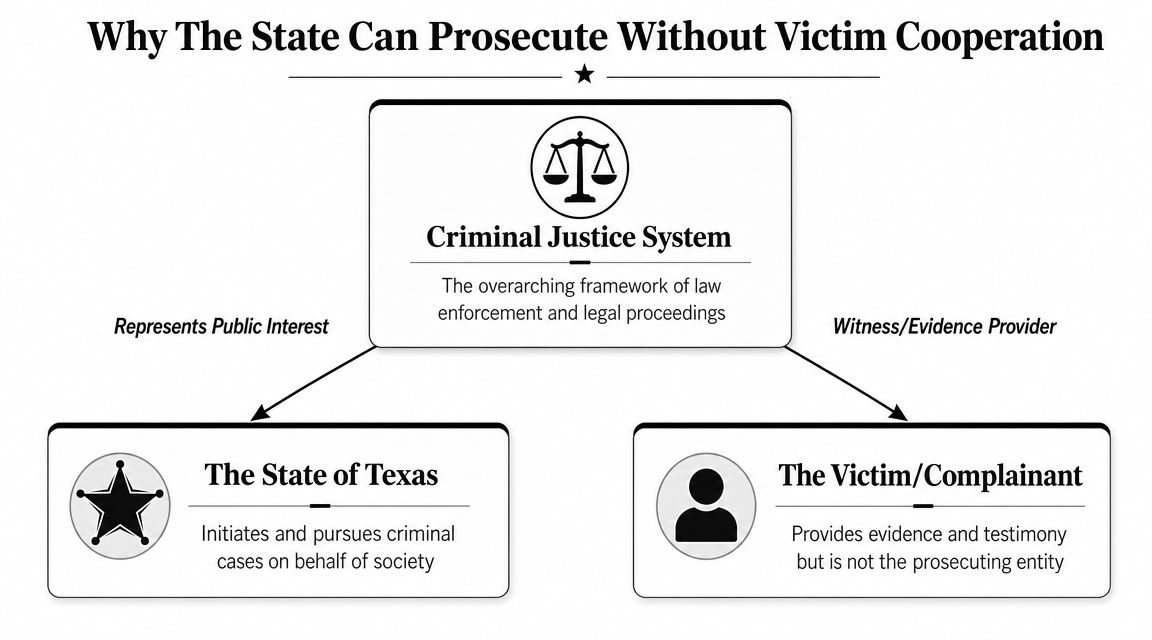
Who controls the case
If an employee reports suspected theft at a business, the company decides whether to pursue the matter. The employee may be an important witness, but the employee doesn't own the claim. In a criminal case, the "company" is the State of Texas. The complainant may provide evidence, but the government decides whether to prosecute.
Texas defense sources explain this directly. In Texas criminal cases, a victim's refusal to testify doesn't automatically end the prosecution because the case belongs to the State, not the complainant. If a properly subpoenaed witness fails to appear, a court may issue a writ of attachment, and prosecutors may still try to proceed using other evidence such as an admission by the defendant, an independent eyewitness, or prior testimony from a preliminary hearing, as discussed in this Texas analysis of what happens when an alleged victim doesn't show up.
That one rule explains why people get blindsided. They thought the case depended on one person showing up and repeating the accusation. Sometimes it does. Often it doesn't.
Why prosecutors think this way
A prosecutor isn't supposed to ask only one question: "Does the complainant still want this case?" The prosecutor asks a different set of questions:
| Question | Why it matters |
|---|---|
| Is there enough admissible evidence? | Without admissible proof, the case may stall or fall apart. |
| Is there corroboration? | Recordings, injuries, and other witnesses can reduce dependence on one person. |
| How serious is the allegation? | Judges and prosecutors often treat higher-stakes cases more aggressively. |
| Can the witness be compelled to appear? | A subpoena changes the court's options. |
Those decisions start early. If you want a better sense of charging decisions generally, this guide on how prosecutors decide whether to file charges in Texas helps explain the screening process.
Practical rule: Don't assume "they don't want to testify" means "the case is dismissed." It means the prosecutor has a problem to solve. Sometimes it's a big problem. Sometimes it isn't.
What this means for you
Your legal opponent is the government. That's the frame you should use from the start. If you're facing assault, family violence, or another charge, the main issue is whether the State can meet its burden in court. Everything else, including recanting, noncooperation, and missed court dates by witnesses, matters only because it changes that proof question.
What a Prosecutor Can Do When a Victim Refuses to Testify
When a complaining witness stops cooperating, prosecutors usually focus on two tracks. First, they try to secure the witness's attendance. Second, they look for a way to prove the case without relying on live testimony from that person.
The subpoena problem
A subpoena is a formal court order directing a witness to appear. Ignoring it is a serious mistake. If a witness was properly subpoenaed and doesn't appear, the judge can take steps to compel attendance.
That doesn't mean every reluctant witness gets dragged into court in every case. It does mean the court has tools, and prosecutors know how to ask for them. If the witness does appear but refuses to answer, that creates another layer of legal trouble for the witness and another strategic decision for the State.
The evidence prosecutors look for
Texas criminal practice recognizes that the victim doesn't control whether prosecution continues. The State may keep going if it has independent proof such as 911 recordings, body-worn camera video, police observations, medical records, photographs, and third-party witness testimony, as explained in this discussion of domestic violence cases when a victim doesn't want to press charges.
That list matters because it shows how a prosecutor builds a backup case. In plain English, prosecutors ask whether they can tell the story through other people and other records.
Here are common examples:
- Emergency recordings: A 911 call may capture panic, statements made during the event, or background sounds the prosecutor argues support the charge.
- Officer observations: A police officer may testify about injuries, damage, demeanor, or what was happening at the scene.
- Digital and physical evidence: Photos, messages, damaged property, and medical documentation may give the prosecutor something concrete to work with.
- Other witnesses: Neighbors, family members, friends, or bystanders may supply parts of the story the State needs.
This short video gives a useful general overview of how these cases can continue even when the complaining witness is reluctant:
What works for the State and what doesn't
From the prosecutor's side, compelling attendance can help if the witness is wavering but still likely to answer questions. It works less well when the witness is firmly hostile, evasive, or likely to say things that hurt the State's case.
Building around the witness works best when the file already contains strong independent proof. It works poorly when the original accusation is the only real evidence and everything else is just repetition of that accusation.
That's why two assault cases that sound similar can head in very different directions. One becomes a plea negotiation because the file is packed with corroboration. The other gets weaker every time the court date moves because the witness is central and the backup proof is thin.
Common Scenarios for Victim Testimony Refusal
Refusal to testify isn't typically motivated by a single, simple reason. Real life is usually more tangled than that. In Texas assault and family violence cases, the refusal often grows out of relationships, money, fear, guilt, parenting concerns, or the simple fact that the legal system is stressful.
The domestic violence pattern prosecutors expect
A very common scenario starts with a heated argument, an arrest, and then a sudden change in position. A partner may later say they don't want the defendant to go to jail, don't want a conviction affecting work or immigration, or want the family back under one roof. Sometimes the original report was exaggerated. Sometimes the later recantation is incomplete. Sometimes both sides are dealing with pressure from relatives.
Prosecutors know this pattern well. That matters because they often view recantations cautiously rather than taking them at face value.
A defense-oriented Texas source notes that in many misdemeanor domestic violence and assault cases, charges are often dropped when the victim refuses to testify, but that isn't universal. It depends on whether the prosecutor still has enough admissible evidence to prove guilt beyond a reasonable doubt. When the victim's statement is the only evidence, refusal to testify can leave the State with little or no usable trial evidence, as explained in this Texas discussion of victims refusing to testify.
Scenarios that tend to weaken the case
Some situations make the State's job much harder:
- No corroboration: There are no photos, recordings, injuries, or outside witnesses.
- A changing story: The complainant gave different versions at different times.
- A weak police file: Officers documented very little beyond the initial accusation.
- A misdemeanor setting: In lower-level cases, the State may be less willing to push a weak file to trial.
If your case involves recanting or changed statements, this guide on assault victim recantation in Texas is useful background.
A recantation doesn't speak for itself. The court looks at the full file, not just the newest version of events.
Scenarios that still worry the defense
Other fact patterns remain dangerous even when the witness refuses to cooperate. A frantic 911 call, visible injuries on camera, a neighbor who saw part of the event, or damaging statements by the accused can keep the case alive.
This is why broad internet advice often misleads people. Two defendants may both hear, "the victim won't testify." One has a realistic shot at dismissal. The other still faces a file the State can present in a convincing way.
Judges also know that witness reluctance can come from many causes. They won't assume it means the accusation was false. They also won't assume it means the State can still prove the charge. They wait to see what evidence survives legal challenge.
Your Rights and How the Defense Can Respond
A victim's refusal to testify is not an automatic win. It can still create a real defense advantage. The biggest reason is that criminal trials have evidence rules, and prosecutors can't read every statement in the police report to the jury.

The Confrontation Clause matters
The Confrontation Clause is part of your Sixth Amendment rights. In simple terms, it gives you the right to confront and cross-examine witnesses against you in many trial situations. If the State wants to use prior testimonial statements from a witness who won't answer questions, the defense may object.
Texas legal commentary explains that if a victim is subpoenaed, appears, and still refuses to answer, the court can treat that as contempt. But the more important trial issue is the Confrontation Clause. If the State tries to use the victim's prior testimonial statements, the defense can challenge them unless the witness is available for cross-examination or a recognized hearsay exception applies. That can sharply reduce the admissible evidence pool, as discussed in this analysis of whether a witness can refuse to testify in a criminal case.
What the defense often targets
A defense lawyer usually looks at several pressure points at once:
- Police statements: Were they testimonial? If so, can they come in without cross-examination?
- Recorded calls: Are they admissible for the truth of what was said, or only for limited purposes?
- Officer testimony: Is the officer describing observations, or just repeating someone else's statement?
- Documents and photos: Do they prove an element of the offense, or only suggest something happened?
Defense focus: The question isn't whether the accusation exists in a report. The question is whether the prosecutor can legally place that evidence before a judge or jury.
Strategic options after the witness backs away
When the witness becomes unavailable or refuses to cooperate, a skilled defense attorney may:
- Push evidentiary objections early. If key statements are excluded, the State may have a much weaker case than it expected.
- Use the weakness in plea negotiations. Some cases become candidates for reduction because the proof risk has changed.
- Prepare for trial from a position of pressure. If the State's story now has gaps, those gaps matter.
- Protect you from unforced errors. Contacting the witness, violating bond conditions, or trying to shape testimony can destroy otherwise useful advantage.
In Texas criminal defense, strategic legal representation is vital. A firm like Law Office of Bryan Fagan, PLLC handles Texas criminal defense matters including assault and family violence cases, and the practical work often involves reviewing body camera footage, police reports, recorded statements, bond terms, and trial admissibility issues rather than relying on assumptions.
Don't confuse leverage with safety
A weaker case is still a pending case. You still have to appear in court, follow bond conditions, and prepare as if the State may proceed. That's true whether the charge is assault, DWI with a related disturbance, theft tied to a household conflict, or another offense where witness cooperation changes over time.
What to Do if You Are a Witness Served with a Subpoena
If you're the witness and you've been served with a subpoena, the worst move is pretending it will go away on its own. A subpoena is a court order. Ignoring it can create a new legal problem on top of the one you're already trying to avoid.
What not to do
Don't skip court because you're nervous. Don't assume the prosecutor will excuse you because you've changed your mind. Don't rely on advice from friends, family, or the defendant about what the subpoena "really means."
If you've already missed a setting or are worried about the consequences, this article on what happens if you miss a court date in a Texas criminal case helps explain why fast action matters.
If you were served, treat the date as real until a court or lawyer tells you otherwise.
What to do instead
Take a calm, structured approach:
- Read the subpoena carefully: Check the court, date, time, and whether it requires testimony or records.
- Talk to a lawyer for yourself: A witness may need independent counsel, especially if testimony could expose the witness to criminal risk.
- Preserve communications: Keep the subpoena, voicemails, texts, and any contact from the prosecutor's office or defense counsel.
- Show up unless your lawyer advises otherwise: Failing to appear usually makes things worse, not better.
When the Fifth Amendment may matter
Some witnesses worry that testifying could incriminate them. That concern can be real. In those situations, the proper step is not refusal by silence or disappearance. The proper step is getting legal advice about whether a Fifth Amendment privilege may apply to specific questions.
That doesn't mean every reluctant witness can refuse to answer everything. It means the issue has to be handled the right way, in the right setting, with legal guidance. Courts take lawful privileges seriously. Courts also take defiance of subpoenas seriously.
A note for families
Families often try to solve this informally. They call each other, pass messages, and try to smooth things over before court. That can create more risk for everyone. If you're a witness, get your own advice. If you're the accused, don't coach, pressure, or contact the witness in ways that violate court orders.
How a Houston Criminal Defense Attorney Can Protect Your Rights
When a witness refuses to testify, the case doesn't turn on one dramatic moment. It turns on a series of smaller decisions by prosecutors, judges, and defense counsel. Which statements can come in. Which recordings matter. Whether the witness appears. Whether the remaining proof is enough.
That's why these cases can't be judged by rumor. Practical defense work means reading the file closely, spotting evidentiary weaknesses, challenging inadmissible statements, and deciding whether the better path is negotiation or trial. If you're facing a Texas assault defense case, a related protective order issue, or charges tied to a family conflict, you need a lawyer who understands both procedure and courtroom strategy.
Legal practice is also more document-heavy and video-heavy than is commonly expected. For lawyers interested in workflow and case review systems, it's useful to compare the best legal tech tools used for organizing records, transcripts, and evidence. Those tools don't replace legal judgment, but they show how much modern defense depends on careful evidence analysis.
The same general rule applies whether you're dealing with assault, drug possession, theft, or a DWI case with disputed witness accounts. The State still has to prove the charge with admissible evidence. If your case ends favorably, you may also want to ask about expunction, nondisclosure, record sealing, or other post-conviction and post-case relief that can help you move forward.
If you've been charged with a crime in Texas, call The Law Office of Bryan Fagan, PLLC for a free and confidential consultation. Our defense team is ready to protect your rights.
If you're dealing with an assault, family violence, DWI, theft, or drug case in Texas, don't assume the case is over just because a witness changed course. Get clear advice about the evidence, your bond conditions, plea options, trial risks, and whether relief like expunction or record sealing may be available later. Contact Law Office of Bryan Fagan PLLC for a free and confidential consultation.