Being arrested for assault in Texas can be terrifying, flipping your world upside down in an instant. Yes, assault charges can be dropped, but there’s a huge misunderstanding about who actually has the power to make that call. You don’t have to face this alone.
The person who accused you cannot simply "drop the charges." That decision belongs entirely to the prosecutor representing the State of Texas. Understanding this is the first step toward building a strong defense.
Understanding Who Controls Your Assault Case
One of the first questions racing through your mind is probably, "Can I get these charges dropped?" It’s a common belief that if the accuser changes their mind, the whole thing just disappears. That’s not how the Texas criminal justice system works.
Once an arrest is made, the case stops being a private disagreement. It officially becomes The State of Texas vs. You. At that point, the prosecutor—an attorney working for the government—takes complete control. Their job is to represent the state's interests, not the personal wishes of the alleged victim.

This means even if the accuser signs a sworn statement asking for the case to be dismissed, known as an Affidavit of Non-Prosecution, the prosecutor can still push forward. If they believe there's enough other evidence to get a conviction, they often will, especially in cases involving family violence allegations.
So, what does this all mean for your defense? It means your strategy must be aimed squarely at the prosecutor, not the accuser.
To get a dismissal, you need to convince the State that its case is too weak, flawed, or problematic to pursue. A skilled Houston criminal lawyer knows exactly how to pick apart the state's evidence, find inconsistencies, and negotiate directly with the prosecutor. Getting a handle on this dynamic is the first, most critical step toward protecting your rights.
Who Decides if Assault Charges Are Dropped in Texas?
To make it crystal clear, let's break down who has the power in your assault case. The table below outlines the roles of each party and who holds the authority to drop the charges.
| Party Involved | Role in the Case | Authority to Drop Charges? |
|---|---|---|
| The Alleged Victim | The person who made the initial accusation. They act as a key witness for the State. | No. They can express their wishes but cannot force a dismissal. |
| The Prosecutor | The government attorney who represents the State of Texas and prosecutes your case. | Yes. They have the sole discretion to dismiss or "nolle prosequi" the case. |
| Your Defense Attorney | Your legal representative, whose job is to challenge the State's evidence and advocate for you. | No. They can argue for dismissal through motions and negotiations but do not make the final decision. |
| The Judge | The neutral official who presides over court proceedings and ensures the law is followed. | Yes, but only in specific circumstances. A judge can grant a motion to dismiss filed by your defense but cannot drop charges on their own whim. |
Understanding this power structure is fundamental. Your entire defense hinges on influencing the one person with the ultimate say: the prosecutor.
How a Prosecutor Thinks About Your Assault Case
To understand if your assault charges can be dropped, you first have to step into the prosecutor's shoes. They aren't just your opponent; they're a decision-maker with a specific job: to get convictions for the State of Texas when the evidence is solid. They do more than just skim a police report—they dissect your entire case to see if it's worth the state's time, money, and resources to chase a conviction.

This evaluation comes down to a powerful legal concept known as prosecutorial discretion. This gives them the authority to weigh the facts and decide whether to push forward, offer a plea deal, or drop the case altogether. Figuring out their thought process is the secret to finding the weak spots your attorney can attack.
Evaluating the Strength of the Evidence
For any prosecutor, the single most important factor is the strength of their evidence. It’s that simple. They have to prove "beyond a reasonable doubt" that you committed assault as defined in the Texas Penal Code. If they don't think they can meet that high bar, their case is in trouble from the start.
They'll run through a mental checklist, asking critical questions:
- Is there physical evidence? This includes photos of injuries, medical records, or a weapon. A case without physical proof is immediately on shaky ground.
- Are the witnesses credible? Eyewitness testimony can be powerful, but prosecutors know it's often unreliable. They will look hard at whether witnesses have conflicting stories, hidden biases, or just aren't believable.
- What does the police report say? They're looking for clean, consistent statements and by-the-book police work. Any sloppiness, inconsistencies, or constitutional violations by the officers can destroy their entire case.
A prosecutor's job is to build a case that can win at trial. If they see significant holes, inconsistencies, or a lack of credible evidence, they become much more open to considering a dismissal.
The Role of the Alleged Victim
While the alleged victim can’t just "drop the charges," their cooperation is still a massive factor for the prosecutor. If the victim becomes uncooperative, changes their story, or simply decides they want to move on, it makes the prosecutor's job incredibly difficult.
Without their star witness, the state might be left with nothing but secondhand evidence, which usually isn't enough to convince a jury. This is one of the most common reasons assault charges get dropped. A sharp defense attorney knows how to highlight these evidentiary problems to the prosecutor. By understanding what is prosecutorial discretion and how it guides their decisions, you and your lawyer can get ahead of their next move.
Knowing what they're looking for is the first step in building a defense strategy that convinces them that dropping your case is their best and only option.
Common Reasons Assault Charges Get Dropped
Just because you’ve been arrested for assault doesn’t mean your case is a done deal. Far from it. Many assault cases in Texas look strong on paper but are shaky underneath. Prosecutors know they have to prove their case "beyond a reasonable doubt," and if they can't meet that high standard, they would often rather dismiss the charge than risk losing at trial.
This is where your defense comes in. Certain weaknesses can unravel the State's entire case, creating clear opportunities for your attorney to push for a dismissal. These aren't loopholes; they're fundamental protections built into our justice system.
Insufficient Evidence to Prove Guilt
The number one reason an assault charge gets dropped is a lack of solid evidence. The prosecutor carries the entire burden of proof. This means an accusation alone is never enough—they need credible, verifiable evidence to have any hope of getting a conviction.
A case can fall apart for many evidentiary reasons:
- No physical proof: There may be no photos of injuries, no medical records to back up the story, and no objects connecting you to the alleged incident.
- Inconsistent statements: If the accuser’s story keeps changing or contradicts what other witnesses say, their credibility evaporates.
- Lack of witnesses: Without anyone else to corroborate the story, the case becomes a "he said, she said" situation, which is notoriously difficult to prove in court.
When a prosecutor sees these major holes, they know their odds of winning at trial are slim. That’s the perfect time for your defense attorney to step in and negotiate a dismissal.
An Uncooperative Alleged Victim
As we’ve mentioned, the alleged victim doesn’t have the power to "press" or "drop" charges. However, their cooperation is almost always essential for the State’s case.
The U.S. Constitution gives you the right to confront your accuser in court. This means the prosecutor can’t just read a police report to the jury; they need the alleged victim to show up, take the stand, and testify against you under oath.
If that person refuses to cooperate, stops returning the prosecutor’s calls, or states they don’t want to proceed, the case often grinds to a halt. Without their star witness, the State is usually forced to dismiss the charges.
A prosecutor can try to force a victim to testify by issuing a subpoena, but that’s a risky move. An unwilling person often makes for a terrible, unpredictable witness on the stand—a gamble most prosecutors aren’t willing to take.
Arguing a Valid Legal Defense
Sometimes, the facts of what happened aren't in dispute, but your actions were legally justified. The Texas Penal Code offers strong protections for people who act to defend themselves or others from harm.
A strong legal defense can make it impossible for the State to prosecute. The most common justification in assault cases is self-defense. If your attorney can show that you reasonably believed you had to use force to protect yourself from someone else's unlawful attack, the charge cannot stick. This same principle applies to defending another person and, in certain situations, protecting your property.
An experienced Texas assault attorney knows how to gather the evidence needed—like witness statements, security footage, or text messages—to build a compelling self-defense claim and present it to the prosecutor. Often, this is enough to get the case dropped long before it ever sees a courtroom.
The Legal Pathways to a Case Dismissal
When a prosecutor decides to drop an assault charge, it isn't an informal handshake deal. It’s a formal legal action that follows specific procedures in a Texas court. Understanding these official pathways can demystify the process and show you how a dismissal actually happens. Your attorney’s entire goal is to navigate these channels to secure the best possible outcome for you.
An experienced defense lawyer has several tools to push for a dismissal, and the specific path often depends on where your case is in the legal process and the reasons for dropping it.
Formal Legal Procedures for Dismissal
The journey from being charged to walking away with a dismissal involves precise legal steps. These are established procedures designed to ensure justice is served fairly.
Here are the main ways an assault case is officially dropped in Texas:
- Motion to Dismiss: Think of this as a formal written request your attorney files asking the judge to throw out your case. This motion argues there are legal reasons why the prosecution cannot move forward, like a violation of your constitutional rights or a fatal flaw in the evidence.
- Nolle Prosequi: This is a Latin term that means "we shall no longer prosecute." The prosecutor files this official notice with the court, stating that the State is abandoning the case. This is the most common way charges get dropped due to weak evidence or an uncooperative victim.
- Grand Jury No-Bill: For felony assault charges, a prosecutor must first present the case to a grand jury. If the grand jury decides there isn’t enough probable cause to proceed, they return a "no-bill." This stops the case in its tracks before it ever really gets started.
Pretrial Diversion: A Path to a Clean Slate
For some, especially first-time offenders, a pretrial diversion program offers an alternative route to a dismissal. It's like a contract between you and the prosecutor. If you complete certain conditions—like counseling, community service, or staying out of trouble for a set period—the prosecutor agrees to dismiss your charge.
This path lets you earn a dismissal and keep your record clean without the risk and stress of a trial. It’s an excellent option that a skilled attorney can often negotiate for you, particularly in misdemeanor assault cases.
This flowchart shows how factors like weak evidence or witness issues can lead a prosecutor to drop the charges.
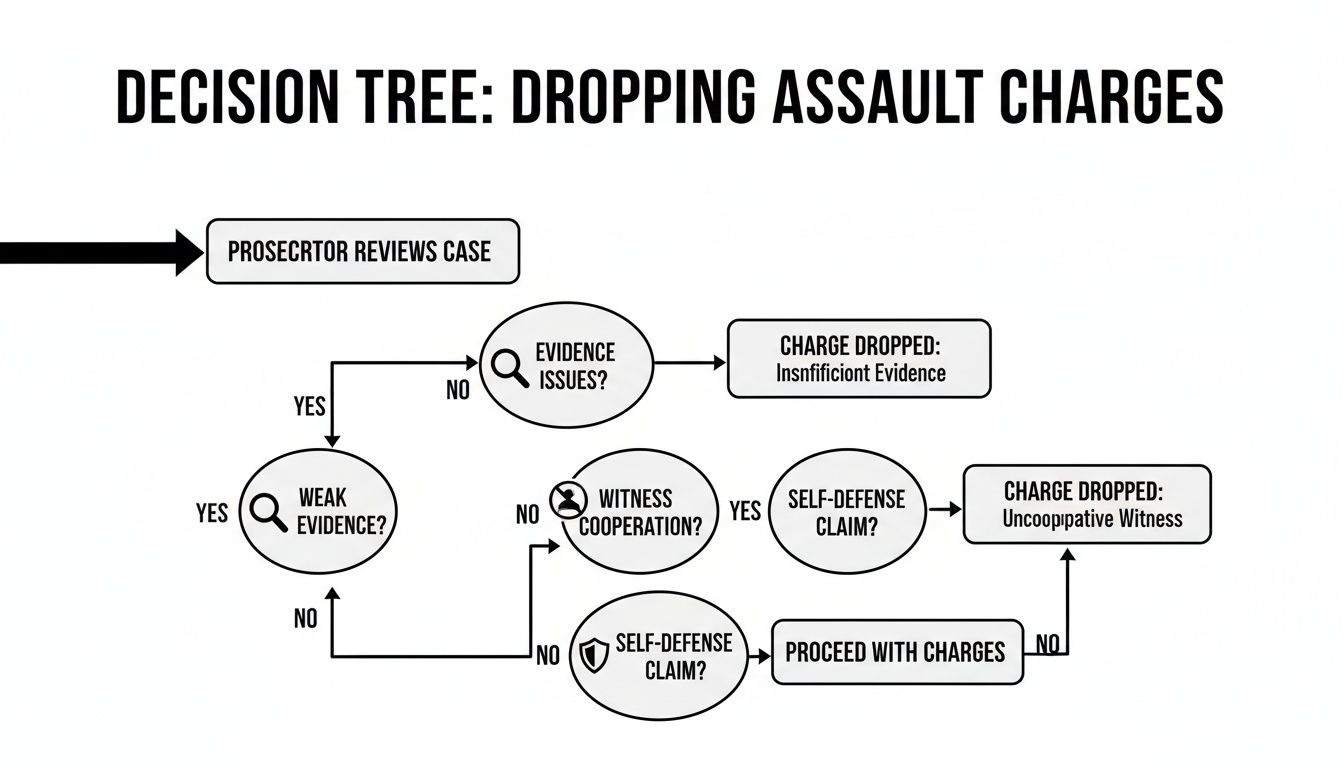
As you can see, a prosecutor’s decision is often a practical one based on their odds of winning at trial. This isn't unique to Texas; in Canada, for instance, about one-third of cases are withdrawn before a verdict, showing a common trend where prosecutors cut their losses on weaker cases. You can find out more by exploring global conviction rate statistics.
How a Defense Attorney Fights to Get Your Charges Dropped
Trying to convince a prosecutor to drop your charges on your own is a massive, often costly, mistake. An experienced Texas criminal defense attorney is your most critical ally, immediately shifting your position from defensive to proactive. They don't just sit back and wait for the State to build its case—they start building yours from day one.
Think of your attorney as both your advocate and your private investigator. Their first move is to launch a completely independent investigation into every detail of the incident. They refuse to take the police report at face value.
Uncovering Weaknesses in the State's Case
A police report almost always tells just one side of the story—the side that led to your arrest. Your lawyer’s job is to find the other side by digging into every piece of information, hunting for inconsistencies, sloppy errors, and procedural mistakes.
This deep-dive investigation includes:
- Interviewing witnesses: They will track down and speak with everyone involved, searching for conflicting accounts or new details that poke holes in the prosecution's narrative.
- Analyzing physical evidence: Your attorney will scrutinize photos, medical records, and any other physical proof to see if it actually supports what the State is claiming.
- Visiting the scene: Sometimes, understanding the physical layout of where an incident happened can reveal crucial details that were completely overlooked in the initial police walkthrough.
When a defense attorney puts together a strong case, they often lean on methodical data analysis. This can be supported by external Legal Data Integration And Reporting Services to organize complex timelines and evidence in a way that’s clear and effective.
Challenging Evidence with Legal Motions
Beyond just investigating the facts, your attorney has powerful legal tools to protect your constitutional rights. If law enforcement cut corners or made serious mistakes during your arrest or the investigation, key evidence against you might get thrown out of court.
One of the most effective strategies is filing a Motion to Suppress Evidence. This is a formal legal document that asks the judge to exclude any evidence that was obtained illegally, such as through an unlawful search or an improper interrogation.
A successful motion can completely cripple the prosecutor's case. Without their key evidence, they may have no choice but to dismiss the charges altogether. You can learn more about how a motion to suppress evidence works in Texas in our detailed guide.
Negotiating Directly with the Prosecutor
Armed with the facts from their own investigation and the leverage from potential legal challenges, your attorney engages the prosecutor directly. They present a compelling, evidence-backed argument that highlights every single weakness in the State’s case—from unreliable witnesses to unconstitutional police conduct. The goal here is simple: to show the prosecutor that moving forward with a weak case is not in the State's best interest.
Assault charges get dropped more often than you might think. For instance, national statistics on sexual assault show that over 95% of cases effectively see charges dismissed before a trial even begins, meaning 98% of perpetrators ultimately walk free. For Texans facing any type of assault charge, these numbers highlight just how valuable an experienced lawyer is—someone who knows exactly how to find and exploit those evidentiary gaps to maximize your shot at a dismissal.
Common Questions We Hear About Dropping Assault Charges
If you're facing an assault charge in Texas, your head is probably spinning with questions. The unknown is terrifying, but getting clear, honest answers is the first step toward taking back control. This section tackles the questions we get asked most often, offering practical insights straight from our experience defending Texans just like you.
Will Charges Be Dropped If The Victim Signs an Affidavit of Non-Prosecution?
Not necessarily, and this is a huge misconception. An Affidavit of Non-Prosecution is a formal, sworn statement from the alleged victim saying they don't want to press charges and want the case to go away. While it’s a powerful tool for your defense attorney, it doesn't tie the prosecutor's hands.
Here’s the thing: once the police are involved, the case isn't between you and the victim anymore. It's "The State of Texas vs. You." Prosecutors, especially in family violence cases, often push forward if they have other evidence, like:
- Recordings of the 911 call
- Body camera footage from the responding officers
- Photos of injuries
- Statements from other witnesses
Think of the affidavit as a strong piece of your defense puzzle. It helps, but it’s rarely the whole picture. The prosecutor makes the final call.
How Long Does It Take to Get Assault Charges Dropped?
There’s no magic number here. The timeline can swing wildly from a few weeks to well over a year. It really depends on the county you’re in, how complicated your case is, and how backed up the prosecutor’s office is.
A simple misdemeanor case with obvious holes in the evidence might get dismissed pretty quickly through early talks between your lawyer and the prosecutor. But a serious felony assault charge? That’s a different ballgame. It will almost certainly take much longer, sometimes waiting on further investigation or even a grand jury review. This is exactly why getting an attorney on your side from day one is so critical—they can start pushing for a faster, better outcome immediately.
If My Charges Are Dropped Does That Clear My Record?
No. This is the most important—and most misunderstood—part of the whole process. A dismissal is a victory, but it does not automatically wipe the arrest off your criminal record. The arrest, the charge, and the fact that it was filed will all still be there for anyone to see on a background check for a job, an apartment, or a professional license.
To truly erase it and get your clean slate back, you have to take another legal step. After the case is dismissed, you can file a separate civil lawsuit called a Petition for Expunction.
An expunction is a court order that commands government agencies to destroy all records of your arrest and the dropped charge. It essentially makes it as if the whole thing never happened. You can learn more by reading our guide that explains clearing your record after a dismissal in Texas. Don't skip this final step; it’s the only way to truly move on.
If you’ve been charged with a crime in Texas, call The Law Office of Bryan Fagan, PLLC for a free and confidential consultation. Our defense team is ready to protect your rights.