Police in Texas generally can't search the data on your cell phone without a warrant. They can often take the phone, but reviewing your texts, photos, apps, or location data usually requires a judge's approval unless a narrow exception applies.
Being stopped or arrested in Texas can feel overwhelming, especially when an officer asks, “Whose phone is this?” or “Can you open it for me?” In that moment, many individuals are unsure whether they have to hand it over, whether saying no makes things worse, or whether the police can start scrolling through the device.
The short answer is that your phone gets stronger privacy protection than most physical items in your pocket. That matters in DWI, assault, theft, and drug possession cases, because a phone can hold far more than a single message. It can reveal where you were, who you spoke with, what photos you took, and when certain events happened.
If you're trying to figure out can police search your phone without a warrant in texas, the key is to separate two different acts. One is seizing the phone. The other is searching the data inside it. That distinction often decides whether evidence stays in the case or gets challenged.
Your Rights During a Police Stop in Texas
A common Texas traffic stop goes like this. An officer says they smell alcohol, or thinks you were distracted, or believes a text message may be connected to what happened. Then the officer notices your phone in the cup holder and asks to see it.
In most situations, you don't have to consent to a search of your phone. The Fourth Amendment protects you from unreasonable searches and seizures, and that protection extends to digital privacy. If you want a plain-English overview of how illegal searches work, this guide on illegal search and seizure in Texas is a useful starting point.
What you can say during the stop
You don't need to argue with the officer. You also don't need to explain your entire life on the roadside.
A calm response often sounds like this:
“I do not consent to a search of my phone.”
That sentence matters. It's respectful, clear, and easy to remember.
What confuses people most
Many Texans think that if they're under arrest, police can automatically go through everything on the phone. That isn't the general rule. Arrest and phone access are not the same thing.
People also worry that refusing consent will make them look guilty. In reality, asserting your constitutional rights is not the same as admitting anything. The better approach is to stay polite, stay quiet, and avoid physically resisting if an officer takes the device.
- Don't grant access to the phone on request: If an officer asks, you can decline consent.
- Don't volunteer explanations: Extra statements often become evidence later.
- Don't delete anything: That can create a separate problem.
- Do remember details: Write down what the officer asked, what you said, and whether anyone touched the screen.
If your case involves a Texas DWI attorney, a Houston criminal lawyer, or a Texas assault defense team, those first few minutes can shape the entire defense. Small details matter, especially if the prosecution later claims you gave permission.
The Supreme Court Ruling That Protects Your Phone
The modern rule starts with a major Supreme Court decision. In 2014, the U.S. Supreme Court unanimously decided Riley v. California, and held that police generally may not search the contents of a cell phone seized during a lawful arrest without first getting a warrant supported by probable cause, as explained in this discussion of phone search law in Texas.

Why the Court treated phones differently
Before that ruling, officers often relied on the old “search incident to arrest” rule. That doctrine allowed police to search items found on a person during a lawful arrest. The Supreme Court said smartphones are different.
A wallet might hold a few cards and receipts. A phone can hold years of messages, photos, app records, and location history. So the Court drew a line. Police may often secure the device itself, but the digital contents are not open for immediate inspection just because an arrest happened.
Practical rule: Your phone is not treated like a pack of cigarettes, a wallet, or loose papers in your pocket.
What that means for you in Texas
This is a nationwide constitutional rule, so it applies in Houston, Dallas, Austin, San Antonio, and everywhere else in Texas. It's the foundation for the answer to can police search your phone without a warrant in texas.
Here's the simplest way to put it:
| Situation | General rule |
|---|---|
| Police arrest you and take your phone | They may be able to secure the device |
| Police want to read messages or open apps | They generally need a warrant |
| Police claim an exception applies | They must justify that exception later |
If you want to reduce the amount of private material exposed in everyday life, Simply Tech Today's online privacy guide offers general digital privacy tips that can help outside the criminal law setting too.
The important point is this. The law recognizes that your phone is a map of your personal life. That's why the warrant requirement matters so much.
Exceptions to the Warrant Rule for Phone Searches
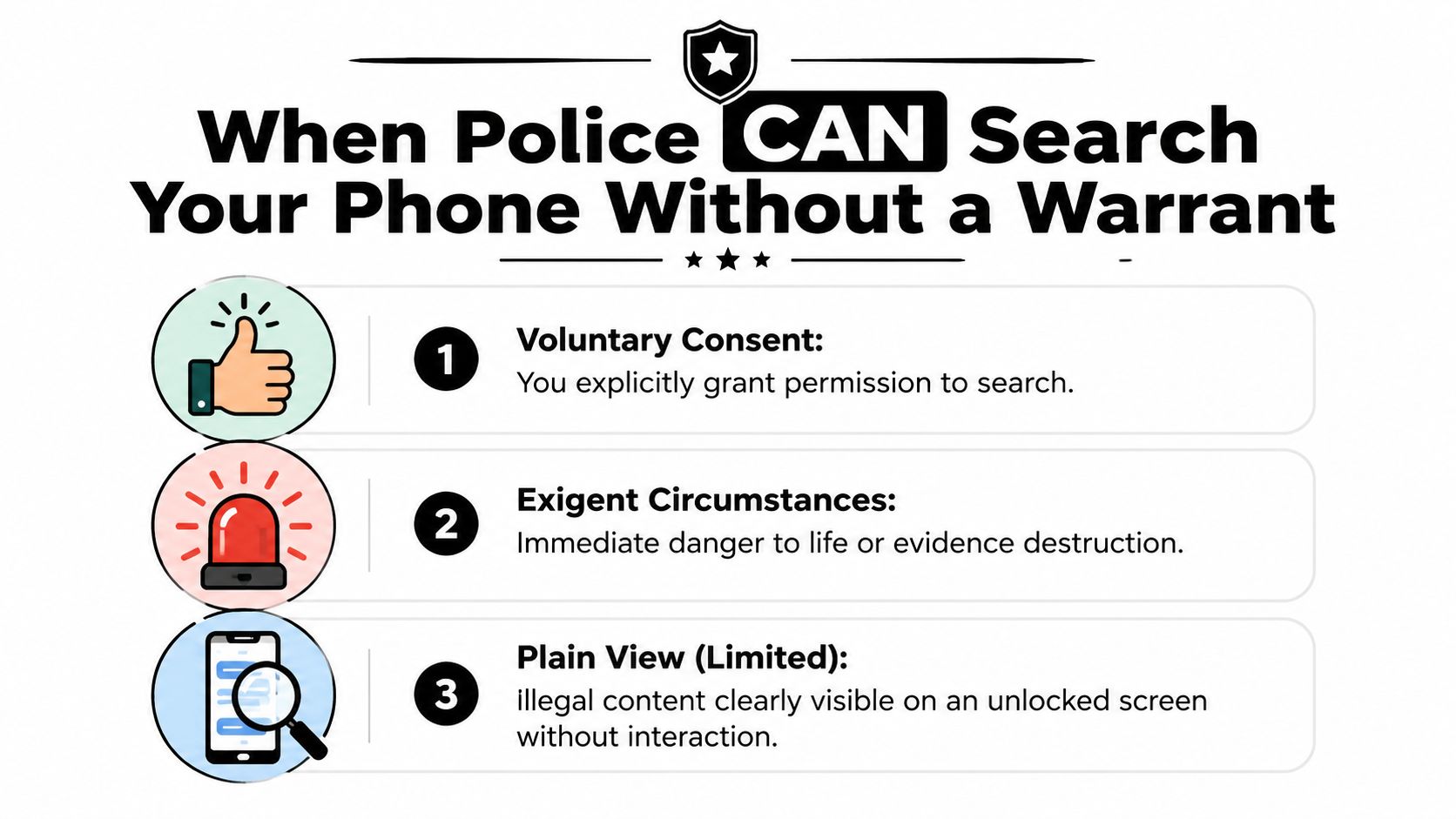
The warrant rule is strong, but it isn't absolute. Texas law includes limited exceptions. Under Texas Code of Criminal Procedure Chapter 18, a peace officer may search a cellular telephone or other wireless communications device without a warrant only in limited circumstances, including when the officer reasonably believes there is an immediate threat to life or serious bodily injury and the device contains evidence needed to address that emergency, as described in this overview of the Texas emergency exception for phone searches.
Consent changes everything
The most common exception is the simplest one. You say yes.
If you voluntarily give permission, officers usually don't need a warrant. That's why police often ask in a casual tone. “Mind if I take a look?” can sound minor, but legally it can be a big deal.
A few practical points:
- Clear refusal helps: Say you do not consent.
- Silence is risky: It can create later arguments about what happened.
- Partial consent still matters: If you allow one thing, the dispute may become how far that permission extended.
Emergency situations are narrow
Texas law recognizes true emergencies. If officers reasonably believe there is an immediate threat to life or serious bodily injury, and the phone has evidence needed to deal with that emergency, they may act without waiting for a warrant.
That is not the same as convenience. It is not the same as curiosity. It is not the same as wanting to move faster.
A real emergency is about preventing immediate harm, not expanding an investigation.
Here is a helpful explainer on the topic:
Plain view is limited
Sometimes officers see something on a screen without manipulating the phone. For example, the phone may already be accessible and displaying a visible message or image. That can create a different issue than opening apps, scrolling, or searching through files.
The key question is whether the officer merely observed what was already visible, or whether the officer interacted with the device to reveal more information.
- Visible lock screen alert: May be treated differently from a manual search.
- Opening messages: Usually raises stronger warrant concerns.
- Scrolling through photos: That looks much more like a search.
If officers rely on an exception, your lawyer should closely test whether the facts really fit that exception.
Understanding Seizure vs Search of Your Phone
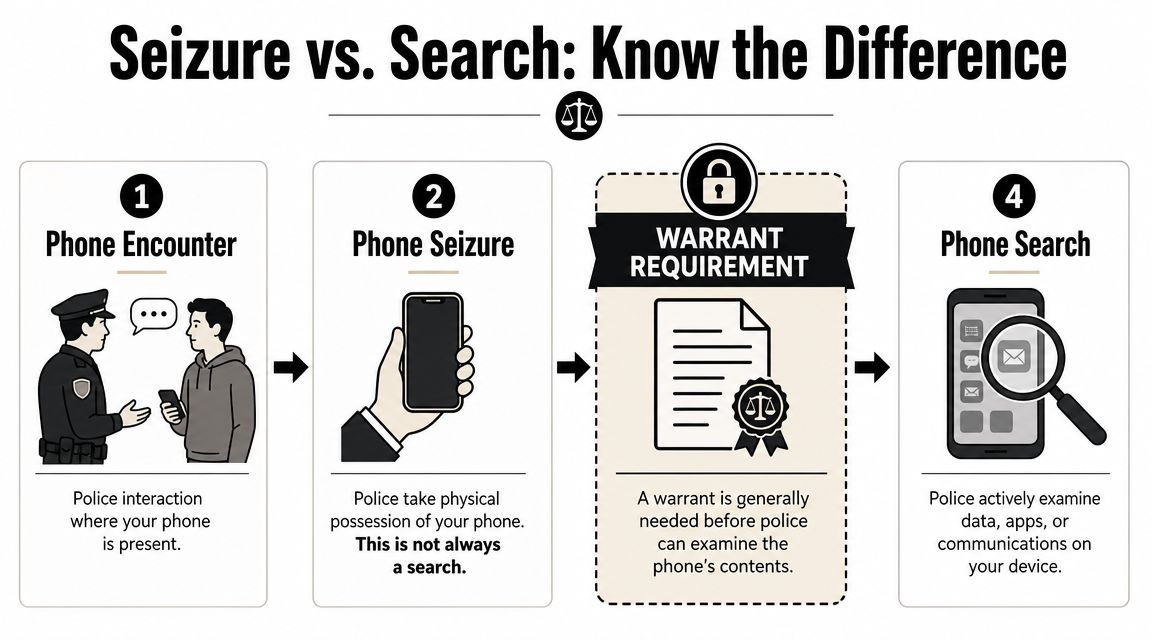
Many cases hinge on the definitions that follow. Seizure means police take possession of the phone. Search means they examine the digital contents.
Texas legal commentary consistently reflects that an arrest alone does not authorize a full phone search. Police may hold the handset while seeking a warrant, but later have to justify any data access with a particularized warrant or a recognized exception, as discussed in this article on Texas phone seizure and search rules.
A simple way to picture it
Think of your phone like a locked briefcase filled with private records. Police may sometimes take the briefcase and hold it. That doesn't automatically let them read every document inside.
That same distinction often controls suppression issues in criminal court. If you want to understand how illegally obtained evidence can be kept out, this overview of the exclusionary rule in Texas helps explain the remedy.
Details you should preserve right away
Your memory becomes evidence too. As soon as you can, write down what happened.
Focus on these facts:
- Passcode request: Did officers ask for your code?
- Accessing the device: Did you grant access yourself, or did someone force or pressure you?
- Scope: Did they stay within what they asked for, or keep going?
- Timing: Did they search on the spot or later?
If police took your phone, that fact alone doesn't answer whether the later data search was lawful.
This distinction matters because phone data can reveal much more than the original accusation. A single search can expose communication logs, cloud-linked media, metadata, and location-related information that broadens the case.
How Phone Search Rules Apply in Common Texas Cases
Legal rules make more sense when you see how they play out in ordinary cases.
DWI after a crash
Suppose you're stopped after a collision, and the officer thinks you may have been texting while driving. The officer can ask for the phone. The officer may even take steps to secure it depending on the situation.
But that doesn't automatically mean the officer can stand on the roadside and open your messages. A later review of texts, apps, or time-stamped communications usually raises the warrant issue discussed above.
If you're facing a DWI allegation, the phone question can become part of a larger defense that also examines the stop, field sobriety testing, statements, and arrest procedure.
Drug possession arrest
Now consider a possession case. Officers find suspected drugs during a search of your car or person and arrest you. They may suspect the phone holds buyer contacts, seller contacts, or messages about delivery.
That suspicion does not by itself create open-ended authority to search the device on the spot. The prosecution still has to justify access to the contents under the governing rule or a valid exception.
Theft investigation
In a theft case, police may believe you coordinated with someone by text or app. They may want chats, photos of property, or location-related information.
Here's the practical split:
| Type of police action | Main legal issue |
|---|---|
| Taking the phone as evidence | Was seizure allowed under the circumstances? |
| Reading messages, photos, or app history | Was there a warrant or a valid exception? |
Why this matters in charging decisions
Phone evidence can push a case in unexpected directions. What began as a simple theft accusation can become a broader timeline dispute. A routine arrest can lead to arguments about intent, identity, or who else was involved.
That's one reason defense lawyers examine the phone issue early in cases involving DWI, drug possession, assault, and theft. The problem isn't only what police found. It's also how they found it.
If your case moves forward, the process usually includes arrest, an initial appearance or arraignment, negotiations over the charge, possible pretrial motions, and then either a plea or trial. If there's a conviction, sentencing follows. Later, some people may qualify for relief such as expunction, nondisclosure, or other post-conviction options, depending on the result of the case and their record.
What to Do If Police Illegally Searched Your Phone
If you believe police searched your phone unlawfully, act quickly and carefully. Don't argue about the law with officers after the fact. Don't try to “fix” the situation by deleting material. Start preserving facts for your defense lawyer.
Your first steps
Write down everything you remember while it is still fresh.
Include:
- Who handled the phone: Officer names, badge numbers, or agency if known.
- What they said: Especially any request for consent.
- What you did: Whether you refused, stayed silent, or provided access to the device.
- What they viewed: Texts, photos, call logs, apps, or location-related material.
Then gather paperwork. Keep copies of charging documents, bond paperwork, inventories, and any search warrant materials your lawyer can obtain later.
The legal remedy is a motion to suppress
When police obtain evidence through an unlawful search, the main remedy is a motion to suppress. That asks the judge to keep the evidence out of the case. If you want a plain-language explanation, this article on a motion to suppress evidence in Texas breaks down how that challenge works.
A suppression fight usually focuses on questions like these:
- Was there a warrant?
- If so, did the warrant cover what officers searched?
- If there was no warrant, does the government claim consent or emergency?
- Did officers go beyond the limits of any claimed permission?
The strongest phone-search challenges often come from simple facts the officer overlooked, such as unclear consent, an overbroad review, or a search that started before any warrant existed.
Why legal help matters early
Phone search litigation is detail-heavy. Small facts can change the outcome. A defense lawyer can compare the report, body camera footage, warrant paperwork, and your account to see whether the search was legal and whether key evidence should be excluded.
In a criminal case, one option for that kind of representation is Law Office of Bryan Fagan PLLC, which handles Texas criminal defense matters including DWI, drug charges, assault cases, theft allegations, and post-case remedies such as expunction and record sealing where available.
If the phone evidence is central to the prosecution's theory, suppressing it can significantly change plea negotiations, trial strategy, and sentencing exposure. And if your case ends favorably, you may later want to ask about clearing the record through expunction or record sealing, depending on your circumstances.
If you've been charged with a crime in Texas, call The Law Office of Bryan Fagan, PLLC for a free and confidential consultation. Our defense team is ready to protect your rights.