Being arrested in Texas can be terrifying—but you don’t have to face it alone. The U.S. and Texas Constitutions give you rights, and one of the most powerful shields you have is a legal doctrine called the exclusionary rule. So, what is the exclusionary rule? In plain English, it’s a rule that stops prosecutors from using any evidence against you if law enforcement found that evidence by violating your constitutional rights.
Your Shield Against Unlawful Police Actions

Think of it like a penalty flag in a football game. The Constitution sets the rules for police—how they can search your property, when they need a warrant, and what defines probable cause. If an officer breaks those rules, they’ve committed a “foul.”
Maybe they searched your car without a legal reason or entered your home with a faulty warrant. Any evidence they discover because of that illegal action—drugs, a weapon, or anything else—gets thrown out. The judge essentially throws a penalty flag on the play, and the evidence becomes inadmissible. It cannot be used to convict you.
Why Does This Rule Exist?
Some people mistakenly believe the exclusionary rule is just a way for people to "get off on a technicality." That’s not the point at all. The rule exists for much bigger reasons that protect everyone, including you.
Its main goals are to:
- Deter Police Misconduct: The rule’s primary job is to hold law enforcement accountable. If police know that breaking the rules will make their evidence useless, they are far less likely to cut constitutional corners during a traffic stop for a DWI or an investigation for an assault charge.
- Uphold Your Constitutional Rights: The Fourth Amendment protects you from unreasonable searches and seizures. Without the exclusionary rule, that protection would be just empty words. This rule gives it teeth.
- Preserve the Integrity of the Justice System: It sends a powerful message that our courts won’t participate in unconstitutional behavior. The government must play by its own rules to secure a conviction.
This protection is a cornerstone of any solid criminal defense in Texas. Whether you're dealing with a DWI in Houston or a drug charge in Dallas, understanding how the exclusionary rule works is the first step toward fighting for your rights.
The exclusionary rule isn't just a legal theory; it's a practical tool your attorney can use to challenge the prosecution's case. A successful motion to suppress evidence based on this rule can lead to reduced charges or even a full case dismissal.
At The Law Office of Bryan Fagan, PLLC, our experienced Texas criminal defense attorneys dig into every detail of your arrest. We scrutinize police reports, analyze body cam footage, and review search warrants to find any violations of your rights. If we find that evidence was gathered illegally, we will fight aggressively to get it thrown out of court. That one action can completely change the outcome of your case and safeguard your freedom.
The Landmark Court Cases That Forged This Protection
The exclusionary rule feels like it has always been part of our justice system, but it was built, piece by piece, by ordinary people whose rights were violated. Understanding this history shows why this protection is so critical for anyone facing criminal charges in Texas today, whether it's for a DWI, assault, theft, or drug possession.
This legal shield began with the 1914 Supreme Court case Weeks v. United States. Federal agents stormed into Fremont Weeks' home—without a warrant—and seized papers they used to convict him. The Court decided that if the government could use illegally seized evidence, the Fourth Amendment would become meaningless. That decision created the exclusionary rule, but with a major catch: it only applied to federal law enforcement.
For nearly 50 years, this meant state and local police, including every officer in Texas, could ignore it. This created a system where your constitutional rights depended on which agency arrested you.
Mapp v. Ohio: A Game Changer For State Defendants
Everything changed in 1961 with the bombshell case of Mapp v. Ohio. Police in Cleveland, Ohio, descended on Dollree Mapp's home, believing a bombing suspect was hiding inside. She stood her ground and demanded to see a warrant. They forced their way in anyway, flashing a piece of paper they claimed was a warrant but which was never seen again.
They didn't find their suspect. Instead, they found materials considered "obscene" under Ohio law and used them to convict Ms. Mapp. She fought her case all the way to the U.S. Supreme Court.
The Court's decision in Mapp was a legal earthquake. It declared that the exclusionary rule wasn't just a good idea—it was a fundamental right. It applied the rule to state and local law enforcement through the Fourteenth Amendment.
This ruling was monumental. It made the exclusionary rule the law of the land for every police department and sheriff's office in America, including in Texas. From that point on, evidence found during an illegal search by a Houston police officer or a Dallas County deputy could be thrown out of court.
The Journey to Universal Protection
The road from Weeks to Mapp was long. Before Mapp, the courts struggled with what to do when states violated the Constitution. A key case was the 1949 case of Wolf v. Colorado. The Supreme Court admitted that the Fourth Amendment's privacy protections applied to states but refused to force the exclusionary rule on them, leaving states to "figure it out" themselves. Unsurprisingly, only about half the states adopted any version of the rule. You can learn more about the evolution of the exclusionary rule and its slow application to the states by reviewing federal justice resources.
Another case, Rochin v. California (1952), showed just how ugly things could get. Police, again without a warrant, broke into a man's home, saw him swallow pills, and then had doctors pump his stomach against his will to retrieve them. The Supreme Court was so horrified they threw out the conviction, calling the police's behavior "shocking to the conscience."
These cases set the stage for Mapp. They’re a powerful reminder that the exclusionary rule isn't a legal loophole. It's a hard-won right born from real-world abuses of power, designed to keep the government from breaking its own laws. At The Law Office of Bryan Fagan, PLLC, we know this history inside and out. We understand that challenging how police gathered evidence isn't just a defense tactic—it’s about holding the government accountable to protect your freedom.
How the Exclusionary Rule Works in Texas Today
The exclusionary rule isn’t just a dusty legal concept; it's a powerful tool we use every day in Texas courtrooms to protect people just like you. Whether you're facing a DWI in Houston, a drug possession charge in Dallas, or any other criminal allegation, this rule is a cornerstone of a strong defense.
But how does it actually work in a real case? It all starts with a legal filing called a Motion to Suppress Evidence.
A Motion to Suppress is your attorney's formal challenge to the judge. It says, "Your Honor, the police violated my client's constitutional rights, and the evidence they found because of it cannot be used against them." This motion is the legal lever that forces the court to stop and scrutinize how law enforcement built their case against you.
The Power of Texas Code of Criminal Procedure Article 38.23
Here in Texas, we have an extra layer of protection. Beyond the U.S. Constitution, our state has its own, stronger version of the exclusionary rule written directly into state law: the Texas Code of Criminal Procedure, Article 38.23.
Article 38.23, often called the "Texas Exclusionary Rule," states that no evidence obtained by an officer in violation of the laws or constitutions of the State of Texas or the United States shall be admitted into evidence against the accused.
This is a massive advantage for anyone facing charges in Texas. It means that if the police violate not just the Constitution but any Texas state law during their investigation—such as a specific rule in the Transportation Code during a traffic stop—the evidence they seize can be thrown out. This often makes our state rule even more powerful than its federal counterpart.
How a Motion to Suppress Works Step-by-Step
Filing a Motion to Suppress is far more than just filling out a form. It’s the final product of a meticulous investigation into every detail of your arrest, arraignment, and the entire criminal procedure. Here's a step-by-step guide to how we build one:
- Gathering All the Evidence: The first thing we do is demand everything the prosecutor has. This includes the officer's report, witness statements, lab results, and—most critically—any body camera or dashcam footage.
- Scrutinizing Every Detail: We then put that evidence under a microscope. We're looking for any misstep or rights violation. Did the officer have a valid reason (reasonable suspicion) to pull you over? Did they have probable cause to search your car? Was the search warrant they used legally sound?
- Filing the Motion: If we find a violation, we draft and file a formal Motion to Suppress. This legal document lays out the facts of your case, pinpoints the specific right that was violated, and makes the legal argument for why the evidence must be excluded.
- The Suppression Hearing: The judge then schedules a hearing. Here, the prosecutor puts the officer on the stand to justify their actions. This is our chance to cross-examine the officer, exposing inconsistencies in their story and the constitutional errors they made. This happens before any trial or plea bargaining.
- The Judge's Ruling: After hearing both sides, the judge makes a decision. If they agree with our motion, the evidence is suppressed—it's legally barred from being used against you at trial.
This is exactly why having a trusted guide and strong defender is so vital. We know what illegal police conduct looks like, and we know how to dismantle an officer’s testimony on the stand.
The Real-World Impact of Suppressing Evidence
A successful motion can completely change the game. In many drug possession cases, the drugs are the only real evidence. If we get the drugs suppressed, the prosecutor often has no choice but to dismiss the case entirely.
In a DWI case, suppressing the breathalyzer results or the field sobriety tests can gut the state's argument. This often forces them to offer a much better plea bargain, like a reduction to a less serious offense such as reckless driving. This isn't about a "technicality"—it's about holding the government accountable to the laws they are sworn to uphold and protecting your rights during sentencing and beyond. Even illegally obtained confessions can be thrown out, which is especially relevant in cases involving potential violations of your Miranda rights.
Understanding the Exceptions to the Rule
While the exclusionary rule is a powerful shield, it’s not absolute. The courts have created several “exceptions” that give prosecutors a chance to argue that even illegally obtained evidence should be allowed in court.
Knowing these exceptions is critical for a realistic view of the legal fight ahead. A skilled defense attorney must not only prove your rights were violated but also be prepared to counter the state’s attempts to use one of these backdoors.
This diagram shows how challenging evidence with the exclusionary rule—typically through a motion to suppress—fits into the big picture of Texas criminal law. It all comes down to a careful review of the evidence.
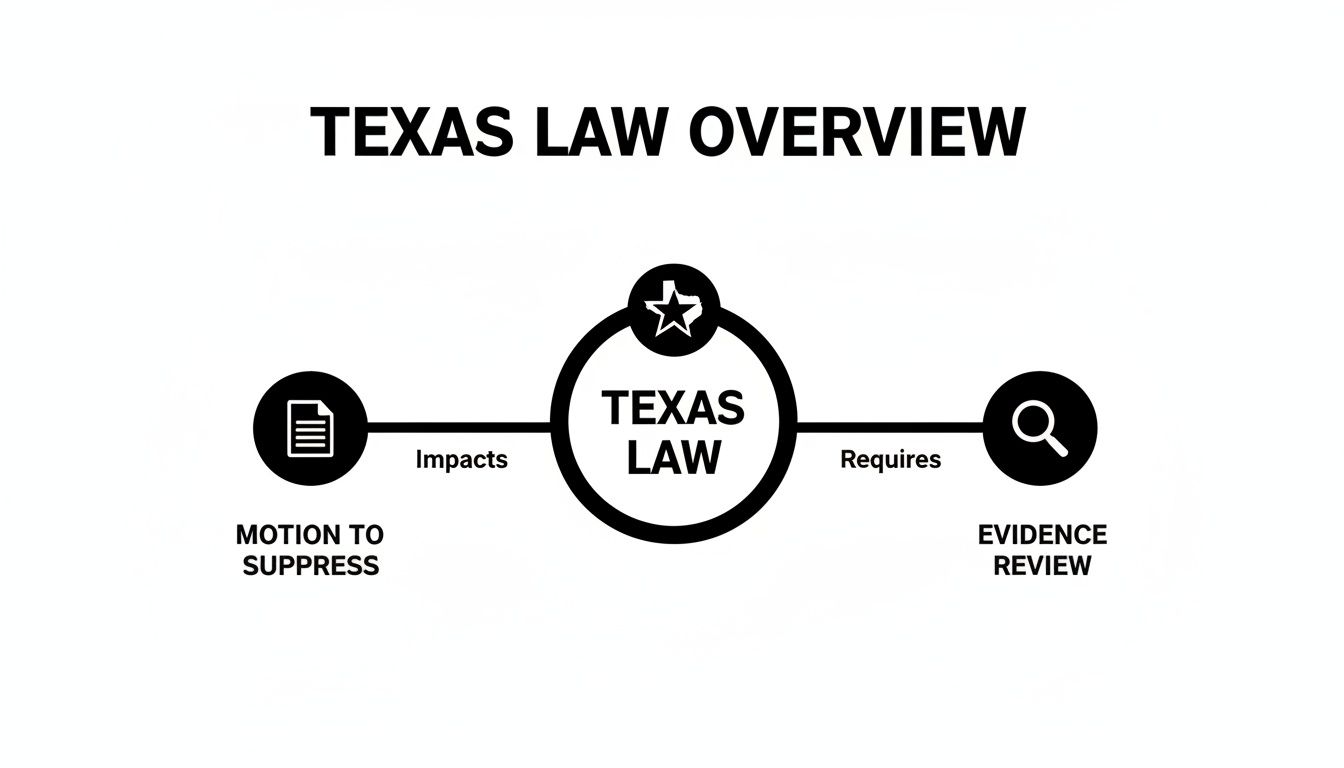
As you can see, filing a motion to suppress is a central strategy, but its success hinges on a deep dive into the specifics of how police gathered every piece of evidence.
The Good-Faith Exception
This is the most common exception prosecutors use. The good-faith exception applies when police officers rely on a search warrant that they believe is valid, but is later found to be defective.
Let’s say an officer gets a warrant signed by a judge to search your home. The officer conducts the search, finds evidence, and makes an arrest. Later, your defense attorney discovers a technical mistake the judge made when issuing the warrant, making it legally invalid.
Under the good-faith exception, the court might still allow the evidence. The reasoning is that the officer was acting in good faith, trusting what appeared to be a legitimate court order. The goal of the exclusionary rule is to deter police misconduct, not to penalize an officer who was following the proper procedure. This exception was established in United States v. Leon (1984).
The Inevitable Discovery Doctrine
This is another major workaround for the prosecution: the inevitable discovery doctrine. This rule allows illegally obtained evidence if the government can prove they would have found it legally anyway.
Imagine this: an officer illegally searches the trunk of your car and finds a stolen item. At the same time, other detectives were already getting a valid search warrant for your home based on a solid tip that the stolen item was there. If they can convince a judge they would have inevitably found the item at your house, the evidence from the illegal trunk search may be admitted.
A Key Battleground: The burden is on the prosecution to prove discovery was truly "inevitable," not just a possibility. A good defense attorney will attack this by showing the so-called "inevitable" path was just a hunch or that the separate investigation wasn't as far along as the state claims.
Other Key Exceptions
A few other exceptions can make or break a case.
The Independent Source Doctrine: This applies when police discover evidence through two channels—one illegal and one perfectly legal and independent. If the legal source is untainted by the illegal action, the evidence is fair game. For example, an officer illegally enters a shed and sees stolen goods. If another officer, working off a separate tip from an informant, gets a valid warrant for that same shed without knowing about the illegal entry, the evidence can likely be used.
The Attenuation Doctrine: This exception is about distance. If the connection between the illegal police conduct and the discovery of the evidence is weak or "attenuated," the evidence might be allowed. A judge will look at how much time passed, whether any other events happened in between, and how flagrant the police misconduct was.
Here’s a quick breakdown of the most common exceptions your attorney will need to be ready to fight.
Key Exceptions to the Exclusionary Rule at a Glance
| Exception Name | Simple Explanation | Practical Example |
|---|---|---|
| Good-Faith | Police relied on a warrant they thought was valid, but it had a hidden technical flaw. | An officer uses a warrant signed by a judge, but it’s later found the warrant lacked sufficient probable cause due to a judicial error. |
| Inevitable Discovery | The evidence would have been found through legal means eventually, regardless of the illegal search. | Police illegally question a suspect who tells them where a weapon is, but a search team was already legally combing the area and would have found it anyway. |
| Independent Source | The evidence was discovered through a separate, legal source completely unrelated to the illegal action. | An illegal search reveals drugs in a car, but a drug-sniffing dog (a legal source) also independently alerted on the same car. |
| Attenuation | The link between the illegal police act and the evidence is too remote or has been broken by an intervening event. | An officer makes an illegal stop, but lets you go. A week later, you are arrested on an unrelated warrant, and a search reveals evidence connected to the first stop. |
These exceptions aren't automatic wins for the prosecution. Fighting back demands a rock-solid grasp of constitutional law and a painstaking review of every detail in your case. Our attorneys at The Law Office of Bryan Fagan, PLLC, specialize in dismantling the prosecution’s claims to protect your rights. To understand more about the specific legal tool we use, you can learn more about the motion to suppress evidence in our article.
Real-World Scenarios Where This Rule Is Crucial

Legal theories are abstract until they’re the only thing standing between you and a conviction. At The Law Office of Bryan Fagan, PLLC, we’ve seen countless cases where a single police mistake, brought to light by the exclusionary rule, becomes the key to a client's freedom.
These real-world scenarios show just how powerful a deep understanding of what is the exclusionary rule can be in changing the outcome of a criminal case in Texas.
Scenario One: The DWI Stop Without Legal Cause
Picture this: you’re driving home through Houston after a late dinner. Suddenly, red and blue lights flash in your rearview mirror. The officer says you swerved once inside your lane and immediately seems determined to prove you've been drinking. He rushes you through field sobriety tests and, before you know it, you're in handcuffs for a DWI.
Here's the problem for the prosecution. A minor, single swerve within your own lane is not enough to establish the reasonable suspicion required by Texas law for a traffic stop. From the moment those lights came on, the stop was illegal.
- The Constitutional Violation: The officer violated your Fourth Amendment right against unreasonable seizure. He stopped your car without a valid legal reason.
- The Defense Strategy: A Texas DWI attorney would immediately file a Motion to Suppress. During the court hearing, we would cross-examine the officer, using his own dashcam footage to prove no legitimate traffic violation occurred.
- The Result: Because the initial stop was illegal, everything that followed—the field sobriety tests, your answers to his questions, and the breath or blood test results—is now "fruit of the poisonous tree." The judge is required to suppress it all. With no evidence left, the prosecutor has no case, and a dismissal is the most probable outcome.
This is the exclusionary rule in its purest form. It’s not about arguing whether you were intoxicated. It’s about proving the government broke the rules to get its evidence, making that evidence inadmissible in court.
Scenario Two: The Illegal Car Search for Drugs
Think about this common scene. You get pulled over for speeding—a valid reason for a stop. The officer gives you a ticket, but then asks, "You don't mind if I take a quick look in your car, do you?" Feeling pressured and anxious, you say, "I guess so."
The officer searches your vehicle and finds a small amount of a controlled substance under a seat. Now you’re facing a drug possession charge, a serious felony in Texas. The issue? The officer had no probable cause to search your car, and your "consent" wasn't freely given—it was the product of police authority and intimidation. In situations like this, reviewing an officer's transcript of deposition can reveal inconsistencies that strengthen your defense.
- The Constitutional Violation: The search violated your Fourth Amendment rights. There was no warrant, no probable cause, and your consent wasn't truly voluntary.
- The Defense Strategy: As your Houston criminal lawyer, we would file a Motion to Suppress the drug evidence. In court, we'd argue that you merely gave in to a show of authority and did not provide the knowing, voluntary consent required for a legal search.
- The Result: If the judge agrees that your consent was invalid, the drugs discovered during that illegal search get suppressed. Since the drugs are the core evidence in a possession case, the prosecutor will almost certainly be forced to dismiss the charges.
Your Next Steps to Protect Your Rights
Knowing your rights is the first step, but defending them is where the fight begins. If you believe your rights were violated during an arrest in Texas, the clock is already ticking. The most important move you can make is to remain silent.
Do not speak to law enforcement or prosecutors without an attorney present. Your first call should be to an experienced Texas criminal defense attorney who can step in, stop the questioning, and prevent you from accidentally damaging your own case.
Hiring the Right Defense Team
At The Law Office of Bryan Fagan, PLLC, our team lives in the details. We meticulously review every piece of the puzzle—scrutinizing police reports, analyzing body camera footage, and deconstructing search warrants to pinpoint the moment your rights were violated. Our job is to hold the police accountable and use the exclusionary rule to your advantage.
For Texans facing charges like a Texas DWI, drug possession, or assault defense, the legacy of cases like Mapp v. Ohio is a critical defense tool. It means that illegally seized evidence can completely destroy the prosecution's case. You can find more details on the history and application of the exclusionary rule to see how much it impacts modern cases.
A successful Motion to Suppress doesn't just win a hearing; it can win your entire case. Getting key evidence thrown out often forces a prosecutor to dismiss the charges or offer a drastically reduced plea deal.
This outcome opens the door to future post-conviction relief like expunctions and record sealing, which are crucial for moving on with your life without a criminal conviction holding you back. A successful defense isn’t just about the current charge—it’s about protecting your future. If you're getting ready for your initial court appearances, you can learn more about what happens at a pretrial hearing in our article. Don't wait to get the help you need.
Frequently Asked Questions About the Exclusionary Rule
When you’re trying to make sense of a criminal charge, a legal concept like the exclusionary rule naturally brings up questions. Let's tackle some of the most common ones with clear, practical answers.
Does the Exclusionary Rule Guarantee My Case Will Be Dismissed?
Not necessarily, but it can be a game-changer. The rule only forces the court to throw out evidence that was gathered illegally. If the prosecutor has other, legally obtained evidence strong enough to prove their case, the case can still go forward.
That said, in many situations—especially with charges like drug possession—the illegally seized evidence is the only thing holding the case together. When your defense attorney gets that key piece of evidence suppressed, the prosecutor is often left with nothing and has no choice but to dismiss the charges.
Does This Rule Apply to Confessions?
Yes, absolutely. The exclusionary rule isn't just for physical items like drugs or weapons; it also covers verbal statements and confessions. If police illegally stop or arrest you and you confess to a crime afterward, that confession is considered "fruit of the poisonous tree" and can be suppressed.
This is a huge reason why you should never speak to the police without an attorney present. Anything you say can be used against you, but if your statement was the result of a rights violation, it can and should be fought in court.
How Do I Know If Evidence in My Case Was Illegally Obtained?
The honest answer is you probably won't know for sure on your own. Spotting a Fourth Amendment violation takes a trained legal eye. An experienced criminal defense attorney knows how to analyze police reports, search warrants, and bodycam footage to find the subtle mistakes and procedural errors that most people would miss.
A defense attorney’s job is to challenge the state's case from every angle. We are trained to spot constitutional violations that can turn a seemingly hopeless situation into a winnable case.
To protect yourself, it's essential to understand your rights when arrested, as these are precisely what the exclusionary rule aims to safeguard.
Is It Expensive to File a Motion to Suppress?
Filing a Motion to Suppress is not an extra step—it's a core part of building a strong criminal defense. It's one of the most powerful tools we have to protect your rights.
At The Law Office of Bryan Fagan, PLLC, we are transparent about strategy and costs. During our free, confidential consultation, we will discuss every potential angle for your case, including practical advice and guidance on what happens after an arrest, so you can make informed decisions with confidence.
If you’ve been charged with a crime in Texas, call The Law Office of Bryan Fagan, PLLC for a free and confidential consultation. Our defense team is ready to protect your rights. You can reach us at https://texascriminallawyer.net.