Yes, you can be charged with a crime in Texas even if no one was physically injured. In some crash cases involving only property damage, leaving the scene can still lead to a Class C misdemeanor if the damage is less than $200, or a Class B misdemeanor if the damage is more than $200.
That catches many people off guard. You may be sitting at home after a tense argument, a traffic stop, or a minor accident thinking, “Nobody got hurt, so how can this be criminal?” In Texas, the law doesn't only punish broken bones or visible injuries. It also punishes threats to people, risks to public safety, and damage to property.
If you were arrested, received a citation, or learned that charges may be coming, your confusion is understandable. A no-injury case can still affect your freedom, your job, your record, and your family. The good news is that these cases often turn on details like intent, credibility, what you knew at the time, and whether police can prove each legal element.
The Shock of an Arrest Without an Injury
Being accused of a crime when no one was hurt feels unreal. Many people expect the criminal system to step in only after physical harm. That isn't how Texas law works.
A prosecutor doesn't need bruises or hospital records in every case. Sometimes the alleged harm is fear. Sometimes it is unsafe conduct. Sometimes it is property loss, financial loss, or a failure to do what the law required after an incident.
Why this feels so confusing
It's common to think in everyday terms. If there was no injury, people assume there was no victim. Texas law uses a broader view.
The law asks different questions:
- Was someone placed in fear? A threat can lead to charges even without a punch.
- Did your conduct create danger? That's why offenses like DWI or reckless driving can be charged without a crash injury.
- Did property get damaged or did money get taken? Theft, criminal mischief, and hit-and-run situations often fall into this category.
- Did you fail to act when the law required action? After a crash, for example, stopping and giving information matters even if you didn't cause it.
Practical rule: If police are involved, don't assume “no injury” means “no case.”
That matters early. After an arrest, you may go through booking, a magistrate appearance, bond conditions, and then an arraignment where the court tells you the charge and asks for a plea. After that, your case moves into discovery, plea discussions, motions, and sometimes trial. In no-injury cases, the evidence often comes from body camera footage, witness statements, texts, surveillance video, and your own words.
The real issue in these cases
The better question usually isn't just can you be charged if no one was injured in Texas. The key question is what type of harm the law says you caused or risked causing.
That framework helps. Some charges are about threatening people. Others are about protecting the public from dangerous conduct. Others are about property and financial rights. Once you know which bucket your case falls into, the charge starts to make more sense, and so does the defense.
Why Texas Law Punishes Acts Without Physical Harm
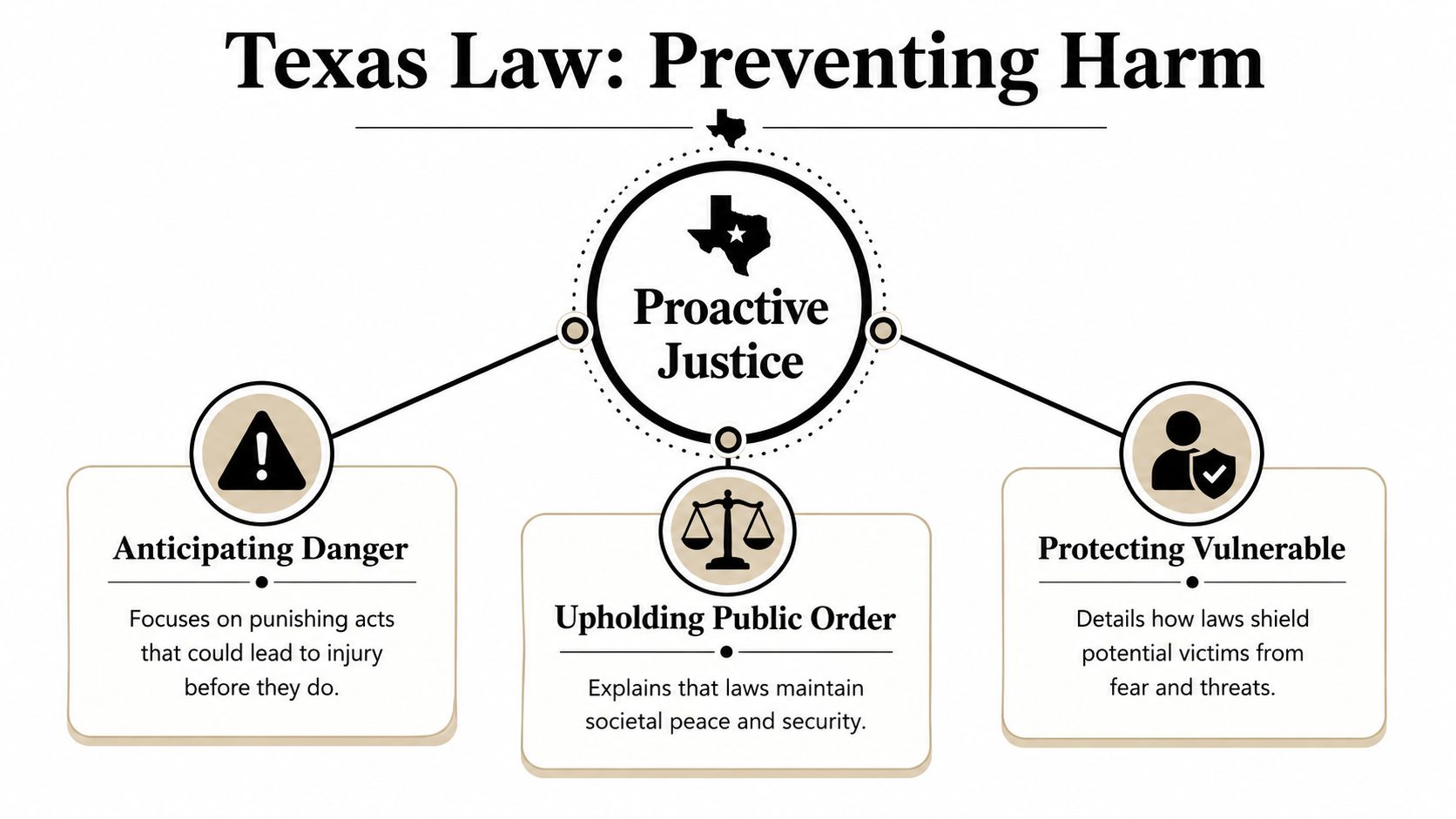
Texas criminal law is built to stop harm before it gets worse. That idea can feel unfair when you're the one charged, but it explains why no-injury cases exist.
A simple comparison helps. Fire codes don't wait for a building to burn down before they punish unsafe wiring. The point is to prevent the fire. Criminal law often works the same way. It targets conduct that threatens people, disrupts public order, or invades someone else's rights, even if the worst outcome never happened.
Threats to people
Some crimes focus on fear itself. If someone reasonably believes they're about to be hurt, the law may treat that as real harm. That's why assault allegations don't always require an actual injury.
This comes up in heated arguments, family disputes, road rage, workplace conflicts, and online communications. If your case involves offensive contact or a threat allegation, a more detailed guide to assault by contact under Texas law can help you understand how these charges are framed.
Risks to public safety
Other charges exist because the conduct puts the public at risk. DWI is the clearest example. The state doesn't need to wait for a collision before acting. The alleged crime is operating a vehicle while intoxicated, not causing a particular injury.
The same logic can apply to reckless behavior, firearms offenses in some situations, or conduct that creates panic. The law steps in because the danger is immediate enough that waiting for actual injury would defeat the purpose.
Damage to property and public order
Not every legally protected interest is physical safety. Texas also protects ownership, control of property, and basic public order. That is why theft, burglary, forgery, and certain crash-related offenses can be prosecuted without a bodily injury claim.
The absence of injury doesn't end a criminal case. It just changes what the prosecutor says the harm was.
When people understand this, they stop making one of the most common mistakes in these cases. They stop assuming the charge is absurd just because nobody went to the hospital. A stronger approach is to focus on the actual legal element the state must prove, then attack that element directly.
Common Charges Involving Threats and Fear
Some of the most stressful no-injury cases involve allegations that another person felt threatened, intimidated, or offended. These charges can arise from a few seconds of conduct and a single witness statement.

Assault by threat and offensive contact
Texas Penal Code § 22.01 covers more than causing bodily injury. It also reaches conduct that threatens another with imminent bodily injury and contact that a reasonable person would find offensive or provocative.
That means a person can face an assault charge even when there are no cuts, bruises, or medical records. The fight in court often becomes whether the words or actions were threatening, whether the contact was intentional, and whether the witness account is reliable.
Common disputes include:
- Words versus context. Angry words during an argument may sound different when the full conversation is heard.
- Intent versus accident. In crowded or chaotic settings, contact may have been incidental rather than criminal.
- Fear versus exaggeration. The state still has to prove the complainant's reaction fits the legal standard.
If your allegation involves digital messages, social media, or remote communications, this article on online threats and assault charges in Texas is especially relevant.
Terroristic threat and similar allegations
A terroristic threat charge usually centers on what was said, how it was said, and what result the state claims you intended. Prosecutors may rely on texts, call recordings, witness recollections, or screenshots.
These cases are often less straightforward than they first appear. Tone gets lost. Sarcasm gets stripped away. People quote each other badly. That doesn't mean the accusation is harmless, but it does mean the state's version isn't always the full story.
In threat cases, context is often the battlefield.
Family violence cases without visible injury
Some family violence accusations involve threats, offensive contact, or conduct that allegedly placed someone in fear. These cases can move quickly, and they often bring extra consequences like emergency orders, no-contact conditions, and restrictions on returning home.
A hard truth in Texas is that a case may continue even if the complaining witness later changes course. Prosecutors may try to move forward using 911 calls, officer observations, photos, messages, or statements from other witnesses. That is why your response in the first days matters so much.
After an arrest, the process usually starts with booking and a magistrate setting. Bond conditions can be imposed early. Arraignment follows, then evidence exchange, negotiations, and possible motion hearings. In some cases, a plea bargain may be available. In others, trial is the right path. The right strategy depends on what the state can prove, not on how strong the accusation sounds at first.
When a Mistake on the Road Becomes a Crime
You leave a grocery store, back out, feel a light bump, and tell yourself the other car probably wasn't damaged. An hour later, an officer is calling about a hit-and-run report. That is how many no-injury road cases begin in Texas. What felt minor at the scene can turn into a criminal investigation fast.
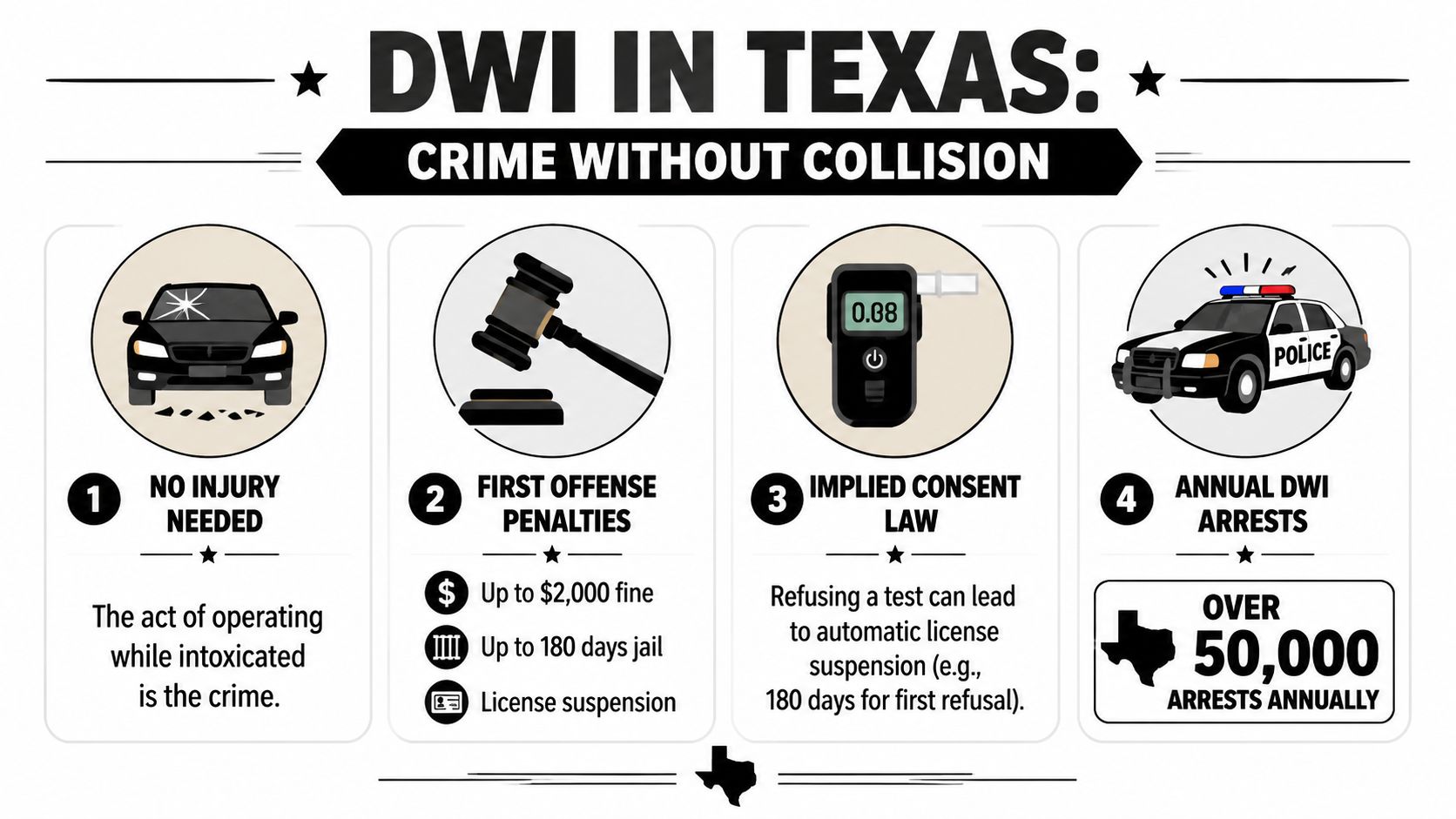
Road cases fit the same basic pattern as the rest of this article. The law is often trying to prevent a specific kind of harm before someone gets hurt. On the road, that usually means risks to public safety. A prosecutor does not need a broken bone or ambulance record to file charges if the allegation is that your driving created a serious enough danger.
DWI and reckless driving
DWI is the clearest example. The accusation is operating a vehicle while intoxicated. A case can be filed after a routine stop, a stalled car, or a minor traffic incident with no injury at all.
Reckless driving works from a similar public-safety concern, but the proof is different. The state usually tries to show willful or wanton disregard for the safety of people or property through speed, weaving, racing, ignoring traffic controls, or other conduct that made the situation dangerous. In practice, these cases often turn on specifics. What the officer saw, what the video shows, where the driving happened, traffic conditions, and whether witnesses are exaggerating all matter.
Leaving the scene after property damage
Another common no-injury charge involves leaving the scene after a crash that damaged a vehicle, fence, sign, mailbox, or other property. The legal problem is often the failure to stop, identify yourself, exchange information, and handle the accident the way Texas law requires. Fault is a separate issue.
That point catches people off guard. I have had clients assume they could sort it out later through insurance, especially if the impact seemed small or they were frightened and drove off. Texas does not treat that as a paperwork issue. Once a driver leaves without meeting those duties, the case can move from civil inconvenience to criminal exposure.
These cases are also more fact-sensitive than they look. Did the driver know a collision happened? Was there actual property damage? Was the scene unsafe? Did panic, confusion, or poor visibility affect what the driver understood in the moment? Those details can change how a case is charged and how it should be defended.
What usually helps and what usually hurts
After a road-related arrest or investigation, the early choices matter.
What helps
- Follow bond conditions carefully. If the court limits your driving or imposes other rules, comply with them exactly.
- Preserve evidence quickly. Save photos of the scene, vehicle damage, repair estimates, dashcam footage, location data, and witness contact information.
- Get legal advice before making statements. Explanations given too early often lock people into facts they later need to clarify.
What hurts
- Trying to explain everything on the spot. Partial accounts and changed details are easy for the state to frame as dishonesty.
- Assuming insurance will solve the criminal case. Insurance may address money. It does not make a charge disappear.
- Posting about the incident online. Photos, jokes, and comments can end up as exhibits.
If you are facing a DWI, reckless driving allegation, or a crash-related charge, the first job is to identify what harm the state says your conduct created. In road cases, that usually means danger to the public or damage to property. Once that theory is clear, the defense work gets more focused: challenge the stop, test the officer's observations, examine video, pin down timelines, and separate a bad moment from a criminal offense.
Property and Financial Crimes Without Physical Harm
Not every criminal case is about danger on the road or fear during a confrontation. Some are about ownership, possession, and money.
The law treats these interests seriously because people and businesses depend on stable property rights. If someone takes, damages, enters, or manipulates property without legal authority, the state may file charges even though nobody was physically injured.
Theft, burglary, and criminal mischief
Theft is the easiest example. Shoplifting, taking cash, keeping property you weren't entitled to keep, or depriving an owner of property can all lead to prosecution without any bodily injury allegation.
Burglary works differently. The core accusation is unlawful entry with criminal intent, or remaining somewhere without consent under circumstances the law prohibits. If no one was inside, that doesn't erase the offense.
Criminal mischief also fits this category. The alleged harm is damage or tampering with property. That could involve a vehicle, a fence, a window, or business equipment.
White-collar and financial allegations
Financial cases often feel less dramatic, but they can carry lasting consequences. Credit card abuse, forgery, fraud-related accusations, and similar charges are still criminal because the claimed harm is economic.
These cases are document-heavy. Prosecutors often lean on bank records, transaction histories, business records, surveillance footage, signatures, device data, and communications. The key defense questions are often narrow and technical:
| Issue | Why it matters |
|---|---|
| Identity | Can the state prove you were the person who made the transaction or signed the document? |
| Intent | Was this a deliberate fraud or a misunderstanding, mistake, or authorized use? |
| Ownership and consent | Did the complaining witness actually withhold permission? |
| Record accuracy | Are the business or banking records complete and properly connected to you? |
A no-injury case can still threaten your job, license, and future because the record itself may do damage long after court ends.
That is why these cases shouldn't be brushed off as “just property” or “just paperwork.” A theft or forgery allegation can create problems with employment, housing, education, immigration, and professional credentials even before a conviction.
How a Lawyer Defends You Against No-Injury Charges
You can get arrested, sit in jail, post bond, and still keep asking the same question: how is this a criminal case if nobody got hurt? That is usually the first problem a defense lawyer has to solve. The state is not only trying to prove what happened. It is trying to fit your conduct into a category of harm Texas law punishes, whether that alleged harm is fear, public risk, or property loss.

A good defense starts by identifying what the prosecutor is really selling. In a threat-based case, the state often argues that your words or actions put someone in fear. In a road case, it usually argues that your driving created a danger to the public. In a property or financial case, it focuses on damage, loss, or unauthorized use. Once that theory is clear, the defense can attack the weak point instead of arguing in circles.
What the state usually relies on
In no-injury cases, prosecutors often build the file out of indirect proof. That may include witness statements, 911 calls, body camera footage, surveillance video, vehicle photographs, phone records, social media posts, and your own statements.
My job is to test whether those pieces prove the charge. A witness may be repeating assumptions instead of firsthand facts. A video may start too late. A police report may turn a heated argument into a threat case by summarizing words loosely instead of quoting them. That kind of detail matters because these cases often rise or fall on context, intent, and timing.
If you want a clearer sense of that process, this explanation of how criminal defense attorneys build a defense strategy gives a useful overview. Firms such as the Law Office of Bryan Fagan PLLC handle this kind of case review in Texas misdemeanor and felony matters.
Common defense approaches
The right defense depends on the accusation, but several patterns show up often:
- Dispute intent. The state may call it a threat, fraud, or reckless act. The facts may show anger, confusion, accident, or poor judgment instead of criminal intent.
- Challenge fear or risk. In many no-injury cases, the prosecutor has to prove more than rude behavior or a bad decision. The state still has to show a real threat, a real public danger, or actual property loss.
- Test the witness story. Complaining witnesses can overstate what happened, leave out their own role, or change details over time.
- Raise a lawful explanation. Self-defense, defense of property, consent, mistake of fact, or authorization may apply depending on the charge.
- Attack police procedure. An unlawful stop, weak identification procedure, bad search, or sloppy evidence handling can change the value of the whole case.
Here is a short video that helps explain how defense strategy is built in criminal cases:
Preventing the case from being framed as worse than it is
A large part of defense work is stopping charge inflation. I see that often in road cases, threat allegations, and property offenses. A minor collision can get described as conduct that endangered others. A heated argument can get framed as a true threat. A disputed transaction can get charged as intentional theft or fraud before anyone has sorted out permission, ownership, or account access.
That is why early case work matters. The defense may need to gather phone data, preserve surveillance footage before it disappears, photograph a scene, get repair records, or lock down witness statements while memories are still fresh. If the facts do not support the higher charge, the goal is to show that early and clearly.
Sometimes the best result is a dismissal. Sometimes it is a reduction, pretrial diversion, or a plea that protects your record better than a trial gamble would. The right path depends on the evidence, your history, the county, and how much risk comes with fighting versus resolving the case.
Frequently Asked Questions About the Legal Process
What should you do first after being charged
Stay calm and stop talking about the facts of the case with police, the complaining witness, friends, or online. If you've been arrested, you'll usually be booked, taken before a magistrate, and given bond terms. Read every condition carefully.
Your next major court setting may be an arraignment, where the charge is formally presented and a plea is entered. After that, your lawyer can obtain discovery, review the evidence, file motions, and begin plea negotiations or trial preparation.
Can a no-injury charge be dismissed
Yes, sometimes. A case may be dismissed if the evidence is weak, a witness is unreliable, police violated your rights, or the facts don't fit the charged offense.
Other times, the better result is a reduction, a diversion option, or a carefully negotiated plea bargain that protects you from worse consequences. The right answer depends on the evidence, your history, and the county where the case is filed.
Can you clear your record later
Possibly. Some people may qualify for expunction, which erases eligible records after dismissal, acquittal, or certain other outcomes. Others may be eligible for nondisclosure or record sealing, which limits who can see the case.
If there was a conviction, post-conviction relief may still be worth exploring in some situations. This is especially important for people concerned about work, school, housing, or professional licensing.
If you're asking can you be charged if no one was injured in Texas, the answer is yes. But being charged is not the same as being convicted, and it is not the same as being out of options.
If you've been charged with a crime in Texas, call Law Office of Bryan Fagan PLLC for a free and confidential consultation. Our defense team is ready to protect your rights.