Skip to content
Being arrested in Texas can be terrifying. You may be worried about jail, your job, your family, your license, or what happens if this charge stays on your record.
A defense strategy brings order to that chaos. It isn't one dramatic courtroom speech. It's a careful plan your lawyer starts building from the first phone call, then tests at every stage of the case. If you're facing DWI, assault, theft, drug possession, or another charge, knowing how criminal defense attorneys build a defense strategy can help you make better decisions and avoid mistakes that hurt your case.
Just as important, you are not a bystander in this process. What you say, what you save, who you talk to, and how quickly you act can all affect the outcome.
Your First Step After a Texas Arrest
The first hours after an arrest matter more than is commonly understood. If police arrested you for a Texas DWI, an assault allegation, theft, or drug possession, your defense often starts before your first court date.
Your job is simple at the beginning. Stay calm. Use your right to remain silent. Ask for a lawyer. Don't try to talk your way out of it, and don't explain the facts to officers, cellmates, family group texts, or social media followers. Many clients think they need to "clear things up" right away. Most of the time, that only gives the State more statements to use against them.
A strong lawyer starts by creating a roadmap. That usually means reviewing the accusation, identifying what the prosecutor must prove, checking how the evidence was collected, and deciding where pressure can be applied early. If you're trying to understand the broad role of a defense lawyer, this overview of legal counsel for criminal charges can help frame the process from a client's point of view.
For people who want immediate practical guidance, this article on what to do immediately after getting arrested in Texas is a useful next step.
What you should do right away
- Protect your silence: Give booking information if required, but don't discuss the facts of the case.
- Gather your papers: Keep bond paperwork, citations, towing papers, property receipts, and any court notice.
- Write down what happened: As soon as you can, make private notes for your attorney about times, locations, witnesses, and officer names.
- Follow release conditions: If the judge ordered no contact, testing, travel limits, or check-ins, treat those rules seriously.
Practical rule: The best first move after an arrest is often the quietest one. Stop talking, start documenting, and get counsel involved quickly.
If you have family outside Texas comparing legal systems in nearby states, a plain-English resource from a criminal defense attorney Northwest Arkansas may also help them understand why early legal advice matters so much.
Initial Case Assessment and Fact Gathering
The first meeting with your lawyer is not a test. It's not a lecture. It's a protected conversation where your attorney starts separating facts, assumptions, and risk.
Your lawyer needs your version of events, even if some parts are embarrassing or make you look bad. Attorney-client privilege exists so you can be honest. If you hide details because you're worried about judgment, your lawyer may get blindsided later by a text message, prior conflict, body camera footage, or witness statement.

What to bring to the first meeting
Bring every document you have. That includes bail paperwork, a citation, charging papers, bond conditions, a notice of court setting, impound papers, and any screenshots, emails, or messages related to the accusation.
If police took your phone, your car, or other property, tell your lawyer that too. In a DWI case, details about the stop, field sobriety testing, and any breath or blood request matter. In a Texas assault defense case, prior messages, injuries, witness names, and whether there was any self-defense issue may become central.
A short checklist helps:
- Court and bond papers: These tell your attorney where the case stands and what deadlines may be approaching.
- Digital records: Save texts, call logs, photos, app messages, and location history.
- Witness information: Even partial names, nicknames, or workplaces can help investigators locate people.
- Medical or counseling records: Sometimes these support mitigation or explain behavior, injuries, or false assumptions.
What your lawyer is looking for
At this stage, a defense attorney starts asking targeted questions. Was there a legal reason for the traffic stop? Who owned the property in a theft case? Did you know drugs were in the vehicle? Were there independent witnesses? Did anyone record the event?
Texas charges are tied to specific legal elements. Under the Texas Penal Code, the State has to prove the parts of the offense charged. For example, theft under Texas Penal Code Section 31.03 generally turns on unlawful appropriation with intent to deprive the owner of property. Assault under Texas Penal Code Section 22.01 often turns on whether the State can prove bodily injury, threat, or offensive contact under the facts alleged. Those legal elements shape the questions your lawyer asks from day one.
Tell your lawyer the bad facts early. A hard fact disclosed in private is a problem to manage. A hard fact discovered late is a crisis.
Your lawyer will also warn you about discovery and disclosure issues. If you're not familiar with that part of the process, this guide to what discovery is in Texas criminal cases and how it works explains why evidence exchange matters so much.
Building Your Case Through Investigation and Evidence
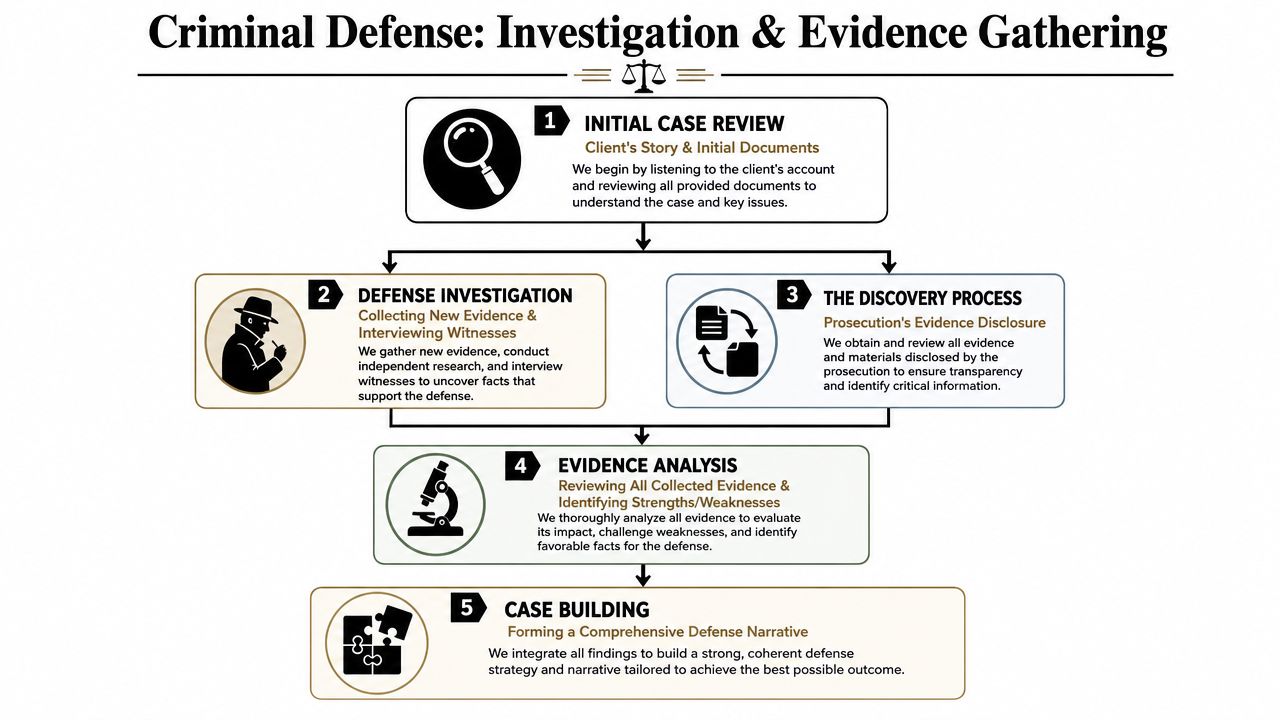
Evidence is the foundation of a strong defense. Your lawyer's job is to test whether the State's proof is accurate, complete, and legally admissible. Your job is to help us find what the police file may have missed, ignored, or misunderstood.
That process often feels slower than clients expect. There is a reason for that. Building a defense works like putting together a puzzle from pieces collected by different people at different times. Some pieces are missing. Some are damaged. Some were gathered in a way the court may not allow. Before we can decide how to fight the case, we have to know what the picture really looks like.
What the defense team reviews
A police report is only a starting point. It is a summary written from the officer's perspective, often under time pressure, and sometimes with facts left out or conclusions stated too confidently. A defense lawyer reads it carefully, then checks it against the underlying evidence.
In a DWI case, that can mean body camera footage, dash camera video, dispatch records, breath test records, blood draw documents, lab paperwork, and maintenance logs for testing equipment. In a drug case, we look closely at where the substance was found, who had access to that place, how officers entered or searched, whether consent was valid, and whether the lab result matches the charge filed. In an assault case, we may compare witness statements, photographs, 911 audio, text messages, social media posts, and medical records.
Small details matter here. A timestamp that does not match. A witness who changes one important fact. A video angle that contradicts an officer's description. A break in the chain of custody. Cases often turn on those details.
Search issues matter too. If officers stopped, searched, or seized property without legal authority, the defense may challenge whether that evidence should be used at all. If you want a plain-English explanation of that process, read this guide on what a motion to suppress evidence does in a Texas criminal case. The same principles behind an illegal search and seizure defense can affect many kinds of criminal charges, not just drug cases.
What you can do to help
Clients sometimes believe they should sit and wait for the lawyer to handle everything. That is a mistake. You may know facts no report will ever capture.
You might know which gas station had cameras facing the parking lot. You might remember the friend who left just before police arrived. You might have texts that show your state of mind, location data that confirms where you were, or receipts that fix the timeline better than memory can. Those facts can help us test the State's version of events.
Here are practical ways to help your own defense:
- Save digital evidence: Keep texts, emails, voicemails, call logs, photos, videos, ride-share receipts, and location history.
- Write a timeline: Put events in order while they are still fresh, including small things that may seem unimportant.
- Identify witnesses early: Give your lawyer names, nicknames, phone numbers, social media accounts, and where those people can be found.
- Preserve, don't edit: Do not delete posts, crop screenshots, rewrite messages, or clean up your accounts.
- Tell your lawyer where evidence exists: Businesses overwrite surveillance footage quickly, and delay can mean it disappears.
Some of the strongest defense evidence comes from what a client preserves in the first few days.
A common example from DWI cases
Say you were stopped after midnight and arrested for DWI. The report may say you drifted out of your lane, had bloodshot eyes, performed poorly on field sobriety tests, and gave a breath or blood sample over the legal limit. On paper, that can look hard to fight.
Then the investigation begins. Was there a valid reason for the stop? Do the videos show bad driving, or only a brief lane touch? Were the field test instructions clear and given on a suitable surface? Does the recording match the officer's written description? Was the blood sample stored, labeled, and tested properly?
That same method applies in other cases. In theft, the question may be whether you intended to deprive the owner of property or whether there was a misunderstanding about ownership or permission. In assault, the issue may be self-defense, mutual combat, injury exaggeration, or a witness with a reason to lie. In a drug possession case, the focus may be whether you knew the substance was there and had control over it, especially in a shared car or home.
Good defense work is disciplined. We gather records, preserve what can disappear, compare one source against another, and look for gaps between accusation and proof. If you stay involved, save evidence early, and tell your lawyer the full story, you give your defense a much stronger factual base to work from.
Developing Legal Theories and Pretrial Motions
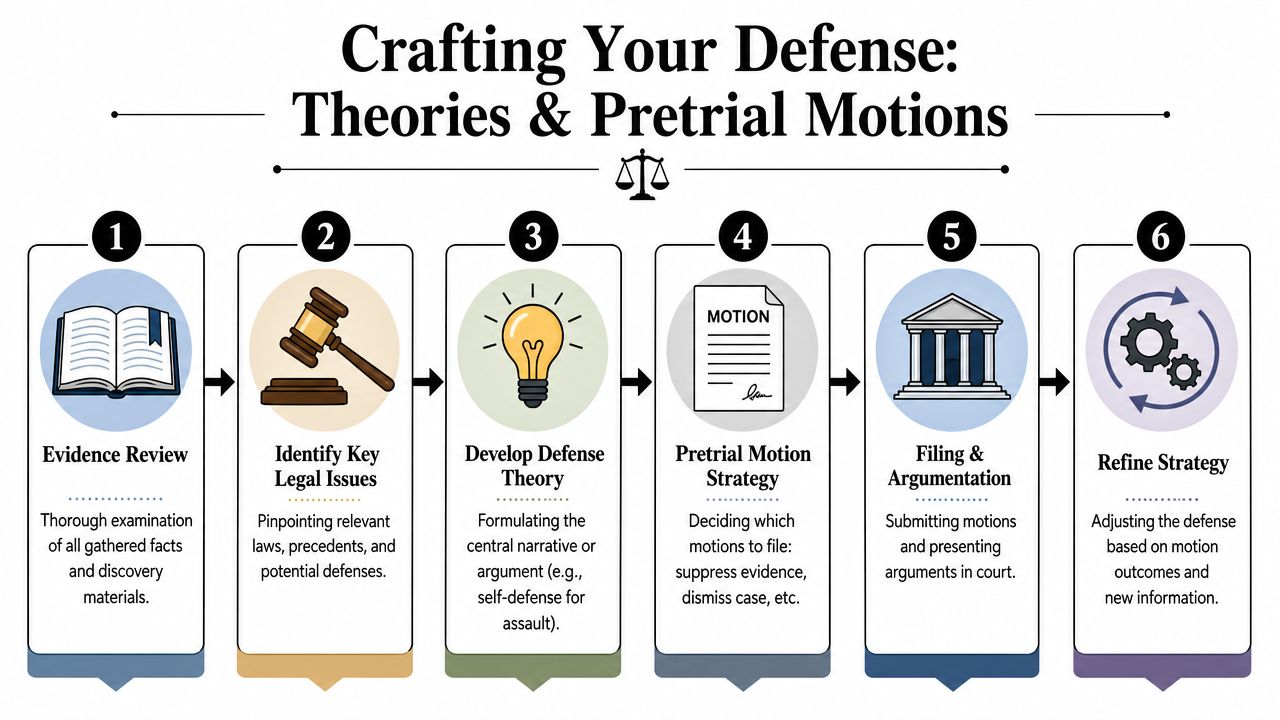
After the facts are gathered, your case starts to take shape around a question a judge can rule on. What legal reason, based on your specific facts, weakens the State's case or blocks key evidence from coming in?
A defense theory is that reason, stated clearly and backed by proof. It is the storyline that connects the facts, the law, and the result your lawyer is asking for. In one case, the theory may be mistaken identity. In another, it may be lack of intent, lack of knowledge, self-defense, or an unlawful search. A good theory gives the case direction, the same way a blueprint gives direction to a builder before the walls go up.
Your role matters here more than clients often realize. This is the stage where small details can change the legal argument. Tell your lawyer about prior contact with police, who else had access to the car or home, whether anyone else was present during questioning, what medications you were taking, and whether there were witnesses the police ignored. A fact that seems minor to you may be the piece that turns a weak argument into a strong one.
How motions put pressure on the case
Once the legal theory is clear, your attorney may file pretrial motions. These are written requests asking the court to decide an issue before trial. That matters because some fights should happen early. If the judge excludes a confession, suppresses drugs found in a car, or limits unreliable identification testimony, the prosecution may lose the evidence it was counting on.
One of the most important tools is a motion to suppress. It asks the court to keep out evidence obtained through an unlawful stop, search, seizure, or interrogation. If you want a plain-English explanation, this article on what a motion to suppress evidence is explains how that process works.
Clients can help with motions, too. Save paperwork. Write down the sequence of events while your memory is still fresh. Do not guess, and do not fill gaps with what you think probably happened. Judges care about specifics. Times, locations, exact words, body camera gaps, who searched what, and whether you felt free to leave can all matter.
Examples in everyday terms
A few common defense theories and motion strategies look like this:
| Charge | Possible defense theory | Possible pretrial issue |
|---|---|---|
| DWI | The State can't reliably prove intoxication | Unlawful stop, test reliability, blood draw procedure |
| Assault | You acted in self-defense | Exclude statements, challenge witness reliability |
| Theft | There was no intent to deprive | Bad identification, weak proof of ownership |
| Drug possession | You didn't knowingly possess the substance | Illegal search, lack of control over location |
Here is the practical point clients should keep in mind. A motion is not filed just to argue that something felt unfair. It needs a legal target and a clear remedy. If the police entered a home without proper consent or probable cause, the motion asks the judge to exclude what they found. If officers kept questioning you after you invoked your rights, the motion asks the judge to block those statements.
Search issues often come up in drug cases, especially where several people had access to the same place. If you want a broader example of how lawyers analyze these problems, this discussion of illegal search and seizure defense shows how unlawful search arguments can affect the prosecution's proof.
The strongest pretrial motion identifies one legal defect, ties it to the record, and asks the court for a specific result.
That is why your participation still matters at this stage. If your lawyer asks you to review reports, listen to recordings, check dates, or clarify who was where, do it carefully and promptly. Good legal theories are built from law, but they are often won by details.
The Crossroads of Plea Bargaining vs Trial
Your phone rings. Your lawyer says the prosecutor has made an offer. You have court coming up, your family wants answers, and you need to decide whether to resolve the case or set it for trial.
For many clients, this is the hardest point in the case because it feels like choosing between certainty and a chance to fight. The right answer depends on the facts, the law, the judge, the witnesses, and your real-life priorities. My job, and your lawyer's job, is to explain the risks in plain English so you can make a clear decision with your eyes open.
A plea offer can be a practical result in the right case. A trial can be the right call in the right case. Neither option should be chosen out of fear, pride, or pressure.
Cases that go to trial carry real risk. Courts and defense lawyers know that once jurors hear a case, outcomes become harder to predict. That is why good defense work at this stage is less about guesswork and more about careful comparison. What can the State likely prove? What evidence will probably come in? What punishment range are you facing if things go badly? What terms can be negotiated if you resolve it now?

When a plea may make sense
A negotiated resolution deserves serious consideration when the prosecution's evidence is likely to be admitted, the witnesses will probably hold up under cross-examination, and the offer reduces the damage in a way that fits your goals. That can happen in DWI cases, assault cases with family violence allegations, theft cases where restitution may help, and some drug possession cases where supervision or treatment is part of the discussion.
Here is the part clients sometimes miss. A plea is not just about the charge on paper. It is about the full package of consequences. You need to know whether the offer includes jail time, probation conditions, drug testing, classes, travel limits, ignition interlock, no-contact orders, firearm consequences, immigration problems, or effects on work licenses.
Your role matters a great deal here because you know which consequence would hurt you most. One client may care most about avoiding jail. Another may need to protect a nursing license, commercial driver's license, or immigration status. Another may be able to accept probation, but not a family violence finding. If you do not tell your lawyer what matters most, your lawyer may be negotiating in the dark.
When trial may be the better path
Trial may be the stronger choice when the State's case has real holes. Maybe a witness changed the story. Maybe the police report leaves out key facts. Maybe the accusation is bigger than what happened. Maybe the plea offer still requires you to accept consequences that do not match the evidence.
Trial is also a test of proof. In Texas, the State has to prove the charge beyond a reasonable doubt. Your lawyer does not have to prove you are innocent. That distinction matters. A defense can win by showing weak identification, inconsistent testimony, missing forensic proof, an unlawful search, or a story that does not hold together.
Clients often feel nervous because they picture trial as one dramatic event. It is better understood as a series of smaller contests. Jury selection tests bias. Witness examination tests memory and motive. Objections test what the jury is allowed to hear. Closing argument tests whether the State's proof adds up.
A trial usually includes these stages:
- Jury selection: Lawyers question potential jurors to identify bias, strong assumptions, and life experiences that may affect the case.
- Opening statements and evidence: The prosecutor presents the accusation first. The defense listens closely and begins testing each part of the story.
- Cross-examination: Your lawyer challenges memory, bias, motive, perception, timing, and contradictions.
- Defense evidence: Sometimes the defense presents witnesses, records, photos, or experts. Sometimes the better choice is to present nothing and argue that the State failed to carry its burden.
- Verdict and, if needed, punishment: The next step depends on the charge and whether punishment is decided by a judge or jury.
Later in the process, some clients find it helpful to hear a general discussion of negotiation and trial considerations in video form:
What your lawyer needs from you at this stage
This decision is yours. Your attorney advises you, but the choice to accept a plea or go to trial belongs to you.
That means you have work to do too.
Start with direct questions. Ask your lawyer for the best likely outcome, the worst likely outcome, and the middle-ground outcome under each option. Ask what facts make the offer reasonable or unreasonable. Ask which parts of the State's case worry your lawyer most.
Then get practical. If a plea offer includes community supervision, read the conditions carefully. A person can avoid jail and still end up with a result that is hard to live with if the reporting rules, fees, testing, counseling, curfews, or travel restrictions do not fit real life. Trial preparation also requires your participation. You may need to help review exhibits, organize timelines, locate witnesses, gather records, and stay disciplined about what you say in public and online.
One more point matters. If trial is the plan, your courtroom behavior becomes part of the defense environment. Dress neatly. Be on time. Do not react to testimony. Do not try to explain things to the judge from counsel table. Jurors watch more than they let on.
Law Office of Bryan Fagan PLLC handles criminal cases across Texas and provides case-stage guidance for charges like DWI, assault, theft, and drug offenses.
Beyond the Verdict Sentencing and Post-Conviction Relief
A case doesn't end when you sign papers or hear a verdict. The next phase often affects your life the longest.
If there's a conviction or plea, your lawyer shifts toward mitigation. That means showing the court who you are beyond the accusation. Judges don't sentence a police report. They sentence a person.
How mitigation works
Good mitigation is concrete. It may include proof of employment, school records, treatment enrollment, counseling attendance, military service, support letters, parenting responsibilities, or evidence that you've already started making changes.
In Texas sentencing, that can matter whether you're dealing with misdemeanor punishment, felony community supervision, or arguments over jail or prison time. If you've been charged with DWI, for example, proactive alcohol counseling may matter. If you're facing assault or family violence allegations, anger management or therapy may help show accountability and stability. If it's a theft case, repayment or restitution efforts may matter.
Judges tend to listen more carefully when a client shows action, not just apology.
Options that may help you move forward
Texas also offers paths that may reduce the long-term damage of a criminal record, depending on the outcome of the case and your eligibility.
The main options often include:
- Expunction: This is the strongest form of record clearing. If you qualify, the records are destroyed rather than merely hidden.
- Order of nondisclosure: This seals certain records from public view, though some agencies may still access them.
- Appeal or other post-conviction relief: In some cases, legal errors, new evidence, or later review may justify further action.
Texas eligibility rules can be technical. The result of the case matters. The offense level matters. Waiting periods may apply. A dismissal does not always mean automatic clearance, and a conviction does not always mean no options exist.
What you should do after the case
Many people make a mistake after court ends. They stop paying attention. That can lead to probation violations, missed classes, unpaid obligations, or lost chances to clear the record later.
Protect yourself by doing the following:
- Keep every court document in one folder.
- Track deadlines for classes, reporting, testing, and payments.
- Finish conditions early when possible.
- Ask about record clearing as soon as your case becomes eligible.
- Stay out of new trouble, because a new allegation can affect old relief options.
A criminal charge is serious, but it doesn't have to define the rest of your life. The right strategy is built step by step, and your part in that process matters at every stage.
If you've been charged with a crime in Texas, call The Law Office of Bryan Fagan, PLLC for a free and confidential consultation. Our defense team is ready to protect your rights.