Being arrested in Texas can be terrifying—but you don’t have to face it alone. Yes, you can refuse a breathalyzer test in Texas. But—and this is a big but—that decision comes with immediate and serious consequences. While it’s your right to say no, Texas law has a system called "implied consent" that automatically triggers penalties the moment you refuse an official test after a lawful DWI arrest.
This is one of the most critical decisions you can make during a traffic stop, so let's break down exactly what you're up against and what your rights are.
The Moment of Truth at a Texas DWI Stop

Seeing flashing lights in your rearview mirror is nerve-wracking. Your mind races, the interaction with the officer feels intimidating, and then comes the question that can change everything: "Will you blow into this?"
As Houston criminal defense lawyers, the question of whether to refuse a breathalyzer is one of the most common—and important—we get. Your answer has major implications for your future, so understanding the landscape before you're in that situation is key to protecting yourself.
Two Types of Breath Tests
Here’s something most people don't realize: there isn't just one "breathalyzer." During a DWI investigation, you'll likely encounter two very different types of tests, and your rights are completely different for each.
The Roadside Portable Breath Test (PBT): This is the small, handheld device the officer asks you to blow into on the side of the road. This test is voluntary. You have every right to politely say no to the PBT, and doing so does not trigger an automatic license suspension. Officers use it simply as a tool to help them build probable cause for an arrest.
The Official Evidentiary Test: This is the much larger, more accurate machine—often an Intoxilyzer 9000 model in Texas—located back at the police station or a central processing facility. This test is only offered after you have been formally arrested for DWI. Refusing this test is what triggers the harsh, automatic penalties we mentioned earlier.
To make this distinction crystal clear, here’s a breakdown of how these two tests and your refusal rights compare.
Roadside PBT vs. Station Breathalyzer Refusal Comparison
| Type of Test | When It's Offered | Can You Refuse? | Consequences of Refusal |
|---|---|---|---|
| Portable Breath Test (PBT) | During the traffic stop, before an arrest. | Yes. This test is voluntary. | No automatic license suspension. The refusal might be mentioned in the police report, but it's not a separate violation. |
| Evidentiary Breath Test | At the station, after a lawful DWI arrest. | Yes, but with penalties. | Automatic license suspension process (ALR) begins immediately. This is separate from the criminal DWI charge. |
Understanding this table is the first step in making a strategic decision during a DWI stop. The test on the road is very different from the one at the station.
Why Refusing the Official Test Has Consequences
So, why does refusing the test at the station cause so many problems? It all comes down to a legal concept called "implied consent."
When you get your Texas driver's license, you aren't just agreeing to follow the speed limit. Buried in the Texas Transportation Code is a rule stating that by driving on public roads, you have already given your consent to provide a breath or blood sample if you are ever lawfully arrested on suspicion of DWI.
By driving on a public road in Texas, you have implicitly agreed to submit to a chemical test if lawfully arrested for DWI. Refusing this post-arrest test is viewed as breaking that agreement, which is why it triggers immediate penalties separate from your criminal case.
This is a critical point. Refusing the PBT on the roadside is a simple exercise of your rights. But refusing the official test back at the station kicks off an entirely separate civil case against your driver's license—an administrative battle that happens alongside your criminal DWI case. Knowing the difference is your first and best tool for protecting yourself.
What Is the Texas Implied Consent Law?
To understand why you can say "no" to a breathalyzer but still face immediate consequences, you need to know about a core Texas legal rule: "implied consent." It’s the engine behind every DWI case and is laid out in Chapter 724 of the Texas Transportation Code. But you don't need a law degree to understand how it works.
Think of your Texas driver's license as more than just a piece of plastic. It’s a contract. In exchange for the privilege of driving on public roads, you automatically agree to a set of rules. One of those unwritten rules is that you consent to give a breath or blood sample if a police officer lawfully arrests you for suspected DWI.
You never signed a specific form for this—your consent is implied the moment you get behind the wheel in Texas.
The Agreement You've Already Made
This "implied" agreement is precisely why refusing a chemical test after an arrest isn't a simple "get out of jail free" card. From the state’s point of view, you're breaking a promise you made when you accepted your license. That’s a critical distinction.
Because of this, the penalty for refusal is automatic and civil, not criminal. It happens entirely outside the DWI courtroom through a process called an Administrative License Revocation (ALR). This is a separate case from your criminal DWI charge, and it moves much faster.
The heart of implied consent is straightforward: By driving in Texas, you agree to be tested upon a lawful DWI arrest. If you refuse, the state can immediately begin the process of suspending your driver's license—no matter what happens later in your criminal case.
This dual-track system—one administrative case for your license and one criminal case for the DWI—catches many people off guard. They often assume that winning their DWI case will automatically save their license, but that's simply not true if they refused the test.
Why Do People Refuse If There Are Penalties?
If refusing triggers an automatic license suspension, you might wonder why anyone would take that risk. The truth is, it's a common decision. In fact, studies show that breathalyzer refusal rates hover around 20-25% nationwide.
One comprehensive report found that across 39 U.S. jurisdictions, the average breath test refusal rate was 21%. While saying "no" keeps a damning BAC number out of the prosecutor's hands, it's no magic bullet. That same research shows that people who refuse but are convicted anyway often face tougher penalties, like longer license suspensions and bigger fines. You can explore the detailed findings on chemical test refusal rates to see the national trends.
Ultimately, the choice to refuse is a complex tactical decision, and what's right for one person might be wrong for another.
Two Separate Battles
It's vital to see your situation as two distinct legal battles once you refuse the test:
- The Administrative Case (ALR): This is the immediate fight to stop the automatic suspension of your driver's license. You have a very short window to challenge this.
- The Criminal Case (DWI): This is the courtroom battle where the state must prove you were driving while intoxicated beyond a reasonable doubt. Your refusal can and will be used as evidence of guilt against you.
Grasping how Texas Implied Consent law works is the first step toward building a real defense. It explains why the fallout is so immediate and why you need a Houston DWI attorney who can fight for you on both fronts at the same time.
The Automatic Penalties for a Breathalyzer Refusal
If you refuse the official breathalyzer at the station after a DWI arrest, the consequences kick in immediately—long before you ever see a criminal courtroom. This is where the Texas Administrative License Revocation (ALR) process begins. Think of it as a separate, civil case that has nothing to do with your criminal DWI charge and everything to do with your driver's license.
Because you refused the test, you technically broke the "implied consent" agreement you made when you got your license. As a result, the Texas Department of Public Safety (DPS) can start the process to suspend your license automatically. This moves fast, with strict deadlines that are easy to miss if you’re not ready.
The Immediate Aftermath of a Refusal
The moment you say "no" to that official breath test, the dominoes start to fall.
The arresting officer will physically take your driver's license right then and there. They'll hand you a piece of paper in its place, officially called a "Notice of Suspension." This paper acts as a temporary driving permit, but more importantly, it starts the countdown clock on your license suspension.
This simple infographic shows the core agreement you make when driving in Texas.
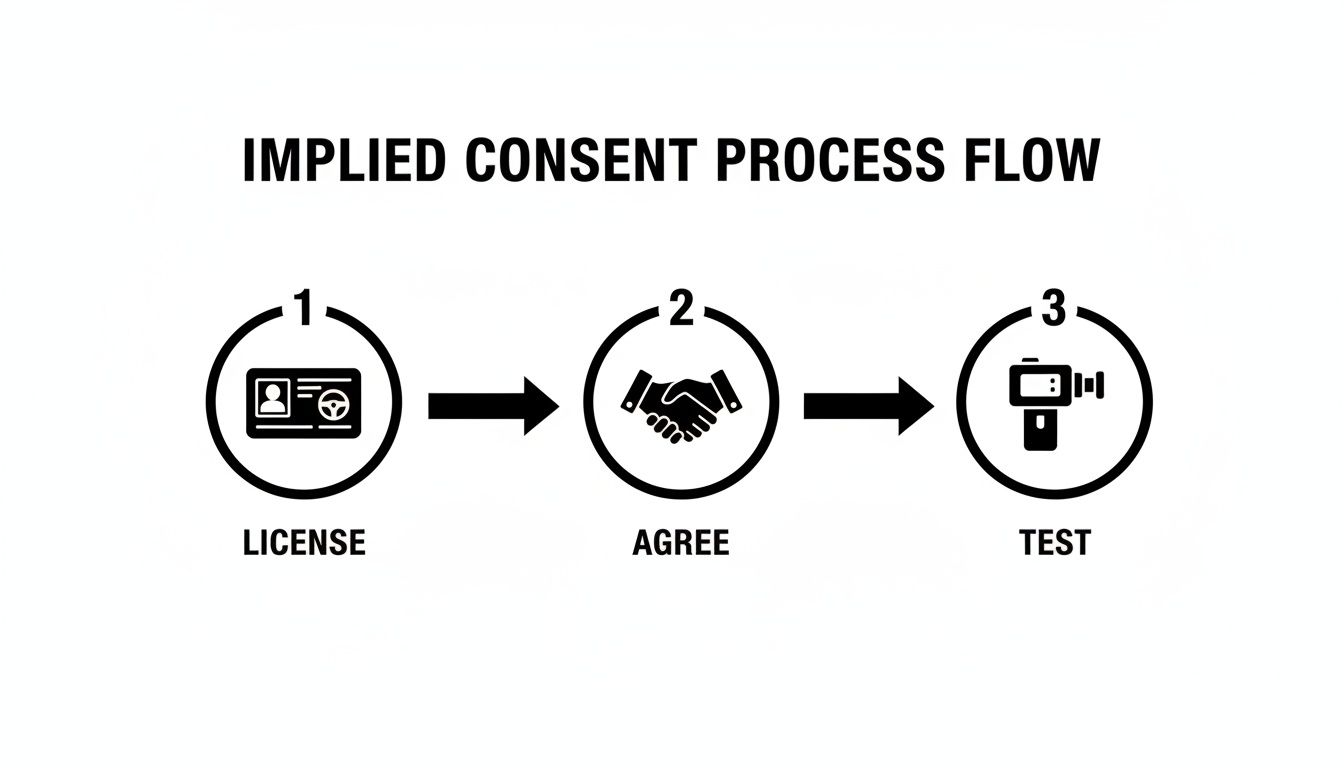
This visual breaks down the implied consent law into its three basic parts: getting a license means you agree to be tested if arrested for DWI.
That notice is your official warning that the state is coming for your license. But you do have a small window of time to fight back.
Texas Administrative License Suspension for Breath Test Refusal
The length of an automatic license suspension for refusing a breathalyzer depends entirely on your past DWI-related history. The penalties are designed to be harsh to discourage people from refusing.
Here's a clear breakdown of the automatic suspension periods you'll face.
| Refusal Scenario | Automatic License Suspension Period |
|---|---|
| First-Time Refusal (No prior DWI arrests or alcohol-related enforcement actions) | 180 Days |
| Subsequent Refusal (A previous DWI conviction or alcohol-related suspension within the last 10 years) | Two Years |
These aren't just possibilities; they are the standard administrative penalties triggered by a refusal. It doesn't matter if your criminal DWI case is eventually dismissed or you're found not guilty—this civil suspension can still move forward.
The most critical thing to remember is the 15-day deadline. From the moment the officer gives you the Notice of Suspension, you have only 15 calendar days to formally request an ALR hearing to challenge it. If you miss this deadline, your license suspension will begin automatically on the 41st day after your arrest, with no chance to appeal.
Fighting Back with an ALR Hearing
That 15-day window is your only shot to stop the automatic suspension. When you request an Administrative License Revocation (ALR) hearing, it puts the suspension on hold and forces the DPS to prove they had a legal right to take your license in the first place.
This hearing is your opportunity to challenge the traffic stop, the arrest, and the officer’s procedure. A skilled attorney can put the officer on the stand and look for mistakes that could get the whole suspension thrown out. Did the officer have a good reason to pull you over? Did they follow the strict rules when they arrested you?
Even if you don’t win the hearing, it's an incredibly valuable opportunity. It allows your attorney to question the arresting officer under oath, giving you a "first look" at the state's evidence. This testimony can be a goldmine when building a defense for your separate criminal DWI case. If you're in this position, you can find out more about what to do in our Harris County ALR Hearing Guide.
Because the deadline is so tight and these hearings are so complex, calling a DWI defense attorney right after your arrest is the single most important thing you can do. Your ability to get to work, go to school, and take care of your family is on the line. You can't afford to let that 15-day window slam shut.
How a Refusal Impacts Your Criminal DWI Case
Beyond the automatic license suspension, your decision to refuse a breathalyzer has a huge impact on your criminal DWI case. While it means the prosecutor can’t flash a specific blood alcohol concentration (BAC) number in front of the jury, your refusal itself becomes a powerful piece of evidence against you. The state will argue you said "no" for one simple reason: you knew you were intoxicated and wanted to hide the proof.
This argument is a legal tactic known as showing consciousness of guilt. In court, the prosecutor will frame your refusal as an admission—not in words, but in action—that you knew you were guilty.
Think of it like a suspect running from the scene of a crime. Does running prove they committed the crime? Not necessarily, but it sure makes them look like they have something to hide. A prosecutor will paint your breathalyzer refusal in that exact same light for the jury.
This is a very effective psychological tool for the prosecution. It's a narrative that any experienced Texas DWI attorney must be ready to dismantle. Without a number from a machine, the state’s entire case suddenly hinges on circumstantial evidence.
Building a Case Without a BAC Number
When you refuse a breathalyzer, you force the prosecutor to build what’s called a "no-test" DWI case. Instead of leaning on a scientific number, they have to piece together other observations and bits of evidence to convince a jury that you had lost the normal use of your mental or physical faculties because of alcohol.
This evidence almost always includes:
- The Officer's Testimony: The arresting officer will get on the stand and describe everything, from your driving patterns (swerving, speeding) to your physical appearance (bloodshot eyes, flushed face) and your general demeanor (slurred speech, unsteadiness).
- Bodycam and Dashcam Footage: Video can be incredibly persuasive. Jurors will see for themselves how you interacted with the officer, listen to your speech, and watch how you moved.
- Performance on Field Sobriety Tests (SFSTs): How you performed on the walk-and-turn, one-leg stand, and other roadside tests will be scrutinized and presented as clear proof of impairment.
- Any Admissions: If you told the officer you just had "a couple of drinks," you can bet that statement will be used against you.
The prosecutor's job is to stack these pieces of evidence so high that a jury feels the only logical explanation for everything combined is that you were intoxicated.
Why Do People Still Refuse?
Given all this, you might wonder why anyone would refuse in the first place. It's a common choice, though refusal rates vary. A multi-jurisdictional U.S. study found a 21% mean refusal rate. In the past, some Texas counties saw refusal rates as high as 50% before "No Refusal" weekends and holidays were put in place. These programs allow police to get warrants to force a blood draw, which has drastically lowered refusal rates. You can read more about how refusal rates impact DWI prosecution to see the national picture.
The decision to refuse is a complicated one, usually made under extreme stress and pressure. While it creates the challenges we've talked about, it also denies the state its single most concrete piece of evidence.
How a Defense Attorney Fights Back
A no-test DWI case might sound intimidating, but it is far from an automatic conviction. A skilled Houston criminal lawyer knows how to attack this kind of case from multiple angles to create reasonable doubt. We don't just take the officer's report at face value; we challenge every single piece of their story.
For example, we can argue:
- Innocent Explanations: Maybe you have bad allergies that cause red eyes. Maybe you have an old injury or a medical condition that affects your balance. Or maybe you were just exhausted and nervous, causing you to stumble over your words.
- Improper SFST Administration: Field sobriety tests have very strict, standardized protocols. If the officer gave the tests incorrectly—on an uneven slope, with confusing instructions, or without demonstrating them properly—the results can be thrown out as unreliable.
- Challenging Officer Observations: We can cross-examine the officer on the stand, pointing out every inconsistency between their written report and what the bodycam footage actually shows. This is how we undermine their credibility.
The whole defense strategy shifts from arguing about a number to taking apart the officer's subjective opinions one by one. You can learn more about how to fight a DWI in Texas in our detailed guide. An experienced attorney knows exactly how to poke holes in the prosecution's story, presenting alternative scenarios that show your actions were not definitive proof of intoxication.
When Your Refusal Can Be Overridden by a Warrant
So you’ve decided to refuse the breathalyzer. You have that right, but it's not the end of the story. A lot of people are shocked to learn that in some situations, the police can still get your chemical sample—even after you’ve clearly said no. This usually happens during what are known as “No Refusal” initiatives, and you need to understand how they work.
Across Texas, especially in big cities like Houston, law enforcement agencies roll out “No Refusal” weekends. They almost always coincide with holidays like Memorial Day, the Fourth of July, Labor Day, and New Year's Eve, which are times when DWI arrests tend to spike. During these periods, the entire legal system is geared up and ready to override your refusal.
How a No Refusal Warrant Works
A “No Refusal” weekend doesn't take away your right to say no. You can absolutely still refuse the breath or blood test. What it really means is that police have a fast-track system in place to get a search warrant for your blood the moment you do.
Here’s a step-by-step breakdown of what happens next:
- You Refuse the Test: After a lawful DWI arrest, the officer reads you the warnings and asks for a breath or blood sample. You decline.
- The Officer Prepares a Warrant: The arresting officer immediately gets to work drafting an affidavit. This is a sworn statement that lays out all the probable cause for your arrest—the bad driving they saw, the smell of alcohol, how you performed on the field sobriety tests, and so on.
- A Judge Is Contacted: During “No Refusal” periods, prosecutors and judges are on standby, often around the clock. The officer sends the warrant affidavit to an on-call prosecutor for a quick review, who then forwards it to a judge.
- The Warrant Is Issued: If the judge agrees there’s enough probable cause to believe you were driving while intoxicated, they will sign a search warrant. This legally compels you to provide a blood sample. The whole process can happen incredibly fast, sometimes in less than an hour.
Once that warrant is signed, your initial refusal no longer matters. You are now legally required to submit to a blood draw.
A "No Refusal" warrant is a legal order from a judge that overrides your refusal. It essentially turns a request for a sample into a legal demand. Resisting at this point is no longer an option and can lead to more legal trouble.
The Consequences of Resisting a Warrant
This is where things can get much worse for you. If an officer shows you a valid search warrant for your blood, any attempt to physically resist the blood draw can land you with more criminal charges. You could be charged with Resisting Arrest, Search, or Transportation under Texas Penal Code § 38.03.
A conviction for that offense means more jail time and hefty fines, all stacked on top of whatever you’re already facing for the DWI itself. The blood draw will be done by qualified medical staff, like a nurse or phlebotomist, in a sanitary setting. At this stage, your only safe and legal option is to comply. The warrant has taken the choice out of your hands.
The impact of these initiatives has been huge. In many Texas counties, refusal rates were once as high as 50%. But after “No Refusal” programs were put in place, those numbers dropped dramatically. A report from the NHTSA noted that after Montgomery County implemented these initiatives, their refusal rates fell to just 10% by 2010. You can read the NHTSA's findings on "No Refusal" initiatives to see just how effective they've been for law enforcement.
Ultimately, refusing the test might only delay the state from getting the evidence they want. It’s another complicated factor to weigh when you’re on the side of the road, forced to make a difficult choice.
What to Do Immediately After a DWI Refusal

If you've been arrested for DWI in Texas and refused the breathalyzer, your mind is probably racing with a thousand questions. It’s a stressful, disorienting experience. But what you do in the next few hours and days is absolutely critical. Take a deep breath—there’s a path forward, but you have to act fast.
Your first and most important move is to get a skilled Texas DWI defense attorney on the phone. The legal clock is already ticking on two separate cases—the criminal DWI charge and an administrative case against your driver’s license. You need a professional in your corner right away.
Prioritize Your Driver's License
The most time-sensitive issue is your driver's license. When you refused the chemical test, the officer handed you a Notice of Suspension. That piece of paper officially starts a strict 15-day countdown to request an Administrative License Revocation (ALR) hearing.
If you miss that 15-day deadline, your license will be automatically suspended on the 41st day after your arrest. There are no do-overs and no extensions.
Your lawyer’s first order of business will be filing the paperwork to demand this hearing. This action puts the brakes on the suspension and gives you a fighting chance to save your license. It’s a deadline you simply cannot afford to miss.
Document Everything Immediately
While the arrest is still fresh in your mind, grab a pen and paper and write down every single detail you can remember. Don't put this off. Memories fade incredibly fast, but those small details can become powerful tools for your defense attorney.
Start a timeline and jot down everything you can recall, including:
- The Traffic Stop: Why did the officer pull you over? What reason did they give you?
- Your Conversation: What questions did they ask? More importantly, what answers did you give?
- Field Sobriety Tests: Which tests did they make you do? Were the instructions clear? Was the ground level and well-lit, or were you on a slope or a gravel shoulder?
- The Arrest and Refusal: What exactly did the officer say when you refused the test? How did they react? Did they read you your rights?
This written record will be invaluable when your attorney sits down to build a defense strategy from the ground up.
Consider an Occupational Driver's License (ODL)
Even if the state does suspend your license, it doesn’t always mean you’re completely stuck without a ride. Your lawyer can help you petition the court for an Occupational Driver's License (ODL).
An ODL is a special, restricted license that allows you to drive for essential reasons, like getting to and from work, school, and your child's daycare. It's a lifeline that helps you keep your life on track while the DWI case is resolved.
While an ODL isn’t guaranteed, it’s a critical option to explore. Our team provides expert assistance with your DWI and driver’s license issues to help you navigate this process. Taking these immediate, focused actions can make all the difference in the final outcome of your case.
Frequently Asked Questions About Breathalyzer Refusals
When you're dealing with the fallout of a DWI arrest, things get confusing fast, especially if you refused a breathalyzer. To cut through the legal noise, here are some direct answers to the questions we hear from clients every day. Getting these answers straight is the first step in protecting your rights.
Can I Refuse the Roadside Field Sobriety Tests Too?
Yes, absolutely. Just like the portable breathalyzer an officer might offer you on the side of the road, you are not required to perform Standardized Field Sobriety Tests (SFSTs). These tests, like the walk-and-turn or one-leg stand, are completely voluntary.
Politely saying "no" to these tests doesn't trigger the automatic license suspension that comes with refusing an official, post-arrest test. But be aware, the officer can still use that refusal, along with anything else they observed, to build their case for an arrest.
Does a Refusal Mean I Will Automatically Be Convicted of DWI?
No, refusing a test is not an automatic conviction. While the prosecutor will absolutely argue that your refusal shows a "consciousness of guilt," they still carry the full burden of proving you were intoxicated beyond a reasonable doubt. Without a BAC number, their entire case hinges on subjective evidence.
An experienced DWI attorney knows how to attack a "no-test" case. We can often poke holes in their argument by:
- Questioning if the initial traffic stop was even legal.
- Challenging the officer’s subjective and often biased observations.
- Showing that field sobriety tests were administered incorrectly or under poor conditions.
- Presenting perfectly innocent explanations for your appearance or behavior.
What Is the Difference Between a Breath and a Blood Test Refusal?
Legally speaking, there is no difference. Texas's implied consent law covers both. When you got your driver's license, you gave your consent to be tested after a lawful DWI arrest, and that applies to either a breath or blood sample.
Refusing one is the same as refusing the other. Both will kick off the exact same Administrative License Revocation (ALR) process.
Can I Still Get an Occupational License If I Refused?
Yes, in many cases, it's possible. Even with a license suspension from a refusal, you can often petition the court for an Occupational Driver's License (ODL). Think of an ODL as a special, restricted license.
It's not a free pass to drive anywhere, but it allows you to handle essential needs like getting to work, attending school, or taking your kids to their activities. It’s a critical tool for keeping your life on track while your case is pending.
If you’ve been charged with a crime in Texas, call The Law Office of Bryan Fagan, PLLC for a free and confidential consultation. Our defense team is ready to protect your rights. https://texascriminallawyer.net