Being arrested in Texas can be terrifying—but you don’t have to face it alone. When the charge is a Class A misdemeanor, it sits at the very top of the ladder as the most serious non-felony offense you can face. This isn't a simple slap on the wrist; it's a charge that lands just one step below a state jail felony and brings with it the potential for significant jail time and hefty fines. The anxiety and uncertainty can feel overwhelming, but understanding your rights is the first step toward regaining control.
What is a Class A Misdemeanor?

If you or a loved one has been arrested, the most important thing to remember right now is that an arrest is not a conviction. You have legal rights, and building a strong defense starts with understanding exactly what you're up against.
A Class A misdemeanor is a serious criminal charge that can disrupt your life. But with an experienced guide, you can navigate the legal system and fight for the best possible outcome.
The Texas Misdemeanor System Explained
Texas law sorts misdemeanors into three distinct levels, each carrying more weight than the last. You can think of it like a pyramid, with the penalties getting steeper as you climb higher.
- Class C Misdemeanor: This is the base level, usually handled with a fine and no jail time.
- Class B Misdemeanor: The middle tier, where jail time and larger fines become a real possibility.
- Class A Misdemeanor: The highest and most severe category of misdemeanor charges in the state.
Because it's the most serious non-felony criminal offense, a Class A misdemeanor conviction can lock you away for up to one year in county jail, hit you with a fine of up to $4,000, or both. The penalties are a world away from those for lower-level offenses, which you can read more about in our guide to what is a Class C misdemeanor in Texas.
These potential outcomes make it crystal clear why you must take this kind of charge seriously from day one.
A charge is just an accusation, not a final judgment. An experienced criminal defense attorney can pick apart the evidence, negotiate with prosecutors, and fight to protect your freedom and your future.
To give you a quick, clear picture of what a Class A misdemeanor really means, we've put together this simple breakdown.
Class A Misdemeanor in Texas at a Glance
This table offers a snapshot of the key elements you'll encounter when dealing with a Class A misdemeanor charge in Texas.
| Aspect | Details |
|---|---|
| Maximum Jail Time | Up to 1 year in county jail |
| Maximum Fine | Up to $4,000 |
| Probation (Community Supervision) | Up to 2 years |
| Common Examples | Second DWI, Assault Causing Bodily Injury, Burglary of a Vehicle |
Staring down these possibilities alone is a daunting prospect. But with the right legal guidance, you can navigate the system and start working toward a much better resolution.
Common Examples of Class A Misdemeanors
Figuring out the penalties is one thing, but it’s more helpful to see how these charges appear in the real world. Many people are shocked to learn that an everyday situation can spiral into one of the most serious non-felony offenses in Texas.
Let’s walk through some common crimes that land people with a Class A misdemeanor charge. This will give you a clearer picture of what the State of Texas has to prove to get a conviction.
Driving While Intoxicated (DWI) Second Offense
A first-time DWI is usually a Class B misdemeanor. But if you are arrested for a second one, that bumps it up to a Class A misdemeanor. To secure a conviction, the prosecutor must prove you were driving a vehicle in public while intoxicated and that you have a prior DWI conviction on your record.
This jump in severity shows just how seriously Texas takes repeat offenses. The penalties get much steeper, making a solid legal defense even more critical.
Assault Causing Bodily Injury
This is one of the most frequent Class A misdemeanor charges we see. Under the Texas Penal Code § 22.01, this happens when someone intentionally, knowingly, or recklessly causes bodily injury to another person.
So, what exactly is "bodily injury"? It’s not as extreme as you might think. The law defines it as physical pain, illness, or any impairment. That could mean a bruise, a scratch, or even just an action that causes pain without leaving a visible mark. It's a surprisingly low bar for the prosecution to meet.
Burglary of a Vehicle
You'll often hear lawyers call this "BoV," and it’s another common Class A charge. A popular misconception is that you have to actually steal something from the car to be charged.
Under Texas law, you can be charged with BoV if you break into or enter someone's vehicle without their permission with the intent to commit a felony or theft. That word—intent—is the key. It's what a prosecutor has to convince a jury was in your mind at the time.
Theft of Property or Services
In Texas, the value of what was stolen determines how serious the charge is. Theft becomes a Class A misdemeanor when the property or services are worth $750 or more but less than $2,500. This covers everything from shoplifting a high-end item to stealing a bicycle or failing to pay a contractor for a significant job.
The specific details of your case matter immensely. A skilled attorney can scrutinize every piece of evidence—from the alleged value of stolen items to the definition of "bodily injury"—to challenge the prosecution's claims and protect your rights.
It's also important to know that Texas law isn't static. For instance, recent legislative changes have stiffened penalties for certain offenses, showing a clear trend toward tougher punishments. A perfect example is House Bill 2073, which ramps up the consequences for violating court orders or bond conditions in sensitive cases like family violence or stalking. While many of these violations remain Class A misdemeanors, repeat offenses can now be bumped up to felonies. You can learn more about the 2025 legislative changes on versustexas.com.
Other Common Class A Misdemeanors
While the charges above are some of the most common, plenty of other actions can lead to a class a misdemeanor texas charge. These include:
- Violation of a Protective Order: Disobeying the terms of a court-issued protective order is taken very seriously.
- Unlawful Carrying of a Weapon: While Texas has permitless carry, there are still strict rules about where and how you can carry a handgun.
- Public Lewdness: This involves knowingly engaging in specific sexual acts in a public place where others could be offended.
- Perjury: This is the act of knowingly making a false statement under oath during an official proceeding.
Seeing these examples makes it obvious how one bad decision or a simple misunderstanding can throw you into a serious legal fight. The stakes are just too high to go it alone.
Navigating the Texas Criminal Justice Process
The legal system can feel like a tangled, confusing maze, especially when you’re anxious and unsure of what’s coming next. If you’re facing a Class A misdemeanor in Texas, you’ve just been pushed into that maze. But you don’t have to walk through it blind. Understanding the process is the first step toward taking back control. Here is a step-by-step guide on what to expect.
Step 1: The First 48 Hours After an Arrest
It all starts with the arrest. You’ll be taken into custody, booked at a local jail, and processed—which means fingerprints, a mugshot, and paperwork. During this time, it is absolutely critical that you remember your rights.
You have the right to remain silent. You also have the right to an attorney. Calmly and clearly state that you will not answer any questions without your lawyer present. This is not an admission of guilt; it's a smart, constitutionally protected move.
Within 48 hours, you must be brought before a judge or magistrate for your first court appearance, called an arraignment. This is a critical hearing where a few key things happen:
- Formal Charges: The judge will read the official Class A misdemeanor charge against you.
- Your Rights: You'll be formally advised of your constitutional rights again.
- Plea Entry: The court will ask you to enter a plea. Your attorney will almost always advise pleading "not guilty" at this stage to keep all your legal options open.
- Bail is Set: The judge determines the amount of your bail—the money required for your release from jail while the case moves forward.
Step 2: The Pre-Trial Phase Where Cases Are Built
Once you’re out on bail, your case enters the pre-trial phase, which can last several months. This is where the real legal work begins. Your defense attorney and the prosecutor will kick off a process called discovery, where they exchange all the evidence they’ve gathered. This includes police reports, witness statements, and any video or audio recordings.
This is also the time for plea bargaining. Your attorney will negotiate with the prosecutor to see if a favorable deal can be reached without going to trial. This could mean:
- Getting the charge reduced to a less serious offense (like a Class B misdemeanor).
- Agreeing to probation instead of jail time.
- Securing an outright dismissal of the charges.
The infographic below shows how some of the most common Class A misdemeanor charges travel through the Texas criminal justice system.
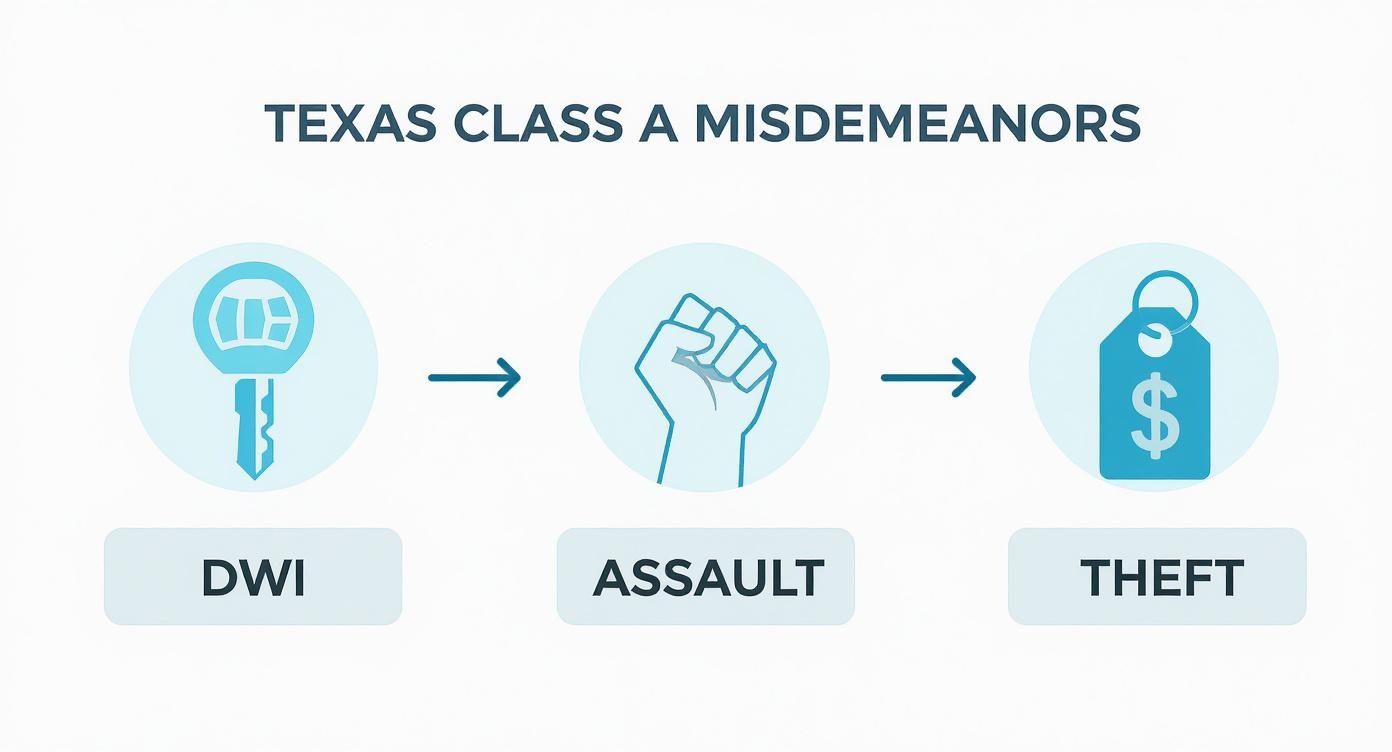
As you can see, even though the crimes are different, the legal pathway they follow from arrest to resolution is largely the same.
During the pre-trial phase, your lawyer might also file pre-trial motions. These are formal requests asking the court to rule on certain issues before a trial ever starts. For example, a "motion to suppress" asks the judge to throw out evidence that was obtained illegally. A successful motion can sometimes cripple the prosecution's entire case.
Understanding the typical timeline can help set realistic expectations. While every case is unique, the table below gives a general overview.
Typical Timeline for a Class A Misdemeanor Case
| Stage | What Happens | Key Objective |
|---|---|---|
| Arrest & Booking | You are taken into custody, processed, and held in jail. | Protect your rights by remaining silent and requesting a lawyer. |
| Arraignment | First court appearance where charges are read and bail is set. | Plead "not guilty" to preserve all legal options and secure release on bail. |
| Discovery | Lawyers for both sides exchange all evidence related to the case. | Analyze the prosecution's evidence to find weaknesses. |
| Pre-Trial Hearings | Lawyers argue motions, such as motions to suppress evidence. | Exclude illegally obtained evidence and challenge the state's case. |
| Plea Negotiations | Your attorney negotiates with the prosecutor for a potential deal. | Reach a favorable outcome, like a charge reduction or dismissal. |
| Trial or Resolution | The case either goes to trial or is resolved through a plea agreement. | Achieve the best possible outcome, whether through a verdict or a plea. |
This timeline isn't set in stone, but it shows how the different pieces of the pre-trial process fit together as your attorney builds your defense.
And you're not alone in this. Misdemeanor charges have a massive impact on the Texas justice system. In fact, these charges accounted for over 2.7 million jail admissions in 2023, making up 35 percent of all jail admissions. That staggering number from prisonpolicy.org shows just how many Texans find themselves in this exact situation every year.
Ultimately, this entire pre-trial period is foundational. The evidence gathered, the negotiations held, and the motions filed will shape the direction of your case, determining whether it heads to trial or gets resolved long before then.
How to Build a Strong Defense Strategy
When you’re facing a Class A misdemeanor in Texas, it’s easy to feel like you’re on your back foot. But a good attorney doesn’t just play defense—they go on the offense. Building a solid defense strategy isn't about passively waiting for the prosecution to make its move; it's about actively dismantling their case from every possible angle.
A criminal charge is just the prosecutor's version of events. Your defense is your chance to tell the real story and expose the weaknesses in theirs. This isn't about crossing your fingers and hoping for the best. It's about strategic, proactive work designed to protect your freedom and your future.
Questioning Every Piece of Evidence
The foundation of any strong defense is a ruthless examination of the prosecutor’s evidence. The state carries the entire burden of proving its case beyond a reasonable doubt—and that’s an incredibly high legal bar to clear. Your attorney’s first job is to create that doubt.
This process often starts by scrutinizing how the evidence was collected. For instance, if the police conducted an illegal search of your car or home without a proper warrant or probable cause, any evidence they found can be thrown out of court. This is accomplished through a powerful legal tool called a motion to suppress.
Think of it like a referee throwing a flag for an illegal play. If the police didn't follow the rules, the evidence they gathered can be disqualified. A single successful motion to suppress can gut the prosecution's entire case before a trial even begins.
Common Angles for a Strong Defense
Every case is different, but many successful defense strategies are built on a few core principles. A knowledgeable Texas criminal defense lawyer will dig into every possibility, including:
- Challenging Witness Credibility: Are the state's witnesses reliable? Do they have a personal reason to lie or embellish the truth? Your attorney can investigate their background and use cross-examination to expose inconsistencies in their testimony.
- Demonstrating Lack of Intent: Many crimes require the prosecutor to prove you had a specific criminal intent. In a theft case, for example, they must prove you intended to permanently deprive the owner of their property. If your actions were just a misunderstanding or an accident, that critical element of intent is missing.
- Establishing an Alibi: Can you prove you were somewhere else entirely when the alleged crime happened? A solid alibi, backed up with evidence like receipts, GPS data, or credible witness testimony, is one of the most powerful defenses you can have.
- Arguing Self-Defense: In an assault case, perhaps you were only acting to protect yourself or someone else from harm. Texas law gives you the right to use reasonable force in self-defense, and this can be a complete defense to the charge.
The sooner you hire an attorney, the better. Critical evidence can disappear, and witnesses' memories can fade. An experienced lawyer knows how to preserve evidence and start building your case from day one.
Exploring Alternative Resolutions
Building a defense doesn't always mean gearing up for a dramatic "not guilty" verdict at trial. In many situations, the smartest strategy involves negotiating a favorable outcome that sidesteps the risk, cost, and stress of a trial altogether.
Your attorney can negotiate with the prosecutor for a range of positive results. This might mean getting the charges knocked down to a less serious offense, like a Class B misdemeanor, or even getting a complete dismissal if the evidence against you is particularly weak.
Another powerful tool in Texas is deferred adjudication, which allows you to complete a term of probation to avoid a final conviction on your record. You can learn more about how this works by reading our guide on what is deferred adjudication in Texas.
The key takeaway is that you have options. Facing a class a misdemeanor texas charge is serious, but a proactive and well-planned defense strategy can completely change the outcome of your case.
Understanding the Long-Term Consequences
A conviction for a Class A misdemeanor in Texas isn't just a one-time punishment. The real impact doesn't stop when you pay the fine or finish your jail time. It leaves a permanent mark on your record that can follow you for years, slamming doors shut long after the judge’s gavel falls. These are what we call "collateral consequences," and they can affect nearly every corner of your life.
This criminal record becomes a public document, easily found by anyone who runs a background check. It’s a red flag that can disqualify you from opportunities you might not even know you were considered for.
How a Misdemeanor Record Impacts Your Future
A Class A misdemeanor Texas conviction creates a serious ripple effect, making it much harder to achieve your personal and professional goals. This isn't just a scare tactic; it's the practical reality for countless Texans navigating life with a criminal record.
These consequences often include:
- Employment Barriers: Most employers run background checks as a standard part of hiring. A theft conviction could knock you out of the running for jobs in finance or retail, while an assault charge might prevent you from working in fields like healthcare or education.
- Housing Difficulties: Landlords and apartment complexes almost always screen potential tenants. A criminal record can trigger an automatic denial of your rental application, making it incredibly hard to find a safe place to live.
- Professional Licensing Issues: If you're a nurse, teacher, pilot, or hold any other state-issued professional license, a conviction could trigger a review by your licensing board. This can lead to suspension, revocation, or a refusal to renew the license you worked so hard to earn.
- Educational Opportunities: Some colleges and universities ask about criminal history on their applications. A conviction could affect your admission status or your ability to get financial aid and on-campus housing.
Real-World Examples of Lasting Harm
To really understand the stakes, think about these situations. A nurse convicted of a second DWI—a Class A misdemeanor—could face a full-blown investigation from the Texas Board of Nursing, putting their entire career on the line. In another common scenario, a young person convicted of burglary of a vehicle might find themselves unable to enlist in the military or pursue their dream of a career in law enforcement.
A criminal record isn't just a summary of a past mistake; it's a lasting barrier that can limit your future potential. A strong legal defense is focused not only on the immediate penalties but also on preventing these long-term consequences.
A Class A Misdemeanor on your record can have huge long-term implications, especially with jobs, making it critical to understand how criminal record checks for employers work. These checks are now a routine part of the hiring process for many companies, making a clean record more valuable than ever.
The very existence of these consequences highlights why it's so important to fight the charge from day one. An experienced attorney works to avoid a final conviction—whether through a dismissal, an acquittal, or a plea to a lesser charge—precisely to shield you from this future damage. To get a better handle on your situation, you can read our guide on how long a misdemeanor stays on your record in Texas. Protecting your future is the ultimate goal of a strategic defense.
Can My Record Be Cleared After a Charge?

A Class A misdemeanor charge can feel like a shadow following you, even long after your case is over. But a past mistake shouldn't define your future. Fortunately, Texas law offers specific pathways to help you clear your name and get a fresh start through expunctions and record sealing.
Understanding these post-conviction relief options is the first real step in putting this chapter behind you for good. Think of them as legal tools designed to help you move forward, free from the weight of a criminal record.
Expunction vs. Nondisclosure: What's the Difference?
When it comes to clearing your record in Texas, you'll hear two main terms: expunction and an order of nondisclosure. They might sound similar, but they work in completely different ways. Knowing which one you might qualify for is absolutely critical.
An expunction is the clean slate. Think of it like permanently deleting a file from a hard drive. Once a judge grants an expunction, the records of your arrest and charge are physically destroyed. Legally, it’s as if it never happened.
An order of nondisclosure is more like sealing that same file away in a locked, private vault. The record technically still exists, but it’s hidden from public view. Government agencies and law enforcement can still see it, but potential employers, landlords, and the general public cannot.
Both an expunction and a nondisclosure are designed to limit public access to your criminal record, which allows you to legally and honestly say you haven't been convicted of a crime on most job or housing applications.
While an expunction offers the most complete relief, it's also much harder to get. A nondisclosure provides a powerful alternative for many Texans who don't qualify for a full record destruction.
Who Qualifies to Clear Their Record?
Eligibility for either an expunction or a nondisclosure hinges entirely on how your criminal case ended. The rules are strict, and you have to meet the specific criteria laid out in the Texas Code of Criminal Procedure.
You might be eligible for an expunction if your case had one of these outcomes:
- You went to trial and were found "not guilty" (acquitted).
- The prosecutor dismissed your case.
- You were pardoned or later found to be actually innocent.
An order of nondisclosure, on the other hand, is generally available if you successfully finished a deferred adjudication program for your Class A misdemeanor. This is a very common outcome for first-time offenders who complete all the terms of their probation without any trouble.
However, you can't file the day you finish probation. There are mandatory waiting periods. For a Class A misdemeanor, you typically have to wait two years from the date your deferred adjudication supervision ended before you can petition the court for a nondisclosure.
Figuring out the requirements to clear your record can get complicated fast. An experienced attorney can pull your case history, confirm which type of relief you qualify for, and walk you through the entire petition process from start to finish.
Your Questions Answered
When you're staring down a criminal charge, your mind is probably racing with questions. It's completely normal to feel overwhelmed. This section is here to give you straight, clear answers about facing a Class A misdemeanor in Texas.
Will I Automatically Go to Jail for a Class A Misdemeanor?
No, jail time isn't guaranteed. While the law allows for up to a year in county jail, that's the maximum punishment—not a mandatory sentence.
The final outcome depends on the unique facts of your case, your criminal history, and the strength of your defense. A good lawyer can often find a path to a better result, whether that means negotiating for probation, getting into a deferred adjudication program, or even having the charges reduced or dismissed.
What Is Probation Like for This Type of Charge?
In Texas, probation is officially called "community supervision." It’s a very common alternative to jail time and can last for up to two years for a Class A misdemeanor. The idea is simple: you get to stay in the community, but you must follow a strict set of court-ordered rules.
These conditions often include:
- Checking in with a probation officer regularly
- Completing community service hours
- Attending required classes or counseling
- Passing random drug and alcohol tests
- Paying all fines and court costs
Following these requirements is non-negotiable. If you violate a condition, the judge can revoke your probation and sentence you to jail.
Can a Class A Misdemeanor Be Reduced to a Lower Charge?
Yes, and this is often a primary goal for a skilled Houston criminal lawyer. Through plea bargaining, your attorney negotiates directly with the prosecutor to get the charge lowered to a less serious offense.
For instance, getting a Class A misdemeanor dropped to a Class B misdemeanor is a significant victory. A Class B conviction carries much lighter penalties and looks far less severe on your permanent record. It's a strategic move that can make a massive difference for your future.
If you’ve been charged with a crime in Texas, call The Law Office of Bryan Fagan, PLLC for a free and confidential consultation. Our defense team is ready to protect your rights.